{{ 'now' | timezone: 'America/New_York' | date: '%b %d, %Y' }} |
|
|
Hello and welcome back to The Best & The Brightest. I’m Leigh Ann
Caldwell.
Both President Trump and Rep. Marjorie Taylor Greene have declared Washington, D.C., “safe” after hundreds of National Guard troops, ICE agents, and F.B.I. officers were deployed to the city—mostly to touristy areas and commercial avenues that weren’t exactly hotbeds of crime. Trump, during a press conference with Ukrainian
President Volodymyr Zelensky, boasted that people are once again going out to restaurants. Actually, I secured a difficult-to-get last-minute reservation for five this weekend, and the restaurant was half empty. Mission accomplished?
Regardless, more soldiers are coming to D.C., after the governors of West Virginia, South Carolina, and Ohio agreed to send National Guard troops. I was somewhat surprised by the involvement of Ohio Governor Mike DeWine, who
is term limited and hardly a Trump sycophant. But Ohio Senator Bernie Moreno told me DeWine “felt it’s critical” to answer the call. “We don’t care if it’s a Democrat or Republican making the request,” DeWine told Cleveland.com. “We respond to these requests.”
By the way, if you still haven’t subscribed to
Puck and everything we have to offer—including insider reporting on the businesses of entertainment, A.I., finance, media, sports, art, fashion, you name it—you’re missing out. Waiting for a corporate or group rate? Email our concierge, Fritz@puck.news, and we’ll get you sorted.
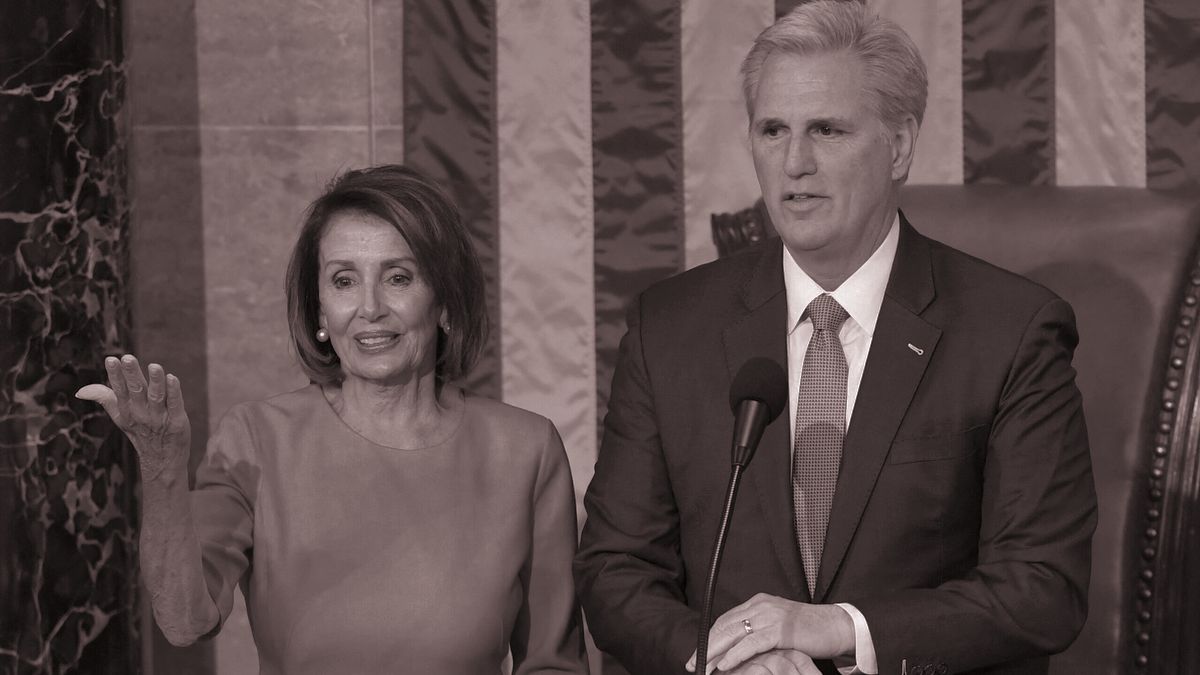
In today’s issue, my partner Abby Livingston takes a close look at how Nancy Pelosi and
Kevin McCarthy, both former House speakers, are whipping their California fundraising networks to raise money for what’s shaping up to be a titanic electoral battle over redistricting.
But first… |
- High
stakes in the Oval: Monday’s meeting between Trump and Zelensky seemed to go relatively well, all things considered, thanks in part to the cheerleading squad the Ukrainian president brought with him to the White House—and they all knew how to behave. Every attendee, which included European Commission President Ursula von der Leyen, Italian Prime Minister Giorgia Meloni, French President Emmanuel Macron, British Prime Minister Keir
Starmer, German Chancellor Friedrich Merz, Finnish President Alexander Stubb, and NATO Secretary General Mark Rutte, thanked and praised Trump profusely for moving the peace process forward. Zelensky, having learned his lesson after his last dressing-down in the Oval, even wore a suit.
The Europeans were pleased that Trump “signaled” he’d participate in a joint, “NATO-like” security guarantee for Ukraine as part of any
peace deal. (Details of the U.S.’s participation are not clear.) Zelensky also pushed for the release of Ukrainian prisoners and the return of thousands of Ukrainian children abducted by Russia. The group was less successful at convincing Trump that a ceasefire should precede further talks—he dropped the ceasefire demand on Friday and didn’t pick it back up today. Trump
phoned Putin in the middle of their meeting, and after it all concluded, he posted this on social media: “I called President Putin, and began the arrangements for a meeting, at a location to be determined, between President Putin and President Zelenskyy. After that meeting takes place, we will
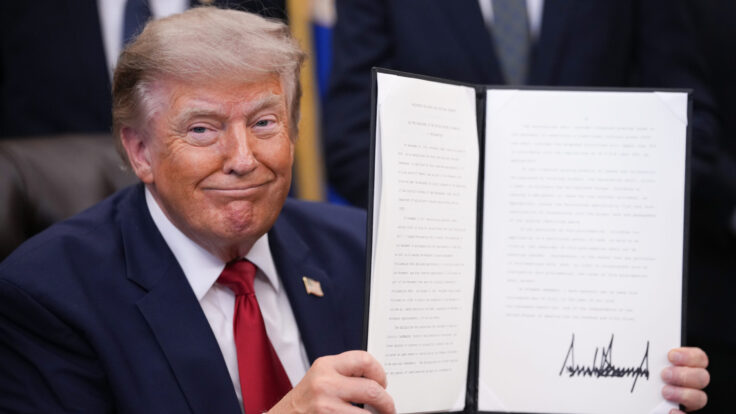
have a Trilat, which would be the two Presidents, plus myself.” - Bigger than redistricting: As Trump waited for European leaders to arrive at the White House, he declared on social media that he’d issue an executive order to eliminate mail-in voting in the midterm elections, saying that states “must do” as the federal government demands. Well, not exactly: The president doesn’t have the constitutional power to order states to change their election
procedures—only Congress can do that. And Republicans have traditionally resisted federal involvement in how states run elections, although past convictions aren’t exactly predictive these days.
When I asked the White House if they had any details on what a potential executive order might look like, spokesman Harrison Fields said, “President Trump
wants to secure America’s elections and protect the vote, restoring the integrity of our elections by requiring voter I.D., ensuring no illegal ballots are cast, and preventing cheating through lax and incompetent voting laws in states like California and New York.”
During his Oval Office press avail with Zelensky, Trump said that mail-in voting is “bigger than anything having to do with redistricting.” Both, of course, are issues Trump intends to leverage in the midterms so that
Democrats—traditionally more likely to use mail-in balloting—don’t regain the House. - Meanwhile, in Ohio…: Earlier today, former Ohio Senator Sherrod Brown formally announced his campaign to challenge Senator John Husted, who was appointed to fill J.D. Vance’s seat. Though Brown lost to Bernie Moreno last year, his entrance makes this race less of a longshot for Dems: Even Republicans quietly admit that
Brown is an excellent campaigner and formidable politician. They also acknowledge that Husted, a mild-mannered and so far low-key senator, doesn’t yet have wide name recognition in the state. And because Trump won’t be on the ballot in 2026, many of his supporters might just stay home. Then again, it’s Ohio, which made a right turn in 2016 and hasn’t looked back.
|
|
|
As the gerrymandering battle shifts to the West Coast, two fading California political
heavyweights, Nancy Pelosi and Kevin McCarthy, are being drawn back into the ring for another round. |
|
|
California Governor Gavin Newsom is betting everything on his biblical, eye-for-an-eye
campaign to offset Texas’s proposed congressional redistricting with an equally gerrymandered map of his own—his presidential ambitions, the potential future of the party, and a whole lot of money. The statewide ballot initiative is expected to cost at least $200 million, according to multiple political operatives. “The cost of the initiative will be exponentially greater than the cost if all sides played in those districts in 2026,” said a Republican who works on House races, citing
the high number of expensive media markets that blanket the state. “You’re going to see cycle-wide spending on an initiative one year before the actual election cycle.”
Naturally, the feeding frenzy has attracted the attention of two of the state’s most practiced fundraisers, Nancy Pelosi and Kevin McCarthy. Both former House speakers built their political power bases in California, which sends the largest number of representatives to Congress. And, of
course, nearly every sitting California member came up through the political machines built by Pelosi or McCarthy, both of whom helped redefine fundraising in the super PAC era. Now, it’s their shared neighborhood at war, as California Democrats seek to neutralize Trump’s plan to gain five seats in Texas—the first shot in what seems likely to become a national redistricting arms race.
Pelosi, in particular, is a generational fundraiser within her party, and she intends to unleash that firepower once again, a source close to her confirmed. “She definitely wants to be involved in any way she can,” this person said. Sure, Pelosi has gone out of her way, in her post-speakership, to portray herself as just another rank-and-file member. (Hakeem Jeffries is running the show now, people…) And yes, California Reps. Zoe
Lofgren, the delegation chair, and Pete Aguilar, the third-ranking Democrat in House leadership, have spearheaded the mapmaking process. But as demonstrated by the calculated way in which Pelosi orchestrated the end of Biden’s reelection campaign, she can be just as powerful behind the scenes.
In some ways, Pelosi has been here before. During her first tour as the top House Democrat, in 2004, she flipped five seats—a striking achievement in a
sour cycle that featured John Kerry losing at the top of the ticket. But the Texas G.O.P. also flipped five seats that same year, on the strength of a fresh congressional map. Moreover, Pelosi has been fixated on Democrats’ redistricting strategy for years, even though most politicians don’t worry about it until late in any given decade. In her first term as speaker emerita, she donated $1.5 million to the National Democratic Redistricting Committee, chaired by former Attorney
General Eric Holder, and the associated National Redistricting Action Fund—which advocate for independent redistricting commissions and work to “combat gerrymandering.”
That positioning is somewhat ironic now, given Pelosi’s current support for precisely such a gerrymander in her home state. But, like Newsom, she has framed the California effort as necessary to counter Texas. Both politicians are also in lockstep in describing the ballot initiative as conditional on Texas passing its maps. The current proposed language also states that California’s gerrymander would be temporary, and that the independent mapmaking commission would be restored in 2030. The California Democratic political class, if not their voters, are largely united by the notion that, while they didn’t
ask for this war, they would be fools to “unilaterally disarm,” in Pelosi’s words.
It’s all reminiscent of the party’s rhetoric in 2010, when Democrats reluctantly changed their tune on super PACs after losing the House. “It would be political malpractice for House Democrats to unilaterally disarm against
secretive Republican special interests,” Pelosi’s then-political director, Jennifer Crider, told Politico in 2011. These days, we have Newsom declaring, “It’s not good enough to just hold hands and have a candlelight vigil and talk about the way the world should be. … We have got to recognize the cards that have been dealt, and we’ve got
to fight fire with fire.” |
Of course, threading that needle in the TikTok soundbite era will require putting a lot of money behind the
message. And Democrats will be up against McCarthy, something of a fundraising powerhouse himself. McCarthy’s tenure as speaker lasted only nine months, but that shouldn’t obscure the fact that he was essentially the financial nexus of the California G.O.P. for 15 years, until he resigned from Congress in 2023. Democrats may scoff at his reentry into politics, given the unceremonious end of his Capitol Hill career. But McCarthy promised to raise $100 million to fight the ballot initiative almost
as soon as Democrats released their proposed maps, according to Politico, and his top California lieutenants are joining the
fight.
Also, it’s personal for McCarthy, who helped recruit and elect the very Republican members that the California gerrymander would likely eliminate. “He has personal relationships with a lot of these guys that span before their time in the House, and in a lot of instances, he was the one who recruited them to run for the House,” said a California Republican who’s involved in the redistricting fight. “All of these guys are his ride-or-dies.” Take Republican Doug
LaMalfa, whose 1st district would get mauled under the new maps. The Northern California stalwart was fiercely loyal to McCarthy even until the very end of his speakership, when he issued a statement chastising the “splinter group” of Republicans, led by Matt Gaetz, who ousted McCarthy on what LaMalfa called “one of the most frustrating
and self-destructive days” he’d seen in Congress. “On a personal note,” he wrote, “Kevin McCarthy is a good friend who did not deserve to be betrayed this way.”
But McCarthy may not be the biggest-name Republican in the fight. Trump will likely get involved, and former Governor Arnold Schwarzenegger, still a brand-name force in California politics, is a longtime foe of gerrymandering (his spokesman has quoted him as calling it “evil”). Though he’s kept a low profile, it’s
hard to see Schwarzenegger staying on the sidelines, given that independent redistricting reform beyond California is his political legacy. In a post on X last week, Schwarzenegger wrote that he was “getting ready for the gerrymandering battle.” He attached a photo of himself pumping weights while wearing a shirt that read, “F*** the Politicians. Terminate Gerrymandering.”
|
|
|
Join Emmy Award-winning journalist Peter Hamby, along with the team of expert journalists at Puck, as they let you in on the
conversations insiders are having across the four corners of power in America: Wall Street, Washington, Silicon Valley, and Hollywood. Presented in partnership with Audacy, new episodes publish daily, Monday through Friday. |
|
|
Unique and privileged insight into the private conversations taking place inside boardrooms and corner offices up and down Wall
Street, relayed by best-selling author, journalist, and former M&A senior banker William D. Cohan. |
|
|
|
|
JULIA IOFFE & IAN KRIETZBERG |
|
|
Need help? Review our FAQ page or contact us for assistance. For brand partnerships, email ads@puck.news. You received this email because you signed up to receive emails from Puck, or as part of your Puck account associated with {{customer.email}}. To stop receiving this newsletter and/or manage all your email preferences,
click here. |
Puck is published by Heat Media LLC. 107 Greenwich St, New York, NY 10006 |
|
|
|