Welcome back to Wall Power. I’m Marion
Maneker.
For those of you not following the Winter Olympics—I’ve been enjoying the cross-country skiing and long-track speed skating, and Mrs. Wallpower is intrigued by the skimo competition coming up later this week—today we have two good reads. One comes from the ubiquitous Glenn Adamson, the curator and design and craft historian, who went to see Cooper Hewitt’s new Art of Noise
exhibition, which explores how design shapes the way we experience music. The ritual of listening to music on dedicated devices seems to be making a comeback; the Cooper Hewitt show is a welcome reminder of that, in an age where everything has become just another app on our phones.
Also, our friends at Air Mail have a great
preview of the Fondation Beyeler’s new Cézanne show. I was at an opening earlier this week where a prominent dealer, whose heart lies with impressionists and modernists, was lamenting that the show might close before she gets to the Swiss culture capital of Basel. J.S. Marcus offers a vicarious experience.
Mentioned in this
issue: Knight Landesman, Michelle Kuo, David Velasco, Danielle McConnell, Tina Rivers Ryan, Jake Gyllenhaal, Joseph Becker, Paul Morley, John Vassos, Wendell Castle, Ron
Arad, Mathieu Lehanneur, Virgil Abloh, Dieter Rams, Tibor and Maira Kalman, and many more… |
|
|
A MESSAGE FROM OUR SPONSOR |
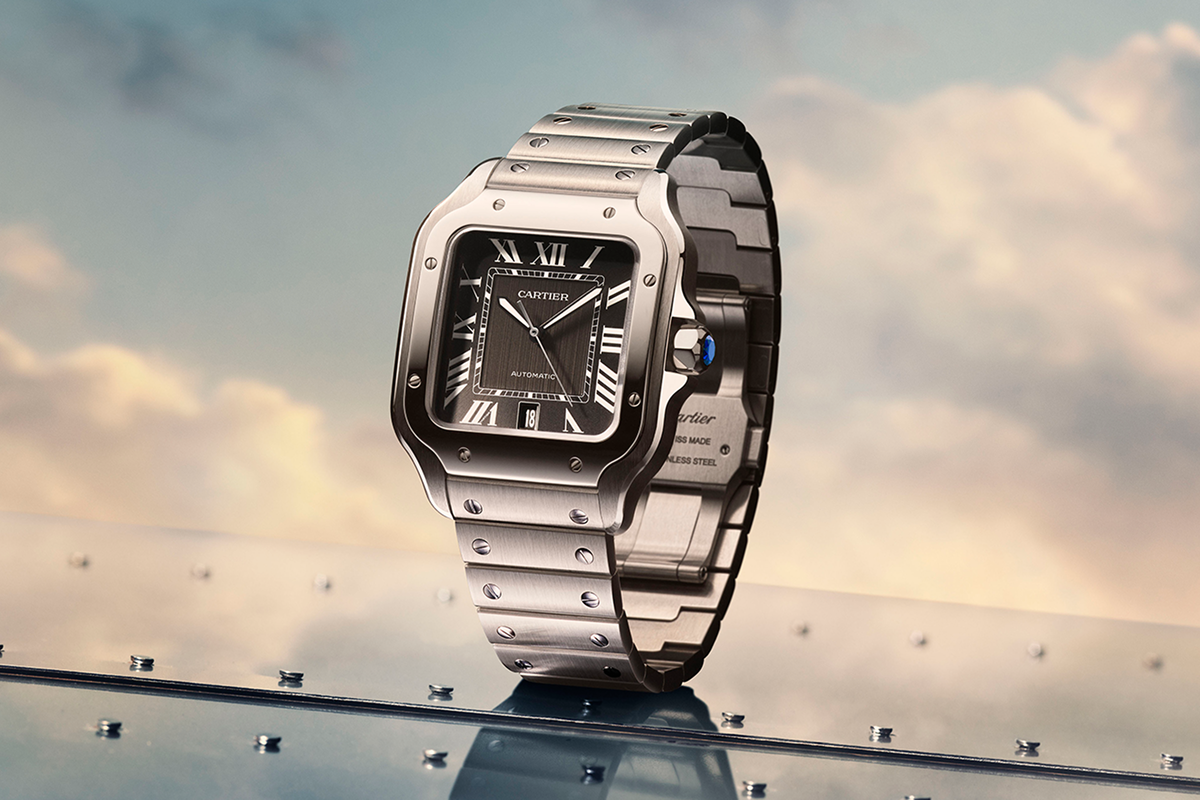
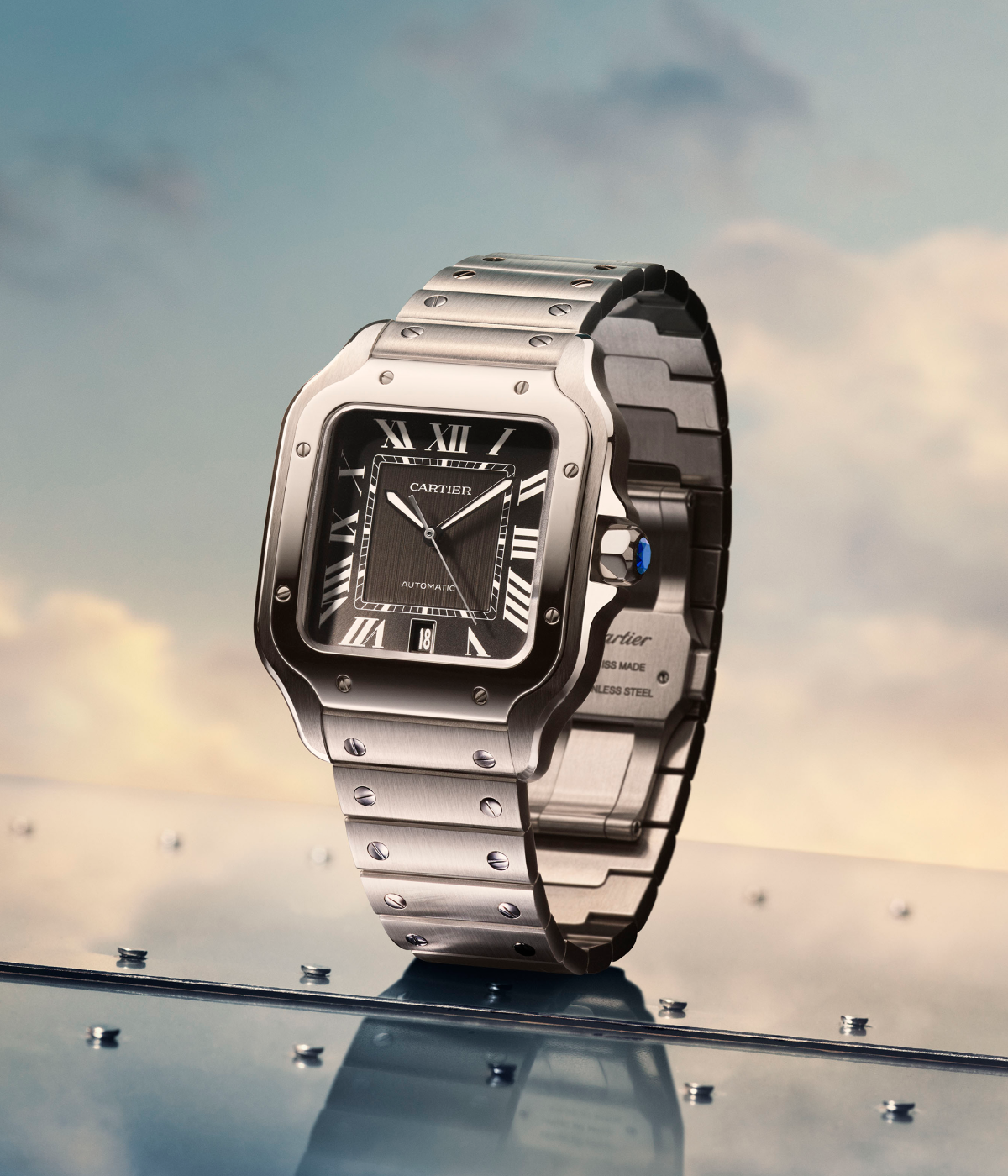
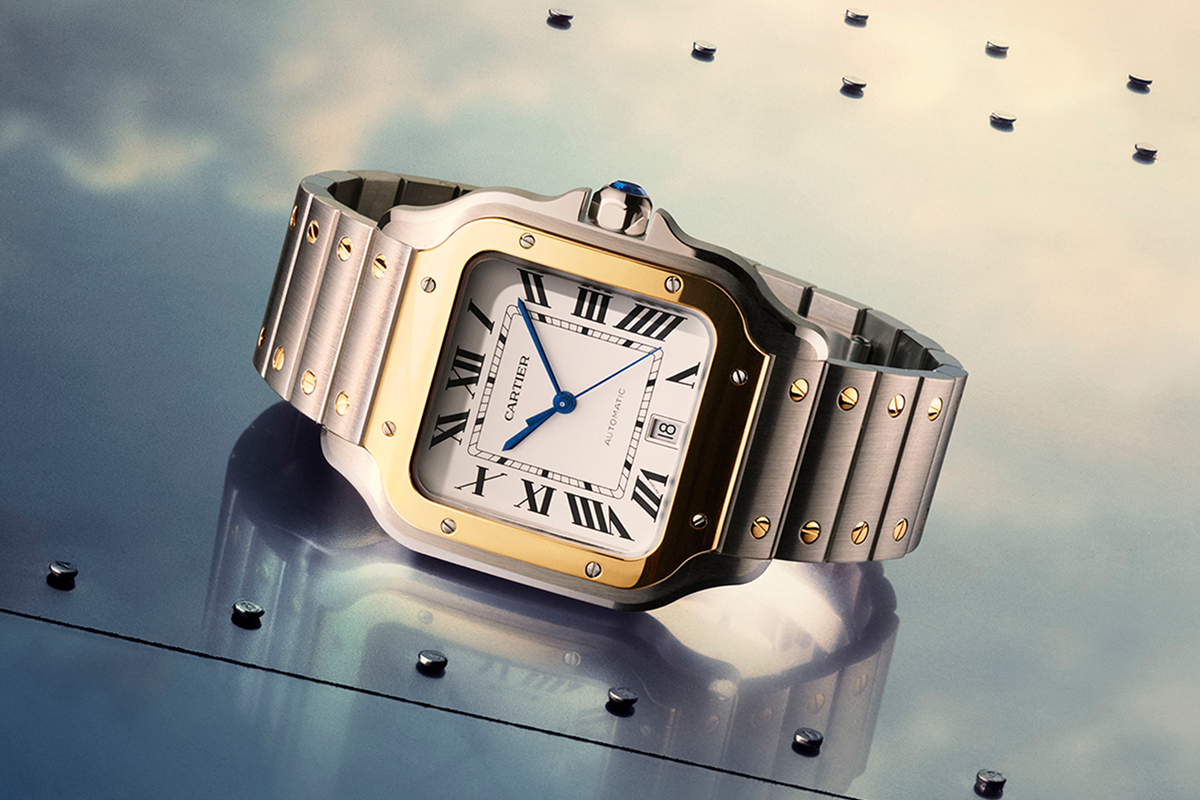
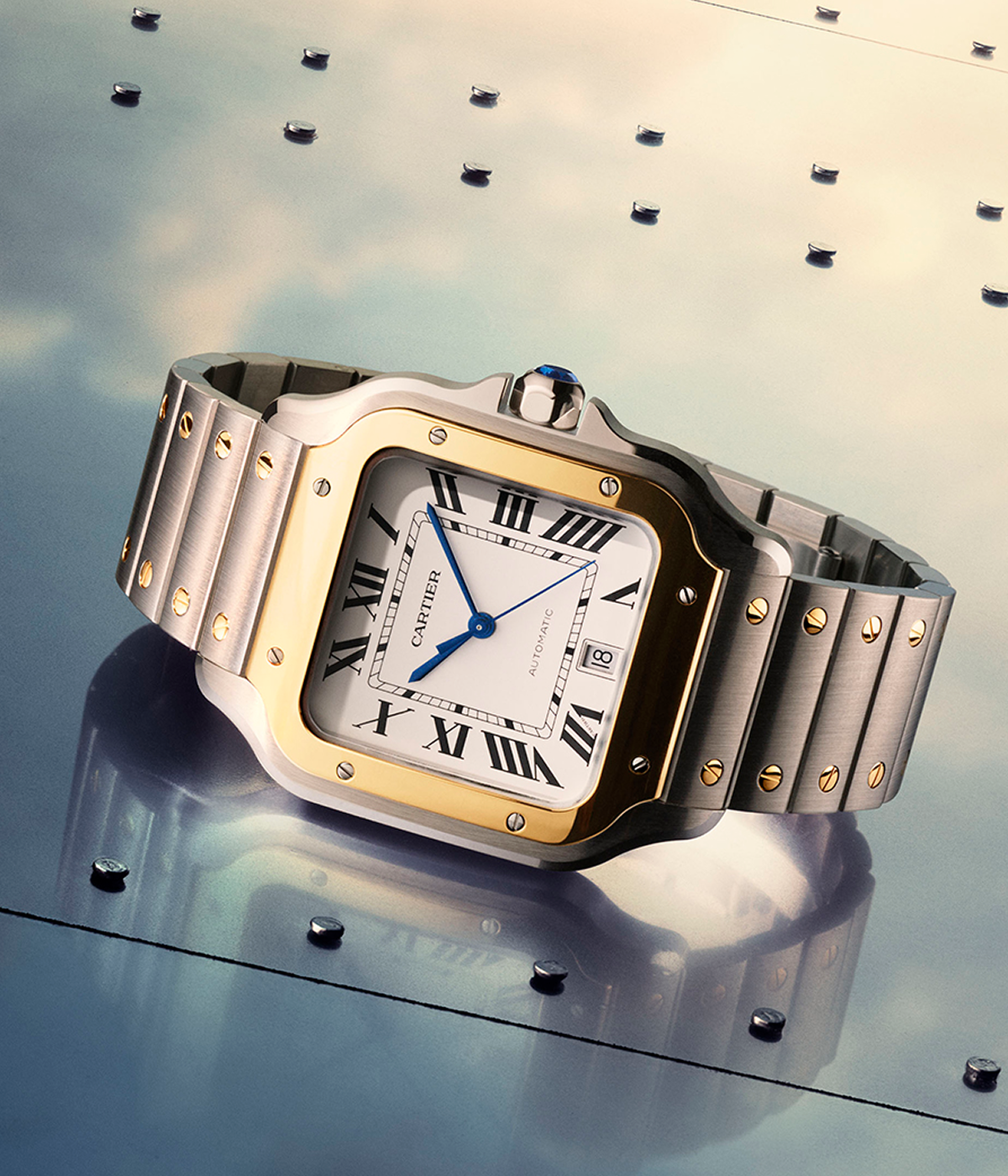
Created for aviator Alberto Santos-Dumont to tell the time mid-flight, this is the first modern watch
specifically designed to be worn on the wrist. Bold creativity soars with signature visible screws, rounded angles, and innovative new models. Shop Santos de Cartier. |
|
|
- As the Artforum turns: There’s been more than enough drama at Artforum over the last nine years, but last week we got a little more when Tina Rivers Ryan, the magazine’s editor, revealed on Instagram that she is leaving the magazine at the end of the month. She will be replaced by two editorial staffers.
The magazine’s
woes began with harassment accusations against former publisher Knight Landesman in October 2017. The next day, editor-in-chief Michelle Kuo resigned, but the magazine fought Landesman’s accuser until finally settling with her in 2021. In 2022, Penske Media Corp. bought the magazine,
keeping on publisher Danielle McConnell. Then, David Velasco, who had been elevated after Kuo’s departure, was fired for going rogue and editorializing about Hamas’s October 7 attack on Israel. Enter Rivers Ryan two years ago. Now she’s gone.
There is one curious thing about all this tumult. For a long time now, Artforum’s editorial content has not been the driving force of its success. Indeed, Landesman had created a magazine
where the ads were the content. That, in turn, meant galleries felt compelled to promote their artists’ shows there. Collectors stopped responding to those ads—any print ads, really—long before Velasco’s political stunt. But his misstep allowed the galleries to opt out under the guise of a moral, rather than economic, stance, and it doesn’t seem galleries have returned to the magazine. So how will changing editors address that basic problem?
|
Photo: Sylvie Chan-Liat/Courtesy Musée d’Orsay |
In the postimpressionist pantheon, the French painter Paul Cézanne is first among
equals. Vincent van Gogh and Paul Gauguin certainly have more compelling biographies, and Georges Seurat—of Sunday in the Park with George fame—has been played on Broadway by the likes of Jake Gyllenhaal. But Cézanne’s newfangled fracturing of old-fashioned still lifes and landscapes became the very motor of modernism. Indispensable to figures as diverse as
Pablo Picasso and Henri Matisse, not to mention Wassily Kandinsky and Piet Mondrian, Cézanne (1839–1906) can still reliably mesmerize. And with a substantial portion of his works in private hands, he can still surprise.
Switzerland’s Beyeler Foundation, blessed with a Renzo Piano–designed
premises near Basel, made the case for Cézanne’s supreme position in the visual arts when it mounted Cézanne and the Modern back in 1999, giving a native son of Aix-en-Provence pride of place alongside Picasso, Matisse, and Alberto Giacometti. Last month, the museum went one step further by bumping him from top billing to solo
performer. Of the 58 oil paintings and 21 works on paper featured in the exhibition Cézanne, around half are from private collections, while the rest are on loan from museums on both sides of the Atlantic.
Paul Cézanne came into his own in the 1880s, when, after passing through a Paris-based impressionist period, he returned to Provence. Here he managed to call the
impressionists’ bluff by going beyond their light-dappled distortions and using planes of color to all but break with linear perspective.
Emphasizing his final period, the Swiss show begins around 1890, with celebrated oil-on-canvas paintings such as The Card Players (1892–96), from London’s Courtauld Gallery, and unfinished landscape drawings, ghostly half-rendered in graphite and watercolor, from Switzerland’s Esther Grether Family Collection. |
|
|
A MESSAGE FROM OUR SPONSOR |
|
|
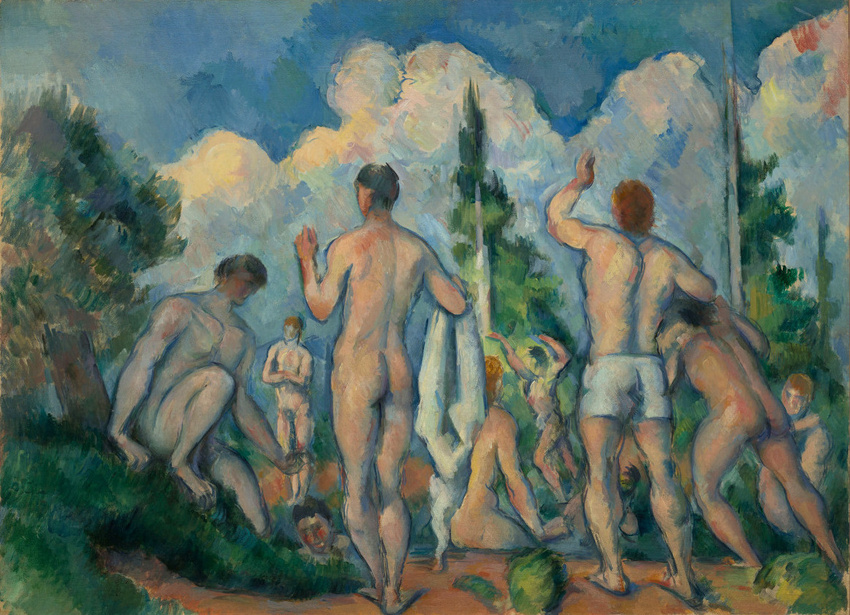
Some of the privately owned works haven’t been seen in public for decades. Indeed, one oil version
of a sunny bathing scene—a favorite subject that Cézanne revisited dozens of times—has never before been shown in public. Painted between 1900 and 1906, but left unfinished, it has flesh-colored trees, a pale-blue sky, and eerie outlines of naked bodies. It’s as if the artist were looking through squinted eyes.
Writing in the catalogue, the distinguished Cézanne scholar Gottfried Boehm, a Swiss-based German art historian now in his 80s, argues that many of these
apparently unfinished artworks, though fragmentary, can still be regarded as “complete.” And for Ulf Küster, the exhibition’s curator, it’s tempting to consider even the supposedly finished works, which almost invariably feature one of a handful of Cézanne’s recurring motifs—in this show, Provence’s Mont Sainte-Victoire, tables with fruit, and the bathing scenes—as part of a single, ongoing, never-quite-repeating series whose larger, open-ended endeavor is to reinvent
painting.
By revising through repetition, and dispensing with perspective, Cézanne came to free himself from mere perception. He painted what he felt rather than what he saw. And in not depicting or reflecting reality but, rather, creating his own, Cézanne in this final phase helped install subjectivity as the core tenet of modern art.
The show will also do its bit to reintroduce the artist as “Paul Cezanne,” sans acute accent—the spelling preferred by the artist himself, who
signed his paintings that way. Though now in limited use, the accentless version is on the march, says Küster, forecasting that, in a decade or so, “Paul Cézanne” may be gone for good.
And now… |
|
|
A new exhibition at Cooper Hewitt, Art of Noise, presents a vibrant
history of the long, complex relationship between music and design. |
|
|
It’s always fun to navigate an exhibition with your ears. At the Musical Instruments Museum in
Brussels, you can do this using proximity-based headphones. Approach a case full of 19th century saxophones—which, it turns out, are named for the Belgian inventor Adolphe Sax—and hear them honk. The Victoria and Albert Museum’s epic touring exhibition David Bowie Is used similar technology, delivering an immersive soundtrack as if transmitted directly from ground control.
Then there’s Art of Noise at Cooper Hewitt, which opened this past Friday and
lasts through mid-August. It’s another captivating aural experience, although here the sound is pervasive, subtly overlapping, and leads you from one gallery to the next. The show is about the intersection of music and design, but there are no saxes, synthesizers, or any other musical instruments. Instead, the curator Joseph Becker—who created the exhibition for SFMOMA, where it originated in 2024—chose to focus on graphic design and products made for “playback,” such as radios,
record players, stereos, speakers, and wearable devices. The ghosts in these machines haunt the space. You never see music being physically generated (unless you count a needle in a groove), but it spills through the air nonetheless, and into your ears.
If there’s one disheartening aspect to this topic, it appears early on, in a section on portable devices. A series of beautiful, pop-inflected artifacts dwindles down, finally and inevitably, to a single iPhone. With its screen blank, it
feels somewhere between a punctuation mark and a miniature gravestone. In his recent book, A Sound Mind, the journalist Paul Morley—who was also the in-house intellectual for Art of Noise, the conceptually inclined New Wave group—wrote about the experience of digitized listening, noting that, “It’s progress, and you can never deny that … but it’s also a regression, possibly even a betrayal of all that imagination and ambition that led to the music existing in the first
place, something that makes you think about what happens if music goes missing.”
Indeed, one way to understand Art of Noise (the exhibition, not the band) is as a counternarrative to this recent trend toward dematerialization, a gathering of objects that are as expressive as the music they play. Product design shows are inherently challenging—somehow, they have to be more interesting than the local Apple Store—but this one manages to succeed brilliantly, partly because of
the abundance of objects, variously nostalgic and unfamiliar, but also its razor-sharp scenography. Most objects in the show congregate in tightly spaced miniature skylines, set on planes of cobalt blue raised on metal armatures. The exhibition design, as well as other features in the show, including a “choir” of sculptures that sing in unison, come courtesy of Teenage Engineering, a Swedish electronics firm with a background in video game development. |
|
|
Their expansive approach to product design is evident throughout the show, with standard-issue
devices juxtaposed against more charismatic objects, evoking the poetic potential of playback. For example, there’s a 1935 phonograph by industrial designer John Vassos, tricked out in scarlet and chrome like an art deco roadster; a sculptural hi-fi in carved wood by Wendell Castle, converted from a blanket chest; Ron Arad’s apocalyptic Concrete Stereo, the perfect thing for listening to Einstürzende Neubauten; a music player in
the shape of a golden bonfire by French designer Mathieu Lehanneur (who also created the balloon-shaped cauldron for the 2024 Paris Olympics); and a gorgeously sleek, high-tech D.J. deck that Teenage Engineering created for the late, great Virgil Abloh.
Meanwhile, Dieter Rams, the high priest of German modernism, is represented by a whole mini-exhibition of terse products for Braun, the consumer products company. Among them, a T1000 world
band radio stands out, displayed with its front down, revealing its forbiddingly complex control panel, and with its antenna all the way up, scraping the gallery ceiling. It looks like something that could tune into signals not just internationally, but intergalactically. |
Of course, visitors can’t actually touch any of these objects. But their interactive aspects get
explored in several ways. Most important are a series of videos, which also provide the show’s environmental soundtrack, that show how a few of these devices work, with well-chosen music to match. Achille Castiglioni’s space-age RR-126 radio-phonograph plays “Nowhere to Run” by Martha and the Vandellas. A monumental boom box from the 1980s drops “The Message,” Grandmaster Flash’s seminal showcase of hip-hop turntablism. The exhibition also has a cushy listening area, where
visitors can curl up with bespoke set lists by New York luminaries including Deborah Gordon, the proprietor of the venerable jazz emporium the Village Vanguard, and Rocky Bucano, the co-founder and C.E.O. of the soon-to-open Hip Hop Museum in the Bronx.
This local orientation also informs Becker’s selection of graphics, which are quite different from those of the San Francisco edition of the exhibition. That version had hundreds of psychedelic posters
(feed your head!), whereas here, there are only about 30. In their place is an extensive collection of ephemera from New York City’s diverse music scenes. Punk and disco, so often understood as mutually exclusive subcultures, sit in conversation, their D.I.Y. fliers conjuring a lost world of interconnected nightlife.
There is also a wealth of material from the city’s salsa scene, including album covers by the Puerto Rican designer Israel “Izzy” Sanabria,
who did for Sabu’s Jazz Espagnole what Tibor and Maira Kalman did for the Talking Heads. With ICE marauding through American streets, one of Sanabria’s designs will stop you in your tracks: It features mugshots of the musician and activist Willie Colón (who, by the way, was name-checked by Bad Bunny in the Super Bowl halftime show), along with his fingerprints and the legend “WANTED BY F.B.I. … armed
with trombone and considered dangerous.”
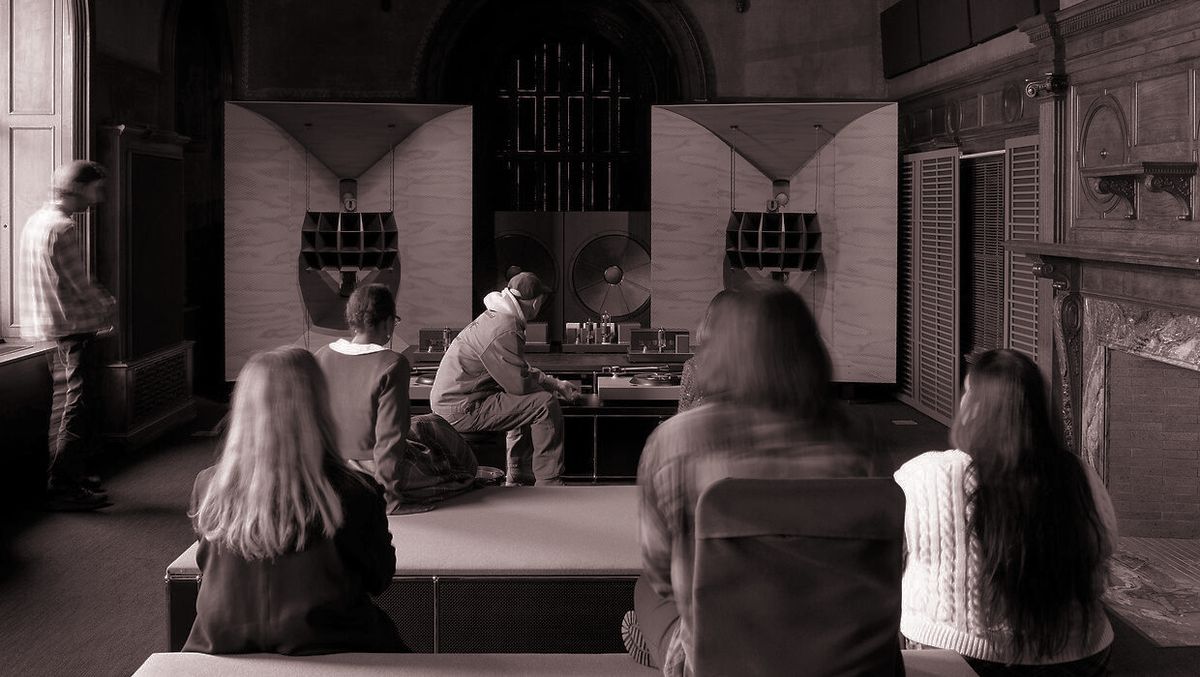
Ideally, visitors will exit the exhibition via the ground-floor listening room, which features a hand-crafted sound system by Devon Turnbull. (The room has been open since December; the main show was supposed to open then, too, but it was delayed by the government shutdown.) Cooper Hewitt’s historic library has been completely transformed into what Turnbull calls a “shrine to music.” Guests are invited to deposit their shoes at the
door; inside, they’ll find elevated seating facing story-high speakers, which look like they could blow out eardrums across Central Park.
When I visited the museum on a wintry Thursday, the music wasn’t all that loud—just supremely gorgeous. In addition to themed days of listening (classical on Monday, jazz on Fridays), the museum has lined up a dream list of V.I.P. musicians to come and spin. On the day I stopped by, I found the legendary Harlem-based auteur of ambient music,
Laraaji. Dressed head to toe in saffron-colored garb, he came across like a hip incarnation of the Dalai Lama, and the attentive crowd was mesmerized. With programming like this, Cooper Hewitt has become a place not just to visit, but to hang out for hours or days at a time. Spotify and Bluetooth are modern miracles, but as this exhibition reminds us, music has been gathering people together for millennia. Let’s hope the melodies linger on. |
Thanks, Glenn. It’s great to have you aboard. I’ll be back on Tuesday with much more.
Until
then,
M |
|
|
Puck founding partner Matt Belloni takes you inside the business of Hollywood, using exclusive reporting and insight
to explain the backstories on everything from Marvel movies to the streaming wars. |
|
|
The ultimate fashion industry bible, offering incisive reportage on all aspects of the business and its biggest
players. Anchored by preeminent fashion journalist Lauren Sherman, Line Sheet also features veteran reporter Rachel Strugatz, who delivers unparalleled intel on what’s happening in the beauty industry, and Sarah Shapiro, a longtime retail strategist who writes about e-commerce, brick-and-mortar, D.T.C., and more. |
|
|
Need help? Review our FAQ page or contact us for assistance. For brand partnerships, email ads@puck.news. You received this email because you
signed up to receive emails from Puck, or as part of your Puck account associated with {{customer.email}}. To stop receiving this newsletter and/or manage all your email preferences, click here. |
Puck is published by Heat Media LLC. 107 Greenwich St., New York, NY 10006 |
|
|
|