Welcome back to Wall Power. I’m Marion Maneker. Thanks to those of you
who were kind enough to send your best wishes to my father-in-law. He enjoyed his time sharing stories of his exploits with his grandchildren, as he should.
In tonight’s issue, a discussion on the art of Australia’s First Nations. The National Gallery has a new show, drawn from the collection of the National Gallery of Victoria, in Melbourne, titled The Stars We Do Not See, which gives a sampling of the wide range and function of Aboriginal art. The Washington
Post’s art critic didn’t like the show, calling it “inclusive to a fault,” “incoherent,” and “a crashing disappointment.” I’m going to try to explain why he missed the point.
Mentioned in this issue: Evan Beard, Sebastian Smee, Emily Kam Kngwarray, Tim Leura Tjapaltjarri, Clifford Possum Tjapaltjarri, Gulumbu Yunupingu, Naminapu Maymuru-White, Maggie
Napangardi Watson, Paddy Bedford, Patju Presley, David Frum, Murray Frum, William Barak, and many more…
But first… |
-
Beard leaves Level: After nearly five years running Level & Co., an Upper East Side gallery tied to Masterworks, Evan Beard is striking out on his own but retaining Masterworks as a client. Now operating as Evan Beard & Co., the new gallery also plans to open an office and exhibition space on the Upper East Side sometime soon. According to Beard, the firm will be “a discreet private bank–type operation where we go very deep with a core group [of] large clients, mostly
in the United States” who “build living collections—buying and selling along the way—and a few more who are investment driven.” The firm will have “5-6 employees to start,” and Beard is in the process of hiring them. Because, he said, “January will be super active.”
|
Now, let’s get to the Aboriginal art… |
|
|
The Stars We Do Not See, a new show at the National Gallery, offers a
reflection on the past and modernism that seems perfectly at home in the capital these days. |
|
|
Yesterday, a useful analogy dawned on me as I walked along the National Mall in Washington, D.C.,
trying to get back to my car before the meter ran out. I was dodging the puddles that had formed in the pea stones and trying to stay dry under my small-but-sturdy hotel umbrella, still thinking about The Stars We Do Not See—a show of Australian Aboriginal art from the National Gallery of Victoria, in Melbourne, currently on display in the National Gallery’s East Building.
The show was meant to be a survey of art from the 250 language groups that make up the wildly diverse and
unbelievably ancient culture of Australia’s First Nations. More than focusing on the art itself, however, the show attempts to explain how art functioned for these formerly nomadic groups whose identity, ethics, and cosmography were fused to the lands they came from—a concept the show refers to as “Country.”
In fact, “art” is something of a misnomer for the objects the Aboriginal Australians created. As the show tries to demonstrate, the works on display are artifacts of a 65,000-year-old
oral tradition, expressed in images and designs combining features of maps, legal documents, kinship records, and other mechanisms for tying the past to the present. So this is what dawned on me as I trudged through the downpour: The 200 objects from 130 artists on view at the National Gallery were not much different from the monuments and museums that line the National Mall itself.
One of the functions of Washington, D.C.—the reason families and schools make ritual trips—is to remind
ourselves who we are, where we come from, and what we’ve experienced as a people, the best and the worst of it, along with our ideals and aspirations. Aboriginal art tries to do the same thing. Patterns and symbols were applied to cave walls, bark shelters, and bodies long before the elders of those various language groups started committing their designs to eucalyptus bark, logs, or shields. While some cultures build stone edifices to create a ritual experience, in which past and present
reinforce their understanding of themselves, these materially poorer people offered the same gesture through image-making. Of course, Aboriginal monuments, as befits a formerly nomadic culture, are more portable and replicable than ones on the mall. But they are not any less significant.
Don’t take my word for it. “The permanence of these works is in our minds,” The Washington Post’s Sebastian Smee quoted an Aboriginal elder saying. “We do not need
museums or books to remind us of our traditions.” |
Just as Washington has monuments and museums that appeal to different aesthetic traditions and
audiences, The Stars We Do Not See offers a survey of Aboriginal art and its functions. But Smee wanted something different. After seeing the Tate’s very good solo retrospective of the art of Emily Kam Kngwarray, he traveled back to his native Australia, where he saw a great deal more Aboriginal art—which, from the way he described it, was some of the best.
But Smee, who got his M.A. in fine art at University of Sydney, seemed almost jealous of his expertise. He
complained in his piece that Aboriginal art “has too often been mischaracterized (as craft or ethnography) and sold short (as art market product),” and that the show doesn’t display its aesthetic excellence. Worse, and somewhat bizarrely, he griped that the show was too inclusive, and that it “appears to have been assembled by committee, with low-level ethical considerations—above all, an obligation to represent as many communities as possible—elevated over sharp aesthetic decisions.” The
result, apparently, is “arbitrary and unkempt, as if someone has emptied their pockets into an airport security tray.” Finally, he writes, “the impact of the show’s scattered masterpieces is diluted throughout with desultory works of scant visual appeal. The curators didn’t need to throw in everything to convey the range and variety of Australia’s Indigenous art.”
Here is where I think Smee’s zeal to advocate for the very best Aboriginal art misses the point—and value—of the show. As Smee
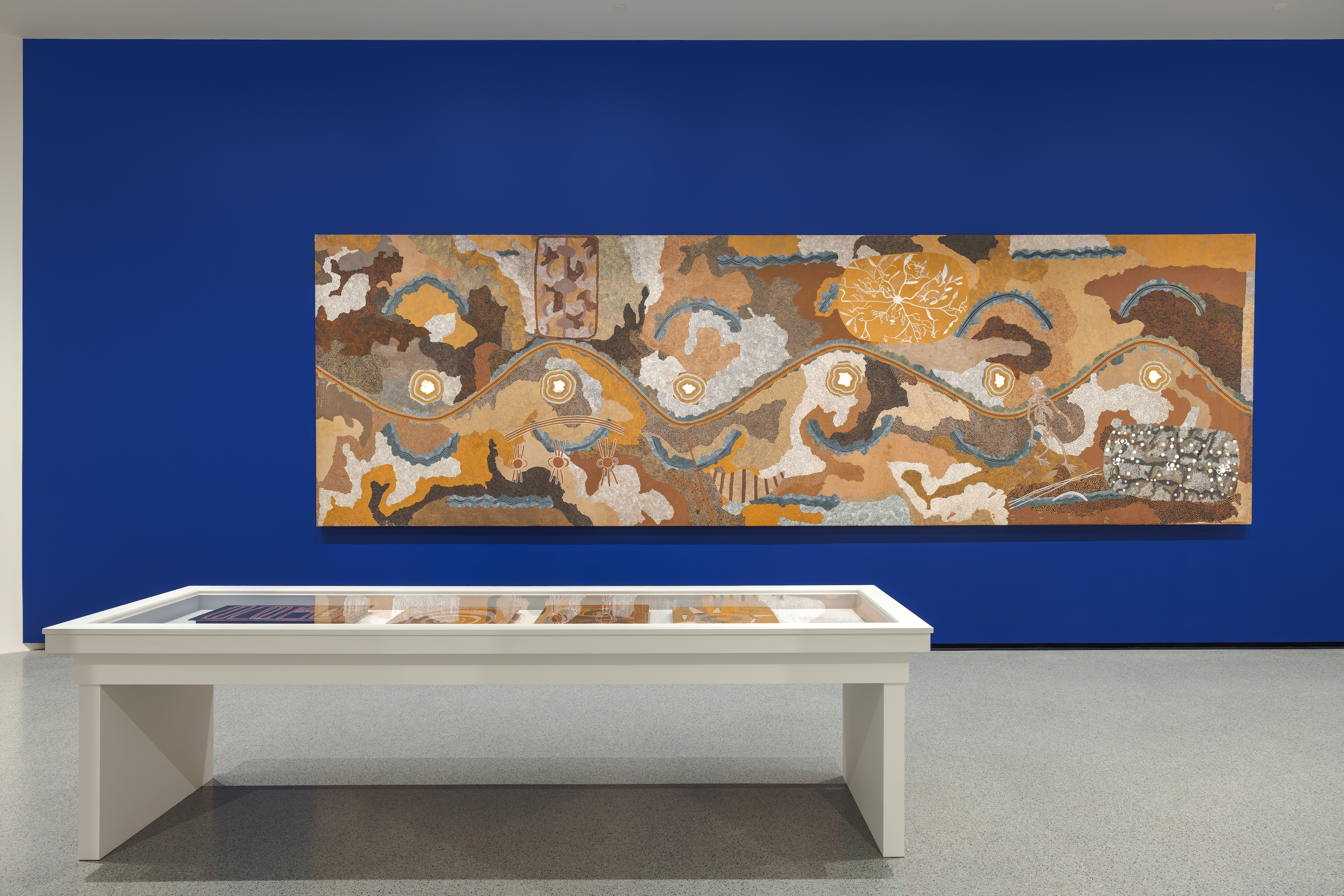
admits, the show has some undeniably beautiful works, masterpieces even. It opens with a display of intricately decorated memorial poles from various artists and language groups, and it contains several visually stunning and culturally important works. For instance, Tim Leura Tjapaltjarri and Clifford Possum Tjapaltjarri’s Spirit Dreaming Through Napperby Country, from 1980—an extremely large painting that dominates a wall in the early galleries—is an
amalgam of images and meanings, containing multiple “dreamings,” or stories from the “whenever” that provide context and allegory. But it also “chronicles the catastrophic dispossession experienced by Anmatyerre people,” according to the catalogue, when their ancestral lands in the center of the continent were taken over by settlers who created a massive ranch, known in Australia as a cattle station. |
Tim Leura Tjapaltjarri, Clifford Possum Tjapaltjarri, Spirit Dreaming Through Napperby Country
(1980), at The Stars We Do Not See: Australian Indigenous Art, National Gallery of Art, Washington. Photo: Courtesy of the National Gallery of Art |
There are other works in the show that can be admired for their striking abstract beauty or
intricate workmanship, including the work from which the show takes its title. Gulumbu Yunupingu, an artist known as “the star lady” in part due to the Indigenous practice of substituting a “mourning name” for a close relative after their death, has a memorial pole and several eucalyptus bark canvases on display. These are filled with elaborate patterns of crosses and dots depicting the stars of the southern sky, and “the stars we do not see.”
Another creator of intricate
depictions of the stars, Naminapu Maymuru-White, has Milniyawuy (River of Stars), from 2020, in the show. It’s a black-and-white work of a more domestic size, whereas Emily Kam Kngwarray is represented by a massive black-and-white work, Anwerlarr Anganenty (Big Yam Dreaming), from 1995. There are plenty of other works that you can, and should, admire simply for their aesthetic appeal. But some of what you (or Smee) view as a masterpiece will be
subjective.
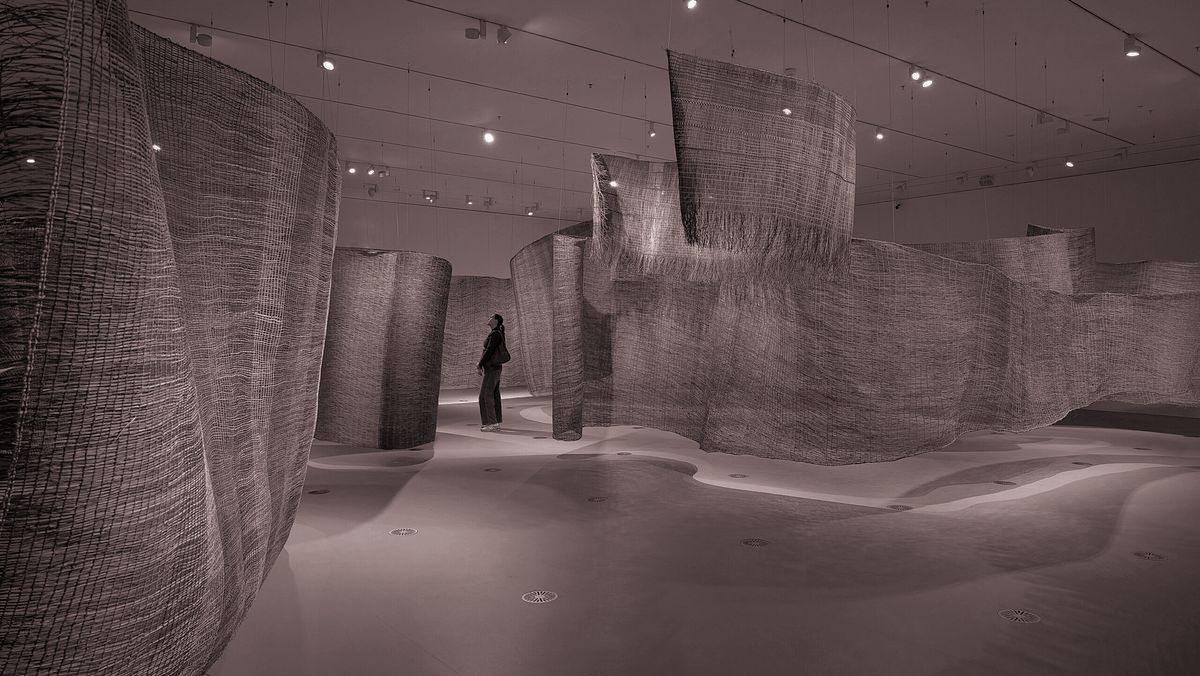
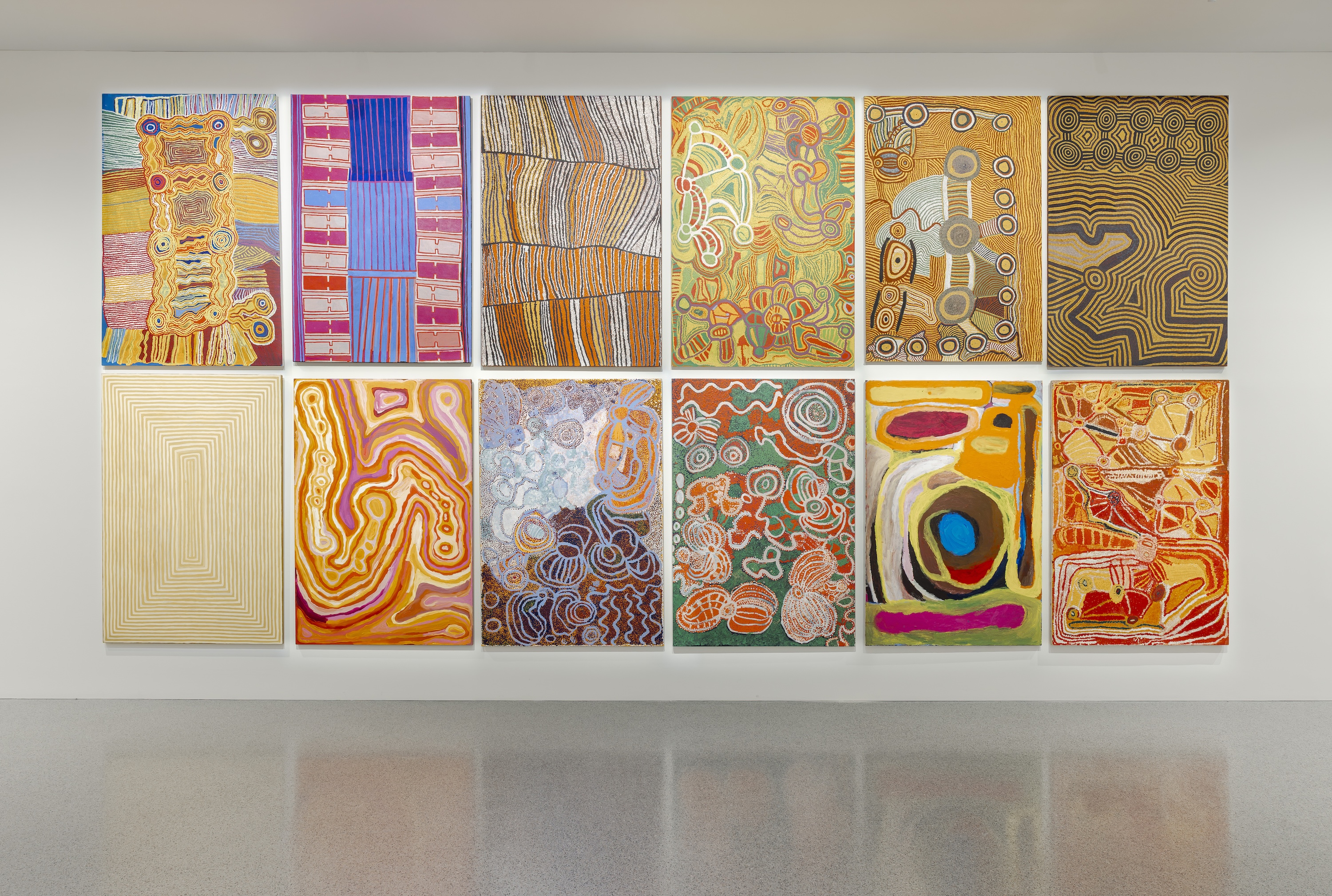
I loved Maggie Napanardi Watson’s Wititji (Hair String), from 1997, for its vibrant colors. Paddy Bedford’s Joowarringayin—Devil Dreaming, from 2000, has a powerful graphic simplicity. Patju Presley’s Apanyin, from 2004, is intricately colorful, dominating the array of works that tries to contain it. There are several more breathtaking works, including many of the memorial poles and the woven fishing
weir that hangs above the entrance to the exhibition. |
I don’t entirely disagree with Smee. It would be great if a museum like MoMA, the Met, or the Art
Institute of Chicago would devote their curatorial time and logistics budget to organizing a show of the greatest aesthetic works made by Aboriginal artists. But such a show would do something reductive: judge the art works by our own standards. |
The Stars We Do Not See: Australian Indigenous Art at the National Gallery of Art,
Washington. Photo: Courtesy of the National Gallery of Art |
But Smee’s review reminded me of something David Frum told me last year when I
interviewed him about his father Murray Frum’s internationally recognized collection of African and Oceanic Indigenous art. The senior Frum had told his son that the easiest way to recognize a fake was if, upon seeing the work for the first time, you liked it too much. All great art requires a bit of distance, even shock and discomfort, but Indigenous art has a greater sense of misprision because, Murray explained, “it wasn’t made for you.”
The Stars We Do Not See
has a consistent theme: It shows how Indigenous art in Australia has been used to preserve Aboriginal culture, but also crucial evidence of land rights. For instance, the show has a group of eight oval shields that were used in a historic court case to substantiate Indigenous activists’ land claims. The court sided with the activists. (The shields are cheekily displayed next to a group of skateboards, also decorated with Indigenous patterns.)
There’s also a work by William
Barak, an Indigenous leader from the 19th century whose crudely drawn image Ceremony, from 1898, was an important source of information about Indigenous practices. It’s estimated that 90 percent of the Aboriginal population of Australia perished during Barak’s lifetime. If The Stars We Do Not See does nothing more than illustrate how the Indigenous people of Australia have navigated preserving their cosmology while both adapting to and resisting the modern world, then
the show will be a success. |
That’s it for today. I’ll see you again on Tuesday.
M |
|
|
Puck founding partner Matt Belloni takes you inside the business of Hollywood, using exclusive reporting and insight
to explain the backstories on everything from Marvel movies to the streaming wars. |
|
|
The ultimate fashion industry bible, offering incisive reportage on all aspects of the business and its biggest
players. Anchored by preeminent fashion journalist Lauren Sherman, Line Sheet also features veteran reporter Rachel Strugatz, who delivers unparalleled intel on what’s happening in the beauty industry, and Sarah Shapiro, a longtime retail strategist who writes about e-commerce, brick-and-mortar, D.T.C., and more. |
|
|
Need help? Review our FAQ page or contact us for assistance. For brand partnerships, email ads@puck.news. You received this email because you
signed up to receive emails from Puck, or as part of your Puck account associated with {{customer.email}}. To stop receiving this newsletter and/or manage all your email preferences, click here. |
Puck is published by Heat Media LLC. 107 Greenwich St., New York, NY 10006 |
|
|
|