Hello and welcome back to The Best & The Brightest. I’m Leigh Ann
Caldwell.
It’s been another wild day on Capitol Hill. Yesterday, we saw a dozen Epstein survivors tell their stories and demand that Congress seek answers and accountability. (They also suggested that they would create and release their own list of people they saw interact with Epstein.) Today, there was an explosive hearing in the Senate Finance Committee with H.H.S. Secretary Robert F. Kennedy Jr., who was aggressively questioned about
his management of the C.D.C. I’ll have more on that below.
In today’s issue, Abby Livingston is back with a deep dive into how House Democrats, confronted with Trump’s redistricting war, are trying to make sense of a midterm congressional map that might look very different from what they had contemplated just six months ago.
But first… |
- R.F.K.
in the hot seat: It’s always interesting to watch a contentious hearing to see who defends the witness, who helps out by avoiding the hot-button issues, and who goes on the attack. Well, today’s hearing in the Senate Finance Committee with the H.H.S. secretary did not disappoint. Kennedy walked into the hearing without too many friends on the committee after dismissing the C.D.C.’s entire vaccine board as well as its newly confirmed director, Susan Monarez. Kennedy called
Monarez a liar for claiming she was fired after refusing to endorse his anti-vaccine policies, and blasted the American Association of Pediatrics as “gravely conflicted.” And that’s just how the hearing started.
He quarreled with most Democrats, including Sen. Mark Warner, who asked Kennedy whether he agreed that more than a million Americans died from Covid. Kennedy said he didn’t know how many died. “I’d like to see the data,” he said, dismissing the reams of real-time
data compiled by state and federal officials. But the most interesting exchanges came with Republicans like Sen. John Barrasso, the party whip from ruby red Wyoming, who said he’s grown “deeply concerned” about Kennedy’s plans.
Sen. Bill Cassidy, the former physician who was the deciding vote to give Kennedy the role, was even more furious, questioning Kennedy’s contradictory statement that Trump should receive the Nobel Peace Prize for Operation Warp
Speed while Kennedy himself had attempted to restrict vaccine access as an attorney for Children’s Health Defense. “I would say we’re effectively denying people a vaccine,” Cassidy said. “I think you’re wrong,” Kennedy responded.
|
We’ll have more on the C.D.C. fallout next week. Meanwhile, as Washington awaits Friday’s first B.L.S. jobs
report since Trump fired the head of the agency, I reached out to Puck’s own Ian Krietzberg for a preview of how A.I. may or may not be impacting employment numbers. Here’s the latest from The Hidden Layer, his essential newsletter on the industry… |
|
|

| Ian Krietzberg
|
|
- Last month, I
wrote about a team of researchers at a think tank called the Economic Innovation Group, who published a report debunking some of the hysteria about the feared A.I. jobpocalypse. Notably, the researchers found a paucity of evidence suggesting that this doomsday was around the corner. After breaking occupations into categories based on their
exposure to A.I. obsolescence, the researchers discovered, ironically, that the “unemployment rate for the most A.I.-exposed workers” was actually rising less quickly than for “the least exposed workers.” Somewhat humorously, the report was titled AI and Jobs: The Final Word (Until the Next One)—a reference to the fact that we’re still in the early days of understanding how this technology will truly impact the workforce, despite vocal protestations that we’re
headed down a path of no return.
Now, a cohort of more sober and circumspect researchers is adding their flavor to the industry scholarship. In a new report, published just a few weeks after the E.I.G. paper, Stanford economists Erik Brynjolfsson, Bharat Chandar, and Ruyu Chen came to a broadly similar
conclusion. Using data from ADP, the largest payroll provider in the U.S., they identified that employment has declined 20 percent since 2022 for early-career employees (aged 22-25) in exposed fields such as software development and customer service. But Chandar noted that it’s not clear that “these findings are fully driven by A.I. Many other things
changed in the U.S. economy at the same time.” It is entirely possible that a substantial portion of this decline was the result of rampant overhiring by Big Tech during the pandemic. Meanwhile, and critically, employment remained stable among older, middle-aged groups.
The Stanford team concluded that seniority, training, and experience were key factors in job retention. But, at a macro level, their analysis aligned with the E.I.G. finding that the jobpocalypse narrative has been
overhyped…
[Read more here]
|
|
|
Until recently, conventional wisdom held that Democrats would almost certainly retake the
House in 2026. Now, amid the political wreckage of the redistricting arms race, they’re no longer so sure. |
|
|
Washington is roaring back to life this week as members return from a tumultuous recess to an even more
chaotic fall session, opening with this week’s Epstein showdown, the ongoing implosion of the C.D.C., and a looming shutdown fight. But the post–Labor Day window also marks the beginning of a midterm cycle that’s unlike anything most political operatives have ever seen.
Earlier this summer, the conventional wisdom held that Democrats were increasingly likely to retake the House, while the Senate would be a longshot. But that thinking has since shifted. Thanks to
Trump’s redistricting push, Republicans now have a better chance at holding the House, while Democrats have somewhat improved their odds at achieving a slim Senate majority. Democrats started this cycle with a miserable Senate map, tasked with defending Georgia, Michigan, and New Hampshire, but it’s become a bit less miserable
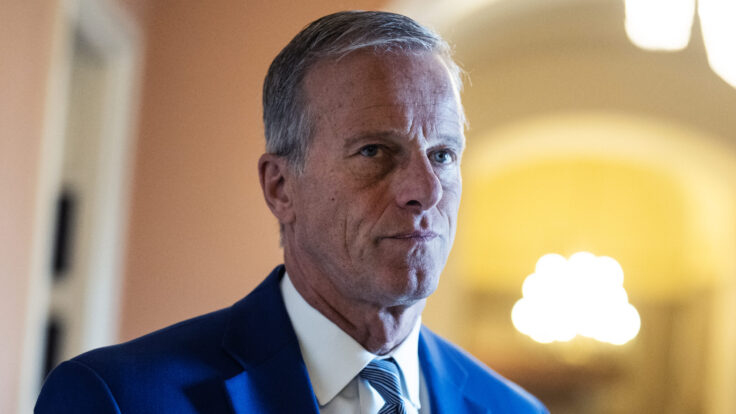
thanks to the retirements of Joni Ernst and Thom Tillis. And, as my partner Leigh Ann Caldwell reported last night, Senate Majority Leader John Thune is under immense pressure to keep other disillusioned incumbents, especially Susan Collins, from following them out the
door.
Instead, it’s now the lack of clarity surrounding the House map that’s truly agonizing Democrats. The reliable historical pattern for every midterm is that the out-of-power party almost always picks up seats. But because Trump has torched so many political precedents—having orchestrated a blatantly self-serving pre-midterm gerrymander in Texas, and now pushing a second one in Missouri—nobody wants to put their faith in the pendulum. “Even in years where redistricting
happened, the timelines, processes, and expectations were clear. People knew what was going to happen and when, and could plan accordingly,” said Jesse Ferguson, a Democratic consultant. “Now you can be a member of Congress in any given state and find out that Donald Trump has ordered up new seats in your state, and your entire political reality shifts overnight.”
Of course, members of both parties have more to worry about than just the immediate consequences of
redistricting, including retirements, more difficult primaries, and districts being spread too thin. There are also the second-order effects: Democratic Texas Rep. Marc Veasey, for example, recently suggested that the state’s March primary and May runoffs could be delayed due to the
Democratic challenges to the new map. I’ve heard the same concern in some Texas Republican circles. After all, this precise dynamic helped Ted Cruz pull off his shocking underdog primary win in 2012: Redistricting delayed the primary, leading to a low-turnout runoff election in the oppressive heat of a Texas summer. This cycle, it could end up prolonging the knock-down, drag-out Cornyn-Paxton brawl, consuming G.O.P. dollars that would be better spent
elsewhere. |
For now, the parties are still finding confidence in polling, although the data can be read a half-dozen
ways. Republicans mostly shrug off Trump’s unfavorables, given internal polling that shows their incumbents still hanging on. More encouragingly, they say, the Democratic brand is in the toilet.
Democrats, for their part, are reassured by generic ballot numbers—the polling that shows they have a low-single-digit advantage in “generic Democratic candidate versus generic Republican” matchups—which is broadly indicative of the national mood. “I would be perplexed if Democrats didn’t win the
House and do well in the Senate, but it’s a wild and crazy time,” said a Democratic lobbyist.
For the next few months, both parties will be focused on fundraising and recruitment. “Dems have some serious self-created headwinds,” said longtime Republican operative Doug Heye. “But Republicans were still D.O.A. at this point in 2010, and it all turned around for them with the House vote on Obamacare.” Indeed, many Democratic members and operatives I’ve spoken
to remain unfazed by state redistricting, arguing that a blue wave should be strong enough to withstand any gerrymandering hijinks. They also point to Republican retirements in the Senate, and Nebraska Rep. Don Bacon’s in the House, as encouraging signs, along with the fact that the D.C.C.C. has nearly kept pace with the N.R.C.C.’s fundraising this year while House Democrats have the cash-on-hand advantage.
Democrats are encouraged by their recruitment drive, too. (Among
the top announcements this week were Scranton Mayor Paige Cognetti, who’s challenging Republican Rep. Rob Bresnahan.) In fact, recruitment has gone possibly too well: Several Republican-held seats are jammed with Democratic challengers, which makes them far more unpredictable for a party that prefers to keep a tight leash on primaries in competitive seats. (Pennsylvania’s Ryan Mackenzie has five such challengers, New York’s Mike
Lawler has eight, and Tom Kean Jr. of New Jersey faces 10.) On the other hand, crowded primary fields are usually good for party-building; they reach more voters, and sharpen candidates’ skills well before the general election.
Still, much depends on California. As the Cook Political Report’s Dave Wasserman put it: If the state’s Democrat-led redistricting initiative passes, Republicans will be underdogs to hold the House; if Democrats fail, the
result will be “a very close fight” for the House. In the meantime, red states beyond Texas are at various stages of joining the redistricting fray.
Missouri, for one, has just kicked off a special legislative session to draw new maps that would dismantle the Kansas City–based district of Democratic Rep. Emanuel Cleaver. Ohio is looking at a court-mandated redraw that could jeopardize the careers of Democratic Reps. Marcy Kaptur and Emilia
Sykes. Indiana has yet to commit to a redraw, but Republicans would presumably target the district of Rep. Frank Mrvan. Florida Republicans may also redraw their state lines, possibly putting as many as five Democrats—Reps. Kathy Castor, Jared Moskowitz, Darren Soto, Debbie Wasserman Schultz, and Frederica Wilson—into tougher districts.
As for the Democrats’ defense against these
redraws, California might end up being the easy part, along with Utah, where a court-ordered redraw may give Democrats a shot at a competitive seat. In Maryland, where Gov. Wes Moore has been raising his profile in recent weeks, a potential redraw is possibly on the table—Moore has sent subtle signals that he might go after Republican Rep.
Andy Harris’s Eastern Shore district—but local Democrats have avoided something like this for years, for fear of spreading their districts too thin. There are similar worries in Illinois, where the bigger concern is that the legal barriers are simply too significant for a redraw this cycle.
Of course, hovering in the background is New York, which will not redraw this cycle. But if Democrats torpedo their fair maps ahead of the 2028 cycle, it could lead to a bloodbath for
the state’s Republicans—an outcome dependent on Gov. Kathy Hochul winning reelection. (She appears to be on track to face Rep. Elise Stefanik next year.) |
High candidate turnout is a positive sign that Democrats are on offense, but it also presents
perils—particularly in California, with its treacherous jungle primary system. It’s possible that so many Democrats run for a House seat that they spread the vote among themselves thinly enough for two Republican candidates to advance to the general, locking Dems out of competing for a winnable seat. Should the new district map pass in California, these open primaries will be closely watched, and could get messy.
Meanwhile, the party’s endorsement process could be equally unruly.
Democrats concede that a formal endorsement from one of the party committees could do more harm than good. There have been moments of overt Democratic ruthlessness on this front: In 2018, the D.C.C.C. dumped an opposition research file of a Democratic candidate who party leaders believed could have jeopardized a
House seat, which they ultimately won that fall. But this is a much more anti-establishment moment, with Dems more often wielding an invisible hand to support preferred candidates (or quietly tamping down problem candidates they believe could blow the general election). This usually comes by word of mouth, by telegraphing to donors which candidates should be supported; party leaders have pushed back against interest groups like Emily’s List for boosting candidates, specifically in California, to
avoid a lockout situation.
This level of chaos isn’t present on the Republican side. Yes, primaries are brewing in major Senate races, like in Georgia and Texas, but they’re generally far quieter for a simple reason: Trump. As recently as the late 2010s, Republican primaries were rollicking affairs, pitting the Tea Party against the establishment. But now that Trump has consolidated control, all’s quiet on this front. The entire Republican primary apparatus—from Senate seats down to the
state legislatures—is organized around winning the Trump endorsement. After that ruling comes down, most Republican primary races are effectively over. Even when he was out of office, Trump had a 96 percent win rate in primary endorsements in 2024. He’s only cemented his power since returning to office. |
|
|
Join Emmy Award-winning journalist Peter Hamby, along with the team of expert journalists at Puck, as they let you in on the
conversations insiders are having across the four corners of power in America: Wall Street, Washington, Silicon Valley, and Hollywood. Presented in partnership with Audacy, new episodes publish daily, Monday through Friday. |
|
|
Unique and privileged insight into the private conversations taking place inside boardrooms and corner offices up and down Wall
Street, relayed by best-selling author, journalist, and former M&A senior banker William D. Cohan. |
|
|
Need help? Review our FAQ page or contact us for assistance. For brand partnerships, email ads@puck.news. You received this email because you signed up to receive emails from Puck, or as part of your Puck account associated with {{customer.email}}. To stop receiving this newsletter and/or manage all your email preferences,
click here. |
Puck is published by Heat Media LLC. 107 Greenwich St, New York, NY 10006 |
|
|
|