{{ 'now' | timezone: 'America/New_York' | date: '%b %d, %Y' }} |
|
|
|
Welcome back to Dry Powder. I’m William D. Cohan, writing to you from Paris,
where all anyone wants to talk about is the heat. Not France’s 3-0 thumping of Iraq late Monday evening, or Keir Starmer’s resignation, or even the runway dispatches of my partner Lauren Sherman are any match for the sweltering temperatures, which have regularly been topping 100 degrees, with little relief on the horizon. Tuesday was the country’s hottest day on record. Quelle horreur.
This is a real head-scratcher for the
French. Paris is basically on latitudinal par with Vancouver, where it’s around 65 degrees right now. At a local boulangerie, we bumped into a nice lady from Atherton, California, with an apartment here, who said she was leaving soon because it’s too hot. We also spied a bunch more Americans at an early-afternoon showing of The Devil Wears Prada 2 (nice cameo, Kara), where the air-conditioning was modest—which still made it infinitely cooler than almost anywhere else,
except the Monoprix. The other night, a French lady dining next to us at Pizza Chic took ice cubes and rubbed them all over her arms and legs.
There are other makeshift remedies, like walking in the shade on every street—which means a uniform choreography of pedestrians crossing back and forth from one shadow to another. Thanks to the heat, everyone in Paris this week seems to have a slightly pained expression on their face. But at least no one says a word when you show up at your divine
dinner reservation in shorts and a t-shirt. And I am here to tell you that the chanterelles at Le Bon Georges are still to die for.
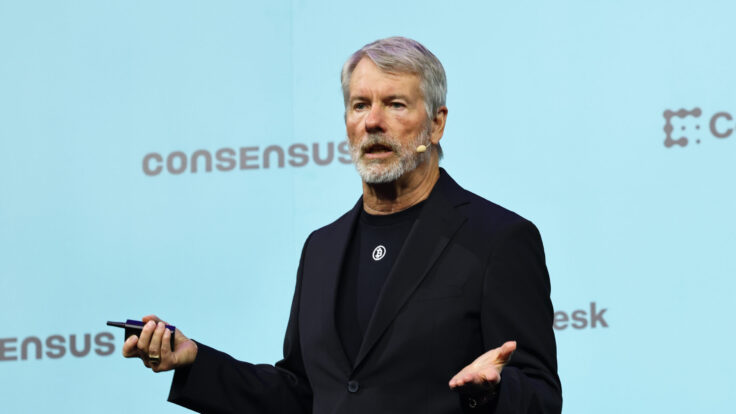
Anyway, back to business. The main event today is a check-in with the world’s foremost Bitcoin evangelist, Michael Saylor, and the dire straits in which he finds himself now that the reference cryptocurrency has fallen by more than half since peaking at $126,000 in October. It’s spooky stuff, even for a true believer like Saylor. Plus: notes
on the SpaceX sell-off and Bernie’s new plan to nationalize Silicon Valley.
Also mentioned in this issue: Jim Chanos, Bill Hwang, Howie Hubler, Bruno Iksil, Jérôme Kerviel, David LaValle, Elon Musk, Bernard Arnault, and more. |
- Down
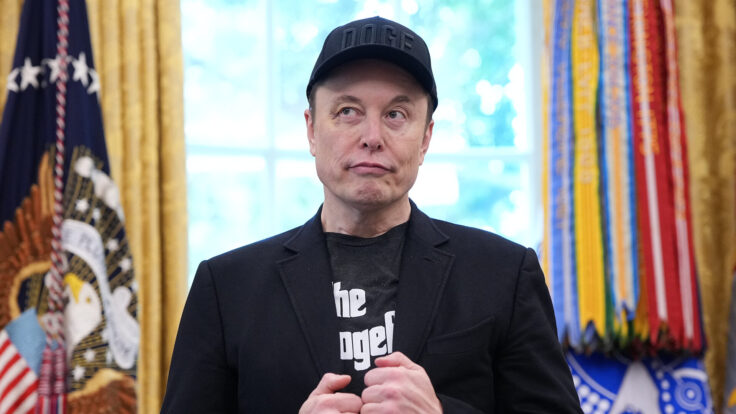
here we all float: As was entirely predictable—thank you, Wall Street underwriters—the SpaceX I.P.O. is having a rough go of it. After reaching a high of $225 a share last week, SpaceX is currently trading at around $155, down more than 40 percent from its peak, though still above the I.P.O. price of $135 per share. In effect, anyone who bought SpaceX after it went public has pretty much lost money, and those who bought the stock last week when it traded at around $225 a share have lost
a lot of money. Don’t worry, though, Elon will be just fine. He remains the world’s first trillionaire, though just barely. Monday’s decline in the SpaceX stock—down 16.4 percent—cost him $152 billion, or about as much as Bernard Arnault’s entire net worth. That’s not something you can write every day.
|
|
|
|
A MESSAGE FROM OUR SPONSOR |
INSPIRE AWE
Revered by all. Driven by those who lead by example. Elevate every move you make in a Range Rover.
EXPLORE
|
|
|
|

| Ian Krietzberg
|
|
- Sanders’s golden stake:
Sen. Bernie Sanders has finally released the full, official text of his bill to nationalize artificial intelligence. As expected, the centerpiece is a requirement that “the largest A.I. companies” fork over half their equity (and commensurate board representation) to the government. And yet the law would also seem to extend well
beyond the frontier model labs: It defines “applicable” companies as those “engaged in activities” related to A.I. services, data centers, compute infrastructure, and advanced robotics. Any designated company with more than $200 million in annual revenue would be subjected to this one-time stock seizure, which would seed a new sovereign wealth fund managed by an independent commission. That same commission would leverage its voting shares in the relevant companies to block
corporate decisions that might be harmful to the American public and push for those that might be beneficial.
The bill would also require companies managing both A.I. and non-A.I. businesses to cleave their operations in order to ensure that the equity stakes would be specific to the appropriate entity. Sanders said that the total size of the fund, based on today’s valuations, would be around $7 trillion, though it’s unclear how he arrived at that number. According to the bill, a 5
percent annual dividend would provide a direct payment to “everyone in America.” Nice work, Bernie.
In a statement heralding the bill, Sanders evoked the Alaska Permanent Fund, the state’s oil- and gas-based public wealth fund. The difference, of course, is that today’s top A.I. labs are currently losing billions of dollars.
In an industry that is more focused on valuations than profitability, it may be a while before there’s much wealth to share.
|
|
|
|
And now, a little more on Saylor… |
|
|
|
Bitcoin has now fallen by more than 50 percent from its all-time high. Does the
cryptocurrency’s number one evangelist have an escape hatch? |
|
|
|
For reasons that don’t make a lot of historical—or logical—sense, the U.S. stock markets are either at or
near their record heights. The Dow Jones Industrial Average remains within a few ticks of 52,000, around its all-time high, reached a week ago. The Nasdaq reached its climax of a little more than 22,000 on June 17—a day after the DJIA’s record, though the tech-heavy exchange had a rough outing on Tuesday. The S&P 500 peaked at 6,144 on June 18. So, you know, it’s basically been risk-off euphoria in the stock market for months now.
In an environment where stock indices seem to know no
bounds, you might think that Bitcoin—the ultimate speculative asset—would be ascending too. It has no business plan, no income statement or balance sheet, no future cashflows to discount back to a present value. Bitcoin is only worth what a buyer will pay for it. And at the moment, that’s about $60,000 per token, or about half of its all-time high of around $126,000, reached on October 6. It’s down 30 percent so far this year, while the Dow has risen 6.5 percent. Bitcoin has always been
a volatile asset, but it still has to sting if you were among the crowd that bought BTC late last year.
One person who has been buying all along, at whatever price, has been Michael Saylor, one of my favorite protagonists of this strange era of finance. Saylor is the billionaire former C.E.O. and current executive chairman of Strategy, or what used to be called MicroStrategy, the publicly traded enterprise-software maker that has gone all in on not only buying Bitcoin but
also holding it as a terminal asset, sort of the way Peter Thiel is holding on to his end-of-world New Zealand retreat.
As faithful Dry Powder readers know, Saylor is one of the world’s leading Bitcoin proselytizers. He is an absolutely mesmerizing advocate for the digital currency and has bet his entire company on the notion that BTC, of which there are only 21 million units, will continue to go “to the moon,” as the kids say. At a Bitcoin conference in
Nashville two years ago, Saylor predicted Bitcoin would hit $13 million per coin by 2045, and that this was his base case. In that scenario, Bitcoin’s total value would be $280 trillion “and account for 7 percent of global wealth,” he said. (In his bull case, he said Bitcoin could reach $49 million per coin.) |
|
|
|
A MESSAGE FROM OUR SPONSOR |
INSPIRE AWE
Revered by all. Driven by those who lead by example. Elevate every move you make in a Range Rover.
EXPLORE
|
|
|
|
Strategy, the largest corporate holder of BTC, now owns
847,363 Bitcoins, worth roughly $51.5 billion. Unfortunately, Saylor paid an average price of around $75,600 per, meaning that at current prices his stash is about 17 percent underwater. His last big purchase came on May 18, when he bought just under 25,000 Bitcoins for an aggregate purchase price of a little more than $2 billion, or about $81,000 per. Then, on June 1, Saylor did something once unfathomable: He sold 32 Bitcoins at an average sale price of $77,135, generating minuscule
proceeds of around $2.5 million.
For the ultimate Bitcoin holder, this was quite the shock. On an earnings call, Saylor said that he sold the handful of tokens as a cash-management exercise to pay the dividends on an issue of preferred stock and to “inoculate the market and send the message that we did it.” Whatever the reason, the Strategy stock is down some 40 percent since right before Saylor announced the sale.
Not that long ago, I
wrote about how Jim Chanos, the famous short seller, had started betting against Strategy. Using a metric that Saylor refers to as mNAV, or enterprise value divided by his Bitcoin holdings, Chanos pounced when Strategy’s mNAV hit a whopping 2.3x. Needless to say, Chanos was spectacularly correct about Saylor’s Bitcoin bet being wildly
overvalued, and he made plenty of money on that short bet. Meanwhile, on Monday, Saylor bought another 520 Bitcoins, for $35 million, or $67,000 per BTC. |
In the past year, Strategy stock has been down more than 75 percent. The company now has a market
capitalization of $34 billion, a mere 66 percent of the value of its Bitcoin holdings. Currently, Saylor’s Bitcoin bet is some $17 billion underwater, which would make it one of the largest, if not the largest, gambles gone awry in trading history—alongside the misadventures of Bill Hwang, Howie Hubler, Bruno Iksil (a.k.a. the London Whale), and Jérôme Kerviel. Of course, Saylor’s losses are only on paper at the moment,
and a turnaround could materialize at any time. But if Bitcoin continues its downward trend, Saylor could find himself in a very tight spot indeed… (Saylor has attributed the decline of Bitcoin to ongoing capital rotation into A.I., another primo speculative asset class.)
Saylor, as ever, remains optimistic. In a post on X over the weekend, he included a chart of Strategy’s
recent purchases with a tag line, “Looks better with more dots,” suggesting to the faithful that he remains a buyer despite the shocking recent sale. In another post he confided: “Bitcoiners agree on the 99% that matters. We shouldn’t let the 1% divide us while nearly all global capital has yet to enter Bitcoin’s monetary network. The opportunity is bigger than the argument.” By using
an enterprise value of $55 billion—adding in $21 billion worth of Strategy’s accumulated debt and preferred stock—Saylor’s current mNAV calculation yields a barely above water 1.06x.
In a recent conversation on CNBC, CoinDesk Data & Indices president David LaValle said that we’re in the midst of a second “crypto
winter.” But unlike the first one, this winter is “more about ‘When do I get back in?’ as opposed to ‘Is there a future?’” for crypto, and Bitcoin in particular. He analogized the current pessimism about cryptocurrency to how he felt when he bought his first smartphone, “which is a great example of a disruptive technology that has been incorporated into my life. I didn’t get the smartphone and say this thing is garbage because I can’t get a taxi in front of my home whenever I
want it. I was very excited that I didn’t have to carry an MP3 player and my cellphone at the same time.” LaValle continued: “We do not yet know what the application of crypto is going to be that is going to be that kind of Uber version of the smartphone. We believe that tokenization is going to be a wave in the future, and tokenization of real-world assets is going to be something that changes the way that all investors engage in the market.”
It’s hard to predict the ultimate outcome of
Saylor’s massive bet on Bitcoin. When BTC was trading around $120,000, he looked like a genius. Now, with the price of Bitcoin halved, investors have cooled on the whole Saylor strategy. He’s still worth around $2.7 billion, though, based on his ownership of Strategy stock, so he’ll be just fine pretty much however this shakes out. The problem, as always, is what happens to the investors who bought Bitcoin and Strategy at their peaks. They’re the ones who might be hard-pressed to make it through
another crypto winter. |
|
|
|
Need help? Review our
FAQ page or contact us for assistance. For brand partnerships, email ads@puck.news.
You received this email because you signed up to receive emails from Puck, or as part of your Puck account associated with {{customer.email}}. To stop receiving this newsletter and/or manage all your email preferences, click here. |
Puck is published by Heat Media LLC. 107 Greenwich St., New York, NY 10006 |
|
|
|
|