Social Media “Hysteria,” Hulu Unrest, and the Javanka Question Happy Friday, dear reader, and welcome back to The Daily Courant, our afternoon dispatch highlighting the latest and greatest journalism being published at Puck.
Today, we direct your attention to Dylan Byer's judicious analysis of the present scandal engulfing Facebook—the Trump-buttressing, Myanmar-genocide-facilitating, teen-confidence-crippling tech giant whose “existential crisis” may be not only apocryphal but rather evidence of an existential crisis faced by the media itself.
Plus, below the fold, Matt Belloni examines the growing unrest inside Hulu after assimilation into the Disney mothership. And Tina Nguyen reports on whether the disappearance of Trump's favorite children offers clues to his designs on 2024.
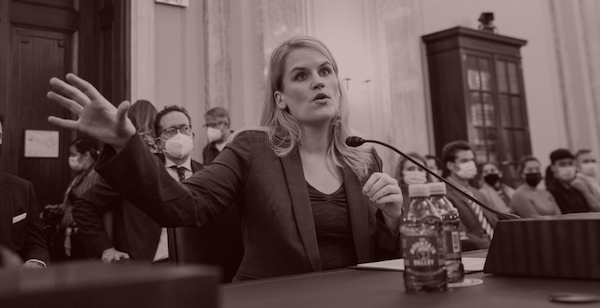
Despite coverage suggesting the contrary, Facebook is not facing an existential crisis, and Frances Haugen is far from Facebook's worst nightmare. In fact, she might even be the company’s ideal whistleblower. There are two ways of understanding Facebook’s most recent crisis, which stems from a series of damaging articles in The Wall Street Journal and a 60 Minutes interview with Frances Haugen, the whistleblower who leaked the internal research that led to those articles. The first, which has been nearly ubiquitous across digital media and cable news, is that Facebook is the rapacious, monstrous, Trump-buttressing, Myanmar-genocide-facilitating, teen-confidence-crippling brainchild of a boychik C.E.O. and his world-eating hot-or-not-derived website. And yes, this view has been popular. Vanity Fair noted that Facebook has entered “a new era of existential crisis.” CNN claims that Haugen is the company’s “worst nightmare.” USA Today reports that this may finally be Mark Zuckerberg‘s “moment of reckoning.” These views have been amplified across cable news with the shrill tones reminiscent of the Trump era.
But here is the second way to understand Facebook’s ordeal. It’s less popular, less hysterical, and much more accurate. Facebook is not facing an existential crisis, and Haugen is far from Facebook’s worst nightmare. In fact, she might even be Facebook’s near-ideal whistleblower. She does not want to break the company up (its actual worst nightmare), nor does she want to remove its Section 230 legal protections (she would like to tweak them). In fact, Haugen has been advocating for measures that Facebook, itself, has called for publicly, such as a new digital regulator to oversee social media firms in the same way that the F.C.C. oversees telecom and media. As any Facebook critic will tell you, such a move would likely solidify rather than diminish the tech giants’ power, since it would prevent future companies from reaching the clout that Facebook has already accumulated. On the policy front, it’s almost like she’s a plant.
Perhaps the most damaging blowback from this crisis has coalesced around a particular Journal piece headlined, Facebook Knows Instagram Is Toxic for Teen Girls, stemming from the research that Haugen funneled to the paper’s reporters. And yet this isn’t entirely true. The research itself actually showed that an overwhelming majority of teen girls reported that Instagram had no impact on their mental health or well-being issues, or made them feel better. For many, it was no different than flipping through Cosmo or watching Beverly Hills 90210 had been generations earlier, with the exception that Facebook was far more sophisticated than Hearst or Fox in getting you to stay engaged with the content. “Researchers have worked for decades to tease out the relationship between teen media use and mental health,” NPR noted this week. “Although there is debate, they tend to agree that the evidence we’ve seen so far is complex, contradictory and ultimately inconclusive. That is equally true of Facebook’s internal marketing data, leaked by Haugen, as it is of the validated studies on the topic.”
Zuckerberg and his deputies tried this week to offer a fuller picture of their internal data by making the research available and by pointing out that it was conducted for the very sake of improving people’s experiences on Facebook. “When it comes to young people’s health or well-being, every negative experience matters,” Zuckerberg wrote. “We have worked for years on industry-leading efforts to help people in these moments and I’m proud of the work we’ve done. We constantly use our research to improve this work further.”
Not surprisingly, Zuckerberg’s plea largely fell on deaf ears, a reality resulting from Facebook’s lack of credibility with the media...
FOUR STORIES WE'RE TALKING ABOUT 
Longtime “Hulugans,” as they call themselves, describe “total dysfunction” in the company culture since Disney’s takeover of Fox assets in 2019. MATTHEW BELLONI 
The greatest looming question in American politics is, alas, whether Trump will run for president again. And if he does, will his closest family members ride shotgun once again? TINA NGUYEN 
Could ‘No Time to Die’ actually turn a profit? Experts outline the brutal math required to take the Bond tentpole back into the black. MATT BELLONI 
Serious China watchers fear that businesses have underestimated the gravity of Xi’s “regulatory crackdown”—but privately worry that Washington isn’t responding with nearly enough nuance. WILLIAM D. COHAN 
You received this message because you signed up to receive emails from Puck.
Was this email forwarded to you?
Sent to {{customer.email}}
Puck is published by Heat Media LLC.
For support, just reply to this e-mail. For brand partnerships, email ads@puck.news |


SHARE