 |
|
Happy Monday, I’m Eriq Gardner.
|
|
Welcome back to The Rainmaker, a private email about money, power, fame, and the legal arena where they all collide.
Still getting this email forwarded from a colleague? We know who you are and will sue you into oblivion. Avoid a sternly worded cease-and-desist by subscribing here, or reach out to our email concierge Fritz@puck.news for information on corporate and group rates. We know your firm can afford it.
In today’s edition, a conversation with Ted Boutrous, the Gibson Dunn rainmaker and frequent Trump legal adversary, about the ex-president’s extraordinary financial judgments and his four upcoming trials. Could the Florida case go before a jury earlier than everyone expects? Will these trials be televised? Also, some details on former high-flying corporate raider Ron Perelman, who’s found himself in the middle of a bizarre $410 million art insurance case.
But first…
- Kimmel vs. Santos: Perhaps we shouldn’t laugh off the latest legal action brought by former congressman George Santos against Jimmy Kimmel and ABC. The complaint alleges that Kimmel created fake profiles on Cameo to induce Santos to record videos, which were subsequently aired on Kimmel’s late night show. Santos is claiming copyright infringement, fraud, and breach of contract. While a glance at Cameo’s terms of service suggests Kimmel may have overstepped (it probably depends how one interprets the user licensing provisions), First Amendment and fair use defenses are likely, and the contract claim might be more appropriate coming from Cameo directly. Naturally, Kimmel, a seasoned comedian accustomed to legal skirmishes dating back to his prank-call days, is no stranger to such challenges. Who could forget the time he faced litigation from a “rabbi” he humorously claimed had consulted LeBron James before “The Decision”?
|
| The $410 Million Perelman Showdown |
|
| From the ’80s to the aughts, Revlon boss Ronald Perelman fully embodied a Manhattan corporate raider lifestyle that almost seemed ripped from Tom Wolfe—you know, the extraordinary philanthropy, Upper East Side townhouses, Hamptons pile, yacht, jet, and Page Six divorces that Donald Trump merely aspired to. Now, of course, Perelman is seeking a “simpler life” as he told my Puck partner Bill Cohan a few years ago, selling off assets and unwinding various positions.
The truth, as he has acknowledged during depositions, is that the famed investor had massive bank debts. Thus, Perelman began liquidating much of his formidable art collection. Over a span of two years, he offloaded 71 pieces for nearly $1 billion, including transactions with hedge fund titan Ken Griffin. Despite the lucrative sales, not everything found a buyer. At the center of a legal showdown in New York, which is on the path toward a consequential summary judgment hearing next month, are five pieces that have had journeys as fascinating as Perelman’s recent vicissitudes.
Perelman may desire a simpler existence, but he hasn’t outrun his litigious reputation. At issue now is his $410 million insurance claim, made in 2020, that a fire at his East Hampton estate ravaged two Warhols (including an iconic Campbell’s Soup Can), two Ruschas, and a Twombly. At issue, however, is the fact that not only are the works still intact, they appear to be no worse for the wear. But months after rehanging the prized art, insurers write, Perelman had an epiphany that they had lost their “oomph”—his word—in the conflagration.
Court papers vividly recount the inferno, quoting firemen on the scene and stopping just short of likening the blaze to the Great Chicago Fire of 1871. Perelman’s legal team, composed of six lawyers at Covington & Burling and Williams & Connolly, staunchly maintain that the paintings indeed suffered damage in the fire. According to Perelman’s scientific expert, the excessive heat and humidity from the fire caused a chemical reaction, the effects of which may show up years or even decades from now. But at the moment, at least, the paintings look good enough to rehang—which Perelman did during a star-studded party he hosted in the summer of 2019, leading to the current uproarious and novel tussle over whether damage that’s not “visible” is grounds for denying coverage.
The insurers, represented by 11 lawyers at four firms including Steptoe, O’Melveny, and Quinn Emanuel, say these five paintings are really only worth $103 million, and that Perelman’s team of experts has been making too much of minor cracks and alleged chemical changes that have supposedly led to “accelerated aging.” The insurers tell the judge there’s ample evidence of bad faith on Perelman’s part, and that “Perelman’s greatly over-insured paintings, combined with margin calls on his debts, presented hundreds of millions of dollars of incentives for Perelman to suggest that his art was truly damaged and unsellable.”
The insurers also make a big argument pertaining to the 2019 party—guests included Pharrell, Tom Freston, and Andrew Garfield—during which the paintings were on prominent display. As the insurers put it, since Perelman used and enjoyed the artworks while secretly planning to make an insurance claim, he sacrificed his right under the policy to surrender them for $410 million. These artworks, the insurers argue, clearly weren’t worthless if Perelman was still showing them off to his famous friends.
The insurers not only discount Perelman’s view that “the colors no longer pop” on the paintings, they also allege that he concealed his efforts to sell the paintings with false testimony. (Perelman swore, for example, that the Twombly was “not offered for sale at any point in time,” despite the fact that art dealer Larry Gagosian and Griffin visited to potentially purchase that very painting, according to their depositions and contemporaneous emails.) The statements, they add, prevented a fair investigation and violated the “false swearing” provisions of the policy, voiding coverage altogether. Perelman’s legal team, of course, disputes there’s been any false testimony, noting that the 81-year-old was forgetful and that there were never any definitive terms contemplated for the Twombly.
As for the Perelman party pics popping up in a summary judgment motion, you can see two of them below. A hearing is scheduled for March 25. In the meantime, a side battle has broken out regarding whether to seal much of the juiciest information. |
|
|
| And now, from one New York billionaire saga to another… |
|
|
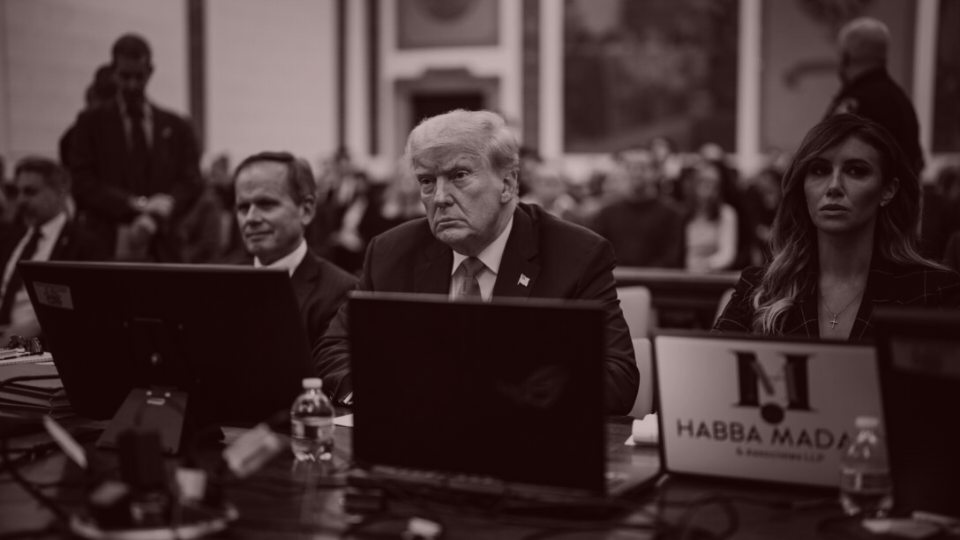
| We’ve stumbled into a genuinely unprecedented chapter in our nation’s history, as a former president grapples with an array of legal entanglements while endeavoring to reclaim the presidency. Consider the events of the last week: One of the four criminal cases against Donald Trump surged forward, flying past dismissal motions and forcing his lawyers to confront the looming reality of an impending trial next month in New York. Simultaneously, the Supreme Court found itself considering whether to pause yet another imminent trial. Meanwhile, a riveting hearing unfolded in Georgia, in which the local D.A. was forced to take the witness stand to explain a potentially problematic romantic relationship that could disqualify her from prosecuting the case. And then, on Friday, a judge delivered a staggering blow to Trump’s financial empire: a $354 million (plus interest!) civil fraud verdict.
In light of all this activity, I connected with Ted Boutrous, a legal luminary renowned for his breadth of expertise. A partner at Gibson Dunn and based in Los Angeles, Boutrous boasts a formidable appellate track record, having represented corporate titans like Walmart and Ford Motor Co., while also prevailing in landmark cases concerning gay marriage. Boutrous is also a stalwart advocate for First Amendment rights, having championed media access in myriad legal battles. It should come as no surprise, given his stature, that he’s been involved in two of the four criminal cases against Trump—representing Manhattan D.A. Alvin Bragg in a skirmish with House Republicans, and also representing leading news organizations pining for video access to the upcoming D.C. election subversion trial.
Our conversation, which has been lightly edited, ranged from whether the Trump trials will be televised, to what to expect from the Supreme Court and the potential curveballs that special counsel Jack Smith might throw, to the gargantuan implications of that monumental civil judgment—including a nightmare scenario that few people are discussing. |
|
|
| Eriq Gardner: If I’m a Vegas oddsmaker setting the over/under on the number of Donald Trump criminal trials we’re going to see before the election, I’d set it at 1.5, mostly because of the uncertainty about the Supreme Court. Are you taking the over or under?
Ted Boutrous: I’m going over. There will be multiple criminal trials and convictions. I have a lot of faith in the judicial system. It doesn’t always function perfectly, but I think that the courts, as they did in the 2020 election, will perform well, and the rule of law will prevail.
Obviously, the trial in New York—the one over whether Trump committed a felony by falsifying business records to cover up a pre-election payment to porn actress Stormy Daniels—is scheduled for next month. Then again, I keep thinking about the state’s very generous system of allowing pretrial appeals, and I wonder if there will be any last-minute efforts to halt it. You see any room for that?
Well, I wouldn’t ever assume that Mr. Trump’s legal team wouldn’t try anything possible. But I think it’s far too late for any sort of last-minute emergencies in these pending cases. They’ve got their application in the Supreme Court [in the D.C. election subversion case]. But in the other ones, it’s far too late to do anything other than go to trial.
Even the Florida case? Most people assume that one’s not going to make it to a jury because Judge Cannon will allow Trump to slow-walk it.
If you go back and look at the indictment and read about Trump’s handling of the classified documents, that’s such a killer case. And those are important issues that go to the essence of the presidency. It remains to be seen, but at some point, the special counsel may go to the 11th Circuit and say, “There’s no reason we’re not going to trial.” So I think that’s a possibility. I think they were flirting with doing that over this recent tussle about disclosing [confidential] information to the Trump team.
Wait a second. I know about the possibility of trying to get the judge booted, but are you saying that if Judge Cannon sets the trial date far into the future, or gives Trump, say, nine more months of discovery, prosecutors can have the appeals court basically order a trial sooner?
Exactly that, at some point. If there’s no reasonable basis for delay and there’s a need to protect the jurisdiction of the court—particularly given how if Mr. Trump were to prevail as an elected president, he could wipe the proceedings off the map—you could file a mandamus petition at the 11th Circuit and ask for an order mandating that the proceedings happen properly. We could see some version of that.
That’s interesting. I hadn’t considered that. And how about the D.C. case—the one over Trump’s efforts to subvert the results of the 2020 election? What do you think the Supreme Court will do?
I’m betting on the special counsel. I think the justices could always review the immunity issue after the conviction if they wanted. I think they probably talked about this case and the Colorado case concerning ballot access as a bit of a package. They knew this immunity issue was coming. They wanted the D.C. Circuit to rule first. They wanted to take a quick review of the Colorado case—they sort of needed to—and it looks like they’ll reverse and then stay out of this whole world. I feel they won’t want to cut off the judicial process, but I’d love to hear your opinion.
I find it hard to predict what the justices will do. I read Trump’s reply brief where his legal team made a big deal about how special counsel Jack Smith couldn’t just come out and identify why speed was such a need. Obviously, the answer is the election, and while I’m not at all convinced by Trump’s argument that this amounts to election interference, I do wonder if the justices will say, “What’s the big rush here?”
It’s a very difficult situation for the courts because it’s so extraordinary. But I mean, there’s nothing extraordinary about having these cases go to trial before an election. It’d be extraordinary to delay them because of the election. I think the judges are doing their best to be accommodating and have respect for the office of the president. And on the flip-side, Mr. Trump has been demeaning, attacking the courts and the rule of law, saying outrageous things that are false about the judges, which really undermines our democracy in a whole other way. And so when the criminal defendant is behaving in that manner, the idea of delaying the trials so he could possibly become elected president again is just unfathomable to me. |
|
|
| Watching these trials, what will you be focusing on in particular?
You know, I’ve had cases with some sort of political element to them. And it’s very interesting once we get into that court, because people make all kinds of claims in and outside the courtroom, and on TV and in political campaigns. But when you get into court, and the prosecutors have to prove their case, and Donald Trump has to put on a defense using evidence and cross-examination; it’s just a whole different construct that is really interesting to watch unfold, even when you think you know a lot of the facts coming in.
Unfortunately, there are no cameras in New York courtrooms. Are you disappointed in that?
I am. The courts have a lot of leeway in protecting everyone’s due process rights. Letting the public see what’s happening in the courtroom as opposed to reading or hearing reports, I think that’s very important.
In D.C., you have a petition for video coverage. I agree it should be televised, although I’ve become less optimistic about your odds of success. Do you still have big hopes, or would you acknowledge this seems like a long shot?
I still have very, very strong hopes that the District Court or the D.C. Circuit will agree with us that while the federal rules impose some limits that many have assumed add up to a blanket prohibition, there’s room in the way the rule is worded with technological capabilities that can be applied to allow video and/or audio. We just had a D.C. Circuit argument we could listen to live and it was a criminal case. And so I’m very hopeful on the pending petition, but we figure the district court will want to get all the other things ironed out before focusing on this.
I thought about it the other way. Judge Tanya Chutkan now has all this free time with the election subversion case on pause—she should deal with this one issue that doesn’t need to wait for the Supreme Court.
I hadn’t thought of it that way. Let’s have our hearing. Exactly.
If the judge rejects you, would you appeal?
You could. These sort of access orders are appealable. I’ve had other cases on behalf of news organizations back to independent counsel Ken Starr’s investigation that lost before the chief judge, and we appealed and were able to persuade the D.C. Circuit. So we think we have history on our side. We have technology on our side, we have the First Amendment on our side, public access principles on our side, and we think that the rules, correctly interpreted, support our position. |
|
|
| The $354 million judgment against the Trump Organization is something I could actually see being vulnerable on appeal. But then again, Trump will probably have to put up a lot of collateral to even get that far. That’s not an aspect of the appellate process that people usually focus on, but that’s a lot of money. I imagine banks won’t be too eager to bond Trump, and I bet the judges aren’t going to go out of their way for him either.
I think it’s a very difficult situation for Mr. Trump for exactly those reasons. There’s a prejudgment interest amount that’s incorporated into the judgment, too. It’s like getting a loan. And you need to show that you’d be able to pay back whoever posted the bond for you—so it is a very complicated, very difficult situation. And it has significant ramifications for Mr. Trump and his family and his company, even if they think they have good arguments on appeal. These consumer statutes give the Attorney General this sort of enforcement authority, and with these factual findings, I think it’s going to be very difficult to appeal. But as you’re pointing out, just to get to the point of being able to appeal without having to forfeit assets, sell assets, I think it’s going to be a tough road.
My guess is that the first step by Trump’s team will be to stay enforcement of judgment pending an appeal, so the A.G. isn’t putting liens on his assets. And that’s when the bond question will come up—with Trump looking to move forward without collateral, and the judge analyzing issues like whether Trump has the ability to pay the judgment, and the potential complexity of the collection process. The judge has a lot of discretion here, and maybe there will be an appeal over just this.
I think that’s exactly right. Normally, you’d have a bunch of post-trial motions that clearly ask for a stay. There are circumstances you can appeal without a bond, or if certain conditions come, for example, freezing assets. There are different creative things judges can do. You have to ask the judge first, and if the judge denies, you can go to the Court of Appeals and ask for a stay under different conditions. So there’s probably going to be a lot of collateral litigation going on, plus there’s the E. Jean Carroll case where the clock is ticking on the automatic stay.
Absolutely. Actually, I think this collection issue might be the single most underrated aspect of Trump’s various legal headaches. The nightmare scenario might not be Trump becoming president and then pardoning himself. It might be Trump becoming president, and then New York looking to foreclose on Trump Tower. Damn, what would happen next? That’s what keeps me up at night.
I was thinking about that exact thing, and how it plays out. And you know, the other thing is they could seek to enforce judgment by attaching property in other jurisdictions. So Mar-a-Lago would be fair game. And as we know by Clinton v. Jones, that sort of civil litigation in the personal realm can continue whether the individual involved is president of the United States. So, you know, there are just a whole nother wild set of scenarios that could ensue.
I mean, there’s a decent chance that, a few months from now, Trump will be a convicted felon who owes more than a billion dollars. That ups the stakes of the election.
That’s true. It’s a very good point. I keep using the word “wild” because it really is a combination of circumstances for somebody who may still be running for president with those convictions and a massive judgment against him. |
|
|
| That’s it for today. Reply with any comments. I always love hearing them. Even the negative ones, although I appreciate the kind notes greatly! |
|
|
|
| FOUR STORIES WE’RE TALKING ABOUT |
 |
|
 |
| Buffett’s Shari Short |
| You don’t get as rich as Buffett without knowing when to cut and run. |
| WILLIAM D. COHAN |
|
 |
|
 |
| Catch-81 |
| The Cafe Milano crowd on the political topic du jour. |
| TARA PALMERI |
|
|
|
|
|
 |
|
|
|
Need help? Review our FAQs
page or contact
us for assistance. For brand partnerships, email ads@puck.news.
|
|
You received this email because you signed up to receive emails from Puck, or as part of your Puck account associated with . To stop receiving this newsletter and/or manage all your email preferences, click here.
|
|
Puck is published by Heat Media LLC. 227 W 17th St New York, NY 10011.
|
|
|
|