 |
 |
|
Welcome back to The Varsity, my twice-weekly private email on the heroes and villains of the sports media business. Happy Day 1 of the U.S. Open to all who celebrate.
It’s been a busy week in the industry: Paramount Global’s deal with David Ellison and Gerry Cardinale collapsed. The NBA is in the final stages of negotiating $75 billion worth of media rights deals. But the one story that dominated my social feeds on Wednesday pertained to competitive eating. Hours after Major League Eating banned Joey Chestnut from Nathan’s Famous Hot Dog Eating Contest on July 4, of course, Netflix announced that the hot-dog-eating champ would face off against his arch rival, Takeru Kobayashi, during a Labor Day competition—proving once and for all that the streaming giant is deadly serious about sports!
On that note, if I catch you forwarding these private emails to colleagues who can clearly afford them, I will make you watch Marchand’s competitive eating tryout for the July 4 Coney Island event! Not pretty!
Let’s get to it…
|
Player of the Week:
Mike Whan |
|
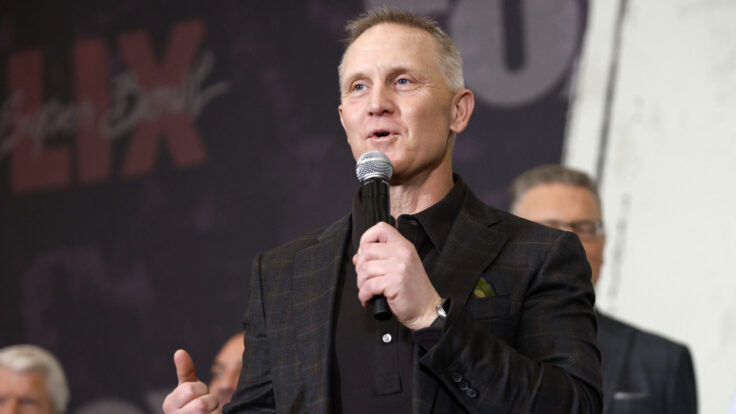
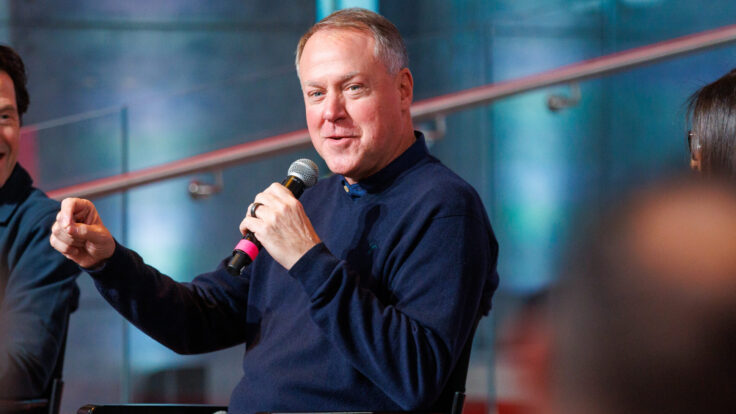
| As the U.S. Open teed off from Pinehurst this morning, it was hard not to juxtapose the angst-ridden PGA Tour with the ascending USGA, the sport’s governing body in the U.S. Since USGA C.E.O. Mike Whan took over three years ago, he has made the staid USGA look far more dynamic. Whan’s insistence on promoting anchor sites, such as Pinehurst and Pebble Beach, and increasing the tournament’s purse to a record level, has deservedly been in the spotlight this week. He should be praised for bringing some much-needed stability to the sport. |
Down to the J.V.:
Roger Goodell |
|
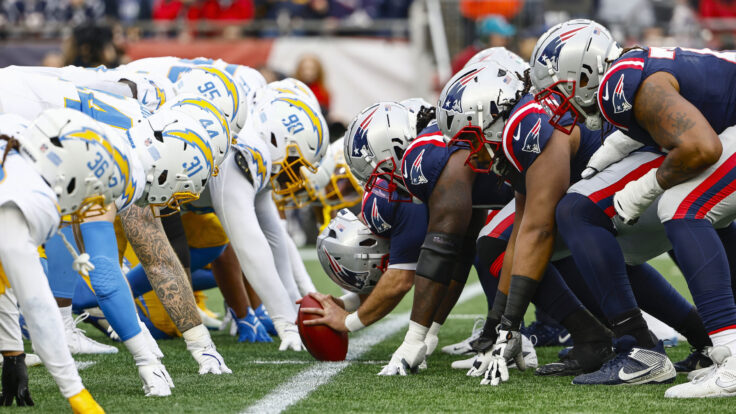
| One of the many (many, many) ancillary victims of Shari Redstone’s Paramount mess is Goodell and his NFL. CBS pays the league more than $2 billion per year for broadcast rights. Now that the Skydance bid has been rejected, the NFL must depend on a highly leveraged company to continue making those payments. More on this below… |
|
A MESSAGE FROM OUR SPONSOR
|
 |
| New AI-tailored content experiences
Sports media rights holders face new challenges as the way fans consume content continues to change. There is an increase in focus on short-form content, multiple viewing platforms, and various viewing formats.
WSC Sports, a trusted partner to the NBA, LaLiga, Big Ten Network, Bleacher Report and 460+ other sports organizations, recently announced the release of three new products that empower sports organizations in meeting the changes desired by fans:
- AI-powered content management and creation with expanded support of all types of content including both in and around the game content (press conferences, interviews, fan reactions, arrivals, etc.).
- Vertical content experience in the right holders’ O&O app including stories, vertical swipeable video feeds, polls, and quizzes.
- Expansion of media rights owners’ reach delivered through fully controlled access to pre-agreed, third-party sports properties generating new traffic, exposure, and revenue streams.
|
|
|
| The Starting Five: Shari Edition |
|
- The NFL’s Shari problem: If you want to find out how and why Shari Redstone killed the Skydance/RedBird acquisition in the thirteenth hour, I highly encourage you to read the excellent work of my partners Bill Cohan and Matt Belloni, the latter of whom will have much more in his newsletter tonight, if you’re not already signed up. Meanwhile, I’m told that the move has caused some angst at 345 Park Ave., where NFL executives are gaming out their options in the highly unlikely (but not impossible) scenario that its highly leveraged broadcast partner is unable to make its $2 billion-plus annual rights fee payments.
There certainly is more angst inside the league offices this week than last, now that Redstone appears willing to go it alone, at least for the moment. Paramount Global, of course, is being operated by a troika of interim C.E.O.s known derisively on Wall Street as the “Pep Boys.” On the positive side, those NFL deals, signed a couple of years ago, look like bargain-basement prices compared to the NBA packages that are on the table. “Would you rather have NBC’s $2.1 billion Sunday Night Football package, or NBC’s $2.5 billion NBA package?,” one plugged-in source asked me, rhetorically, before stating the obvious. “It’s not even close. You’d take that NFL deal.”
- The CBS Sports scenario: Paramount’s decision to kill the Ellison bid shouldn’t have any immediate effect on CBS Sports, which has a bunch of long-term rights deals with its biggest properties. The NFL deal runs through 2033 (although the league likely will use its out in 2029), and its Big Ten, PGA Tour, and UEFA deals run until 2030. Its March Madness deals end a couple of years later. Under David Berson, the CBS Sports leadership has a steady hand and a ton of experience.
That said, virtually all the major broadcasters are currently investing heavily in sports in pursuit of reach and live advertising. Brian Roberts and Comcast have been gunning for the NBA; Bob Iger and Jimmy Pitaro have worked out deals with the CFP and NCAA, and will soon renew Disney’s own NBA deal. Fox has essentially turned most of its primetime hours over to live sports. So while Paramount is surely happy that CBS has several big-time sports deals locked in for the next decade, it remains an open question whether it can bid on additional rights given its current predicament.
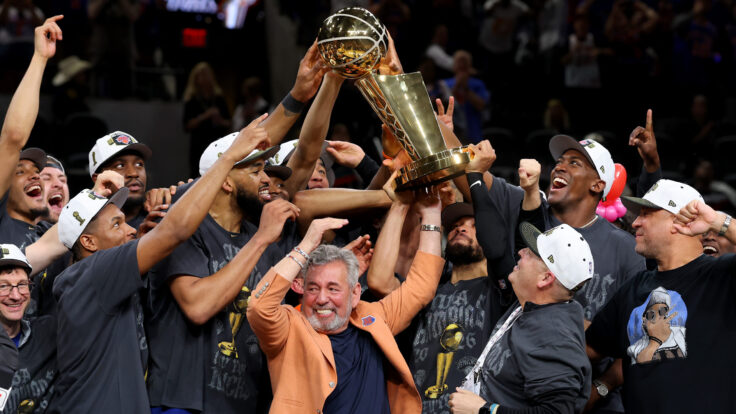
- NBA update: I’m hearing that NBA media rights will stay on the back burner until the Celtics win the title, which is almost certain to happen either tomorrow night or Sunday. (Did I jinx it last week?) The delay is related less to a reluctance to steal the show from its players than the fact that its lawyers are still poring over pending deals with ESPN, NBCU, and Amazon to make sure the contract language can withstand potential legal scrutiny. Warner Bros. Discovery has not been given a timetable for when it can decide to exercise its matching rights. Its executives also haven’t heard whether the NBA will create a smaller fourth package that most likely would come from teams’ local rights—although I’m still told that this is a very unlikely outcome.
The vibe among TNT staffers in Atlanta is, understandably, depressing. However, WBD’s moves to pick up rights to other sports (notably the French Open and CFP) should cushion some of the blow. But the real angst, sources told me, is coming from the 50 or so NBA TV staffers, who work out of WBD’s Atlanta studios and face a decidedly uncertain future. The channel operates as a joint venture between the NBA and WBD. But given NBA TV’s shrinking distribution, the league could unwind that relationship and allow one of its other new partners to operate the channel instead, which would certainly necessitate a move away from Atlanta.
- Private equity comes sniffing around the NCAA: For the past year, I have listened to people like Gerry Cardinale and Casey Wasserman talk about the investment opportunity in college sports. Their contention, broadly speaking, is that professionalizing the college landscape would not only be better for the schools, it would also lead to significantly higher revenue. So I wasn’t overly surprised by Dennis Dodd’s blockbuster report today that the Big 12 is considering selling a 15-20 percent stake in its conference to private equity firm CVC Capital Partners for between $800 million and $1 billion.
The key part of Dodd’s story came from his interview with Florida State A.D. Mike Alford: “The future is—we’re looking at it—private equity. I think it will start at the conference level first if it doesn’t start with us first.” And if the Big 12 is worth $5 billion, one can only imagine the sort of valuations that the SEC and Big Ten might pursue…
- R.I.P. Jerry West: When I saw the news that the Logo died yesterday, my first phone call was to legendary front office executive Rod Thorn. Thorn had known West since he was a teenager. They both attended West Virginia and competed against each other as players and general managers in the NBA. “Everything Jerry did, he did at an extremely high level,” Thorn told me, recalling West as both a player and a G.M. “He was a very, very talented person, who just happened to be one of the best basketball players to ever play the game.”
West was a senior at West Virginia when Thorn was a freshman. At the time, freshmen weren’t allowed to play on the varsity team, but the two practiced against each other. Thorn recalled one practice when West walked into the gym wearing a stylish outfit. “I said to him, Boy, what a great-looking shirt. The next thing I know, he takes the shirt off and just gives it to me,” Thorn said. “He was a very, very generous person. If Jerry liked you, he’d do anything for you. He was a very loyal person.”
|
 |
| Malone’s New F1 Fantasy |
| The ageless mogul’s decision to take a controlling position in Formula E suggests that he’s looking to re-create the magic he found in its sister racing sport. |
|
|
|
| Earlier this morning, John Malone’s Liberty Global announced that it was buying Warner Bros. Discovery’s 25 percent stake in Formula E, the F1 spinoff for electric cars, giving the entity a controlling 65 percent position. On a practical level, the deal made plenty of sense. Malone, who sits on the WBD board, knows that his protégé David Zaslav must sell off non-core assets to service their company’s nearly $40 billion in debt. As part of a much smaller deal, for instance, WBD recently sold the Global Cycling Network back to its original owners.
But Malone, restless as ever at 83, has also been looking to re-create the magic he discovered when Liberty Media—Liberty Global’s separate sister company—bought the commercial rights to Formula One in 2017. Malone is currently on the lookout for mismanaged and underperforming global sports businesses that he can turn around quickly—a strategy he employed earlier this year when Liberty bought the motorcycle racing series Moto GP. (That deal is still awaiting regulatory approval in Europe.) Formula E, which has had a difficult time keeping top sponsors engaged, fits this deal thesis neatly.
The other benefit, meanwhile, is vertical integration. Media companies don’t merely want to rent their programming. They want to own it. That’s why Fox Sports and Disney are part owners of the spring United Football League. It’s why ESPN launched the X Games in the mid-1990s. Malone also has some air cover as his team of operators dig into the business. As Sportico recently reported, Formula E’s former part-owner, WBD, signed a 10-year deal to broadcast the races just a few months ago. |
|
|
|
|
| Malone is hardly the only investor nosing around for underperforming assets in the space that appear ready to be whipped into shape. Another deal, also announced today, further ratifies his strategy—especially the desire to go niche. MSP Capital announced that it was backing a couple of former ESPN executives who are transitioning X Games into a team sports model. MSP, which owns the McLaren F1 team, saw an opportunity to deploy that playbook on the O.G. extreme sports league. “They really started to think about X Games as inspired by F1, if you will, a global calendar that's connected with high stakes and points and pricing,” said Scott Guglielmino, president and C.O.O. of X Games.
X Games’ problems, in a way, came down to ESPN, which still holds a minority stake in the company. The network launched the action sports series in 1995 to provide live programming for its growing list of TV channels. And that, for better or worse, was purely how they evaluated it. “We were a TV company, and this was live television. That’s what we did,” Guglielmino recalled, before noting that the entity will now put more emphasis on marketing, commercialization, and event revenue. “MSP’s thesis is to really stand it up and operate it as a business. It's inspired by Formula One, from a focus on the athletes to its global calendar.”
That global calendar is crucial, not just to X Games, but also to Formula E and Moto GP. That’s because the audiences and the participants are global. “Each Formula One race has become an event unto itself,” Guglielmino said. “It's aspirational. I mean, our north star is to really: Create a global, thriving, durable business around the athletes. This is a way to organize the calendar and to make it year-round, both from a summer and a winter perspective.” |
|
|
| “WNBA commissioner Cathy Engelbert is obviously a very smart person, but I disagree that you can manufacture a rivalry with marketing. How do you do that exactly? Traditionally, rivalries come with the players, obviously (she’s right about that). But it’s the players that start the rivalries based on their dislike of each other and the intensity of the games.” —A Varsity subscriber
“I wonder if PIF will take on Tennis Channel and use it as a distribution arm for the WTA/ATP tours, and inject some investment into its streaming product and app. On top of the rights that Tennis Channel has lost, their distribution via linear and app/streaming is abysmal and doesn't help things.” —A self-described “layperson.”
“Question: If ESPN told Stephen A. to go seek his fortune elsewhere and centered First Take around newly signed Shannon Sharpe, do ratings decline that much?” —A sports business veteran |
|
|
Have a great weekend,
John |
|
|
|
| FOUR STORIES WE’RE TALKING ABOUT |
 |
|
 |
| Sharinobyl |
| Detailing how the Skydance-Paramount deal fell apart. |
| WILLIAM D. COHAN |
|
 |
| Time Will Tell |
| Chronicling Will Lewis’s WaPo redemption rodeo. |
| DYLAN BYERS |
|
 |
|
|
|

|
 |
|
|
|
Need help? Review our FAQs
page or contact
us for assistance. For brand partnerships, email ads@puck.news.
|
|
You received this email because you signed up to receive emails from Puck, or as part of your Puck account associated with . To stop receiving this newsletter and/or manage all your email preferences, click here.
|
|
Puck is published by Heat Media LLC. 227 W 17th St New York, NY 10011.
|
|
|
|