Hello and welcome back to The Best & The Brightest. I’m Leigh Ann Caldwell, on an
extremely busy Monday.
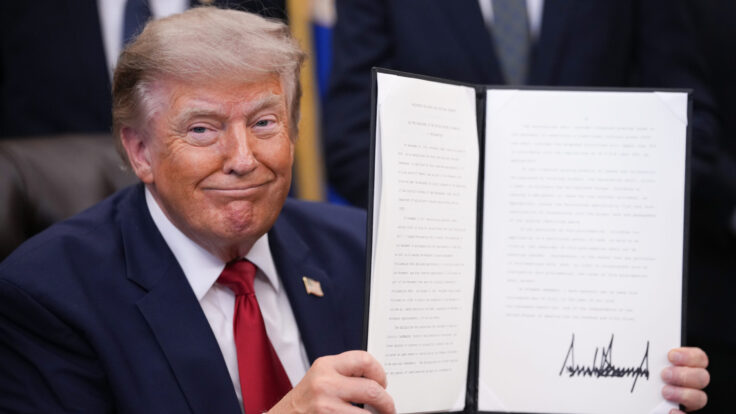
President Trump announced a new trade agreement with the European Union today, which ostensibly includes the E.U. committing to $600 billion in new investments in the U.S., and the purchase of $750 billion of U.S. energy. Democrats and economists, however, are already throwing cold water on the deal, suggesting that the promised investment amounts to smoke and mirrors with no enforcement mechanism. If the deal moves forward, products from
the E.U. will face a 15 percent tariff—much lower than the 30 percent that Trump was previously threatening, but much higher than the tariff of less than 2 percent that the E.U. faced last year.
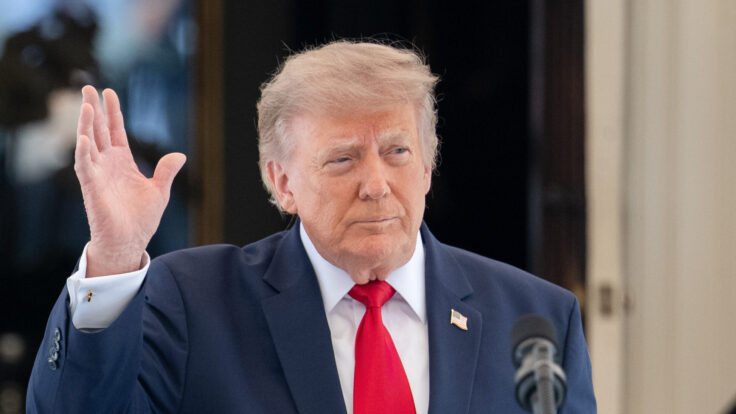
Of course, that wasn’t the only news the president made overseas. During a meeting with U.K. Prime Minister Keir Starmer, Trump said he would move up the deadline for Russia to agree to a ceasefire with Ukraine, or else face sanctions, from September to
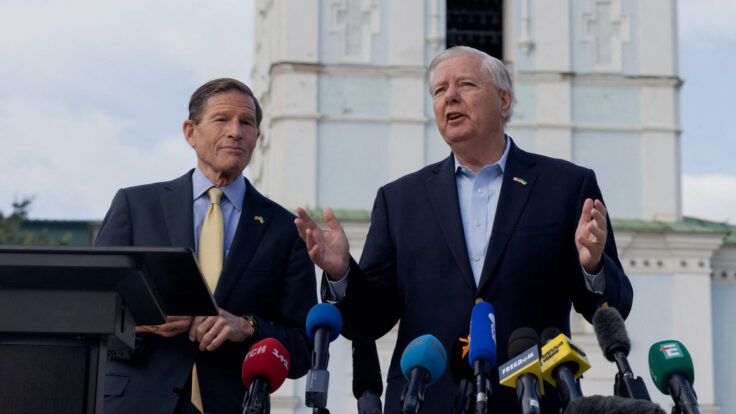
early August. Trump is increasingly frustrated with Russian President Vladimir Putin’s ongoing barrage against Ukraine, but the Senate is unlikely to move on its more aggressive sanctions bill anytime soon—at least, unless the president specifically asks them to do so. And he hasn’t.
Below, my colleague Abby Livingston digs into the fundraising numbers for the first half of the year—which, while heavily favoring Republicans, don’t have
Democrats panicking… yet. |
|
|
A MESSAGE FROM OUR SPONSOR |
Imagine if health care was simple, coordinated, and designed to put your health first. At UnitedHealth Group, we’re focused on comprehensive, proactive care that keeps people healthy over a lifetime. More time with your doctor. Less time worrying. Explore how UnitedHealth Group is streamlining care. |
|
|
But first, a few thoughts about the Senate… |
- Thune’s
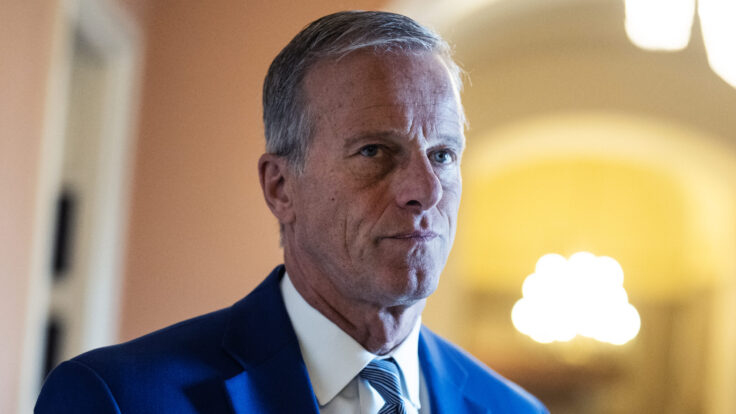
floor fight: This was supposed to be the Senate’s last week in session before members head home until after Labor Day. But Senate Majority Leader John Thune is threatening to spoil the long summer break by keeping them in town beyond Thursday to confirm more of Trump’s nominees. The Senate, as Mitch McConnell used to say, is in the personnel business, given its advice-and-consent role staffing the administration. But senators really
dislike staying in Washington when they’re supposed to be home.
Alas, they may have to delay their holiday plans due to what Thune has called a “historic level of obstruction” by Democrats, who have slowed down the confirmation process by requiring time-consuming votes on all non-military nominees. Thune has noted that Democrats have not allowed any nominee, even those with bipartisan support, to move by voice vote, clogging up the Senate floor. But while he (and Trump) have complained
about the slow pace of confirmations, the majority leader has also boasted that the Senate has already confirmed 107 non-military nominees thus far—more than any recent administration.
While this might not be the kind of pushback against Trump that the Democratic base is agitating for, it’s serving to frustrate a president who wants his administration staffed as quickly as possible. Senate leaders have often negotiated nomination packages across party lines just before the Senate
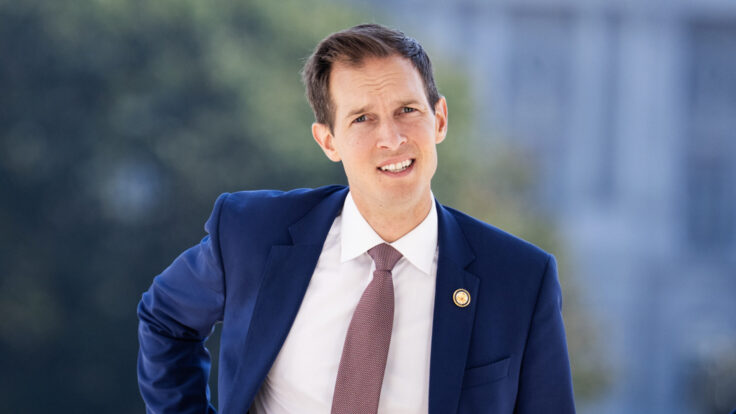
goes on break. But so far, there’s no indication that Minority Leader Chuck Schumer will partake in this ritual. - Money for all: Republican Senator Josh Hawley has introduced legislation to send “rebate checks” to “working” Americans, funded by revenue raised by Trump’s tariffs. The idea originated with the president, and Hawley, brandishing his populist bona fides, quickly put the notion before Congress. The plan would
send checks of at least $600 per adult and dependent child (e.g., $2,400 for a family of four), with the amount reduced for joint filers with an adjusted gross income of more than $150,000.
The legislation could be divisive among Republicans, particularly fiscal hawks, who want any new revenue to go toward paying down the debt—even though Trump has also suggested that tariffs could help pay for the $3.4 trillion tax cut and immigration spending bill. It could also presumably be
somewhat inflationary, injecting debt-fueled stimulus into an economy that’s still running hot. Too bad the president and Jay Powell aren’t exactly on good terms.
|
|
|
Democrats have had a sluggish start to fundraising for the midterms amid the party’s
lingering post-election identity crisis. And yet, there are emerging signs that angry donors who swore off giving are slowly overcoming their trust issues and returning to the fold. |
|
|
Nearly nine months after the party’s Trump-induced identity crisis began, Democrats are
still struggling to channel their political trauma into something more productive: raising money. Indeed, according to the latest fundraising numbers, Republicans have dominated almost everywhere, with all three of the party’s big campaign committees—the R.N.C., the N.R.S.C., and the N.R.C.C.—outraising their Democratic counterparts. In this past quarter, 10 House Republican incumbents in competitive districts raised more than $1 million, compared to one
House Democrat.
Ever since the Biden-Harris switcheroo last summer, and especially since their defeat in November, Democrats have worried about the effect of losing the trust of major donors. And indeed, the mid-July fundraising data would seem to confirm that the post-2024 hangover is real. But oddly, Democratic members and operatives I’ve spoken to over the past few weeks have mostly shrugged off the news. Of course, fundraising matters, but this is
just the way things are now, many argued: Republicans have mastered off-year fundraising, and Democrats will catch up in 2026. |
|
|
A MESSAGE FROM OUR SPONSOR |
Imagine if health care was simple, coordinated, and designed to put your health first. At UnitedHealth Group, we’re focused on comprehensive, proactive care that keeps people healthy over a lifetime. More time with your doctor. Less time worrying. Explore how UnitedHealth Group is streamlining care. |
|
|
We’ll see. Certainly Democrats recognize they have a lot of work to do to repair relationships with
donors, who are still furious that they spent more than $6 billion in 2024 only to lose the White House and every other lever of power throughout the federal government. “For the party type of giving, it’s going to be a longer process to get that money
in the door,” a Midwestern Democratic donor and fundraiser told me. “The different groups are going to have to prove what the money is for and what the political R.O.I. is for this cycle.”
It’s also possible, as Democrats hope, that Republicans won’t sustain their current fundraising clip. The operatives I spoke to argue that the G.O.P. campaign committees have gotten an early boost by gathering low-hanging financial fruit in the wake of Trump’s inauguration, and that they’ll find it more
difficult to raise money once early donors are tapped out. These Democrats say that a Republican fundraising bonanza is expected amid the Big Beautiful Bill tax cut push, and predict their enthusiasm will wane as congressional activity cools now that Trump’s one major legislative priority has passed. |
Cash Rules
Everything Around Me
|
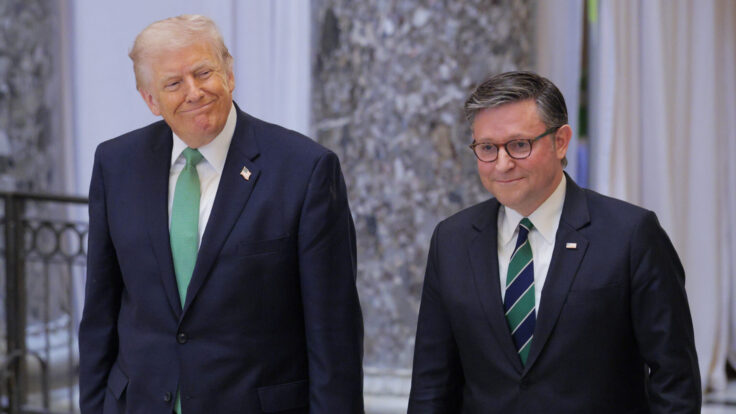
Whatever the case, Speaker Mike Johnson and his leadership team, namely Steve
Scalise and Tom Emmer, have blown the doors off with their 2025 fundraising so far—especially for their vulnerable incumbents. Republicans fundraise differently than Democrats: G.O.P. leaders widely deploy a legal apparatus known as a joint fundraising committee to directly raise money for their incumbents and challengers, generating precious so-called hard dollars that can be used to secure cheaper TV rates next fall. Democratic donors, for their part, usually
concentrate their firepower through the D.C.C.C., where Hakeem Jeffries raises most of his money. But the traditional Democratic money surge doesn’t usually arrive until closer to the election, via fundraising groups like ActBlue, when voter excitement peaks.
Some Democrats argue that they should be taking better advantage of Republican-style joint fundraising committees, themselves, rather than centralizing their efforts. But others have told me that their donors aren’t
as keen on the practice as Republican contributors. If Democrats do manage to shift momentum—and there is a bounce in their step of late, between Trump’s mismanagement of the Epstein drama and the backlash to Texas redistricting—that might go a long way toward allowing them to build up their cash position.
Alas, the D.N.C. lags the R.N.C. on that metric, too. As of mid-July, the R.N.C. posted a whopping $80.7 million in cash on hand, compared to $15.2 million at the
D.N.C. Those committees are the ones most associated with presidential politics, so having Trump in office surely juices the Republican numbers. The D.N.C., meanwhile, lost a month of fundraising in January because members didn’t elect their new chair, Ken Martin, until February. And his honeymoon was extremely brief, given the fury he inherited as the leader of the committee most closely associated with the Biden campaign. The David Hogg controversy
that quickly followed Martin’s election wasn’t exactly helpful, either. |
|
|
Still, when it comes to campaign committees for Senate and House races, Democrats have the upper hand. The
D.S.C.C. is sitting on $13.5 million in cash on hand, with $5.3 million in debt, versus the N.R.S.C’s $7.8 million in cash on hand with $2 million in debt. The D.C.C.C. also came out narrowly ahead with $39.7 million in cash on hand, versus the $37.5 million on the balance sheet of their Republican counterparts at the N.R.C.C. |
Amid all the soul-searching, there is some evidence that angry and disillusioned Democratic donors are
beginning to return to the fold. But the dynamics of both small- and large-dollar fundraising has changed since the 2024 fiasco. Whereas many donors were previously content to write checks to faceless party organs, hoping their money would be put to good use, now they’re preferring to direct money toward individual candidates whom they personally know and trust. “I’m giving to my favorite people,” the Midwestern donor told me, echoing several conversations I’ve had, even though this
particular donor swore off giving altogether as recently as March.
Some of the Democratic members and operatives I spoke to were optimistic that even lesser-known incumbents and candidates may act as gateway emissaries to lure back their donor base. It’s easier, after all, to slip back into the habit of giving via smaller, four-figure donations, rather than cutting abstract six-figure checks to “the party” for an election more than a year away. And there are also several higher-profile
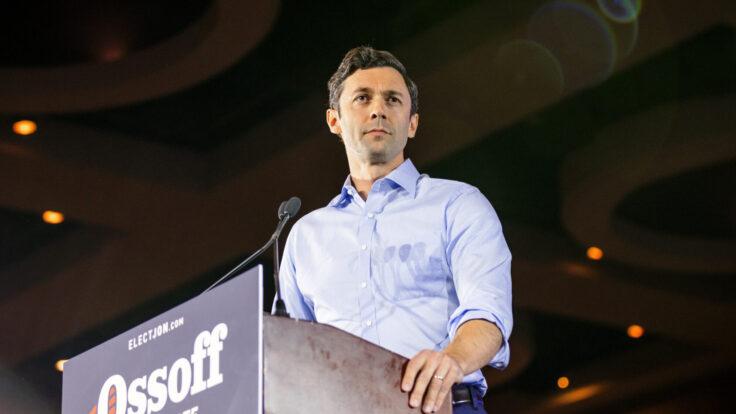
gateway candidates, particularly on the Senate side, who are doing quite well. Freshman Georgia Sen. Jon Ossoff just wrapped up his second eight-figure quarter. Insiders are also predicting that an avalanche of money will pour into next year’s open Senate race in North Carolina, where former Democratic Governor Roy Cooper announced his campaign today—perhaps the party’s best offensive opportunity on an otherwise challenging map.
As has often been
the case over the past decade, it may primarily be Trump himself sending Democratic donors reaching for their checkbooks. This is a shift from as recently as early spring, according to a Democrat who met with donors in March. “I walked away feeling those donors were frustrated and lost,” this person recalled. But now, the Dem told me, “attention has shifted, because a lot of our donors are feeling like they’re under direct threat” as a result of the president’s attacks on law firms,
corporations, and universities where the donor class sits on boards. “As a professional fundraiser,” this person said, “you don’t want people to stick their heads in the sand. They have to be in the fight.” |
|
|
Join Emmy Award-winning journalist Peter Hamby, along with the team of expert journalists at Puck, as they let you in on the
conversations insiders are having across the four corners of power in America: Wall Street, Washington, Silicon Valley, and Hollywood. Presented in partnership with Audacy, new episodes publish daily, Monday through Friday. |
|
|
Unique and privileged insight into the private conversations taking place inside boardrooms and corner offices up and down Wall
Street, relayed by best-selling author, journalist, and former M&A senior banker William D. Cohan. |
|
|
Need help? Review our FAQ page or contact us for assistance. For brand partnerships, email ads@puck.news. You received this email because you signed up to receive emails from Puck, or as part of your Puck account associated with {{customer.email}}. To stop receiving this newsletter and/or manage all your email preferences,
click here. |
Puck is published by Heat Media LLC. 107 Greenwich St, New York, NY 10006 |
|
|
|