Welcome back to Wall Power. I’m Marion Maneker.
I hope you’re
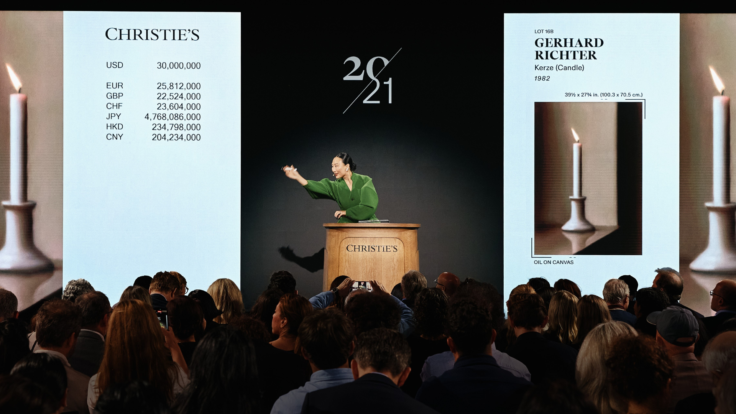
enjoying a long Juneteenth holiday weekend. Almost a decade ago, Christie’s canceled its June contemporary art sales in London; it was the only global auction center with three sales cycles per year. The goal was to eliminate the third season and reshape the global auction calendar, but competitive pressures from Sotheby’s and Phillips kept the early summer season in London alive. Tonight, I’m looking at the London auctions that begin next week, where the mix of property gives us a taste of
where the market might be going.
Up top, The New Yorker profiled Ken Griffin, and you might have missed what he said about his art collection; I’ll tell you what I learned about who bought that $181 million Jackson Pollock; and there’s been another surprise Margo Hoff sale.
Also mentioned in this issue: Si Newhouse, Joe Lewis, Monet,
Rothko, Picasso, Basquiat, Warhol, Richard Prince, Anne Bass, Jerry Hall, the Zabludowiczes, Kaws, Rashid Johnson, Tauba Auerbach, Yoshitomo Nara, and many more.
Now, let’s get to it… |
-
A door into Griffin’s art collecting: There was a fascinating spin to Gary Sernovitz’s very well-done New Yorker profile of Ken Griffin, which was published earlier this week. With Michael Bloomberg, Jamie Dimon, Howard
Schultz, Carly Fiorina, and Meg Whitman all superannuated from politics, Sernovitz dangled Griffin as the next great corporate financial leader who might fix the system. Never mind that Glenn Youngkin hasn’t been able to build on his term as Virginia’s governor, or that Dimon was never serious about becoming Treasury secretary, let alone running for president; it seems Griffin now wants some of
the same adulation. After amassing a $50 billion fortune and building a peerless machine for generating alpha on Wall Street, it’s not a huge surprise that Griffin wants a little credit, and to make a case that his enterprise promotes a public good.
The piece reports that Griffin has given some $2 billion to charity, including direct donations to museums, universities, hospitals, and the U.S. men’s national soccer team. Sernovitz also speculated that “the total value of his art purchases
is almost certainly in excess of two billion dollars.” As far as his interest in art, Sernovitz quotes Griffin on having gotten a late start: “‘Let me be clear—I had no interest or knowledge about art whatsoever until I was almost 30.’ Now, he told me, he sees art as ‘one of the few ways that we as humanity separate ourselves from being animals.’”
Even though Sernovitz doesn’t connect Griffin’s art portfolio to his penchant for buying real estate—and I wouldn’t suggest Griffin buys art as
an investment—he does make this interesting observation: “[Griffin] also told me that, after the 2008 crash, in which he ‘lost virtually everything in 16 weeks,’ he made a decision ‘that some portion of my net worth would be in non-financial assets.’”
|
|
|
|
A MESSAGE FROM OUR SPONSOR |
A MASTERPIECE IN MOTION Unmistakable style. Undeniable attention to detail. Experience composition and craftsmanship at their finest in a Range Rover.
EXPLORE
|
|
|
|
-
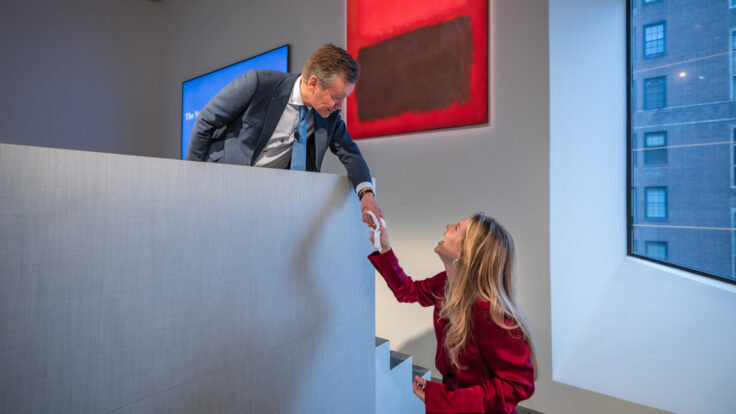
Who bought the Pollock?: I admit I had not given much thought to who bought Si Newhouse’s Jackson Pollock last month for $181 million. One reason the art market is less beguiling now than in the past is the limited cast of characters spending money at the top; any time there’s a nine-figure price, after all, we assume the buyer is Griffin. In this case, I’m told, it was not. More to the point, the bidding on the Pollock showed there were
three serious nine-figure bidders, and the buyer also won Robert Mnuchin’s red Rothko for almost $86 million. That’s $267 million in art purchases—that we know of.
It’s also a collector we’ve not heard much about for a decade or more. That’s an important aspect of the current market: the return of collectors who may not have been priced out of the market, but who either didn’t see works they were excited about or thought the prices were
unattractive. - Is Margo Hoff the new Gertrude Abercrombie?: Several readers have been keeping me informed of the growing momentum around painter Margo Hoff, who died at 98 in her Manhattan loft/studio nearly two decades ago. The boomlet began a little more than two years ago, when someone bought a Hoff painting from 1950 in a Wright auction on a whim. The buyer liked the look of the painting and kept bidding until it cost them $30,000,
which was a record for the artist. In December, Wright was able to sell in quick succession two different, slightly earlier paintings from the 1940s for $95,000 and then $50,000. The buyer of the $30,000 painting then consigned it to Christie’s, which was able to push the boat out further, achieving almost $140,000.
Earlier this week, a small auction house in Georgia had another
dreamscape Hoff painting on offer with an astonishingly low $1,000 estimate. It sold for a $90,000 hammer. An art advisor who has been tracking the Hoff sales—as, it would appear, a number of other interested parties are doing—told me that the final price with fees was around $115,000. I’ll have to take her word for it, since
LiveAuctioneers doesn’t make it easy to connect directly with the Atlanta auction house.
|
Now, let’s take a look at what’s on offer in London… |
|
|
|
This season, in London, Sotheby’s has most of the high-value, historical
works—everything from Freud and Klimt to Monet and Rothko. Meanwhile, Christie’s is leaning into what’s hot: Rashid Johnson, Kaws, Richard Prince, Yoshitomo Nara, and more. |
|
|
|
It’s been a long year in the art market, as with the rest of the world’s markets. I don’t have to
rehash all the causes of uncertainty, but in the end, the May auctions ran the gauntlet as well as could be expected, even if the future shape of the market remains slightly uncertain. On the one hand, we know that big-money buyers are back on the prowl, responding to the new supply of high-quality historical art coming to market. But there’s also a trend where works bought within the past five years of the market are coming back to the auction block. And, surprisingly, these two trends are
taking place at different auction houses during this year’s London sales, which begin next week. |
Most of the high-value works in London are at Sotheby’s, primarily but not exclusively in the
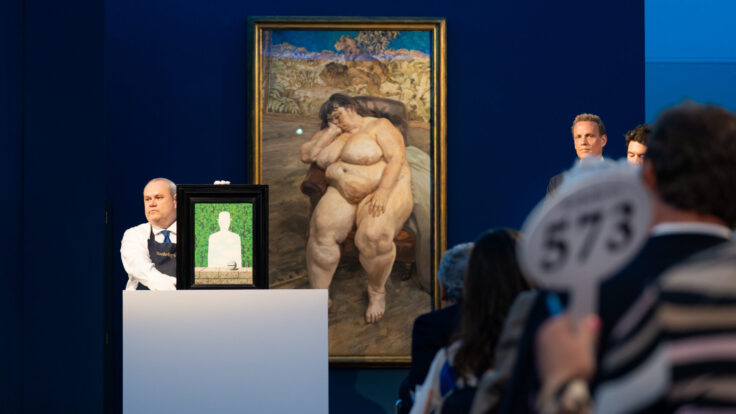
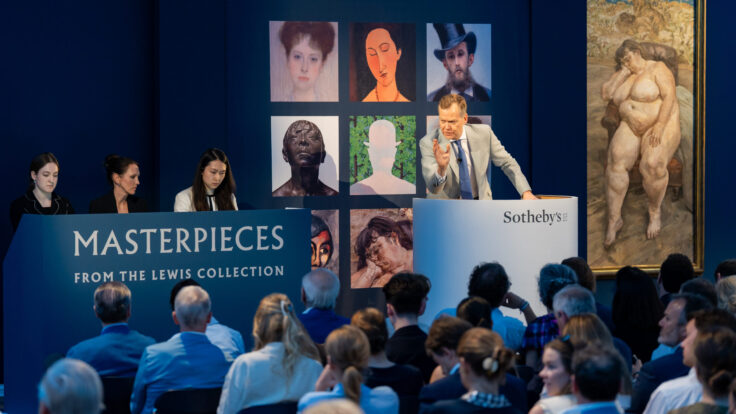
Joe Lewis collection. I’ve already discussed the many top lots in that sale from Lucian Freud, Gustav Klimt, Edgar Degas, Egon Schiele, Amedeo Modigliani, Gustave Caillebotte, Pablo Picasso, Francis Bacon, René Magritte, and
Max Beckmann. Collectors are fully engaged in a chase for the best historical works still in private hands, and this auction gives them plenty to run down. |
|
|
|
A MESSAGE FROM OUR SPONSOR |
A MASTERPIECE IN MOTION Unmistakable style. Undeniable attention to detail. Experience composition and craftsmanship at their finest in a Range Rover.
EXPLORE
|
|
|
|
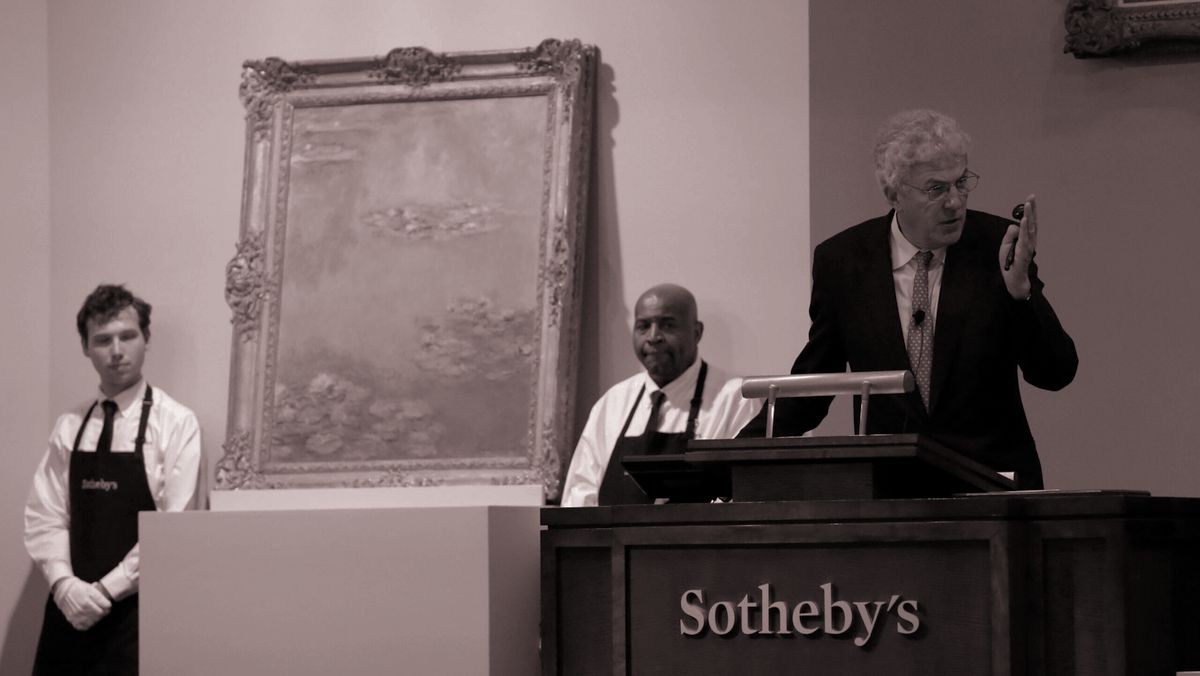
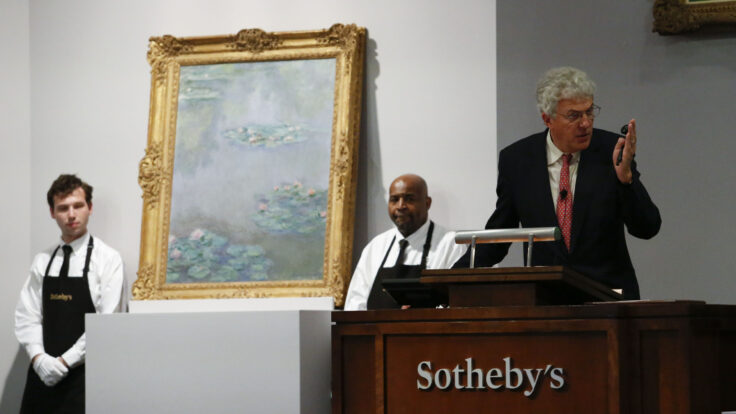
In the various-owners sale, Sotheby’s has two Claude Monet paintings from one
consignor, including Anne Bass’s Nymphéas. There’s also a Peter Doig painting from 1993-94, Cabin Essence, that was previously sold in 2015 for $14.8 million. It comes back to market with a conservative estimate of £10 million. There’s also a yellow, green, and white Mark
Rothko work on paper mounted on linen that’s backed by a third party and estimated at £4 million. After New York’s orgy of eight-figure Rothkos, it will be interesting to see how much demand there is further down the price ladder.
A Wassily Kandinsky canvas from 1909—a fragment of Improvisation
II—is estimated at £4 million. Assuming it sells for the estimate plus fees, the work will cost almost the same as the Kandinsky that just sold at Ketterer for $6.4 million.
Sotheby’s also has a Philip Guston canvas, The Hill, from 1971,
estimated at £2.5 million. At Christie’s, the Zabludowicz collection is also selling a large Guston painting, Mirror Head, from 1977, estimated at £3.5 million. Curiously, both works were acquired
privately in 2017.
Sotheby’s is following up last June’s $825,000 record sale of a Marlow Moss painting with another work, White, Yellow and Black, from 1953, which is estimated at £450,000. If the work sells there, it will be for fairly close to that record price. That’s a great return
for the consignor, who bought it in Amsterdam 13 years ago for a little more than $190,000. |
At Christie’s, we’re going to see a different version of what might be “historical” art. That’s
because the Zabludowiczes are selling selected works from their massive art collection, including pieces by hot artists like Lubaina Himid, Henry Taylor, Glenn Ligon, Kaws, Jacqueline Humphries, and Steven Shearer.
Christie’s likely selected works that its specialists believe will be in demand. For example, sales of
Antony Gormley’s sculptures reached an eight-year high in 2024. Volume dropped last year, but so far we’ve seen as much work auctioned this year as in 2025. Quantum Cloud XXXII, from 2000, is estimated at £300,000. An earlier work in the series, Quantum Cloud XI,
sold in 2008 for nearly $1 million. |
|
|
|
The works of Rashid Johnson have held up fairly well in the wake of the selling
around his recent Guggenheim mid-career retrospective. The Zabludowiczes have Untitled Broken Crowd, which they bought in 2021, on offer with an estimate of £800,000. And over at Sotheby’s, there’s Two Standing Broken Men, from 2020, on offer with a £600,000
estimate. A similar Two Standing Broken Men, from 2018, sold for almost $1.8 million last year.
Richard Prince’s cowboys
have been among his most enduring and desirable works. This one—from an edition of two, plus an artist’s proof, made in 1994, before Prince came to fame—is estimated at £800,000. Rephotographed cowboys (Prince used Marlboro ads as his source material to appropriate the images) have sold for as much as $3.75 million at auction. Another example of this image, which
appears to be from the same edition, sold at auction in 2014 for $1.7 million.
There’s also an example of Yoshitomo Nara’s Your Dog, from 2002, estimated at £550,000. The work comes from an edition of six, plus two artist’s proofs. One of the edition was
sold at auction in 2012 for $566,000. There are also a number of works that the Zabludowiczes bought at a different moment, which might be well timed for new blood. Wade Guyton was all the rage in 2014, when his work had $35 million in auction turnover, and there was a brief revival from 2022 to 2024, when more
than $13 million of his work was auctioned. So far this year, there’s already been as much work at auction as in 2025. This untitled work is estimated at £150,000. Finally, Tauba Auerbach’s technically impressive “fold” paintings were once a sought-after property, with auction results approaching $2.3 million. The Zabludowiczes’ example is being offered
with an estimate of £100,000.
In the various-owners sale at Christie’s, there are at least a dozen works bought in the past six years that are coming back to market. As I’ve pointed out in the past, this is a good sign of the market renewing itself as consignors feel they can get money out of purchases they might now regret. These works are by a range of
artists—including a Jean-Michel Basquiat, an Andy Warhol once owned by model and Murdoch ex Jerry Hall, and another Warhol previously owned by artist Maya Lin. Some of these sales may be opportunistic, as there are still solid markets for Victor Man, Tracey Emin, and Doron Langberg. Of particular note is the Bridget Tichenor work acquired
earlier this year in a private sale, which is now being offered with an £80,000 estimate. Tichenor’s work can be quite small; this larger example will be measured against the three works that were offered in May with similar estimates but sold for prices ranging from $190,000 to nearly $840,000. |
I hope that gives you some bearings to follow the auctions next week. I think many dealers are
hoping that another vote of confidence in art will encourage more buyers on the sidelines to plunge in. We will have to wait and see if that happens.
Enjoy your weekend, everybody.
M |
|
|
|
Need help? Review our FAQ page or contact us for assistance. For brand partnerships, email ads@puck.news. You received this email because you
signed up to receive emails from Puck, or as part of your Puck account associated with {{customer.email}}. To stop receiving this newsletter and/or manage all your email preferences, click here. |
Puck is published by Heat Media LLC. 107 Greenwich St., New York, NY 10006 |
|
|
|
|