Hello, sports fans! And welcome back to Wall Power. I’m Marion
Maneker.
It’s been a big week in the Old Masters market, which saw a mysterious new bidder chase after the $27 million Michelangelo drawing. Tonight, I’ve got news and notes on all the action. Plus, I’ll take you behind the scenes of the market for a young abstract painter named Julia Jo (she’s got an opening tonight), and the closure of Robert Mnuchin’s eponymous gallery following his death.
I’m in a good
mood, so I won’t give you a lecture about subscribing if this newsletter has been forwarded to you. But I will invite you to join or upgrade to the Inner Circle here. Don’t forget that you can interact with me anytime by replying to this email or texting me at +1.917.825.1391 on WhatsApp or SMS.
Mentioned
in this issue: Julia Jo, Robert Mnuchin, Julian Schnabel, Michael McGinnis, Charles Moffett, Hugo Nathan, William O’Reilly, Jennifer Wright, Leon Black, Donna Tartt, Cindy Pritzker, Jay Pritzker, and many
more…
Before we get to the workout, let’s warm up… |
-
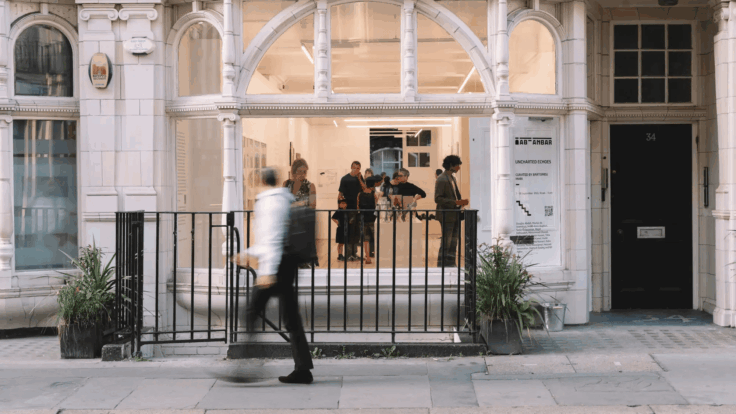
Mnuchin Gallery to close: Like many of you, I got a note late on Wednesday informing me that Mnuchin Gallery will close after the current Julian Schnabel exhibition. This is not really a surprise given the death of the gallery’s legendary owner, Robert Mnuchin. But the art world wants to know what will happen to Mnuchin’s stock, and, of course, the dealer’s personal collection.
A few years ago, when I interviewed Mnuchin, he pointed out that he
had created a fund with some of his friends and clients to buy works for inventory. Assuming Mnuchin’s partners were peers who have had to put their own affairs in order, it’s not clear to me what has become of that art. At least one of the works had been bought at a price far above today’s market for the artist, which means it will have to be held or sold at a loss. But the family has plenty of time. It’s my understanding that although the gallery is closing, Michael McGinnis
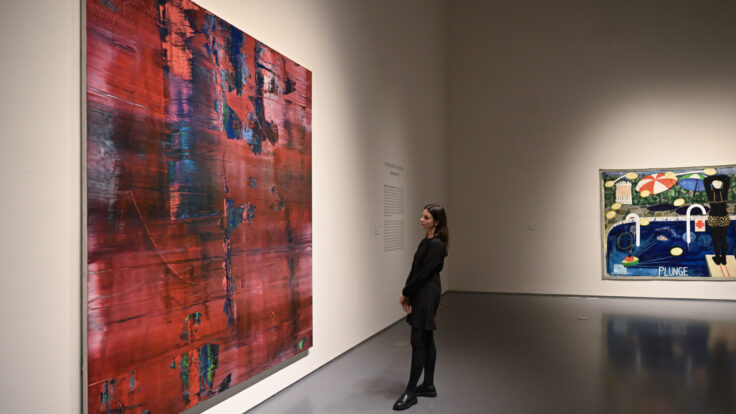
will become an advisor to the family, in addition to dealing privately—which means we’re not likely to see the Mnuchin collection at either auction house any time soon. - Defending Julia Jo: As you’re receiving this, a crowd is filling into Charles Moffett’s Tribeca gallery for the opening of Julia Jo’s third solo show, Beckon. Born in South Korea and based in Brooklyn, Jo belongs to a new generation of young women abstract painters. The category’s speculative jag from a few years ago has died down, but Moffett, taking no chances, has been on guard to protect his artist’s market.
Last November, he went up to Christie’s for the contemporary day sale, where Jo’s large red 60-by-60-inch painting, Rhyme or Reason, was being offered. Christie’s had displayed the
painting at the top of the stairs in its Rock Center showrooms, where it attracted a lot of attention and interest. The $30,000 estimate increased the curiosity, especially since it was close to what the works sell for through Moffett’s gallery. The dealer had to make sure the work did not sell in a way that undercut his artist’s market. The result—a telephone bidder paid slightly more
than $200,000 with fees—also posed a few challenges. Would more of her collectors want to cash out?
In the end, though, the Christie’s sale brought the artist new interest from some seasoned and serious collectors. Moffett found paintings for two of the underbidders, actively engaging with Jo’s collector base to see if anyone wanted out at a profit, but keeping his primary prices where they were. For this new, sold-out show, Moffett made sure to place works with collectors and advisors who
had previously supported the artist and gallery. “I kept it a bit safe,” he told me. “We want stability as much as we can have it.” Although this no longer seems like a market where collector feeding frenzies for young artists rage unabated, it doesn’t pay to be complacent. Christie’s has found another Julia Jo work for its Postwar to Present sale on February 26.
|
Now, set your watches and let’s get started… |
|
|
News and notes from New York’s Old Masters sales: the mystery of a $27 million
Michelangelo, the Rembrandt collector chatter, a Gentileschi selfie, and the surprising fates of two Corneille de Lyons. |
|
|
On Thursday, the art advisor Hugo Nathan brought a new client to
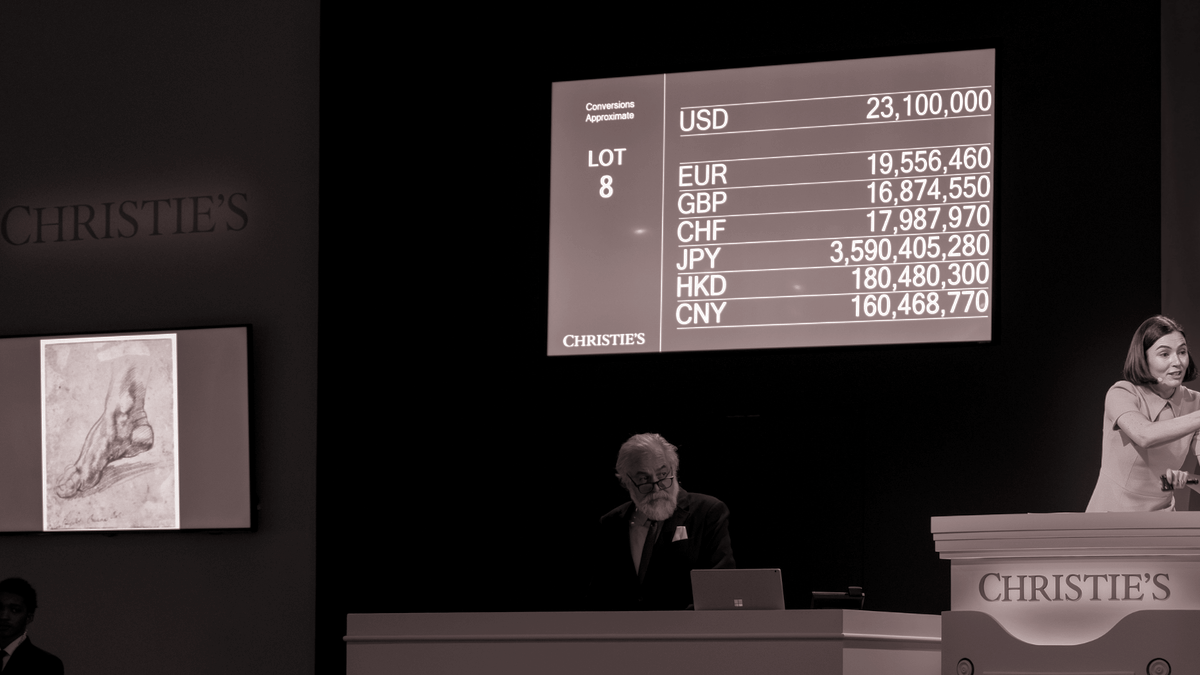
Christie’s Old Masters drawings sale. And, from the looks of the results for the Old Masters sales earlier this week, he wasn’t the only one. A new cohort of buyers seems to be entering the market. Some are sophisticated collectors from other categories, attracted by the low prices and surprisingly “modern images” the auction houses have assembled. Others just seem to be curious about buying extraordinary objects that connect to immortal, infinite themes, like Michelangelo’s
drawing of a foot—a study for the Libyan Sibyl figure in the Sistine Chapel.
Nathan declined to identify his 40-ish-year-old client—surprisingly young, at least in this context—and no one else seems to know him. Nevertheless, the man, who does not work in tech or finance, sat next to Nathan as he made bids opening at $1.3 million and going all the way above $20 million until they tapped out before the end. “I had to stop at some point,” Nathan drily told me later that evening. “I was
meeting someone for lunch.”
Two other bidders, both on the phone with Christie’s staffers, didn’t go much further. Jennifer Wright dropped out around $23 million. The trade is confident that her bidder was Leon Black. But the buyer, represented by Christie’s Andrew Fletcher, was willing to pay just $100,000 more to win at the hammer price of $23.1 million, which translated with the
addition of fees to $27.2 million. That’s a lot of money for a scrap of paper with a small red foot sketched on it, but it’s hard to know what an appropriate price is for a very rare study by one of the world’s greatest artists, who, Nathan reminded me, “doesn’t exist except in his studies.” If you want to own something touched directly by Michelangelo’s genius, you’re probably not going to get another chance.
William O’Reilly, another advisor whose heart, taste, and
expertise lie with Old Masters, thinks this week’s successes—you have to love this $300,000 dog!—were the result of the auction houses rethinking the category. He believes buyers are finally waking up to the fact that owning the latest contemporary artist means collectors will end up with works that look a lot like what their peers have. In response, the auction houses
have “stripped out the dusty material,” he said, and filled the sales with “a lot of good-looking, unique images.”
Both O’Reilly and Nathan said that the new group of collectors coming into the category are buying artworks and images they find attractive and appealing, while worrying less about names and even scholarship. It’s a new kind of connoisseurship, based on the buyer’s self-confidence. A good example was the Jean-Honoré Fragonard painting of a bearded man that
was offered at $600,000 and sold for nearly $2.75 million. O’Reilly quipped that Fragonard had finally reached the price range of Flora Yukhnovich, the contemporary painter with a current exhibition
at the Frick, whose work riffs on the rococo artist.
This is great for all of the stakeholders, but it has had one surprising effect: With so much of the success of these sales resting on the unknowable, individual eyes of so many different collectors, it’s made the results unpredictable—and, to be honest, exciting. |
The hype surrounding the other big
drawing of the week, Rembrandt’s Young Lion Resting, was chatter concerning the one-bid sale at $17.8 million; metals magnate Thomas Kaplan got his price for the fantastic drawing (its quality is undisputed), but no one is really sure how. Earlier, during the Diane A.
Nixon sale of drawings, the bidding was as unpredictable as it was visible. The top lot was a two-sided Mattia Preti study in red chalk that had been estimated at a healthy $200,000, but got bid to a little more than $1.75 million. Carel Fabritius,
whose name can now be uttered only with a quick reference to the Donna Tartt novel The Goldfinch, had a postcard-sized work, Christ and the Woman of Samaria, sell for just above $760,000, even though the estimate was a restrained $80,000.
Do you
remember the Il Pomarancio red chalk drawing estimated at $15,000 that I flagged for an art advisor? Well, forget I said anything. It went for $90,000. Domenico Campagnola’s
landscape was estimated at $25,000, but sold for more than $150,000. A Giovanni Tiepolo Madonna and Child
drawing was earmarked at $80,000, but attracted bids to sell above $450,000. Hans Bol’s The Boar Hunt made nearly $155,000, and Giorgio Vasari’s Dispute of Saint Catherine with Emperor Maxentius sold for just under $110,000. Both works were estimated at $25,000. On the back of the Vasari were notes for his famous, gossipy book about the lives
of the Renaissance artists, which may have added to the interest. The short-lived Leon Bonvin’s still life of wildflowers made a smidge more than $240,000 over a $60,000 estimate. A
study of a tree by Annibale Carracci sold for more than $860,000, nearly triple the estimate, and a Tiepolo that was featured in the exhibition made more than $570,000, or twice its estimate. |
There was a lot more action in paintings. At Christie’s, I didn’t find the
Artemisia Gentileschi selfie as Saint Catherine of Alexandria very interesting, myself, but it sold for a record price of nearly $5.7 million. The Sandro Botticelli Madonna and Child made a solid price of $5.2 million. Its obvious religious imagery is a bit of a drawback these days, and it is a minor picture by a major artist. But this used to be the sort of thing collectors wanted: big names. Contrast that with Sotheby’s result of $2.3 million paid for the
Biagio d’Antonio, a far lesser-known artist who lived almost exactly the same lifespan as Botticelli. His portrait of a young man has all the imagery of a Renaissance portrait. Because the painting had been transferred from the original board it was painted on, it had lost some of its impact. Nevertheless, bidders flocked around the $800,000 estimate, and the result speaks for itself.
Pieter Brueghel the Younger’s A village scene with the Flight into
Egypt sold for just over $2 million. That’s double the estimate. I spoke to the buyer, who thought he was going to lose the work before his last bid held up. He said the scene is rare for Brueghel, with only two or three other versions in existence. Again, buyers seem to crave images that are distinctive, if not truly unique. Jean Siméon Chardin’s
Diligent Mother had a third-party guarantee like the Brueghel, but that didn’t scare off bidders. It also sold for $2 million over a $1 million estimate. Jacometto Veneziano’s small portrait of a prelate was estimated
at $500,000. It looked so good in person that it really didn’t surprise me when it sold for almost $1.5 million. Another striking portrait, this time attributed to the Circle of Sofonisba Anguissola—that’s a new name to me, too—was estimated at $60,000, but sold for a tad over $355,000.
At Sotheby’s, the Lester Weindling
collection sold well, but perhaps with muted bidding given the irrevocable bids taken on all of the lots before the sale. Nevertheless, one of the still lifes by Pieter Claesz, resplendent with ripe fruit, doubled the estimate even if it was less historically important than the other, dour one with tobacco. David Teniers the Younger’s Potters’ Fair at Ghent
sold solidly above the $600,000 estimate, at $1.6 million. And the Abel Grimmer church interior priced at $200,000 sold for nearly $790,000.
It’s hard to remember that in the days of Lord Duveen, American plutocrats wanted tapestries more than paintings. Cindy and Jay Pritzker’s Millefleurs Tapestry with a Unicorn, estimated at a mere $300,000 but sold
for nearly $2 million, brought all of that back to mind. Dealer Stanley Moss’s estate yielded a Giovanni Bellini painting that was estimated at $600,000 but sold for $2 million. A Tintoretto portrait was estimated at $500,000 but
made $1.2 million. Two works by Jean-Baptiste Pater offered as a single lot were estimated at $400,000 but sold for more than $1 million.
There
were many other interesting sales at Sotheby’s, but what really spun me around were the divergent fates of two small paintings once attributed to Corneille de Lyon, the Dutch portrait painter who resided in Lyon, France, in the mid-16th century. The Portrait of a Man was estimated at $400,000 and sold pretty much
there, with a premium price of $508,000. It was displayed alongside another Portrait of a Bearded Man Wearing a Cream Doublet, previously identified as Baron Seymour of Sudeley when the painting was thought to be by Corneille. But since it had been severed from the attribution, Sotheby’s wisely cut the estimate to $200,000. Still, that did not deter buyers more interested in the image than the art history—they
bid it up to an astonishing $2.3 million with fees.
No one can really explain that price to me. Even the buyer of the still fully attributed Corneille was flummoxed when we spoke after the sale. But that’s not a bad thing. Markets are intriguing when they keep everyone guessing. |
I’ve bored you enough with these tales of Old Masters intrigue. Join me again on Sunday, when I’ll
have some sales from Art Basel Qatar to report.
Looking forward to it,
M |
|
|
Puck founding partner Matt Belloni takes you inside the business of Hollywood, using exclusive reporting and insight
to explain the backstories on everything from Marvel movies to the streaming wars. |
|
|
The ultimate fashion industry bible, offering incisive reportage on all aspects of the business and its biggest
players. Anchored by preeminent fashion journalist Lauren Sherman, Line Sheet also features veteran reporter Rachel Strugatz, who delivers unparalleled intel on what’s happening in the beauty industry, and Sarah Shapiro, a longtime retail strategist who writes about e-commerce, brick-and-mortar, D.T.C., and more. |
|
|
Need help? Review our FAQ page or contact us for assistance. For brand partnerships, email ads@puck.news. You received this email because you
signed up to receive emails from Puck, or as part of your Puck account associated with {{customer.email}}. To stop receiving this newsletter and/or manage all your email preferences, click here. |
Puck is published by Heat Media LLC. 107 Greenwich St., New York, NY 10006 |
|
|
|