{{ 'now' | timezone: 'America/New_York' | date: '%b %d, %Y' }} |
|
|
|
Hello, and welcome back to The Best & The Brightest, your daily politics dispatch from Puck. You
already know that it’s foreign policy Thursday and that I’m Julia Ioffe.
Tonight, NatSec Washington has been positively giddy at Péter Magyar’s absolute walloping of Viktor Orbán in Hungary’s elections this past Sunday. You’d think it was Donald Trump who lost the vote, not Orbán. But Magyar is no A.O.C.—and his initial post-victory media tour proves there’s nothing simple about de-Ba’athification. And
that may be the real lesson for Democrats in 2028.
Plus, up top, Abby reads the fundraising tea leaves and finds Democrats getting their groove back—and potentially forcing Republicans to divert money to defense.
Also mentioned in this issue: J.D. Vance, Alex Burns, Vladimir Putin, Joe Biden, Eileen Cannon, James Talarico, John
Cornyn, Ken Paxton, Jon Ossoff, Roy Cooper, Michael Whatley, and more… |
|
|
|
Instagram Teen Accounts: Automatic protections for teens
Instagram Teen Accounts have built-in protections for who can contact teens and the content they can see. Teen Accounts now have a stricter “Limited content” setting for parents who prefer extra controls. Nearly 95% of parents say Instagram Teen Accounts help safeguard their teens. We will continue adding features to help protect teens online. Learn more |
|
|
|

| Abby Livingston
|
|
- Dems stomp Republicans on
fundraising: The Democratic fundraising hangover is officially over. New campaign filings show House and Senate candidates in competitive races mostly clobbering their Republican counterparts—a drastic change from a year ago, when victorious Republicans were stockpiling cash as enraged Democratic donors shut their wallets.
Democrats had
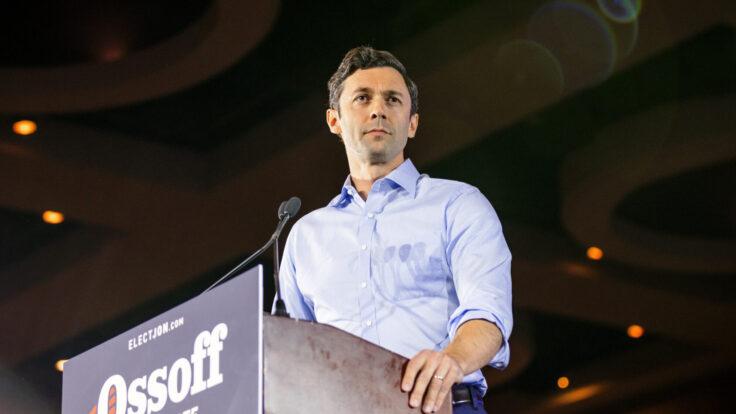
predicted that the first sign of recovery would be an uptick in candidate fundraising, particularly among fresher faces who could serve as “gateway drugs” for otherwise reluctant donors. Well, that’s exactly what happened this quarter. Democratic Senate candidates posted striking numbers: Texas’s James Talarico ($27 million), Georgia’s
Jon Ossoff ($14 million), North Carolina’s Roy Cooper ($13.8 million), Ohio’s Sherrod Brown ($12.5 million), and Alaska’s Mary Peltola ($8.9 million) all cleaned up. Five Democratic House challengers raised more than $2 million. Republicans’ top fundraiser in a competitive race, meanwhile, was North Carolina Senate candidate Michael Whatley, at $5 million.
So what changed? One Democratic source offered a
one-word answer: Virginia—a nod to now-Gov. Abigail Spanberger’s blowout win last fall, which gave Democrats some of their confidence back (though Spanberger’s honeymoon was exceptionally brief).
The indirect consequences may matter as much as the numbers themselves. I’m told that Talarico, for instance, is spending the spring
fundraising for fall TV ads, while Republicans John Cornyn and Ken Paxton burn through money in their runoff competition. The current operative debate about Texas is less about whether the state will flip, but how much of a money pit it becomes for Republicans. Talarico—especially now that he’s sitting on a pile of cash—will
almost certainly force national Republicans to spend in what should be a safe red state, potentially pulling money from other races.
|
|
|
|
The collapse of Viktor Orbán’s Fidesz party, after 16 years of authoritarian rule, offers
mixed signals for America’s left—and a harsh preview of the monumental task that awaits Democrats after Trump is gone. |
|
|
|
The way the American liberal establishment reacted to Péter Magyar’s victory, you’d think it
was Donald Trump, not Viktor Orbán, who had lost the Hungarian election this past Sunday. In elite Washington media circles, Magyar’s sweep was proof that the right-wing illiberalism pioneered by Orbán is not inevitable. It was a light in the darkness. It was a
stinging repudiation of J.D. Vance. And, most of all, it was a template for how Democrats could take back power in 2028. |
|
|
|
Instagram Teen Accounts: Automatic protections for teens
Instagram Teen Accounts have built-in protections for who can contact teens and the content they can see. Teen Accounts now have a stricter “Limited content” setting for parents who prefer extra controls. Nearly 95% of parents say Instagram Teen Accounts help safeguard their teens. We will continue adding features to help protect teens online. Learn more |
|
|
|
Everyone, it seemed, had something to say about how Magyar’s electoral revolution offered a blueprint, a
roadmap, a playbook—you name it!—for Democrats’ path out of the wilderness. Magyar had focused, the Times editorial board wrote, on “bread-and-butter issues.” He “avoided talking about controversial social issues or critiquing Mr. Orbán’s authoritarianism,”
noted the Journal. And given Magyar’s rise through the ranks of Orbán’s Fidesz party only to defect and trounce it, Democrats would be wise to follow his example. They should, as Alex Burns
concluded in Politico, “give a closer look to the leaders frustrating their peers in Washington and defying their home-state political bosses.”
There’s something charmingly solipsistic about these responses, adorned in each instance with various to-be-sure caveats. (“Hungary is obviously a very different
country from the United States,” acknowledged the Times.) In this provincial view, everything that happens in the world is actually about America—though no other place is like America, to be sure. It brings me back to my days as a foreign correspondent in Moscow, ducking out of assignments to interview Russians about what they thought about this or that primary debate in the run-up to the 2012 U.S. presidential election. (The answer was always the same: They didn’t
even know—or care—to watch them.)
To be sure, in the years of upheaval since, elites around the world have come to monitor our elections and political micro-developments closely. To be sure, Orbán became a hero to many on the American right. (Allegedly using state funds to bankroll CPAC’s
Budapest conference didn’t hurt.) And to be sure, his rapid concession after 16 years of autocratic rule is a spectacular, historic moment: the removal of the linchpin of continental Europe’s far-right revanchism, slowing, if only for a moment, the world’s seemingly irrepressible march toward neo-fascism. That moment is definitely worth savoring, on its own terms, for Hungary, for Europe, for
Ukraine, and for the world. |
The euphoria shouldn’t eclipse a few inconvenient truths, however. The first is that Magyar is no liberal. He
is a conservative, a Catholic, and a blood-and-soil nationalist who shunned a gay pride parade and criticized Orbán from the right on immigration. He promised to plug holes in Hungary’s border fence, to end
a migrant visa program for Asians, and to enforce immigration norms even more strictly than the man he ousted. His anti-corruption message included the argument that Orbán’s corruption made his immigration enforcement too weak. In that sense, Magyar resembles other European candidates who managed to beat the far right by harnessing a popular backlash to immigration and advocating for stricter controls. |
|
|
|
He has been skeptical of letting Ukraine into the E.U. and has poured cold water on the idea of a fast-track
accession. He is against sending weapons to Kyiv. And while he slammed Orbán’s servility toward the Kremlin—in a leaked recording of a call, Orbán told Vladimir Putin that he is the mouse to the Russian leader’s lion—Magyar has called for a “pragmatic” approach to Moscow, saying that the geography that
puts these two countries in each other’s orbit isn’t going to change. And that’s not exactly bad news for Trump, whose support is becoming toxic for the European far right. “I’m cautiously hopeful about Magyar,” one Trump administration official told me, praising his policy positions. “If he can stick to his guns on immigration while kowtowing less to
Russia and China, then he’s better for us.”
But it hasn’t even been a week since Magyar was elected. He won’t form a government or take power for another month. When he does, he will gain control of a judiciary and bureaucracy that has been absolutely stacked with Orbán apparatchiks. The media—some 80 percent of it—is controlled by Fidesz. The country is crawling with Russian agents, who will surely try to meddle as they did in other former satellites, like Georgia, that tried to chart a different, more Brussels-friendly course.
How will Magyar uproot the system that Orbán spent 16 years entrenching? His new party, Tisza, has a constitutional supermajority in the Hungarian parliament, but what will reform look like in practice? How, for example, will he fulfill his campaign pledge to
prosecute Fidesz cronies for corruption, given that Orbán packed the bench? Will those cases be heard by Fidesz judges? Will he fire all the judges and risk coming across as politicizing the judiciary to a different end? If he does, who will he replace them with? Or does he let them attrite, wasting precious time—and risk a Hungarian version of Eileen Cannon presiding over a critical case? “The process of de-Orbánizing Hungary is going to be like conducting major surgery on an
unanesthetized patient,” one analyst told me.
If American liberals are looking for a lesson from Hungary, that may be the most salient one: Even if a Democratic candidate wins in 2028, they will have to rebuild all that Trump has destroyed, working within a government bureaucracy that Trump has gutted and politicized and packed with loyalists. Even if the election were tomorrow, that would be a monumental task, and there are still nearly three more years of Trump to go. Meanwhile, the
American voter is always impatient. They want results yesterday. Explaining that it takes time to undo the damage done over many years is a losing message. Just ask Joe Biden—and President Kamala Harris. |
That’s all from me, friends. I’ll see you back here next week. Until then, good night. Tomorrow will be
worse.
Julia |
|
|
|
Join Emmy Award-winning journalist Peter Hamby, along with the team of expert journalists at Puck, as they let you in on the
conversations insiders are having across the four corners of power in America: Wall Street, Washington, Silicon Valley, and Hollywood. Presented in partnership with Audacy, new episodes publish daily, Monday through Friday. |
|
|
|
Unique and privileged insight into the private conversations taking place inside boardrooms and corner offices up and down Wall
Street, relayed by best-selling author, journalist, and former M&A senior banker William D. Cohan. |
|
|
|
Need help? Review our
FAQ page or contact us for assistance. For brand partnerships, email ads@puck.news.
You received this email because you signed up to receive emails from Puck, or as part of your Puck account associated with {{customer.email}}. To stop receiving this newsletter and/or manage all your email preferences, click here.
|
Puck is published by Heat Media LLC. 107 Greenwich St., New York, NY 10006 |
|
|
|
|