Hi, and welcome back to Line Sheet. It’s something of a federal holiday in the U.S.—Happy 250th,
’merica!—so please enjoy your time off. I will be celebrating our nation’s birth in Paris, at the only place that is appropriate.
In today’s issue, Malique “Malique@puck.news” Morris is back with a look at the fascinating week that was in fashion, from Nike’s earnings and Chanel’s acquisition of Charvet to Armani’s engagement of Boston
Consulting Group. (I wonder why they went with BCG and not Bain or McKinsey.) Up top, Malique has a scoop on Blackstone’s Spanx problem, and he also looks at the dynamic secondhand market developing around Matthieu Blazy–era Chanel. I’ve also got a little report on the latest development in the peptide discourse. And you’ll find some smart reader feedback at the bottom, too.
I had an amazing day in London on Thursday. First, I traveled north to
Tottenham to visit the townhouses now occupied by the Sarabande Foundation, which supports young artists and designers via the estate of Alexander McQueen. Trino
Verkade, who worked with McQueen for years, runs the organization, and I was lucky enough to be seated across from her at a Schiaparelli dinner a few weeks ago in London, where I discovered more about this mysterious woman whom I had noticed at fashion shows for seemingly decades. The new site’s rooms will serve as yearlong residences for a mix of fine artists, jewelers, and designers. I ran into Torishéju Dumi and had the privilege of meeting
so many new talents, including Jack Laver, Bisila Noha, and Jingyi Li.
Anyway, it was inspiring, and you should go see the group show.
Then, last night, Puck celebrated absolutely nothing in particular at the Hart, where I was joined by American Express and a solid crew of both Line Sheet stars and readers. I know I always say this, but it was one of the best dinners we’ve thrown: such a great mix of stylists,
retailers, C.E.O.s, editors-in-chief, writers, and even a showrunner—I worked hard to make this one sparkle. Thank you to Amex’s Amanda Christine Miller, who, as I revealed last night, was the first person ever to take me to Nobu, some 20 years ago. And as always, thank you to Team Puck (Alex Bigler for the win) and Sarah, Justin & Co. at DLX for making it all look
easy.
Also mentioned in this issue: Giuseppe Marsocci, Elliott Hill, Dario Vitale, the World Cup, Michael Rider, Celine, Charnel, Fast Retailing, Mike Eckhaus, Zoe Latta, A$AP Rocky, Cricket Whitton, Camper, and more… |
Three Things You Should
Know…
|
- Optimization
nation: The desire to squeeze the most out of everything—from our bank accounts to our bodies—is resolutely American. The New Consumer and Coefficient Capital’s midyear trend report, released just in time to celebrate America’s big birthday, suggests that we have never been more nuts on this front in our 250 years. According to a survey of more than
3,000 U.S. consumers (conducted in partnership with consumer-intelligence firm Toluna), more than a third of them are in “optimization mode,” which means everything from drinking fancier alcohol to, yes, taking peptides.
If you’re reading this, you’re likely quite familiar with peptide stacks, but most people still don’t know what these chains of amino acids actually do. (In short, they tell cells when to repair, regulate, or produce. Whatever that means!) Some 64 percent
of U.S. consumers have heard of peptides, but only 29 percent say they understand them. (And let’s be real, the actual baseline is probably much lower. People always think they’re smarter and better informed than they actually are.) Still, 26 percent of Gen Z and Millennials consider them “exciting/promising,” while another 28 percent consider them “interesting but risky.” (A reminder: The New Consumer is the brainchild of my husband, Dan Frommer, but don’t hold
that against him.)
|
|
|
|

| Malique Morris
|
|
- The Blazy premium:
For years, many luxury shoppers complained that Chanel had pushed the price of its handbags into the stratosphere—and yes, many of the brand’s most desirable bags have nearly doubled in price in less than a decade. But for all the chatter, Chanel has remained one of the world’s most formidable houses because it can still persuade aspirational customers to finance a Classic Flap on a credit card. Now, amid the continued mania for Matthieu Blazy’s still-young tenure at the
house, customers aren’t merely paying full price—they’re paying a premium.
Chanel bags are selling for 24 percent above retail on average on The RealReal, the company recently said, while the Souplissimo and Urban Essential handbags have fetched as much as 60 percent above retail on Fashionphile. The surge reflects the extraordinary demand surrounding Blazy’s first collections, which reached stores only in March. If the resale market is often the clearest indicator of customer desire, Blazy’s Chanel continues to lead the pack. - Spanx exec overhaul: When private equity behemoth Blackstone acquired a majority stake in Spanx at a $1.2 billion valuation in 2021, Skims had already begun reshaping the shapewear business, though Spanx’s obsolescence hadn’t yet calcified. In the past five years, as the story goes, Skims has snatched
a lot of market and mindshare from Spanx, especially among younger consumers. As I reported earlier in the week, Skims is on track to surpass $1.3 billion this year after posting 25 percent year-over-year sales growth in the second quarter. During that same period, Spanx’s U.S. sales, excluding wholesale, fell 19 percent, according to debit and credit card
data from Consumer Edge.
Some of that may owe to a lack of leadership. I’m told that Cricket Whitton, who joined Spanx in 2017 and was promoted to C.E.O. in 2024, left the business sometime last fall. I’m unclear on the exact circumstances surrounding her departure, which wasn’t reported at the time, or who replaced her. Whitton still lists herself as Spanx C.E.O. on LinkedIn. I should have more on this soon. (Spanx and Whitton didn’t respond to requests for comment.)
|
|
|
|
And now, more from the week that was… |
|
|
|
Even for an industry built on season-to-season changeover, this week demonstrated how much
of the fashion world—brands including Nike, Charvet, Armani, and more—is in transition mode. |
|
|
|
While everyone focused on the scorching weather in Paris and New York—people, there are other things
to discuss—it was a quiet week of passages and transitions in the fashion industry. Nike’s fiscal fourth-quarter earnings landed as expected. Overall sales declined, weighted down by China and Converse. Yet C.E.O. Elliott Hill has never tried to disguise the scale of Nike’s rebuilding effort. On a Tuesday earnings call, Hill invoked the Knicks. “The championship wasn’t built on a single series or even in one season. It was built over time, through setbacks and steps forward,
through relationships, and buying into a system where everyone knows their role,” he said. “The real story is everything it took to get there. And that’s exactly how we’re building Nike.” |
|
|
|
Yes, this may have sounded a bit hokey coming from the head of a $46 billion conglomerate. But it was a
reminder that across fashion, many of the industry’s largest and most established brands currently find themselves in various stages of reinvention. Nike’s own strategy has become increasingly clear as it abandons its dalliance as a lifestyle brand and returns to its activewear roots. Hill noted that the company added $1 billion in sales to its running division over the past year and has returned sports to the center of the Nike universe. That shift includes the ambitious 12-week World Cup
campaign, which spans everything from collaborations with Jacquemus to products made with innovative materials. It’s a genuinely humbling approach that shows that the company, under Hill’s leadership, isn’t above acting like an overzealous upstart itching to re-prove itself, especially with its vast resources.
Nike can, and should, go even harder in activewear. NikeSkims, with its $108 stretch leggings and $150 mesh split-toe sneakers, has not been the cultural juggernaut many had
suspected. But its remnant potential is now being underappreciated by the market. As I reported this week, NikeSkims’ sales are on pace to reach $400 million by the end of the year—a significant total for any brand launched in September 2025. (This is not investment advice. Just kidding…) Even without deafening buzz, it has still managed to become a nine-figure business. Could Nike do
more to push it? Obviously, and they will. |
Chanel remains the high point on the parabola that Nike’s currently surfing—proof that major historic brands,
even many decades into their existence, can still reach new heights. After all, creative director Matthieu Blazy has made Chanel the best brand in the world right now, truly. This week, the company announced that it was acquiring Charvet, the 188-year-old chichi custom men’s shirtmaker that counts Lauren as a devoted client. As she noted
this week, in fact, the deal was born from Blazy’s collaboration with Charvet—an homage to Coco Chanel’s old penchant for buying Charvet shirts for her beau.
The industry loves this deal because Chanel and Charvet have become a new type of catnip for elitists: The jam-packed made-to-measure appointments at Charvet’s Place Vendôme boutique mirror the perpetual lines at Chanel stores in every country. Both brands also blur gender lines, an ongoing contention in the culture
wars. Lauren probably has as many Charvet shirts as the bankers I used to sell them to at Saks more than a decade ago. Resident pretty boy A$AP Rocky is as effective a model for Chanel as any of the sharp-cheekboned women who grace the runways.
A much, much lesser example of this kind of no-brainer mashup is Camper. The 51-year-old Spanish purveyor of fashionably clunky shoes announced this week that it acquired a 60 percent stake in Ancient Greek Sandals.
Camper, which reportedly generated €255 million in annual sales last year, isn’t necessarily buying its expansion into sandals. It sells its own bulbous feet-displayers. But the company is seizing on a cultural moment. It’d be foolish to suggest that sleek, barely there sandals are never not in style when the humidity
hits. Yet there is a new wave of desire to expose the toes, especially for men. (The see-through Saint Laurent shoes, anyone?) |
|
|
|
And yet the most monumental transition in the industry also kicked off this week, with perhaps the least
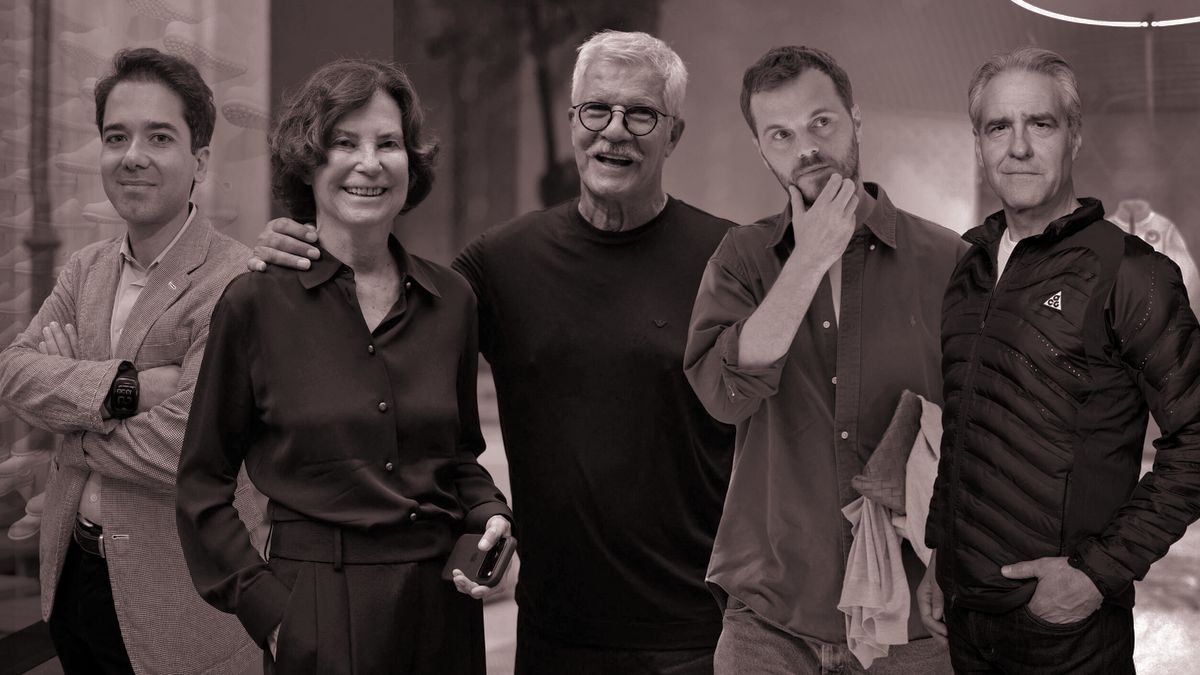
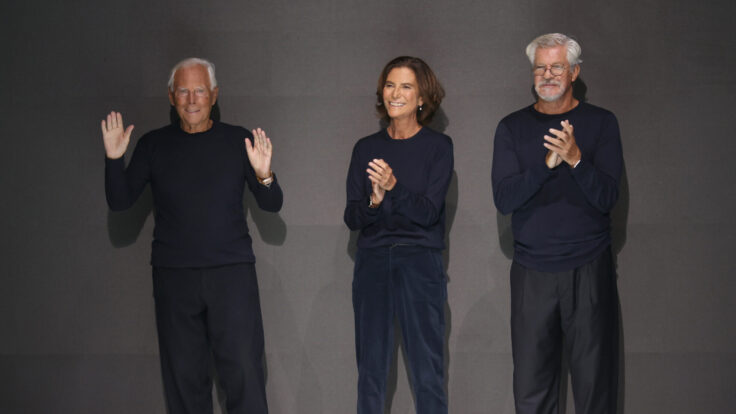
fanfare: On Tuesday, Bloomberg reported that Armani hired management consulting firm Boston Consulting Group. Since Giorgio Armani’s death, the company has been figuring out how to lift the business (revenue fell 3 percent last year) as it gears up to start the process of selling a 15
percent stake of the business, presumably to LVMH, L’Oréal, or EssilorLuxottica, as the designer preordained in his will. Armani, which is run by Giuseppe Marsocci, has until March 2027 to consummate a deal. In the meantime, it’s apparently looking to ratchet up its investment in handbags, a category the brand lags in. The Bloomberg report also added steam to the rumors of a new creative head for Emporio Armani. As Lauren
reported, there’s been dismissible speculation that Dario Vitale might get the gig. Of course, it would make more sense to rejuvenate the brand after it changes hands.
When a mature and historic company tries to reignite growth, there are a couple obvious options: It can focus on the parts of the business that are working, like Nike is doing
with running and other sports, or it can take a shot at reviving parts of the business that have long been underserved, as seems to be the case at Armani. Either way, the path will only add to the brand story—and potentially become a blueprint for someone else. |
On the rise of Michael Rider’s
Celine: “It’s interesting that Celine is showing radical new ideas in the summer. Using men’s to launch them when they’ll get more attention, instead of getting lost in the women’s shuffle. Using men’s as a weapon is smart.” —A luxury executive
On whom Uniqlo should tap next: “If Lemaire and Tran exit Uniqlo U, Fast Retailing should replace them with Eckhaus Latta. The Mango collab success is proof of concept. I also love imagining what Mike and Zoe would do with that influx of money at their own brand. It feels like a continuation plan even Lemaire would cosign.” —A smart journalist
On the Charvet-Chanel of it all: “I
better get my damn shirts!” —A person waiting for their demi-custom shirts
Also on Charvet-Chanel (should we call it Charnel?): “I saw that one coming!” —Everyone |
Have a great weekend,
Lauren
P.S.: We use affiliate links because we are a business. We
may make a couple bucks off them. |
|
|
|
Need help? Review our
FAQ page or contact us for assistance. For brand partnerships, email ads@puck.news.
You received this email because you signed up to receive emails from Puck, or as part of your Puck account associated with {{customer.email}}. To stop receiving this newsletter and/or manage all your email preferences, click here. |
Puck is published by Heat Media LLC. 107 Greenwich St., New York, NY 10006 |
|
|
|
|