{{ 'now' | timezone: 'America/New_York' | date: '%b %d, %Y' }}
|
|
|
Hello, and welcome back to The Best & The Brightest, your daily politics dispatch from Puck. It’s
foreign policy Thursday and I am, as ever, Julia Ioffe.
Tonight, I’m going to explain the newly revamped way in which the U.S. government—well, who am I kidding, the Trump administration—selects and trains American diplomats. Here’s a hint: a lot less critical thinking, a lot less ethnic and socioeconomic diversity, a lot more push-ups, “fidelity,” and minders from the seventh floor. Up top, an A.I. industry dispatch from my Puck colleague Ian
Krietzberg, detailing the implications of Defense Secretary Pete Hegseth’s war on Anthropic, as well as the local political uprisings against A.I. data centers.
Also mentioned in this issue: Dario Amodei, Marco Rubio, Steve Witkoff, Michael Rigas, Tate Reeves, Darren
Thies, Patrick Solowinski, Eric Rubin, Joe Biden, Bernie Sanders, Louis Galarowicz, Stephen Miller, and, yes, Lew Olowski…
|
|
|
A MESSAGE FROM OUR SPONSOR
|
Freight rail safely moves America forward
Safety is the foundation of America’s freight rail network. Skilled workers and advanced technologies work hand in hand to protect people, communities, and goods every day. Across 135,000 miles of track, millions of sensors and next‑generation high‑speed imaging systems continuously monitor rail equipment and infrastructure —identifying potential issues early so crews can address them long before they pose a risk. Together, they’re building a safer, more
resilient rail system that keeps America’s economy moving forward.
Learn more at aar.org/americas-engine
|
|
|
 |
Ian Krietzberg |
|
- Anthropic’s Hegseth
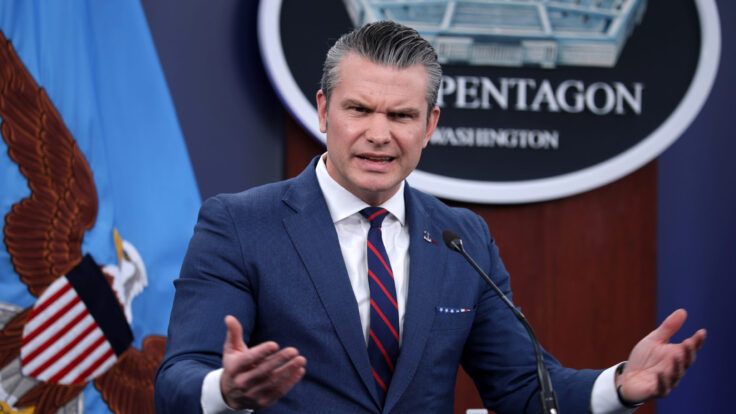
meeting: Dario Amodei’s meeting with Defense Secretary Pete Hegseth on Tuesday morning was cordial enough—no raised voices. Even so, the Pentagon has given Anthropic until E.O.D. Friday to lower its guardrails for military uses of its technology, or risk being forced to do so under the Defense Production Act and designated a supply chain risk. That label is usually reserved for foreign actors and would prevent other government contractors from using Anthropic’s
systems. It’s not exactly clear how much these somewhat contradictory threats would harm Anthropic’s business.At the moment, among the four leading A.I. labs with Pentagon contracts—OpenAI, xAI, Google, and Anthropic—only Anthropic has established red lines around how D.O.D. uses its systems. (Amodei has said he wants to ensure his tech isn’t used
for surveilling U.S. citizens, or for autonomous weaponry without human oversight.) Claude is also currently the only model approved to work with classified material, although a Pentagon official confirmed that other companies, including xAI, are closing in on that designation. But Hegseth’s threats also suggest how much the Pentagon seems to prefer Claude over its competitors.
It seems increasingly unlikely that Amodei will cave, or at least compromise. (He
said in a statement today: “We cannot in good conscience accede to their request.”) And if Hegseth makes good on his threats, things get interesting: Will Anthropic sue the Defense Department to prevent the invocation of the Defense Production Act? Will Anthropic lose its biggest enterprise customers? How will the other hyperscalers compete to satisfy the department’s A.I.
demands? I guess we’ll find out tomorrow. Amodei’s deadline is 5:01 p.m. ET.
- Moratorium wars: As I noted the other week, a new, bipartisan political coalition seems to be forming around opposition to A.I., with a particular focus on data center NIMBYism. Sen. Bernie Sanders has repeatedly called for a moratorium on new
data centers, but he also believes we should curb A.I. adoption overall, given the potentially “catastrophic” impact on the job market. Anyway, proposals for data center moratoriums are popping up in a number of states. There are the usual suspects: New York, Sanders’s own Vermont, and a few counties in Maryland. But proposals are also appearing in Virginia—home to “Data Center
Alley”—Georgia, and Oklahoma.However, Mississippi Gov. Tate Reeves feels differently about the situation. “I understand individuals who would rather not have any industrial project in their backyard,” he tweeted this week. “I do not understand the impulse to prevent our country from advancing technologically—except as civilizational suicide. … We know that being the hub of the world’s most awesome technology will inevitably bring prosperity and authority to our state.”
Mississippi is currently home to about a dozen data centers, and Amazon is
working on a $3 billion expansion in the state. Obviously, Reeves is all for it, but Mississippi residents—specifically those living next to Amazon’s construction site—are less than thrilled. “When I moved out here, it was a peaceful, quiet neighborhood,” one local
told the Mississippi Free Press. “But once all that [development] came, everything went to mess.” According to permits Amazon has already been issued, the two new centers will be home to more than 700 diesel generators, which are, understandably, raising concerns about air pollution.
|
|
|
Ideological screenings are just the beginning of the State Department’s political tests for
new foreign service officers, who must affirm their support for Trump’s executive orders, navigate training seminars monitored by Trump appointees, and demonstrate their “fidelity” at every turn.
|
|
|
Last summer, a new cohort of aspiring foreign service officers sat for the standard written exam required to
enter America’s diplomatic corps. They got their scores and their rankings, and then they waited. In the past, the top-ranked candidates were basically guaranteed to receive offers, with decisions sent out by August. But August came and went, and as applicants watched the Trump administration decimate the State Department workforce, they began to wonder if there would be a new class of foreign service officers at all. Did a White House that had essentially outsourced
Marco Rubio’s job to Steve Witkoff and Jared Kushner even need diplomats anymore?
Then, on September 5, the State Department announced that it had scrapped the old foreign service test in favor of a new, Trumpier alternative. An unnamed State official
told The Daily Caller that the exam was updated to ensure that hiring was “merit-based.” The old one, they contended, was “riddled with D.E.I. principles,” such as asking applicants whether they were drawn to other cultures or people whose first language wasn’t English. To some, those questions might have been meant to reveal the
kind of curiosity required of a diplomat. For the Trump administration, however, the queries were “designed to exclude some ordinary Americans from the Foreign Service based on their upbringing.”
|
|
|
A MESSAGE FROM OUR SPONSOR
|
Freight rail is a leading investor in America’s future
America’s Class I railroads invest $23 billion every year to strengthen and safeguard the nation’s rail network — a level of capital spending that’s six times higher than the average U.S. manufacturer as a share of revenue.
These investments modernize critical infrastructure, train employees, and drive safety innovations. From advanced intermodal hubs to
upgraded tracks and new customer site development, freight rail is building a safer, faster, and more reliable supply chain — ensuring customers and communities benefit from long-term, sustainable growth.
Learn more at aar.org/americas-engine
|
|
|
So after waiting all summer, the applicants were told they had to take the exam all over again. Their old
scores were voided, their rankings lost. And what was in the new test? For one thing, there were no more essays. That meant there was no space for applicants to explain their backgrounds and motivations for applying to the foreign service, or the sometimes winding routes they had taken to get there. Gone too was the section on situational judgment, which asked applicants to choose the best and worst approaches to a thorny scenario. Instead, the test was mostly multiple choice, including
questions about the American political system and a “logical reasoning” section, heavily inflected with statistics. (A website that sells its test-prep services for the foreign service exam says the new FSOT is “part Jeopardy, part SAT, and part LSAT.”)
There were also new kinds of questions about the current president’s policies. “It was a series of
questions like, Trump, in April 2025, instituted this executive order. Do you agree or disagree with this E.O.?” one source with knowledge of the test told me. “It was testing your knowledge of this administration, but it’s also kind of a loyalty test.”
In the meantime, the State Department was also scrutinizing the orientation process. How, exactly, were America’s future diplomats being onboarded and trained? The new administration decided it would leave nothing to chance. When
a runt class of about 60 people went through orientation in September, they were told that there was an addition to the class— Louis Galarowicz, a new special assistant to the foreign service training center and former fellow at the Christian conservative John Jay Institute in Philadelphia. He was there to keep an eye on things, one source with direct knowledge told me.
Another senior State Department source who interacted with Galarowicz during this time told me he went by “Louie G.” and that his role “was to ensure that the right things were taught and the wrong things weren’t taught. And to identify those who may not be fitting into the mold.” (The State Department did not respond to a detailed request for comment.)
|
The foreign service is the face of America’s presence overseas. Established by Congress in 1924, it was
intended to be a professionalized, apolitical cadre of diplomats. After years of contending with the “male, pale, and Yale” label, the foreign service was required by the Foreign Service Act of 1980 to reflect the variety of the United States population. To achieve this, the State Department created, among other things, the Diplomats in Residence program.
This program sent foreign service officers to universities across the country for two-year stints, where they taught and introduced
students to the idea of a career in American diplomacy. Many of these students had never heard of the State Department, let alone what it did. Some of the diplomats in residence were at HBCUs, like Howard, Spelman, or Florida A&M. Others were geared toward reaching broader geographical populations in the South (Tulane and U.N.C.), the Midwest (University of Pittsburgh, Michigan), and the West (University of Arizona, University of Colorado, U.S.C.). The goal was to keep a flow of applicants into
the foreign service that represented the ethnic, geographic, and socioeconomic diversity of the country, so that the face of America overseas would actually look like the America back home.
The testing and training regimen, too, was designed to select for and develop both the intellectual rigor and social tact that diplomats need to navigate complex situations in foreign cultures. To account for the fact that not everyone comes from sterling academic pedigrees or straightforward paths,
the Biden administration had moved the essays to the top of the test, giving applicants the space to explain any challenges they had encountered along the way.
But as with everything else, it all changed under Trump. The president was bent on radically transforming every American institution, and the way in which America chose and trained its diplomats was no exception. In fact, the State Department was treated with special vitriol. In part, this is because the foreign
service’s historical independence and professed apolitical orientation were anathema to a president who believes that loyalty is paramount and everything is political. But it’s also because the foreign service naturally attracts liberal-minded people, the sort who are curious about the wider world and how to change it for the better. And the new administration was not impressed by claims that State Department employees compartmentalize the personal and the professional. Last July, when
Trump officials introduced “fidelity” as a criterion that diplomats need to demonstrate for promotion, everyone understood the implication: political fidelity.
That same month, the State Department eliminated the Diplomats in Residence program. Other initiatives, like the Pickering Fellowship, at Howard
University, were effectively killed. A highly competitive fellowship for underserved (mostly Black and Hispanic) students, it was once a pipeline into the foreign service, but has now stopped accepting new applications. Of the Pickering fellows who placed on the register after sitting for the foreign service exam last fall, only a fraction got job offers, a drastic and glaring departure from
precedent.
Instead, the State Department has turned to the Ben Franklin Fellowship for recruitment. The B.F.F., which is affiliated with the Heritage Foundation, aims to be a kind of Federalist Society for the foreign service. It was founded under the coded banner of “meritocracy” and supporting the America First agenda, but word around Foggy Bottom is that it is the
group to join if you want to advance in your career—which perhaps explains its explosive growth in the past year. The B.F.F.s have already held a recruitment event at Liberty University’s Jesse Helms School of Government. “They want to say, ‘Nobody is joining the foreign service under Biden’s rules,’” a senior diplomat involved in recruitment told me. “‘We’re
picking our people our own way.’”
|
Many Staties were terrified that the revised service exam would become a test of “fidelity,” that to do well
you would “have to pretend to be Stephen Miller while taking it,” one of them told me. But those fears turned out to be largely overblown. People who have actually taken the new test told me that, with the exception of the questions about Trump’s executive orders, most of it consisted of boilerplate questions about the American political system and the history of U.S. foreign policy. (I took the practice test online and can confirm that the questions are more like historical
trivia—alongside statistics and grammar—than a quiz on the philosophical pillars of MAGA and the greatness of Trump.)
|
|
|
Of course, some worry the written exam may be a red herring. “There’s nothing in the written exam that could
be blatantly politicized; they’re not going to leave fingerprints,” said Eric Rubin, a retired veteran diplomat and the former head of AFSA, the foreign service union. Instead, he suggested, it’s the oral exam that is more easily politicized. The previous version, called the Qualifications Evaluation Panel, assessed candidates’ abilities to negotiate and work with others. But “no one knows what’s in” the new version, according to the senior diplomat. (In fact, it hasn’t
been rolled out yet.) “And there’s a lack of visibility on who’s going to be grading these exams.” Current and former foreign service officers are concerned that this part of the exam, as well as the opacity about scoring—unlike in the past, applicants don’t get a score back—might be a way to select for MAGA loyalists, rather than the most-qualified potential diplomats, all under the guise of meritocracy. (According to two sources, Patrick Slowinski, a retired F.S.O.,
conservative podcaster, and lecturer at Liberty University, has been brought out of retirement to oversee the oral exam process.)
Ironically, the ability to beat this sort of loyalty test might be the greatest indication of a liberal-minded candidate’s capacity to thrive in complex political environments. “These kids are not stupid,” the senior diplomat said. “Those who have come in the September and January classes have demonstrated the sophistication of understanding that they’re going
to be subject to the kabuki theater of the screening process, and that they need to say the right thing—or not say the wrong things—so that minders aren’t tipped off.”
|
In the end, the January 2026 class was a large one: over 200 future diplomats and specialists, the latter
including doctors, security personnel, and building managers. This is telling in the context of last summer’s mass layoffs at the department. It wasn’t that the department needed fewer diplomats, it turned out. It just needed different ones. After firing the hundreds of experienced officers who had, in the MAGA view, been woke and anti-Trump, the administration quickly started replacing them with people they deemed to be America First patriots who would push Trump’s agenda
abroad for decades to come. “The great replacement,” one former diplomat joked ruefully.
When the new class finally arrived in Arlington last month for orientation, they found a process transformed. The course had been shortened, classes had been cut, instructors fired. No more squishy stuff about feelings and brainstorming, just top-down instruction. AFSA, the foreign service union that had once been so crucial to the onboarding process, had been stripped of recognition and bargaining
rights, and barred from the premises. Its officers have been left to stalk the entrances and hold shadow happy hours nearby, hoping to lure over some of the new recruits.
Instead, orientation has been dominated by officials from the seventh floor—“very hands-on,” according to one source—constantly changing the schedule, adding or removing speakers, and auditing sessions. (A second source with direct knowledge confirmed this.) Louie G. has disappeared, but a new minder has replaced him: a
foreign service officer named Darren Thies, currently serving as a special assistant to Michael Rigas, the deputy secretary of state for management and resources. When a fellow senior foreign service officer spoke to him, they noted that “he seemed rather apologetic.”
The incoming class was spared one indignity, however. Late last year, when he was still in charge of human resources at State,
Lew Olowski floated the idea of a physical fitness test: New recruits would do push-ups and run, and those who couldn’t would be booted. “My interpretation?” said a diplomat familiar with the discussions. “They don’t want fat foreign service officers.”
This proposal was quickly tabled, however. The foreign service is not the military, and, as one
former State Department official told me, “we’re a pretty dweeby bunch.” More importantly, the department’s lawyers pointed out that mandatory fitness standards could have triggered lawsuits under the Americans With Disabilities Act. “Saner heads are slowly prevailing, but it’s an indication of the zealotry going on there,” said the senior diplomat who works in recruitment. “You simply can’t make people drop and give you 50 in the middle of orientation.”
In the end, a fitness test was
offered at the orientation—but on a voluntary basis. Every afternoon, there is a workout class for those willing to join.
|
That’s all from me, friends. I’ll see you back here next week. Until then, good night. Tomorrow will be
worse.
Julia
|
|
|
Join Emmy Award-winning journalist Peter Hamby, along with the team of expert journalists at Puck, as they let you in on the
conversations insiders are having across the four corners of power in America: Wall Street, Washington, Silicon Valley, and Hollywood. Presented in partnership with Audacy, new episodes publish daily, Monday through Friday.
|
|
|
Need help? Review our
FAQ page or contact us for assistance. For brand partnerships, email ads@puck.news.
You received this email because you signed up to receive emails from Puck, or as part of your Puck account associated with {{customer.email}}. To stop receiving this newsletter and/or manage all your email preferences, click here.
|
Puck is published by Heat Media LLC. 107 Greenwich St., New York, NY 10006
|
|
|
|