Hello and welcome back to The Best & The Brightest. I’m Leigh Ann
Caldwell.
Before we get started, a quick reminder that I’ll be sitting down this week with Oscar-winning director Kathryn Bigelow and screenwriter Noah Oppenheim for an exclusive screening of their new thriller, A House of Dynamite; a Q&A session; and a swanky reception. The event, hosted by Puck and our partners at Netflix, takes place this Wednesday at 6 p.m. at the Navy Memorial in Washington. R.S.V.P.
here!
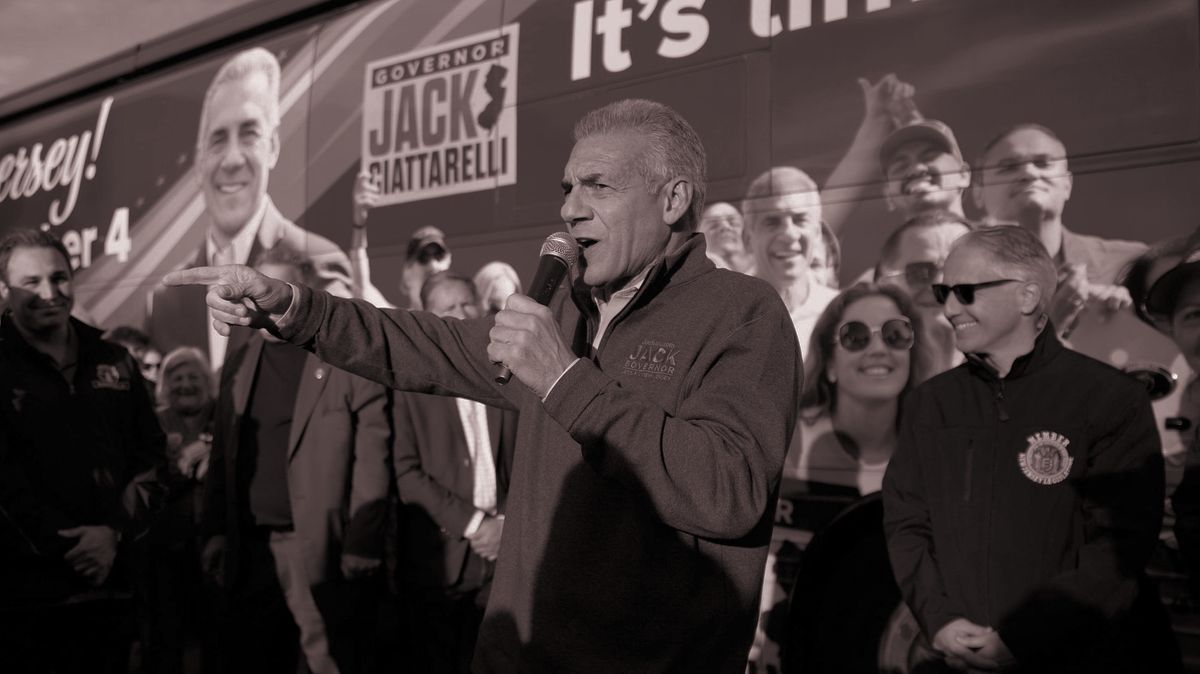
Also, don’t miss me tomorrow night on NBC News, where I’ll be breaking down all the election results—including what we expect will be easy-ish Democratic wins in the California redistricting battle and the Spanberger and Mamdani races in Virginia and New York City. Less certain is the New Jersey gubernatorial race between Democratic Rep. Mikie Sherrill and Republican Jack
Ciattarelli, which remains somewhat close, giving Republicans a very small shred of hope that the Garden State could go back to a Republican governor. Sherrill, that rare helicopter-pilot-Montclair-mom, can’t quite pull away from the repeated runner-up in a state that moved significantly rightward in ’24. (Ciattarelli ran in 2022, nearly topping now-outgoing Gov. Phil Murphy.)
Sherrill has mostly held a single-digit lead, at times within the margin of error,
and Republicans are anxiously watching to see how working-class voters and Hispanics, with whom Trump made inroads last year, will turn out. The problem, of course, is that New Jersey is the nation’s densest state, filled with constituencies that play on every trope, from Christine Todd Whitman Republicans and the heroes and heroines of Springsteen and Lauryn Hill fables, to the Ivy League liberals of Princeton and the immigrant
workers of Bedminster. So, yes, this small coastal state—which serves as a suburb of both Manhattan and Philadelphia, and also gave rise to Bridgegate and Bob Menendez—is complicated beneath its image as a reliably blue stalwart.
To figure out what might go down on Tuesday, my partner Abby Livingston chatted with Mike DuHaime, the veteran G.O.P. consultant, to get a better picture of the demographic shifts on the ground.
|
|
|
Last year, Instagram launched Teen Accounts, which default teens into automatic protections. Now, a stricter “Limited
Content” setting is available for parents who prefer extra controls. Instagram will continue adding new safeguards, giving parents more peace of mind. Learn more. |
|
|
But first, some news and notes around the Puckverse… |
|
|

| William D. Cohan
|
|
- Another Trump-adjacent
curio: Wall Street has been atwitter from the recent near-collapse of the stock of Fiserv, which provides backend technology for banks and payments providers. Fiserv, formerly known as First Data, was a KKR buyout once upon a time. But a very disappointing third-quarter earnings release on Wednesday resulted in new management slashing its full-year earnings projections, and the Fiserv stock tumbled 44 percent in one day, flushing some $30 billion in market capitalization in the process. The
stock was down 47 percent for the week, and the company’s market value now stands at $36 billion.
Wall Street took note that the former longtime C.E.O. of Fiserv was Frank Bisignano, the Jamie Dimon acolyte whom Trump named to head both the Social Security Administration and then the Internal Revenue Service. When Bisignano joined the administration in May, after being confirmed by the Senate, he sold his 3.3 million Fiserv shares for more than $500
million, and was able to defer the capital gains tax on those shares by buying Treasury securities. (This is one of the major perks for corporate titans to encourage them to give up their lofty perches and enter government service.) Those 3.3 million shares would be worth $220 million today. “To see a company that, 12 months ago, had a sterling reputation fall off like this and finish the day down 44 percent, it is the most shocking earnings print I’ve had in my time covering the space,”
Nate Svensson, a fintech analyst at Deutsche Bank, told the Financial Times. “Leaving aside what’s happening with the financials, that is not something you can wave the magic wand and fix overnight.”
The company dutifully announced it was replacing its chief financial officer and several of its directors, including the board chairman and the head of its audit committee. Mike Lyons, who replaced Bisignano as C.E.O. in May, after joining Fiserv in
January from PNC Financial, told analysts that he decided to “reset” analysts’ expectations for the company after reviewing and then rejecting steps Bisignano had taken to achieve certain short-term goals.
“Frank routinely laid people off, deferred investments, and cut costs to meet quarterly earnings targets,” one longtime Fiserv analyst told me. He continued: “I think [Lyons] has finally woken up to the fact that Frank handed him an egg.” This analyst wondered aloud whether this sort of
reset, with the corresponding collapse of the stock, might prompt federal scrutiny, but then offered his guess that “the D.O.J. is not going to pursue him.” (A spokesman for the Treasury Department—Bisignano reports to Treasury Secretary Scott Bessent—did not respond to a request for comment.)
|
|
|

| Dylan Byers
|
|
- The Bari method: In
recent weeks, as Bari Weiss begins her transformation of CBS News, she has been reaching out to multiple anchors and correspondents at Fox News, CNN, and elsewhere, as well as their agents, to see whom she might lure to the network. At times, it seems she is merely information-gathering or blue-skying a fantasy roster of on-air talent. In several instances, however, she has had real discussions about the feasibility of their transfer. Her targets have included Fox News anchors
Bret Baier, Bill Hemmer, and Dana Perino, as well as CNN analyst Scott Jennings; and, as I reported earlier this week, she has also discussed expanding Anderson Cooper’s role at the network beyond 60 Minutes.
In an industry where talent acquisition
has its own set rules of engagement, Bari’s instinctive and freewheeling approach has struck many as unorthodox. To many TV news veterans, it is also seen as a sign of her inexperience and lack of managerial finesse. Network executives lock their talent into yearslong contracts—Anderson’s runs through 2026, Bret’s into 2028, and Dana’s into the 2030s—and include specified negotiation windows that don’t open until the final three to six months of the agreement. Savvier network leaders tend to
re-up their stars before that window ever opens. Getting out of these contracts isn’t impossible, of course, but it doesn’t happen on a whim—and it usually requires quite a bit of discretion. Continue reading…
|
|
|
And now on to the main event… |
|
|
A candid chat with Mike DuHaime, the veteran New Jersey Republican consultant, on the brink
of the Sherrill–Ciattarelli throwdown in the Garden State. |
|
|
New Jersey Republican consultant Mike DuHaime helped elect George W. Bush
and worked on John McCain’s presidential campaign, but he’s perhaps best known as New Jersey Gov. Chris Christie’s political brain. Even Jersey Democrats will privately admit that he’s one of their most frustrating political foes. So he was exactly the guy I wanted to chat up regarding the one great unknown of this election cycle: the Garden State gubernatorial battle between Mikie Sherrill and Jack Ciattarelli. We
spoke today about the factors at play in the off-year’s most interesting race, including the effect of the shutdown, whether Democrats remain in the wilderness, and the all-important voters of Passaic County—a diverse area sandwiched between commuter enclaves and yet psychically a million miles away. As usual, this conversation has been lightly edited and condensed for clarity. |
Abby Livingston: What’s the most
interesting thing in New Jersey one day out from Election Day?
Mike DuHaime: This is the second time we’ve had early [voting], so we can analyze what turnout is going to look like in a way we haven’t really been able to before. Is the composition of the electorate different than in previous years? Is there a change in voter behavior, with Trump voters coming out? Right now, it doesn’t look very different in terms of Democrats, Republicans, and unaffiliated.
|
|
|
Instagram Teen Accounts default teens into automatic protections for who can contact them and the content they can
see.
Nearly 95% of parents say Teen Accounts help them safeguard their teens online. And we’ll continue adding new protections, giving parents more peace of mind. Explore our ongoing work to keep teens safe online. |
|
|
Because the early vote looks lopsided for Democrats, the question is whether Ciattarelli will get
those unaffiliated voters and persuade some Democrats to vote Republican.
It’s always lopsided for Democrats. When Jack lost the last time, he won the Election Day vote by 220,000 votes. There’s still a hesitancy among many Republicans to vote by mail or cast early votes. So Jack is going to get a lot more voters out on Election Day. The question is, did the Democrats build up a big enough firewall in this early vote and vote-by-mail time frame?
The second thing is, is he
getting enough crossover votes? Because there are 850,000 more Democrats than Republicans here. Is there enough of a change in terms of getting those? When Governor Christie won in 2009, he won unaffiliated voters by 30 points, and he only won the election by four. So you need to pick off some Democrats and win those unaffiliated overwhelmingly.
Another question right now: Is this going to reflect a more polarized electorate under Trump, which doesn’t always help Republicans? Or can Jack
get the benefits of the Trump surge while also getting some of those traditional crossover votes that Republicans who win in New Jersey get? It’s generally about white working-class voters. Trump also did a lot better with nonwhite working-class voters—can Jack get some of that?
Republicans have been losing ground with these more moderate affluent voters who were strongly Republican and have drifted away from Trump. Can Jack get them back because he’s more of a moderate centrist
Republican as opposed to a kind of caricature of a D.C. Republican? |
Everyone in the final days is closely watching Passaic County. I spent a lot of time in Passaic in
2012. It was as Democratic as it gets. What has changed there?
It’s my home county, so I know it well. It has been strictly Democratic for probably more than 20 years. It has a core urban area, but it also has some suburbs. In the past, there was always the question of whether the Republican suburbs could out-vote the Democratic core areas. And in recent years, as the Republican Party has done worse and worse in the suburban areas, the county hasn’t even been competitive. But
now, interestingly enough, we’re doing a little bit better in the suburban areas, but we’re also not losing by as much in the urban areas. Trump actually won it last time.
It’s the most heavily Hispanic county in the state, and Trump has done so much better with Hispanic voters than anyone else. It’s also got a heavy Middle Eastern population. It’s got many more Muslim voters than any other county in the state, and they’re tending to vote more conservative as well. So it’s interesting
because it’s so diverse. Typically, Republicans don’t do well in diverse counties, but we are doing well, and when we do well here, we win.
Has the shutdown been a gift to Mikie Sherrill as a sitting congresswoman since she didn’t have to be in Washington for votes?
I hadn’t thought of it that way, but that’s a good point. I ran a race for a congressman once who was running for U.S. Senate. I hated when he had to go to Washington because I felt like every parade or
barbecue or street festival or diner we could stop at was more important than any vote in Washington. As a campaign operative or scheduler, you have two resources that matter more than anything else: money and a candidate’s time. So when you get more of a candidate’s time, that’s a big deal. That’s a good point. |
|
|
Does Mamdani’s race for New York mayor have any impact on the New Jersey governor’s race given that
TV spills over into these airwaves?
It does, but I don’t know if it’s gonna be the difference. I feel like 75 percent of New Jersey is in the New York media market, so it touches a lot of the state. When New York starts to fall apart, that affects New Jersey. There were moments where they were tying Mamdani to Sherrill a little bit more, but I feel like that’s passed. If the race is decided by 10,000 votes, maybe. But if it’s a more traditional margin, I don’t
think we’ll point to Mamdani as the reason. |
The
Midterm Prognostication
|
What is it about Jersey that makes this the more interesting race than Virginia this
year?
We have a better candidate in New Jersey. Republicans have the governorship in Virginia. It’s actually far worse for Republicans to lose Virginia than New Jersey because Virginia is more of a purple state. New Jersey is unique because it is so blue, but Trump did make some gains, and Ciattarelli made some gains last time. We’ve only had one statewide candidate win in the last 25 years, so when you win New Jersey, it’s a big deal.
And historically, Jersey has presaged
the big elections for Republicans. When Christie won in 2009, 2010 was a big year for Republicans. When Christine Whitman went in, in 1993—also when Rudy won in New York—there was a huge year for Republicans in 1994. So maybe more so than Virginia, if Republicans win here, it’s indicative that something is truly changing.
Are Democrats still in the wilderness, or are they learning lessons over the course of this campaign?
Maybe
I’ll tell you on Wednesday. I give Democrats credit for nominating these two candidates in Virginia and New Jersey. I mean, Mikie is squarely in the middle of the Democratic field—there were six candidates, and she was basically in the middle. She had multiple candidates to her left and multiple to her right. The mayor of Jersey City, the mayor of Newark, and the head of the teachers union were to her left, and Democrats opted for somebody a bit more centrist. That was smart. |
|
|
Join Emmy Award-winning journalist Peter Hamby, along with the team of expert journalists at Puck, as they let you in on the
conversations insiders are having across the four corners of power in America: Wall Street, Washington, Silicon Valley, and Hollywood. Presented in partnership with Audacy, new episodes publish daily, Monday through Friday. |
|
|
Unique and privileged insight into the private conversations taking place inside boardrooms and corner offices up and down Wall
Street, relayed by best-selling author, journalist, and former M&A senior banker William D. Cohan. |
|
|
Need help? Review our
FAQ page or contact us for assistance. For brand partnerships, email ads@puck.news.
You received this email because you signed up to receive emails from Puck, or as part of your Puck account associated with {{customer.email}}. To stop receiving this newsletter and/or manage all your email preferences, click here.
|
Puck is published by Heat Media LLC. 107 Greenwich St., New York, NY 10006 |
|
|
|