Welcome back to Wall Power, sports fans. I’m Marion
Maneker.
With two of the world’s richest men—Elon Musk and Jeff Bezos—obsessed with opportunities in space, it should not surprise us that there’s a growing market for memorabilia from beyond the earth’s orbit. Tonight, George Nelson is back with a pre–Geek Week report on the fascinating legal entanglements that have previously held back the market for artifacts from the final frontier.
Up top, I’ve got a few recent
announcements about fall exhibitions in London, Paris, and Palo Alto, and the Hirshhorn Museum is working with Art Bridges to bring more art to every state in America.
But first… |
The Art of
Influence, September 23 at the Bowery Hotel
|
Earlier this week, we announced the second iteration of Puck and the FLAG Art Foundation’s Art of
Influence conference. The event is a safe space for art advisors, collectors, artists, and others in the industry to speak freely about the challenges and opportunities facing the art world. This year’s conversation will include Christie’s C.E.O. Bonnie Brennan; Pace Gallery founder and chairman Arne Glimcher, with C.E.O. Marc Glimcher; Metropolitan Museum of Art trustee Jen
Rubio; and founder of Siren Projects Sophia Cohen. FLAG founder Glenn Fuhrman and I will moderate. (More speakers will be announced in the coming weeks.)
Buy your ticket here.
Also mentioned in this issue: George Condo, Salman
Toor, Albert Bierstadt, Thomas Eakins, Arthur Jafa, Alex Katz, Willem de Kooning, Lee Krasner, Georgia O’Keeffe, Yoko Ono, Christian Marclay, Christina Quarles, Mark Rothko, Andy Warhol, Gustav Klimt, Buzz Aldrin, Cassandra Hatton,
Edgar Mitchell, Jim Lovell, Barack Obama, Nina Ivanovna Koroleva, Sergei Korolev, Brad Palmer, Neil Armstrong, Gary George, Nancy Lee Carlson, Stuart Roosa, and more.
Let’s get started… |
- George Condo returns to Hauser & Wirth: After a brief hiatus, George Condo will be showing with, and represented by, Hauser & Wirth again in 2027. The gallery announced that Condo would have two shows next year—one in its Paris outpost, and the other in their soon-to-be-opened Palo Alto location.
- Salman Toor show at the Courtauld: On October 2, the Courtauld, in London, will open a show of
19 paintings by Salman Toor, the Pakistan-born artist whose work celebrates the intersection of “queer and immigrant lives.” It will be the first solo exhibition for the artist in Europe and will feature paintings all made since 2019.
- The Hirshhorn Museum x Art Bridges: The Hirshhorn Museum will loan works it is currently holding in storage to museums in each of the 50 states and Puerto Rico through a three-year program launched
jointly with Art Bridges, the Alice Walton–founded nonprofit. Some of the museums chosen to participate are in major cities, like Oakland or Queens, but the bulk are in small communities, including Big Horn, Wyoming; Chadds Ford, Pennsylvania; and Shelburne, Vermont. Nearly a third of the participating museums are in towns with populations of less than 150,000, and 20 percent are affiliated with colleges or universities. Albert Bierstadt, Thomas
Eakins, Arthur Jafa, Alex Katz, Willem de Kooning, Lee Krasner, Georgia O’Keeffe, Yoko Ono, Christian Marclay, Christina Quarles, Mark Rothko, and Andy Warhol are among the artists whose work has been requested.
|
|
|
|
With Artemis and SpaceX igniting a renewed sense of energy around the great
beyond, a new crop of collectors are chasing relics from the space race: mission-flown flags, capsule parts, and even meteorites. Once caught in legal limbo, NASA’s wares are becoming the most-compelling historical objects in Sotheby’s Geek Week. |
|
|
|
Of all the blockbuster lots offered at Sotheby’s worldwide auctions this year—from
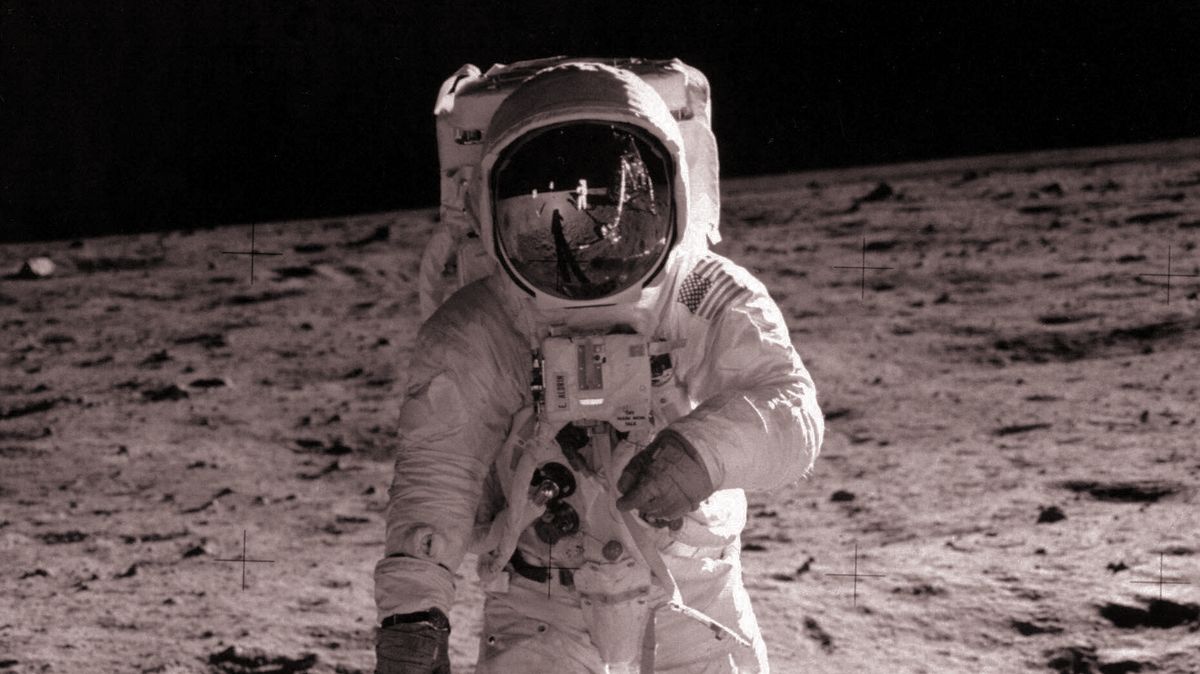
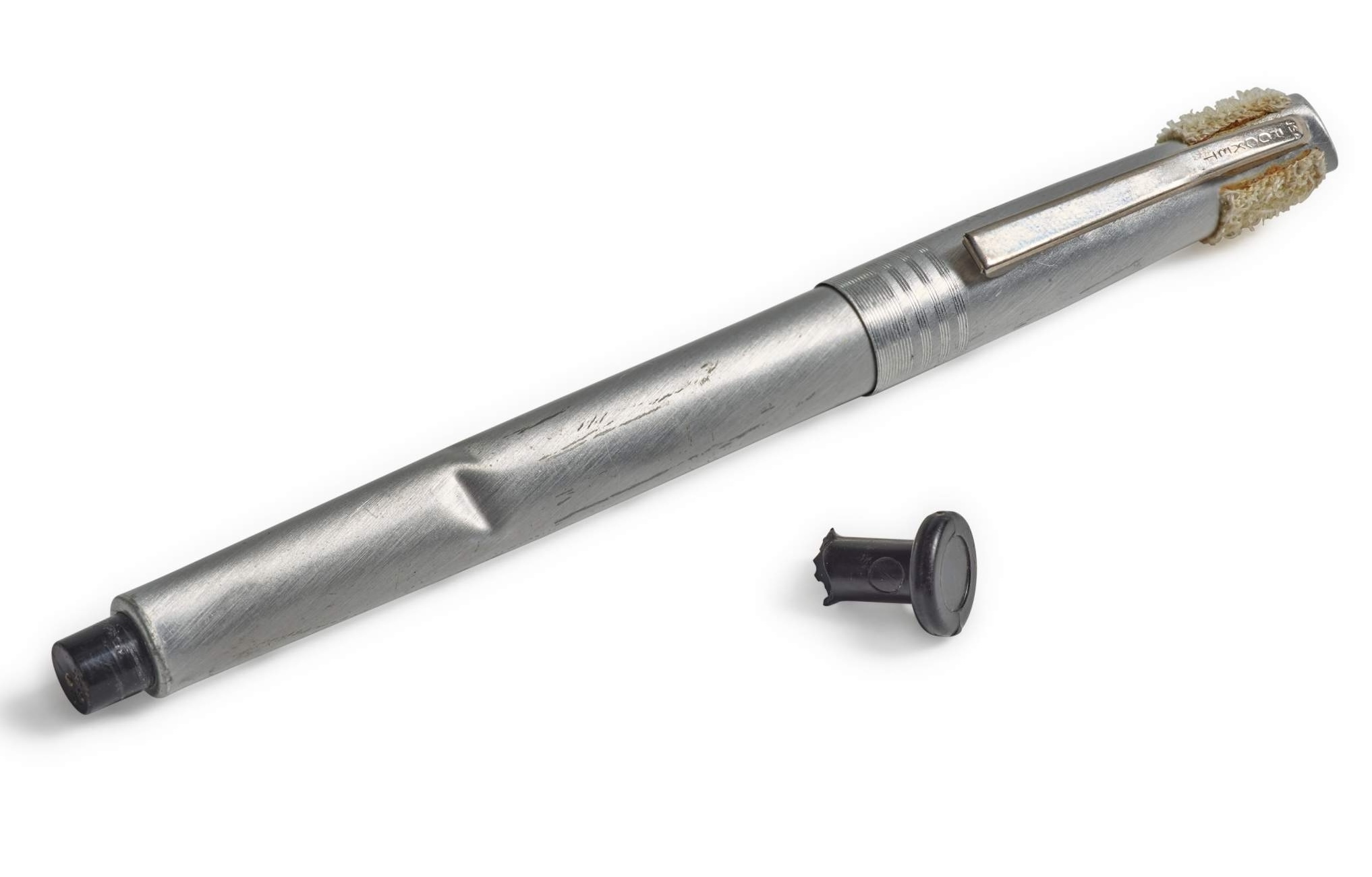
Gustav Klimt masterpieces to $10 million Birkin bags—it may be a simple brushed aluminum pen that is the house’s true M.V.P. The Duro marker carried by Buzz Aldrin on Apollo 11 became an improvised lifesaving tool when a broken circuit breaker threatened to strand the astronauts on the lunar surface. It’s being offered against a $1.2 million high estimate in the live Space Exploration sale that kicks off on July 15. |
The broken circuit breaker switch that nearly ended Apollo 11, and the pen that saved the crew and
the mission. Photo: Courtesy of Sotheby’s |
That auction is part of Geek Week, which features space memorabilia, meteors, and a 38-foot-long
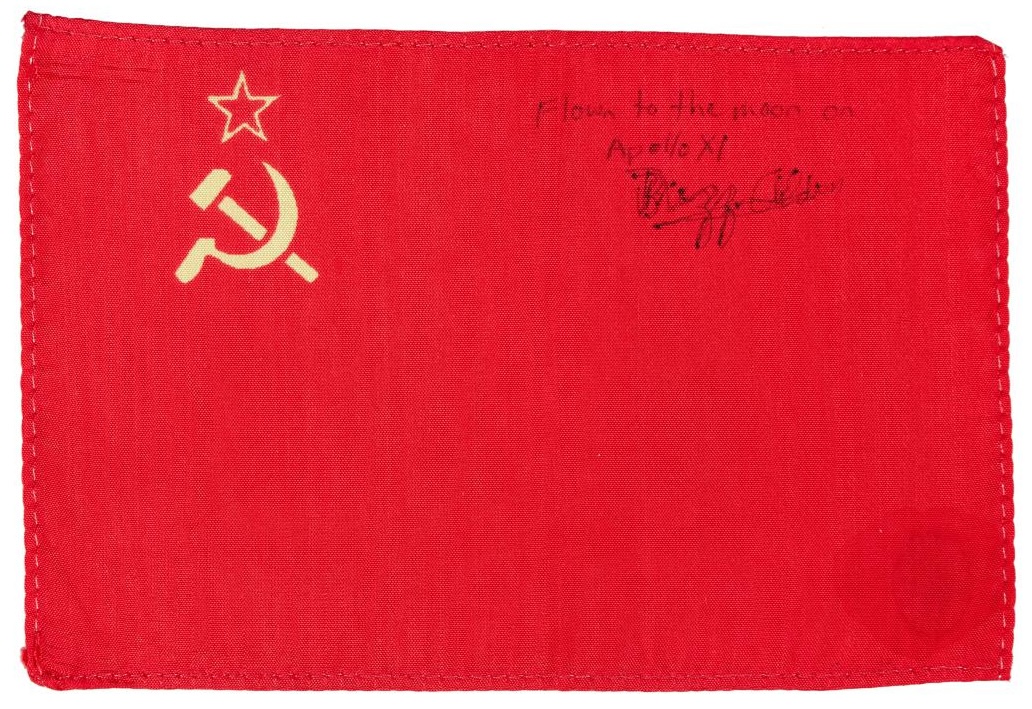
dinosaur skeleton with an estimate as high as $30 million. While dinosaurs tend to dominate the Geek Week headlines—two years ago, Sotheby’s sold a stegosaurus skeleton for $44.6 million—the other two sales, History of Science & Technology and Space Exploration, have their own marquee lots, including a flown Apollo Block II command module pressure hatch from Skylab 3 and the Soviet flag that Aldrin took with him to the moon aboard Apollo 11. (Remember, Nixon made the astronauts
bring the flags of more than 100 nations on their journey.) As Cassandra Hatton, Sotheby’s vice chairman of science and natural history, told me, the market for space-age relics also has a bizarre backstory—one shaped by legal disputes, shifting ownership laws, and a series of NASA administrative blunders. |
For decades, NASA astronauts operated under an informal understanding that certain mission
artifacts were theirs to keep. Over the years, many sold flags, checklists, and other mementos that accompanied them on their missions. But the ownership question was never fully settled until 2012, when Congress formally clarified their rights.
The first major flashpoint came in 2011, after Apollo 14 astronaut Edgar Mitchell consigned to Bonhams a 16mm data acquisition camera that he’d brought back from the moon during his 1971 mission. NASA stepped in to argue that the
camera remained government property. The lot was withdrawn. Mitchell eventually surrendered the camera to the government, which transferred it to the Smithsonian National Air and Space Museum. The issue reached a boiling point the following year, when NASA questioned the planned Heritage Auctions sale of an Apollo 13 checklist belonging to commander Jim Lovell.
Hatton said that NASA’s attitude shifted once the agency and the Smithsonian started to appreciate the
historical significance—and financial value—of the artifacts. “NASA and the Smithsonian realized, ‘Oh my god, these things are super, super valuable historic artifacts. We need to get them back. Why did we let the guys keep these things?’” she told me. “But these astronauts risked their lives and did the most insane thing of basically climbing into a tuna can and being shot off a rocket to the moon knowing they could die. They had regular old salaries. They couldn’t get life insurance. Their
retirement sucked, so the stuff they got to keep from their mission was essentially their pensions.”
Congress eventually intervened. In 2012, President Barack Obama signed HR 4158 into law, giving Mercury, Gemini, and Apollo astronauts ownership rights over the mission artifacts they had kept for decades. The legislation settled the dispute over objects like checklists, personal equipment, and discarded hardware, but drew a hard line around one category: lunar material.
Moon rocks and other samples collected from the lunar surface remain government property and cannot be sold.
The only example of lunar material being legally sold at auction came from the Soviet Union. Three tiny fragments returned by the unmanned Luna-16 mission in 1970 were gifted by the Soviet government to Nina Ivanovna Koroleva, the widow of Sergei Korolev, the architect of the Soviet space program. When Koroleva consigned the samples—weighing just
0.2 grams—to Sotheby’s in 1993, they sold for $442,500 to a private collector.
Brad Palmer, a space specialist at Heritage Auctions in Dallas, told me that the 2012 law “erased any ambiguity” around astronaut-owned artifacts. “Once that happened, they were like, ‘Well, okay, it’s all fair game,’” he said. He said Heritage’s 2019 Neil Armstrong collection represented a turning point for the market, and an introduction to space collecting for people who had
never previously considered it. |
NASA was never the most fastidious archivist. The Apollo 11 tapes are perhaps the clearest example
of how the agency’s own administrative failures helped create scarcity in the space memorabilia market. After the mission, the original recordings of the first moon landing were not treated as priceless historical artifacts. NASA relied on the General Services Administration, the federal agency responsible for the disposal of excess government property, when clearing out old equipment and surplus material. In 1976, a batch of that surplus was sold at auction for just $218. Among the contents
were three reels labeled “Apollo 11 EVA,” which a mechanical engineer named Gary George bought—without realizing that he had just acquired the only surviving original recording of the historic mission.
George initially planned to sell the tapes to television stations, which would have erased and reused them. Instead, his father, a space enthusiast, convinced him to keep the reels. More than three decades later, NASA’s search for the missing Apollo 11 recordings led the
agency back to George, who discovered he had been unknowingly sitting on one of the most important artifacts in space history. He eventually sold the tapes at Sotheby’s in 2019 for $1.82 million.
The lunar sample bag used by Neil Armstrong during the first moon landing to collect moondust is another example of NASA’s complacency. It was mistakenly transferred out of the agency’s possession, ending up in a government auction decades later. A Chicago-area lawyer,
Nancy Lee Carlson, bought it online for $995 without initially realizing its significance. After NASA challenged her ownership in court—and lost—the bag went to Sotheby’s, where it sold for a little more than $1.8 million in 2017. |
The legal uncertainty that once surrounded Apollo artifacts has since given way to a
more-established market. This year’s Space Exploration sale features objects from 96-year-old Aldrin’s personal collection, including his Apollo 11 flown flag, his lunar module pilot’s checklist, and a signed selfie he took with the curvature of the earth in the background. The auction also includes Apollo 14 astronaut Stuart Roosa’s in-flight coverall suit, alongside photographs, medals, and other mission memorabilia. |
Buzz Aldrin’s U.S.S.R. flag, flown to the moon on Apollo 11 in, as the Sotheby’s catalogue notes,
“the spirit of diplomacy.” Photo: Courtesy of Sotheby’s |
Hatton said the appeal of these Mercury, Gemini, and Apollo objects comes down to their connection
to historic firsts. “It’s not the journey that makes it valuable,” she told me. “It’s the fact that they were the first to do it. You’re buying a piece of history that nobody else can replicate.”
When I asked her who was buying space memorabilia, she said the market is being driven by a mix of younger collectors, people with a personal connection to the space race, and, of course, wealthy tech entrepreneurs. “Silicon Valley–type collectors, but also people who remember watching the Apollo
missions as children or had family connections to NASA,” she noted. Whether or not Jeff Bezos—who, in 2013, funded a deep-sea mission to recover Apollo 11’s lost Saturn V engines from the Atlantic Ocean, before donating one to the National Air and Space Museum—bids remains to be seen. |
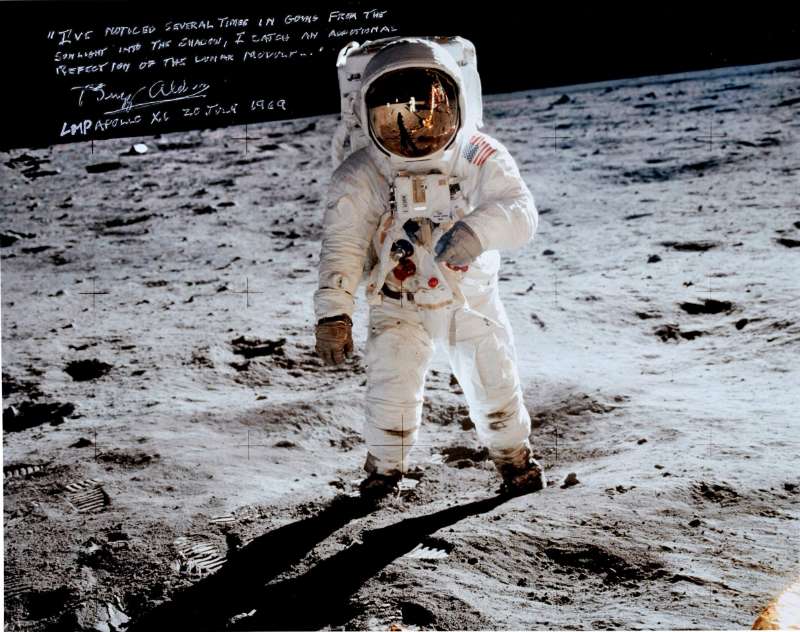
Tranquility Base, photograph signed and inscribed by Buzz Aldrin. Photo: Courtesy of
Sotheby’s |
Palmer told me that as NASA’s Artemis program and future commercial missions gather pace, we’re
likely to see related memorabilia on the market. Still, it’s the space-flown artifacts that generate the most interest. “With space-flown artifacts, which are man-made, there is a very finite supply of objects from the Mercury, Gemini, and Apollo missions,” Hatton explained.
As the most important Apollo material has gradually entered the market, collectors have begun looking for the next category of space-related objects. “You have to think, like in the art market, when you run out
of Old Masters, you look at works on paper or contemporary artists,” she said. “You have to find the next category that excites collectors. Here, meteorites are pretty compelling.” |
Thanks, George. I can see that two lots in Sotheby’s sale have already doubled the estimates in
presale bidding. So I’m curious to see where this goes next week. In the meantime, I’ll be back on Sunday.
M |
|
|
|
Ace media reporter Dylan Byers brings readers into the C-suite as he chronicles the biggest stories in the industry:
the future of cable news in the streaming era, the transformation of legacy publishers, the tech giants remaking the market, and all the egos involved. Also featuring a weekly dispatch from Puck’s crack streaming/media analyst, Julia Alexander. |
|
|
|
|
|
MATTHEW BELLONI & JULIA ALEXANDER |
|
|
|
Need help? Review our FAQ page or contact us for assistance. For brand partnerships, email ads@puck.news. You received this email because you
signed up to receive emails from Puck, or as part of your Puck account associated with {{customer.email}}. To stop receiving this newsletter and/or manage all your email preferences, click here. |
Puck is published by Heat Media LLC. 107 Greenwich St., New York, NY 10006 |
|
|
|
|