Welcome back to Wall Power. I’m Marion Maneker.
The June sales
in London have been a contentious battleground for at least a decade now. I’m not sure that the point of friction was the reverberations of Brexit, as some would have it, but rather the existence of three selling seasons where the other major auction centers have only two. This week, the houses lined up with very different property—and the results tell us a lot about the current shape of the art market. I’ll go into detail on that below.
Up top, Sotheby’s just announced a large collection
for October in New York, which is part of a larger strategy; White Cube opens a show of the work of indigenous artist Sara Flores, who is also featured at the Venice Biennale; and Ken Griffin is mounting a public relations campaign to try to appear less fearsome.
A quick programming note: I’ll be away for a few days starting tomorrow, but that won’t interrupt the publishing schedule. One of the sad realities of the modern world is that we now
have pretty good internet access even in remote locations, but I’ll check in to make sure the newsletter reaches you in a timely way. Then, Wall Power will be off on July 3 and 5. Regular publishing will resume on July 7.
Also mentioned in this issue: Canaletto, Jacob van Ruisdael, Jean-Honoré Fragonard, Francesco Guardi, Max Ernst, Pablo Picasso, Edgar
Degas, Aso Tavitian, Ann Getty, Gordon Getty, Patti Wong, René Magritte, Lucian Freud, Sue Tilley, and more.
Let’s get after it… |
-
Sotheby’s new strategy for big collections: Today, Sotheby’s announced that it will be selling a private collection of more than 900 works spanning antiquities—including a Roman imperial torso—to Old Masters paintings by Canaletto and Jacob van Ruisdael, Jean-Honoré Fragonard, and Francesco Guardi, to modern works by Max Ernst, Pablo Picasso, and Edgar Degas.
The collection will run October 17 to October 22 in an evening auction in New York, along with three other focused sales that are expected to make $60 million or more.
The announcement points to a strategy taking shape that might shift the auction calendar. Sotheby’s has limited space in the Breuer Building; it’s better suited to these kinds of collections than the big crush of the May and November sales. With the success of the de Gunzburg sale in New York in April, and
the Karpidas sale in London last September, Sotheby’s continues to push the auction calendar away from convening sales cycles and toward special events surrounding large or consequential collections. The question is whether an anonymous collection can draw interest the way that collectors like Aso Tavitian or Ann and Gordon Getty did.
|
|
|
|
A MESSAGE FROM OUR SPONSOR |
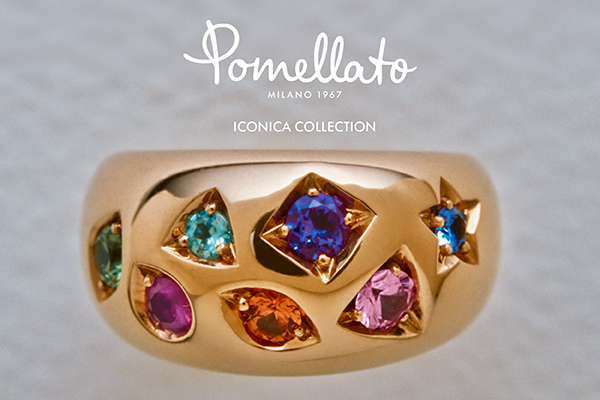
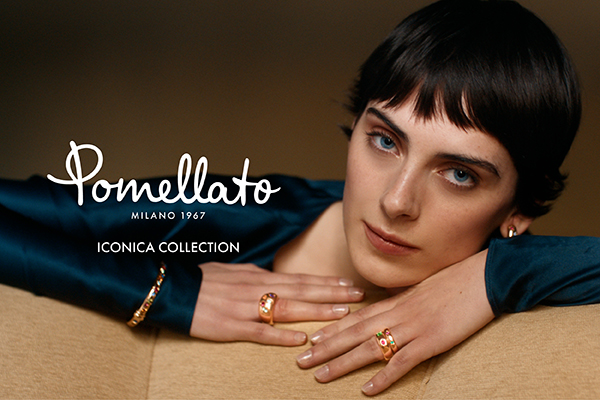
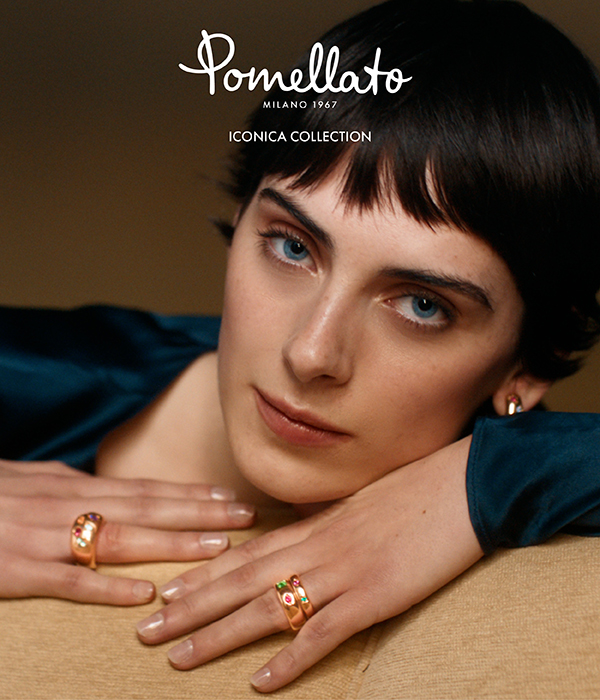
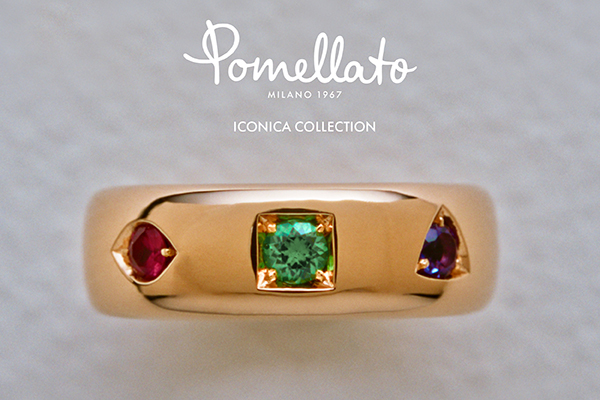
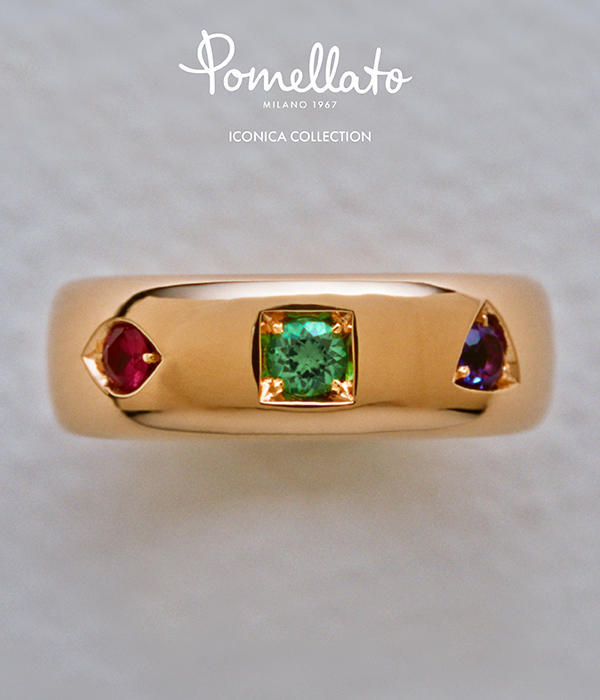
A New Facet of Iconica Long celebrated for its bold volumes and sculptural gold, Iconica reveals a new expression with vibrant gemstones. Crafted and polished by hand, each ring maintains the collection’s signature form while introducing flashes of ruby, emerald, sapphire, amethyst, and tsavorite. Set in carefully composed trios, the stones add depth, movement, and a contemporary edge to Iconica’s unmistakable silhouette. |
|
|
|
- The Griffin charm offensive: It looks like Ken Griffin is responding to that Mamdani pied-à-terre video with a full-blown charm offensive. First, there was a detailed New Yorker profile. Now, The New York Times is following up with a walk-through of Griffin’s
Basquiats at PAMM in Miami, where the trading titan allows himself to be the punchline in a dinosaur joke. The effect of the campaign, of course, is to make Griffin less remote and more, well, relatable. At one point, he shifts the focus of his art collecting from its cost to the emotional effect: “If you’re thinking about art just as, What’s the price tag on that painting, you’re missing the point. It should be: What’s it make you feel?”
|
Sara Flores at White Cube
|
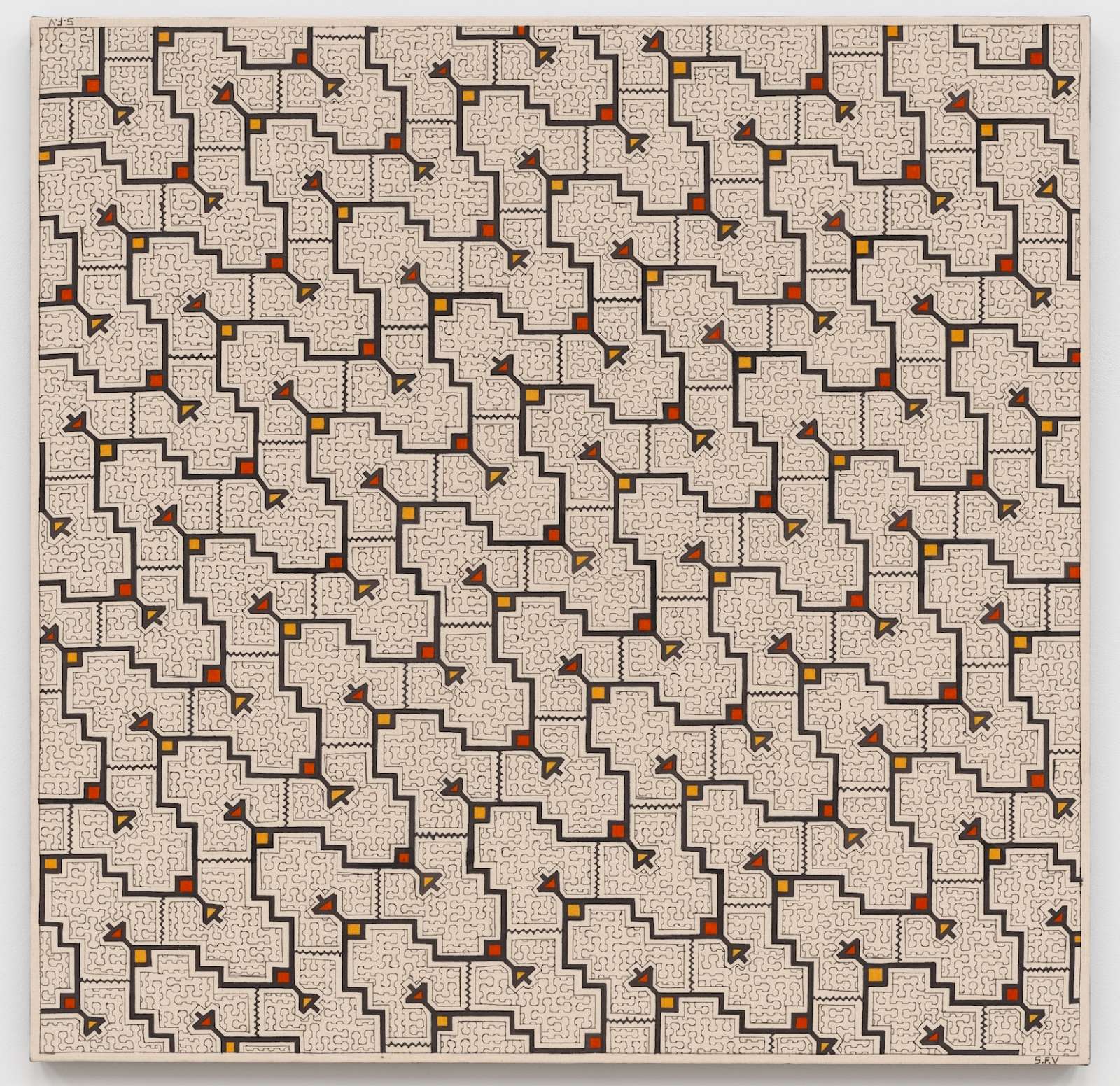
Sara Flores, Untitled (Punté Kené, 2026). Photo: Frankie Tyska/Courtesy of White
Cube |
A few weeks ago, I was walking past the magnificent vitrines at the Princeton University Art
Museum, where there are arrays of pottery from a broad expanse of cultures and time periods, when I stopped in front of this Shipibo-Conibo vessel decorated with an abstract pattern that I immediately recognized. Made in the late 20th century, the ceramic was similar to the paintings of Sara Flores, the artist currently representing Peru at the Venice
Biennale. I had seen Flores’s work at art fairs over the past few years and, this winter, in the home of a major collector.
As is the case with Aboriginal artists from Australia, her work is immediately recognizable for its distinctive use of abstract patterns—part of a cosmology of the Shipibo-Conibo Indigenous group from the Amazon rainforest. Kené, as the design system is called, features in “shamanistic medicine, healing rituals, the consuming of psychoactive drugs and singing of
songs,” as the writer Charles Darwent notes in an essay commissioned by White Cube for a new show of Flores’s work, which just opened on Madison Avenue. The Shipibo-Conibo mostly make their Kené patterns on pottery, their skin, or textiles, but Flores has been using natural materials to dye cotton canvas and stretch those patterns on frames like paintings. The resulting works don’t reproduce well in photos, but in person they are intricate and enthralling.
The
show of 14 works, mostly made in the past year or two, captures the many subtle variations in color, hue, and pattern that characterize her output. Flores’s abstractions contain a number of leaflike filigrees and undulating repetitions that can be either hypnotic or boldly graphic. At 76, Flores has only had her work widely shown this decade. If you
see the show, you’ll understand why it needs more exposure.
Now, let’s get to the main event… |
|
|
|
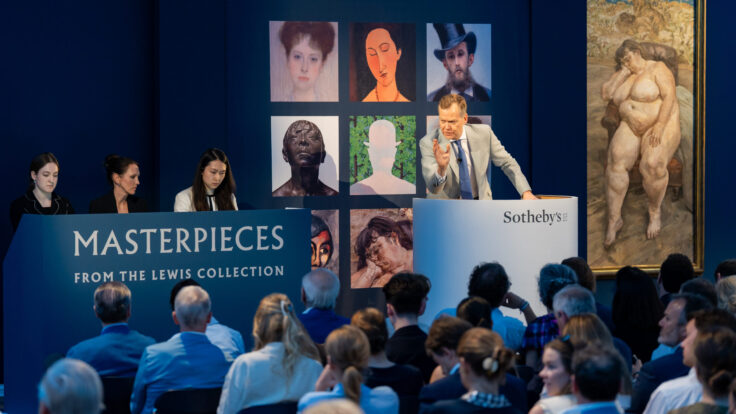
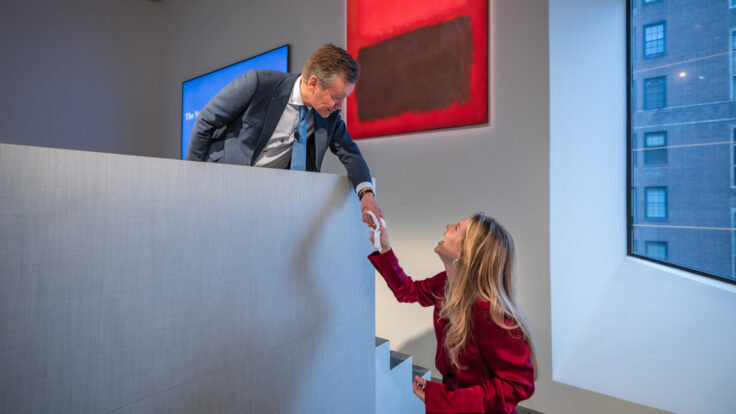
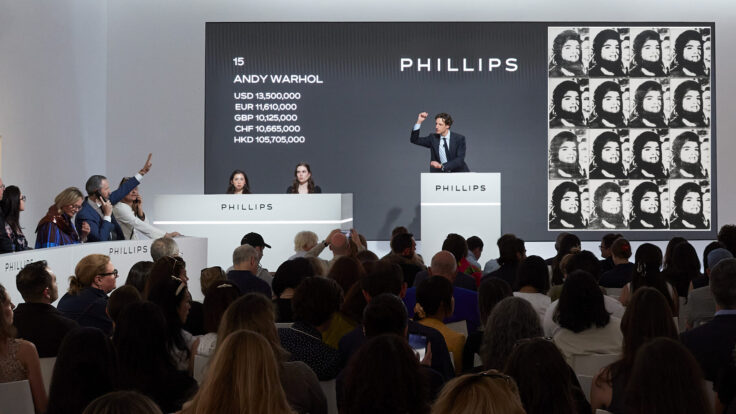
In London, the £306 million Joe Lewis collection at Sotheby’s was a big shot in
the arm—but a closer look at the results suggests the market is still treading water. Meanwhile, over at Christie’s, the Zabludowicz collection underscored the inescapable power of inflation. |
|
|
|
This week’s sales in London were interpreted by some as London fighting back against
Brexit. But that’s not really what’s going on. Sure, the U.K. arms of the auction houses are taking a page from their New York cousins and focusing on big-name collectors whose taste and reputations can drive attention. But a closer look at the numbers suggest the market is still treading water, even if the sales were able to drive attention back toward London as a tastemaking capital of the international art market.
The Joe Lewis collection was this week’s biggest shot
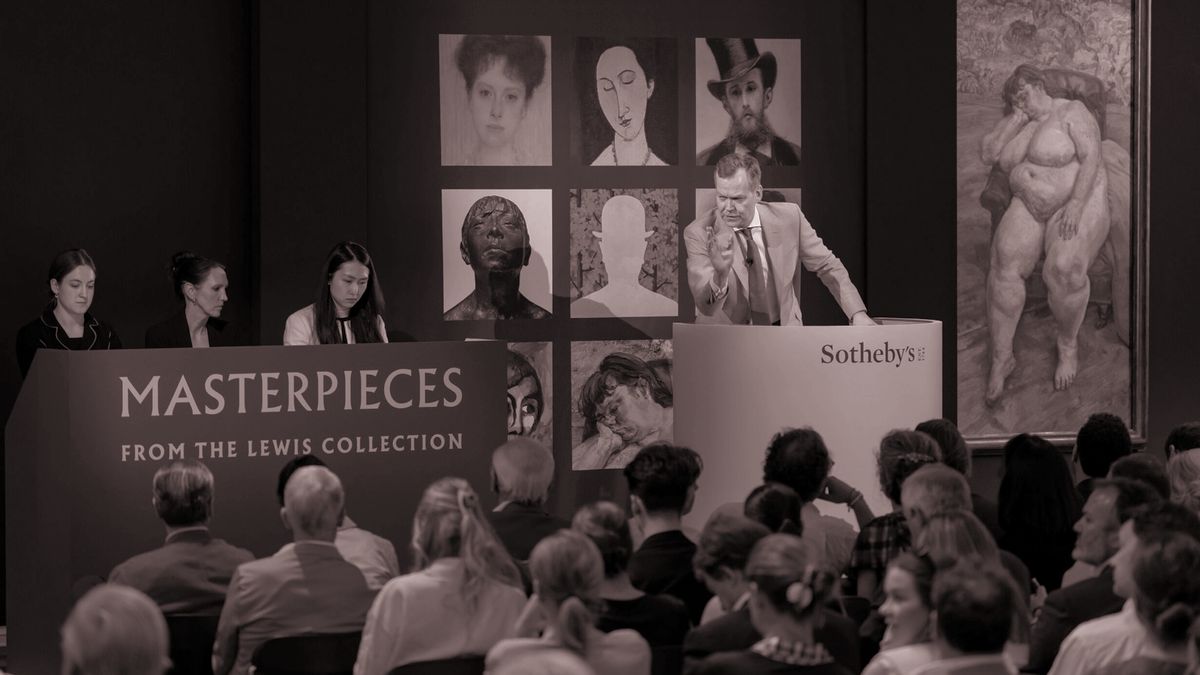
in the arm, making a little more than £306 million, or just over $406 million. That’s wildly impressive, especially since the bulk of the value came from only 25 lots featured in an evening sale, with another 23 works offered during the day sale. Coming so late in June, the Lewis sale provided the global market a second bite at the apple for high-quality, high-value works. Its success should confirm for collectors that the spending we saw in New York in May is real. |
|
|
|
A MESSAGE FROM OUR SPONSOR |
In Living Color Within
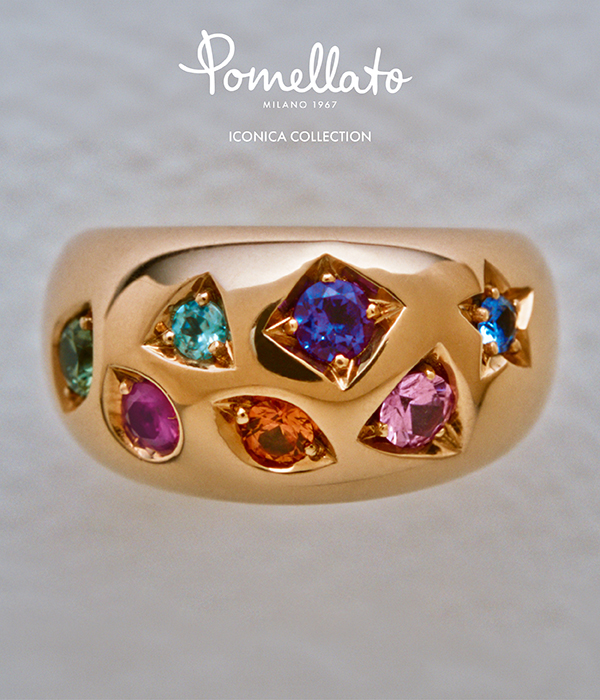
Iconica’s radiant curves, color becomes a clear expression of personality. Saturated gemstones create a vibrant contrast with warm polished gold, balancing design precision with wearability. Both playful and refined, these compositions reflect Pomellato’s distinctly Milanese approach to modern elegance—pieces designed for self-expression and everyday wear. |
|
|
|
Meanwhile, another £97 million ($128 million) was spent at Sotheby’s various-owners
evening sale. With the day sales, the total at Sotheby’s in London was £420 million, or $556 million, depending on how you keep score. Now, we just have to wait until the fall to see whether any vaguely comparable collections will come to market.
Until then, it’s not clear that the new mood in the public markets has loosened up private sales to the degree that could be considered real momentum for the art market. What’s more, the Lewis collection was successful mostly because the
estimates were set quite low to entice bidding, with a couple of notable exceptions. The final numbers were mostly in line with previous values, including some of the recent prices that Lewis himself paid in the past decade or so.
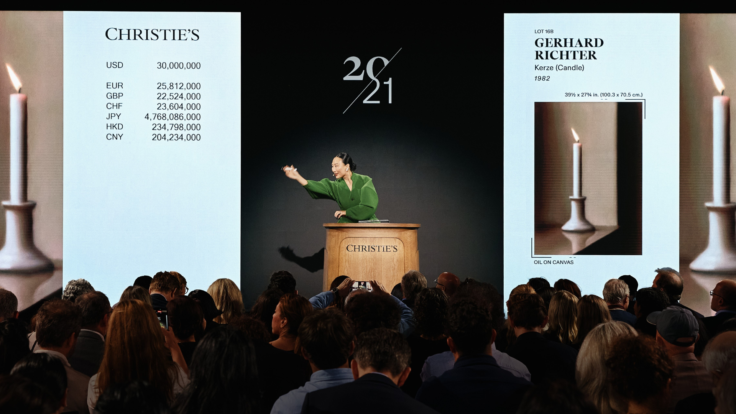
Over at Christie’s, the Zabludowicz collection of contemporary art, mostly made and purchased in the 21st century, made a little more than £15.4 million ($20.4 million). Another £10.2 million ($13.5 million) was spent in the Postwar to Present
sale. Here the prices were mostly in line with estimates, as few of the Zabludowicz works were extraordinary examples of the artists’ output. At Phillips, the total was £12 million ($15.8 million), with most lots selling for prices within the estimate range. Overall, the results for the newer works were stronger than might have been expected at a time when the market is far more focused on historical works of impressionism and modernism. |
Keeping
Up With Inflation…
|
After the Lewis sale concluded, Sotheby’s released some information about the bidding. According to
the auction house, Asian buyers took home more than £120 million worth of art, more than a third of the value of the collection. Just to underscore how important Asian buying is to the market, Sotheby’s tried to gild the lily by pointing out that half of the lots, including all of the top 10, saw bidding from Asian clients. Astute auction watchers spotted art advisor Patti Wong’s colleague seated near the front of the auction and followed his bidding.
As I mentioned on
Wednesday, the powerful Nahmad and Acquavella families were also seated at the front of the saleroom. They bid aggressively on the René Magritte gouache that set a new record for a work on paper at £16 million ($21.6 million), and bought works by Pablo Picasso and Edgar Degas. But for the most part, these prices do not amount to a new step forward in the market.
The previous record for a Magritte work on paper was set two years ago at $18.8 million. |
René Magritte, La Belle promenade (1965). Photo: Courtesy of Sotheby’s |
There were a number of Lewis collection sales that were in line with previous pricing. For example,
the small Picasso gouache that sold for nearly $9.5 million had been bought in 2020 for $8.1 million. And Gustave Klimt’s portrait of Gertrud Loew, which sold for nearly $49 million this week, was acquired by Lewis 11 years ago for $39 million. To keep up with inflation, it would have had to sell for $56 million. A seated nude by Modigliani sold for nearly $65 million, but a nude from 1917 in similar portrait orientation sold in 2010 for $69
million. The large Lucian Freud painting of Sue Tilley sold for $39 million, a price between the two other Tilley paintings that were auctioned for nearly $34 million in 2008 and $56 million in 2015. Again, this Freud would’ve had to sell for that peak price just to keep up with inflation.
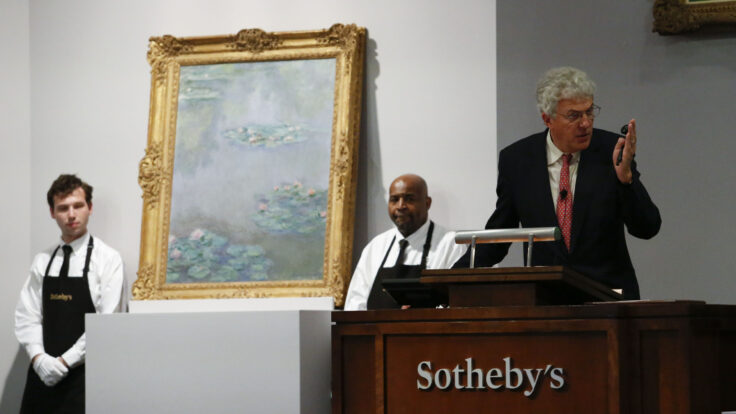
And while we’re comparing recent sales, in the various-owners portion of Sotheby’s night, Claude Monet’s Nymphéas made nearly
$55 million, or a hair below the $56.5 million paid for the same work when Anne Bass’s art was sold at the market’s peak four years ago. The good news is that these works are holding their value or selling at attractive prices, which might entice more very rich people to take a shot at owning them. The bad news is the art market still feels like it has its feet stuck in clay. |
|
|
|
Prince,
Johnson & Hockney…
|
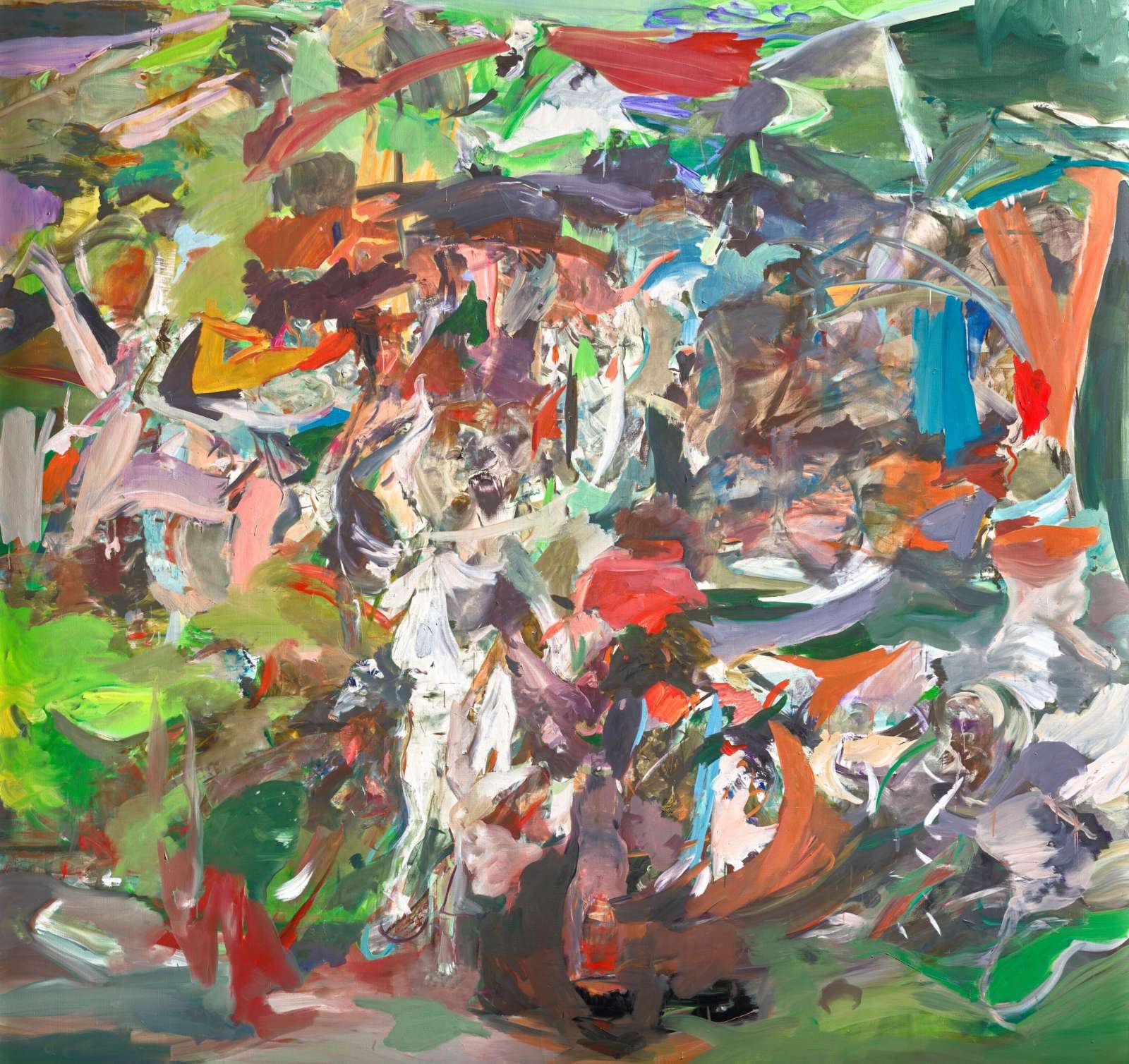
The highest-value work in Christie’s sales was the Cecily Brown
painting, The Haunter, from 2010, which made $3.7 million and seemed to sell to the third-party guarantor. A Julian Schnabel selfie from 2007, acquired directly from the artist, made a solid price of a little more than $500,000, more than twice the
estimate. A Bridget Tichenor painting that had not been to auction before also sold for more than twice the estimate. |
Cecily Brown, The Haunter (2010). Photo: Courtesy of Christie’s |
The Zabludowicz collection had other similarities to the Lewis collection. To wit: The
Richard Prince cowboy sold for $2.1 million with fees—more than the almost $1.75 million that another example from the edition sold for in 2014. I don’t have to remind you that would be $2.5 million in 2026 dollars, but that’s still close enough to demonstrate that Prince’s market is doing just fine. Yoshitomo Nara’s Your Dog,
from 2002, made just slightly above $1 million. In 2012, another example sold for $566,000. Guess what? That’s 28 percent ahead of inflation. And Rashid Johnson’s Untitled Broken Cord sold for $1.27 million. That’s
slightly more than the $1 million paid for a similar but smaller work in May of this year.
At Phillips, the David Hockney painting The Only One With Waves, from 1991, sold for $3.2 million with fees. It was last at auction in 2018, when it cost nearly $2.2 million; it was among the first Hockneys to be auctioned since his death. The Jadé
Fadojutimi painting sold for £425,000 (nearly $600,000.) That’s a respectable price for the artist, but not a significant one. Phillips also tried to gain some traction with South Asian artists, posting works by Subodh Gupta, Shahzia Sikander, and M.F. Husain with approachable estimates. The Gupta struggled against
its estimate, the Sikander made its estimate, and the Husain outperformed its estimate. That market still has a lot of room to run. |
I got a note from an art dealer after I wrote about Marc Spiegler’s op-ed in
The New York Times, wherein the former fair director breezily proposed that galleries “push for legally enforceable resale agreements that can block flipping and let them be less fearful of unknown potential clients.” The dealer presented his case against those who don’t honor resale agreements, especially the auction houses. So I may not
have been clear: I agree that the issue of mistrust between galleries and potential clients is a real one, though it does work both ways when buyers feel they have to jump through hoops to acquire the works they want.
What I was trying to point out is that there is no such thing as a “legally enforceable resale agreement.” Galleries can push all they like; hundreds of years of property law won’t yield. Spiegler could have easily ascertained that by taking 15 minutes to ask a lawyer. Does
that mean galleries shouldn’t try to put into writing the understanding that a collector will give them the right of first refusal in reselling a work? Of course not, and collectors who sign such an agreement, whether it is legally enforceable or not, should keep their word.
Anyway, that’s it for today. I hope you enjoy the weekend.
M |
|
|
|
Unique and privileged insight into the private conversations taking place inside boardrooms and corner offices up and
down Wall Street, relayed by bestselling author, journalist, and former M&A senior banker William D. Cohan. |
|
|
|
Need help? Review our FAQ page or contact us for assistance. For brand partnerships, email ads@puck.news. You received this email because you
signed up to receive emails from Puck, or as part of your Puck account associated with {{customer.email}}. To stop receiving this newsletter and/or manage all your email preferences, click here. |
Puck is published by Heat Media LLC. 107 Greenwich St., New York, NY 10006 |
|
|
|
|