{{ 'now' | timezone: 'America/New_York' | date: '%b %d, %Y' }} |
|
|
|
Hello, and welcome back to The Best & The Brightest, your daily politics dispatch from Puck. It’s
foreign policy Thursday and I’m your host, Julia Ioffe.
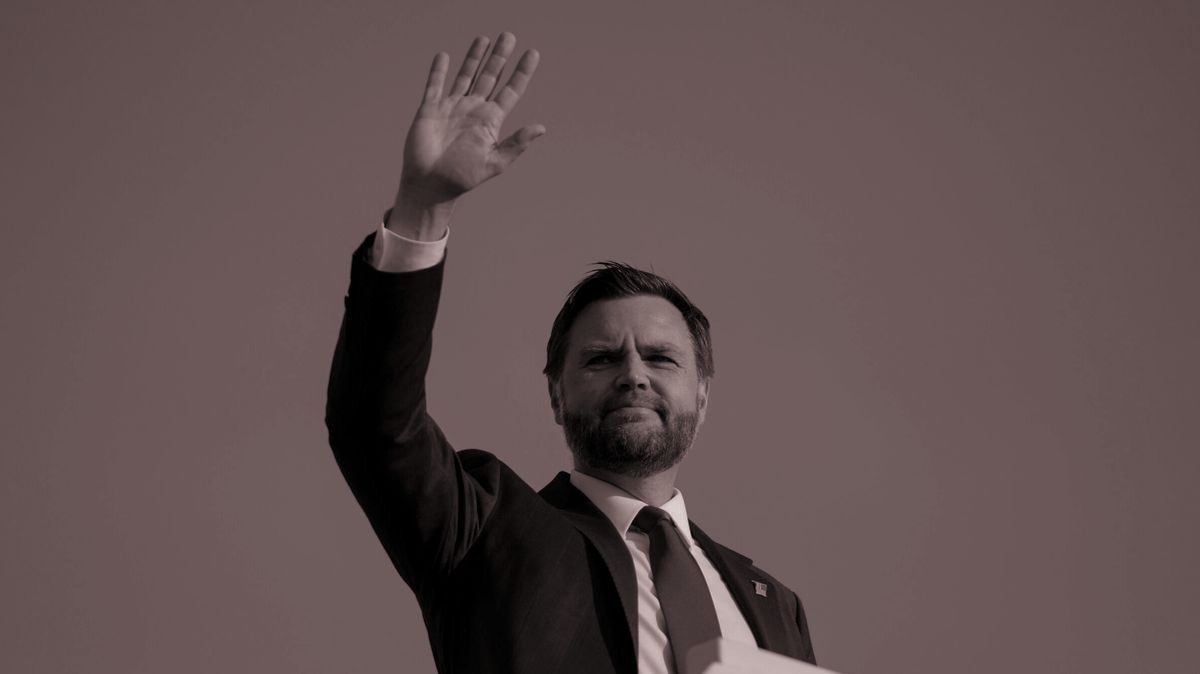
J.D. Vance spent last week selling his 2028 book, Communion, defending the Iran M.O.U.—and scolding Israel. Sure, the president had been cursing out Netanyahu for weeks, but it was still a startling moment. Had someone like Rashida Tlaib or Ilhan Omar made the same comments, I thought, the G.O.P. would’ve lost its mind. Tonight, my reporting
on Vance’s startling rhetorical pivot—how much he’s really changed his own views on Israel and whether it’s all just posturing for 2028.
Also mentioned in this issue: Danielle Pletka, Jacob Reses, Charlie Kirk, Pete Hegseth, Volodymyr Zelensky, Steve Witkoff, Nick Fuentes, Laura Loomer, Heather Olowski, Nancy
Youssef, Andrea Lucas, Donald Trump, Ross Douthat, Pat Buchanan, Candace Owens, Bari Weiss, Missy Ryan, Jared Kushner, Megyn Kelly, Lew Olowski, Trita Parsi, Eran Etzion, Tucker Carlson, C.D. Donahue, and more. |
- Keeping
up with the Olowskis: It’s been a while since we’ve heard from everyone’s favorite State Department political appointee, Lew Olowski. And so, some news! In addition to being a minister at the evangelical church the couple runs in Maryland, Lew’s wife, Heather Olowski, headed the civil rights office at the State Department.
Earlier this month, Andrea Lucas, head of the Equal Employment Opportunity Commission—and infamous for her official video asking, “Are you a white male who’s experienced discrimination at work?”—announced that Heather, a Federalist Society member, would now be head of the E.E.O.C.’s Office of Legal Counsel. In the announcement, Olowski said she was going to work “to
advance the agency’s mission of protecting equal opportunity in America” and on “the agency’s enforcement of the nation’s civil rights laws.”
- Hegseth taketh away: Washington’s defense community, as well as its diaspora of veterans across the country, has been abuzz with the news that Gen.
C.D. Donahue is being forced out by Pete Hegseth, the latest in a long string of casualties in the secretary’s purge of general officers. (Shout-out to the badass Nancy Youssef and Missy Ryan for that scoop.) Meanwhile, sources tell me that Maj. Gen. Pat Work, an ally of Donahue and another rising Army star, has once again been sidelined and will be retiring in the coming months.
The most common
explanation for Hegseth’s purge is the administration’s war on D.E.I., which has forced out many female and Black flag officers, along with the secretary’s belief that the military has gotten too top-heavy. Others say there’s another dynamic at play: Hegseth’s continued rage over the Army’s worship of West Point grads. The military academy—specifically its football team—has long been a factory for generals, and some critics speculate that Hegseth, who played basketball at Princeton, is flustered
by West Pointers and wants them out of his sight. Hegseth’s style throughout has been to appeal to the enlisted (who are not college-educated) in spite of the officers (who are), mirroring the country’s political split. Some retired Army officers believe this is part of the broader Trump culture war, waged as policy.
|
|
|
|
As the Republican base sours on the Iran war and Netanyahu’s adventurism in the Middle East,
the vice president has changed his rhetoric on Israel—positioning himself as the voice of a new MAGA foreign policy. “He sees the writing on the wall,” said one Trump administration official. “He’s trying to save his political future.” |
|
|
|
Last week, as Washington was
melting down over the leaked contents of Donald Trump’s memorandum of understanding with Iran, Israelis were reacting in kind. Israel was not a party to the negotiations—hardly surprising, given Benjamin Netanyahu’s overt opposition to ending the conflict—but the Israelis were particularly irate on two fronts. Not only did the deal
offer nothing on the issue of reining in Iran’s proxies, like Hezbollah, Hamas, and the Houthis, but it also did something far worse: By accepting the Iranian framework that a ceasefire must include Israel and Hezbollah, the M.O.U. essentially relegated Israel to the status of a proxy itself.
The shock and disillusionment ran especially deep because the betrayal came from the very same Trump administration officials that the Israelis had, until recently, perceived as their saviors. With
the signing of the Iran M.O.U., Trump, J.D. Vance, Jared Kushner, and Steve Witkoff “went from idols to outcasts” in Israel, said Eran Etzion, the former Israeli national security advisor. On the Israeli right, he told me, “they went from worshipping Trump and Vance to calling them traitors.”
Vance has not taken kindly to this. “I guess my response to them would be: What is your exact proposal?” he
responded testily when Ross Douthat, the conservative New York Times Opinion columnist, asked him about the Israeli reaction on a podcast episode last Wednesday. “You’re a country of 9 million people. You can’t just kill your way out of solving every single national security problem that you have.” Vance, who has
described himself as one of Israel’s strongest defenders, went on to dismiss the Israeli fears as a “freak-out” and a “weird panic,” which he found “odd” given that “we’ve done a very good job by that particular country and that particular government.”
The following day, Vance continued the tongue-lashing. “Anybody in Israel who thinks their biggest problem is the
president of the United States needs to wake up and smell the reality of the situation that the country is in,” Vance told reporters at the White House. Trump, he added, was “the only head of state in the entire world who is sympathetic to the nation of Israel at this moment in time.” He also scolded Israel for trying to sabotage the negotiations with Iran. “What the president gets a
little frustrated with sometimes is that we seem to be right on the cusp of a major breakthrough in the agreement, and then all of a sudden, there’s a major explosion that goes off in a civilian population center in Beirut, and a lot of people who have nothing to do with Hezbollah lose their lives,” he said. “That is not acceptable.”
This was, on one hand, a familiar role for the vice president, who has made a habit of publicly dressing down allies, from his jaw-dropping 2025 speech to
NATO allies in Munich to his Oval Office berating of Volodymyr Zelensky. But there is also something deeper at play. Once upon a time in American politics, frustrations with Israel—and there have always been many—were typically aired in private. After all, few politicians wanted to be perceived as anti-Israel by a public that broadly supported our ally. But after October 7 and the country’s retaliatory war in Gaza was broadcast to the world on social media, public sentiment
started to shift. Progressives began denouncing Israel—and the right seized on their comments instantly, labeling critics of the war as antisemitic and leveraging those accusations as a pretext to go after liberal academia.
Which is why Vance’s scolding was so shocking. Had someone like Rep. Rashida Tlaib or Rep. Ilhan Omar uttered half of what Vance said, Republicans would have been apoplectic. (And in the past, they have been.) But this was
Trump’s vice president, presumably speaking on behalf of the White House. And so while the usual Republican suspects chided Vance, most stayed silent, and Vance’s sharp words hung uncomfortably in the air. |
“He Sees the
Writing on the Wall”
|
It wasn’t always like this. In the Senate, Vance was known as solidly pro-Israel. He
called Israel America’s “most important ally.” He said the alliance was deeper—“culturally, morally, politically”—than mere geostrategic shared interests. Vance even held up Biden’s State nominees for being too “woke,” including on Israel. For years, his right-hand man has been Jacob Reses, a staunchly pro-Israel Orthodox Jew
who has continued to work for him at the White House. (Reses is leaving at the end of the summer.)
The shift toward publicly bashing Israel has surprised those who knew Vance in the before times. “This is not how he was in the Senate,” said someone who worked with Vance in the chamber. “He was super pro-Israel. I don’t ever
remember him being even somewhat slightly critical.”
After Israel took the U.S. to war, however, public opinion on the country has soured across the political spectrum, and Vance is eyeing the presidency in 2028. “He sees the writing on the wall that an increasing fraction of America hates Israel,” one Trump administration official told me. “He’s trying to save his political future. J.D. very clearly knows that being anti-Israel is the most politically profitable thing to be right now.
And now he gets to be the face of toughness to Israel.” A Trumpworld source contested this narrative. “The V.P. hasn’t shifted his position on Israel,” this source said. “He’s remained consistent. Anyone claiming a shift is inventing one.”
Vance has always had a preternatural talent, dating back to his Senate days, for political flexibility. “He doesn’t believe in anything,” one Senate G.O.P. leadership aide told me back then. “He will do whatever it takes to ascend the greasy pole.” And
in the past year or so, as the Republican base has become increasingly skeptical (or hostile) of Israel, Vance has changed his tune. He was clued into the shift early, as I wrote last summer, by his best friend and confidante Charlie Kirk, who had been surveying young conservatives at Turning Point USA events about their views on Israel. Many
were having a hard time squaring the circle of “America first always—except Israel.”
Shortly before his murder, Kirk and Megyn Kelly had vented on her podcast that they weren’t allowed to criticize Israel at all, even given their past support. Those comments, along with Kirk’s griping in private text messages about a Jewish donor cutting off support for TPUSA for not deplatforming Tucker Carlson, have since become the eye of a conspiracy hurricane, with Candace Owens alleging that Israel had Kirk assassinated. Vance has criticized Owens for “tormenting” Kirk’s family after his assassination, but he is also attuned to the deep well of resentment and suspicion toward Israel that has been working its way from the
right-wing fringes into the mainstream. And ever since Trump decided to go to war against Iran, reportedly at Netanyahu’s urging, the Israel skepticism among young right-wing Americans has reached a fever pitch. Vance, it seems, is trying to capitalize on it—and, perhaps, to keep his Kirk-built base from abandoning him. |
“America First,
No Exception”
|
In recent weeks, word has spread around town that Vance has been regularly talking to Trita
Parsi, the Swedish-Iranian co-founder of the Quincy Institute. The anti-interventionist think tank, which is funded by Charles Koch, bills itself as “transpartisan” and operates in that space between the ends of the political horseshoe—one that, these days, looks increasingly like a circle. When I asked him whether he speaks to the vice president, Parsi told me he didn’t want to get into all that, but he did say that “we’ve been talking to the administration since they
first came into office, on a variety of different issues, including this one.” The Trumpworld source told me that “rumors that Mr. Parsi is advising the vice president are not accurate.” (Parsi, who has a history of making colorful comments about Iran and American Jews, has been a frequent target of Laura Loomer; Bari
Weiss’s Free Press recently reported that the State Department was
investigating Parsi, a green-card holder, and considering deporting him. The State Department quickly denied this.)
Parsi pointed me to a speech that Vance gave in the spring of 2024, before he became Trump’s running mate, at a conference that Quincy co-hosted with The American Conservative, the right-wing journal co-founded by Pat Buchanan. The
speech, in Parsi’s telling, was partly a way for Vance—a representative of the restraint-oriented, realist school of Republican foreign policy—to explain why supporting Israel did not conflict with that view. “He was trying to justify that position,” Parsi said. “But this has become increasingly difficult to do. That cognitive dissonance broke down in the past year.”
Parsi agreed that “if Ilhan or Rashida had said this, there would’ve been mayhem.” But, he explained, Vance’s criticism of
Israel lands differently on the right, especially among its younger cohort. “What’s attractive to folks on the right is that they don’t want to see any exception to America First,” Parsi said. “It’s what elements of the right find so galling—that when they say, ‘America First, no exception,’ they mean no exception.”
What Vance is doing now, Parsi argued, is political cleanup for the White House—and for himself. “Vance’s base has a degree of disappointment with Vance that he didn’t stop
the war,” he told me. “But now that he’s showing how he’s negotiating an end to the war, being critical of Israel—it plays well with the base.” And Vance’s criticism is also more nuanced than mere tongue-lashing, Parsi argued, suggesting that the vice president is attempting to place Israel on the same level as other U.S. allies, like the U.K. and France, which are similarly not immune from criticism. “This is his effort to de-exceptionalize the relationship,” Parsi said of Vance’s thinking.
“It’s a demotion of the relationship with Israel. Among his base, it’s seen as a very positive thing.” |
Vance, like Kirk before him, has repeatedly couched his critiques of Israel as a disagreement between close
friends. And for allies of the vice president, as was the case with Kirk, this makes his criticism far more acceptable than the attacks coming from the left. Vance, of course, has never questioned Israel’s right to exist as a Jewish state or to defend itself—though he has, of late, criticized the high civilian death tolls that occur when it does so. To them, Vance’s criticism of Israel should be seen in the context of his past support.
But some Jewish Republicans are not so sure.
Suddenly, all those little things that had made them raise their eyebrows—when Vance didn’t mention Jews when commemorating Holocaust Remembrance Day, or when he refused to denounce Tucker Carlson’s overt antisemitism—seem to have a different valence. “You can defend
these things episodically. You can say, Well, but he has a great relationship with Israel,” said Danielle Pletka, a Middle East expert at the conservative American Enterprise Institute. “The problem is that Vance is, increasingly, not in the context of the great relationship with Israel. It’s that the context in which Vance exists is one in which antisemitism is the norm.” (When Vance was asked to denounce Nick Fuentes earlier this year, he
said Fuentes should “eat shit.” He demurred when asked to denounce the man’s followers, the “groypers”—“I don’t know what that means,” Vance said—but added, “I think Jew hatred is disgusting.”)
Pletka, who is Jewish, has long been concerned about what she sees as criticism of Israel
serving as a fig leaf for antisemitism on the left—a phenomenon she’s now observing on the right. “Antisemitism got mainstreamed on the left a few years ago,” she told me. “And now we’re seeing a very serious effort on the part of Vance to mainstream it on the right.” Pletka was unnerved. “This is the great convergence,” she continued. “Now you’re seeing a huge convergence between the Vance wing of the Republican Party converging with the Ilhan Omar wing of the Democratic Party. Their aim is to
appeal to the same people.” |
That’s all from me, friends. I’ll see you back here next week. Until then, good night. Tomorrow will be
worse.
Julia |
|
|
|
Finally, a media podcast about what’s actually happening in the media—not the oversanitized, legal-and-standards-approved
version you read online. Join Dylan Byers, Puck’s veteran media reporter, and Julia Alexander, a longtime media analyst, as they sit down with TV personalities, moguls, pundits, and industry executives for raw, honest, sometimes salacious conversations about the business of media and its biggest egos. New episodes publish every Tuesday and Friday. |
|
|
|
The industry’s go-to source for unflinching reporting on the trillion-dollar business of artificial intelligence—perhaps the
single most important new technology of our time. Ian Krietzberg, the powerhouse journalist behind The Deep View, delivers twice-weekly insights into the latest dealmaking and breakthroughs in A.I., and how the intersecting worlds of finance, entertainment, media, and politics are being transformed in its wake. |
|
|
|
Need help? Review our
FAQ page or contact us for assistance. For brand partnerships, email ads@puck.news.
You received this email because you signed up to receive emails from Puck, or as part of your Puck account associated with {{customer.email}}. To stop receiving this newsletter and/or manage all your email preferences, click here.
|
Puck is published by Heat Media LLC. 107 Greenwich St., New York, NY 10006 |
|
|
|
|