 |
|
Happy Monday, I’m Eriq Gardner.
|
|
Welcome back to The Rainmaker, a private email about money, power, fame, and the law.
This week, I’ve got a report about a just-filed Judge Judy defamation lawsuit that targets a media company that screwed up in spectacular fashion, complete with a call-out to Donald Trump’s criminal trial. That’s a lot, I know. (P.S. If this email somehow found its way to you, sign up here to continue receiving this newsletter. Or, better yet, subscribe to Puck.)
Today’s email also highlights other media organizations on the ropes—the Associated Press, for paying photographers embedded with Hamas on October 7, and U.S. News & World Report, which is fighting a subpoena over its hospitals ranking. Finally, I’ll address the latest developments in a wild trial over Elon Musk’s supposedly autonomous vehicles. Why aren’t reporters covering this one?
But first, let’s talk about TikTok’s legal predicament…
|
| Gaming the TikTok Legal Strategy |
|
TikTok has gone on the legal offensive, challenging the freshly minted law that would ban the app in the U.S. if its Chinese parent company, ByteDance, doesn’t divest the entity. “For the first time in history, Congress has enacted a law that subjects a single, named speech platform to a permanent, nationwide ban,” reads the filing. The move wasn’t exactly shocking, and in the week since TikTok’s lawyers at Covington & Burling filed papers calling the law “unprecedented” and “obviously unconstitutional,” the punditry hasn’t been in short supply. Of course, I have thoughts on a case that’s heading toward becoming a memorable First Amendment showdown.
- Shortcuts have already weakened the law: I don’t subscribe to the notion that a TikTok ban is automatically a First Amendment faux pas, given that national security imperatives can sometimes elbow aside free speech. However, the American government’s failure to articulate precisely what TikTok or its Chinese owners are doing wrong undermines the defense. This lack of a robust rationale, ideally delivered with a broad data security review that extends beyond TikTok, could hobble the Department of Justice’s footing. My bet? TikTok will win the early rounds in court. Now about that judicial review…
- Things are about to get a tad funky: See, thanks to language baked into the law itself, TikTok starts out at the U.S. Court of Appeals for the D.C. Circuit, a venue not accustomed to rolling up its sleeves for fact-finding missions. That’s typically the terrain of district courts or executive branch agencies. Will the panel of appellate justices devise some novel protocol to address national security concerns? Will they do so openly? And if TikTok asks the D.C. Circuit to halt the law on a preliminary basis, would they try a cursory scan of the statute’s language to see if it squares with the U.S. Constitution without delving into the nitty-gritty of the national security arguments? I wouldn’t be surprised if one of the sides made a beeline for the Supreme Court at the earliest opportunity, but…
- The Supreme Court is an enigma: When it comes to issues that don’t fit into neat ideological pigeonholes, predicting the whims of the nation’s highest court is like deciphering prehistoric cave paintings. A clue may come from the court’s pending case concerning the Republican-backed laws in Texas and Florida that seek to limit the ability of social media companies to restrict content. If the justices rule that the First Amendment doesn’t tolerate interfering with the decisions of private speech platforms (even if the net result means the ongoing muzzling of Clarence Thomas’ favorite MAGA shitposters), it could be a welcome sign for TikTok. Then again, expect the high court to at least nod to compelling state interests. While I’m leaning toward TikTok having an edge at the D.C. Circuit, the Supreme Court is anyone’s guess.
- The Biden-Trump unknowns: There’s always a chance that Biden and Beijing hash out an accord to untangle this mess, although if the Chinese ever do warm up to the idea of a divestiture, ByteDance would be shrewd to broker those talks post-D.C. Circuit, but pre-Supreme Court denouement, when they can potentially negotiate with a stronger hand. Then there’s the looming specter of a Donald Trump comeback, now that he has shifted from TikTok foe to supporter, for reasons my partner Tara Palmeri elucidated. The prospect of his administration pumping the brakes on defending the law has to be factored in when trying to predict how the case resolves.
|
| Overall, I rate TikTok’s chances of survival as high. |
|
|
- Did the AP pay photographers linked to Hamas?: Among the lesser debates ignited by the horrific October 7 tragedy in Israel is whether the Associated Press crossed the line by paying freelance photojournalists, seemingly associated with Hamas, for images that were taken during the attack. Victims’ families in Miami are now suing the AP, arguing that the outfit willfully ignored the photographers’ ties to Hamas, amounting to “material support” for a terrorist organization and a violation of federal law.
The AP has submitted a bid to quash the case, opening with a preamble extolling the role of a free and independent press. The news service claims dismissal is warranted because the plaintiffs can’t prove that the news agency knowingly assisted Hamas in carrying out attacks, or that its conduct amounted to any sort of substantial assistance. Interestingly, there doesn’t seem to be much precedent here, although the Supreme Court recently shot down the proposition that Twitter, Facebook, and YouTube aided and abetted ISIS by recommending the terrorist group’s content to users. The AP points to that ruling.
- U.S. News & World Report loses this round: A few months back, I flagged that the publication was in court seeking to thwart San Francisco City Attorney David Chiu’s attempt to pry open the arcane methodology it uses for ranking the country’s hospitals. Amid whispers that Chiu’s actions might have been a backdoor attempt to decode the publication’s law school rankings, U.S. News argued that a subpoena infringed on its First Amendment rights.
On May 7, U.S. District Court Judge William Orrick rejected U.S. News’ case, reasoning that the magazine’s objection to Chiu’s subpoena was premature, given there hadn’t been any move to enforce it. Notably, this decision follows on the heels of a D.C. judge halting Texas Attorney General Ken Paxton’s probe into David Brock’s liberal watchdog organization, Media Matters, after it flagged hate speech on Elon Musk’s Twitter. Orrick drew a distinction, explaining that Media Matters had provided evidence that employees had self-censored themselves in reaction to Paxton. Here’s the latest ruling, which has already been noticed for appeal up to the Ninth Circuit.
- Speaking of Musk: Last year, I wrote about the wrongful death case concerning Walter Huang, an Apple engineer who turned on his Tesla’s Autopilot system, became engrossed in a video game, and tragically died when his supposedly autonomous vehicle hit a highway barrier in 2018. The case featured a demand for Musk’s deposition and earned copious media attention—until last month, when Tesla settled with Huang’s family on the eve of the trial. Reporters moved on. End of story, right? Well, not so fast.
In most instances, a settlement is the end of story, but in this situation, there is another co-defendant: the California Department of Transportation (“Caltrans”), alleged to be partly responsible for the crash because it was said to have failed to repair the highway attenuator where Huang was killed. In negligence trials with multiple parties, jurors are sometimes tasked with apportioning blame. Meaning that even though Tesla was settling, a jury would still be considering the automaker’s fault, while also considering Huang’s distraction and the condition of the crash cushion.
Tesla’s eleventh-hour deal with the Huang family irked Caltrans. In court, the agency denounced the settlement, alleging collusion between Musk’s company and the family. Caltrans pointed to Tesla’s sudden interest, late in the process, in proving the attenuator’s role in Huang’s death, even conducting crash tests to show how a functional attenuator would have saved him. Although the settlement remains undisclosed, Caltrans noted it “curiously” approximated the cost of the crash test. The agency wants a judge to reject the settlement. No written ruling has been made.
As the case unfolds in Santa Clara, with the trial ongoing despite Tesla’s settlement, Caltrans has shifted from defending its own work to also asserting that Tesla sold a defective product to Huang—basically, what the plaintiffs were going to argue themselves prior to the settlement. The court stopped issuing court minutes on April 25 due to Tesla’s insistence on confidentiality, but I hope to have the details of the verdict in a future edition. Meanwhile, it’s being reported that the feds are probing whether Tesla committed securities fraud and wire fraud by misleading consumers about its self-driving capabilities.
|
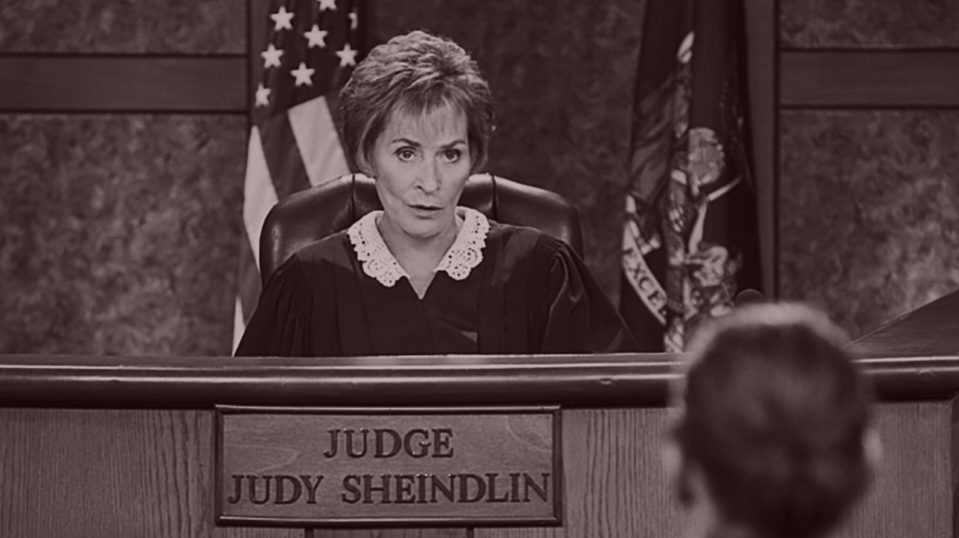 |
| Judge Judy Threatens to Make the Tabloids Pay |
| America’s favorite TV jurist is suing A360 Media, publisher of In Touch Weekly and The National Enquirer, over a Menendez murder trial mix-up. “It’s unconscionable,” she says, “and will be expensive.” |
|
|
|
| In April, In Touch Weekly published a truly bizarre article headlined “Inside Judge Judy’s Quest to Save the Menendez Brothers Nearly 35 Years After Their Parents’ Murder.” According to the piece, television host Judy Sheindlin, better known as Judge Judy, apparently had serious doubts about the 1996 retrial of Erik and Lyle Menendez—the brothers who infamously murdered their parents in their Beverly Hills mansion and are currently serving life without parole—going so far as to label the case “rigged.” The article further suggested that Sheindlin had urged the defense team to demand the recusal of Los Angeles County Superior Court Judge Stanley Weisberg. Alas, none of this was true.
The In Touch reporter apparently confused Judge Judy, whose reality TV courtroom series ran for 25 seasons, with an alternate juror on the trial named “Judi,” who was interviewed in a Menendez documentary. Sheindlin promptly demanded a retraction and gave an interview indicating that she was disturbed enough by the mix-up to pursue legal action. As it turns out, she was not bluffing.
Earlier this afternoon, the 81-year-old jurist filed a lawsuit against A360 Media, which publishes In Touch as well as The National Enquirer, which had published a similar article. Filed by attorney Eric George, Sheindlin’s complaint alleges that it took her a lifetime to build up a reputation as a no-nonsense judge of people and facts, but in “one fell swoop,” that reputation has taken a “body blow, … diminishing her to rube, a fool—or worse.”
Sure, we may live in a golden age for defamation battles (Johnny Depp, Alex Jones, Dominion, etcetera), but we’ve long moved past the routine spectacle of A-listers duking it out with celebrity gossip rags in court. So why give a plainly ludicrous story any oxygen? Well, Sheindlin takes her reputation very seriously, and with a net worth of around $450 million, she has the means to defend it. Of course, this suit also arrives in the middle of Donald Trump’s criminal trial, where the public has just heard about how A360, once known as American Media Inc., allegedly conspired to cover up salacious details about his affairs.
Former American Media C.E.O. David Pecker also testified about another aspect of his reign: their penchant for making stuff up, such as when the Enquirer fabricated a story about Ted Cruz’s dad and Lee Harvey Oswald. Indeed, Sheindlin’s suit nods to Pecker’s testimony, saying it’s “par for the course for A360 Media.” |
|
|
| Although the falsity of what was published seems a given (In Touch has removed the story from its website, but that hasn’t stopped the original gaffe from proliferating online), the case isn’t a slam dunk. To win, Sheindlin will need to convince a court that it is reputation-damaging to express an opinion about the fairness of a murder trial that resulted in a guilty verdict. Moreover, given her status as a public figure, Sheindlin must establish actual malice on the publication’s part—that is, that In Touch knew the story was false, and/or they demonstrated a reckless disregard for the truth.
It’s likely that A360 will argue there wasn’t a “high degree of awareness of the probable falsity,” a winning argument they recently used in court after misidentifying the mother of one of Elon Musk’s kids. Sheindlin’s complaint teases their counterargument, which is that the publication should have done at least some fact-checking: “A review of the documentary source interview and a simple internet search would have sufficed to reveal the truth, and thereby enabled Defendants to have avoided publication of a defamatory story, had they so wished.”
It will also be interesting to see how Scheindlin’s lawsuit plays out in deeply red Collier County, Florida. (I won’t be surprised if A360 tries to relocate the case.) And her argument that fake news has damaged her reputation for judicial fairness, particularly in legal circles, is something any sitting judge may appreciate. If a judge does move it forward, things get riskier for the publisher. Sheindlin’s legal papers emphasize that A360 has failed to issue a retraction, apology, or correction. Under Florida law, that opens the door to punitive damages.
“When you fabricate stories about me in order to make money for yourselves, with no regard for the truth or the reputation I’ve spent a lifetime cultivating, it’s going to cost you,” said Sheindlin in a statement. “When you’ve done it multiple times, it’s unconscionable and will be expensive. It has to be expensive so that you will stop.” |
|
|
| That’s all for this week. Reply with any questions, comments, or tips. |
|
|
|
| FOUR STORIES WE’RE TALKING ABOUT |
 |
| CNN Fantasies |
| Could Jeff Zucker really return to CNN? |
| DYLAN BYERS |
|
 |
| Vulcan Zaz |
| On David Zaslav’s potential spoils from the Paramount mess. |
| WILLIAM D. COHAN |
|
 |
|
 |
|
|
|
|
|
 |
|
|
|
Need help? Review our FAQs
page or contact
us for assistance. For brand partnerships, email ads@puck.news.
|
|
You received this email because you signed up to receive emails from Puck, or as part of your Puck account associated with . To stop receiving this newsletter and/or manage all your email preferences, click here.
|
|
Puck is published by Heat Media LLC. 227 W 17th St New York, NY 10011.
|
|
|
|