{{ 'now' | timezone: 'America/New_York' | date: '%b %d, %Y' }} |
|
|
|
Welcome to The Hidden Layer. I’m Ian Krietzberg, coming off a Mother’s Day where
the greatest gift was provided not by me (flowers, dinner), but by Jalen Brunson (a trip to the Eastern Conference Finals). Hard to compete with that.
Today, we’re decoding the White House’s mixed messaging about “vetting” A.I. models—and how much the administration’s pivot has to do with Mythos. Plus, news and notes on rising cybersecurity threats, a batch of freshly minted millionaires in Silicon Valley, and the latest state-level effort to get ahead of the prickly
sentience question.
Mentioned in this issue: Susie Wiles, Conor Leahy, Adam Kovacevich, David Sacks, Scott Bessent, Kevin Hassett, J.D. Vance, Trump, Biden, Brendan Steinhauser, Charlie Bullock, and more… |
Three Things You Should
Know…
|
- More
A.I. personhood drama: The Missouri Senate passed a bill last week that would preemptively deny legal personhood to A.I. systems. The bill, proposed by Republican State Sen. Joe Nicola, would prevent the models from owning property, getting married, running a company, or (of course) identifying as male or female. It would also
require disclosures from businesses using companion chatbots or other A.I. systems to interact with customers or patients, and it would mandate transparency from political campaigns using A.I. to generate ads and other promotional materials. The bill is not quite at the finish line (it was sent back to the House last week), but Nicola described the Senate movement as “real progress.”
Similar
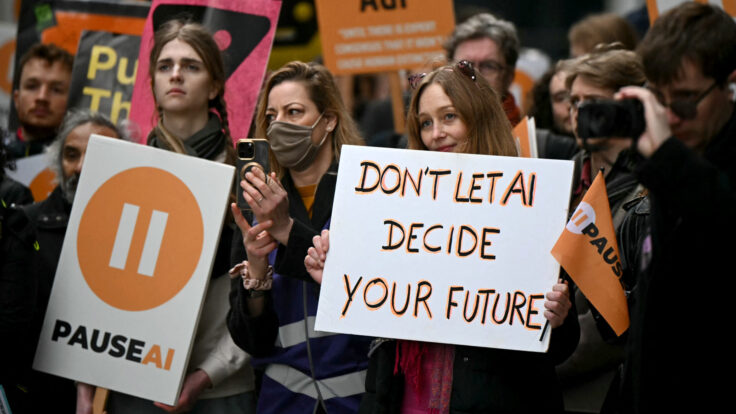
bills seeking to preemptively address the legal status of A.I. models began bubbling up across the country late last year—a reaction, in part, to the heavily anthropomorphized language that tech companies use to describe their products. (Anthropic, for one, can’t stop musing about whether its models are conscious…) Whether these are good policies is certainly up for debate, but
they’re another example of bipartisan, increasingly populist pushback. - Google’s threat intel: On Monday, Google Cloud’s Threat Intelligence group said that it had, for the first time, identified a threat actor taking advantage of a zero-day vulnerability the company believes was
found with an A.I. tool. As a reminder, “zero-day” refers to security vulnerabilities that the developer doesn’t know about, and which an attacker can therefore immediately exploit—giving the developer zero days to patch the bug. (The alleged ability of Claude Mythos to identify zero-day exploits was among the reasons Anthropic cited for not releasing it to the public.)
The attack would have enabled a group of cyber criminals to bypass two-factor authentication on an unnamed
administrative tool. But Google acknowledged that the threat actor was prevented from executing its “mass exploitation event” by the company’s proactive discovery efforts.
Still, it’s becoming increasingly clear that the world is not prepared to handle the myriad cybersecurity implications of A.I. models—which can be powerful tools for threat actors.
Politicians in both the U.S. and U.K. have taken a more pointed stance on these risks in the days since the release of Mythos, which is reportedly being used by some U.S. government agencies despite the Pentagon’s decision to blacklist Anthropic. Is anyone surprised?
|
|
|
|
A MESSAGE FROM OUR SPONSOR |
Retailers can now process millions of transactions in minutes—not hours. Toshiba Tec partnered with McKinsey using
Nvidia accelerated computing to enable real-time recommendations, faster promotion testing, and measurable lifts in sales, profit and long-term customer value. Read the case study. |
|
|
|
- A.I.’s
real winners: According to The Wall Street Journal, OpenAI allowed employees to sell up to $30 million worth of shares each in a recent financing round—part of a mass, $6.6 billion secondary sell-off in October. Overnight, hundreds of Silicon Valley techies became multimillionaires, which surely benefitted the real estate market from
Atherton to Aspen. (Were they in it for the pursuit of A.G.I., or the equity? And how much faith do they really have in the company if they cashed out before the inevitable I.P.O.?) Not bad for a couple of years working at a 10-year-old (former) nonprofit.
|
“To browse the internet today, to consume any sort of content at all, is to be bombarded with A.I. of all
sorts. … Our brains are now performing untold numbers of calculations per day: Is this A.I.? Do I care if it’s A.I.? Why does this sound or look or read so weird? Does this person just write like this? Is this a person at all?”
—404 Media’s Jason Koebler, on the ways that A.I. writing has been breaking our brains. |
- On
Monday, OpenAI launched The OpenAI Deployment Company, a new A.I.-powered consulting and services business—with $4 billion in investment from a partnership of 19 private equity and investment firms—whose sole goal is to help enterprises adopt the company’s technology. (OpenAI also acquired Tomoro, another A.I. consulting firm, as part of the launch.) Intriguingly, Bain
and McKinsey are among the investors—a hedge, perhaps, against their own obsolescence. Meanwhile, Anthropic partnered with Goldman and Blackstone last week to do the exact same thing—but with a mere $1.5 billion behind it.
- Sierra, an A.I. customer service company founded by OpenAI chairman Bret Taylor, announced $950 million in funding last week at a $15 billion valuation. Apparently, the integration is going well, and now Sierra has over $1 billion in the bank to scale, scale, scale.
|
And now for the main event… |
|
|
|
After a yearlong anything-goes policy toward A.I., the White House is suddenly talking about
“vetting” new models and wrapping the industry in red tape. Is the pivot a reaction to midterm polling, J.D. Vance’s 2028 push, or Trump officials seeing something that scared them straight? |
|
|
|
Is the White House about to make a massive pivot on A.I.? That was the question pinging around Washington
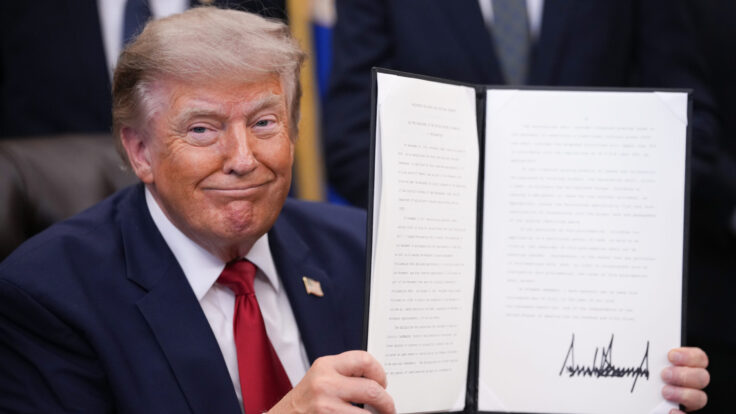
last week after The New York Times reported that President Trump was weighing executive actions concerning government oversight for new models. In an appearance on Fox News, National Economic Council director Kevin Hassett suggested that future A.I. models might go through an F.D.A.-like preapproval
process. “We’re studying possibly an executive order to give a clear roadmap to everybody about how this is going to go,” he said.
Even for an administration that seems to change its mind daily, that would constitute an unusual reversal. After all, the president kicked off his second term by unwinding just about every one of Joe Biden’s A.I.
policies—including an executive order establishing voluntary predeployment safety testing for frontier A.I. developers. He also appointed a since-departed A.I. czar, David Sacks, to serve as a conduit between D.C. and Silicon Valley, and issued an “A.I. Action Plan” that could have been written by the hyperscalers’ lobbyists.
But ever since getting a peek under the hood of Mythos, the secretive Anthropic model that is ostensibly too powerful to release to the
public, the Trump team seems to have changed its tune. “What we’ve had in the past month was a step change in the power of one large language model, but we’re going to see it from the other A.I. companies,” Treasury Secretary Scott Bessent recently said on Fox News. “What we’re determined to do is work with our A.I. companies to allow them to continue to innovate, but our charge in the U.S. government is maintaining safety.” |
|
|
|
A MESSAGE FROM OUR SPONSOR |
Retailers can now process millions of transactions in minutes—not hours. Toshiba Tec partnered with McKinsey using
Nvidia accelerated computing to enable real-time recommendations, faster promotion testing, and measurable lifts in sales, profit and long-term customer value. Read the case study. |
|
|
|
The comments coming out of the administration created such a buzz that White House chief of staff
Susie Wiles felt compelled to weigh in, issuing only her fourth-ever X post on her official account. “The White House,” Wiles noted, “will continue to lead an America First effort that empowers America’s great innovators, not bureaucracy, to drive safe deployment of powerful technologies while keeping America safe.” So… would there actually be no
F.D.A.-like agency for A.I., after all? Asked for comment, a White House spokesperson told me that any policy announcement would come directly from the president, and that any discussion around possible executive orders is, at this point, speculative. |
Adam Kovacevich, the C.E.O. of Chamber of Progress, a tech-industry trade group, told me
that there were two main drivers behind the pivot: the recent departure of Sacks, and the arrival of Mythos. “I think what you’re seeing is some of the normal chaos around factions of Trumpworld: throwing ideas out there, floating ideas in the press, then having to walk them back,” he said. “When there’s a new power vacuum, different factions try to fill it.” Bessent, in particular, may be attempting to step into Sacks’s shoes.
Brendan Steinhauser, C.E.O. of The Alliance
for Secure A.I., suggested that this pivot had latently been in process for a while. “I definitely think there has been a shift,” he told me. “But I was hearing probably two, three months ago that there was starting to be movement in the White House toward what I would call our side: a focus on safety and security.” He added that a lot of the momentum was coming from the Office of the Vice President, and that people within J.D. Vance’s orbit “had grave concerns about some of the
technology and the capabilities.” They and others, including on the National Security Council and in the West Wing, “were sort of pushing the White House to go a certain direction, or at least to take this stuff more seriously,” he said. This, according to The Washington Post, has blossomed into a turf war, with the Commerce
Department and national security aides at loggerheads over what government oversight ought to look like.
Whether acting out of genuine concern or political expediency, either explanation makes sense. Mythos is, by all accounts, an extremely capable model that has unnerved some of the people who have worked with it, and, according to several sources, its release was a bit of a watershed moment for operators in D.C. Poll after poll, meanwhile, shows that Americans are distrustful of A.I.
and worried that the government won’t do enough to protect them from adverse consequences. And Vance, among others in the White House, is presumably thinking about his own political future.
But no matter the root cause or causes, the administration has certainly chosen a conspicuous time to start shifting course. Public distrust and anxiety around A.I. and megacap tech companies has surged in recent months—which, in turn, has already
sparked a tonal change from OpenAI and sent both Democratic and Republican candidates and governors scrambling to respond appropriately. Meanwhile, the White House is quietly seeking a détente with Anthropic, which the Pentagon essentially
blacklisted earlier this year. Last month, shortly after announcing Mythos, C.E.O. Dario Amodei met with Wiles and Bessent—a summit that officials described as “productive and constructive.”
For his part, Kovacevich doesn’t think the administration is simply bending to popular will—midterms notwithstanding. “This White House tends not to change its position based on polling results,” he told me. “I think what happened was banks and other industries came to the White
House with a lot of concern about Mythos, and a panic began.” Charlie Bullock, a senior research fellow at the Institute for Law & AI, agreed that it’s likely a response to the business community, and bank lobbyists in particular—although, he added, “Everything is politics to some extent.” |
A handful of companies have already agreed to engage with the government on A.I. oversight. Last week, the
Center for AI Standards and Innovation, which sits within the National Institute of Standards and Technology, announced agreements with Microsoft, xAI, and Google DeepMind that will let the government do voluntary predeployment evaluations of their models. Details on the arrangement, beyond the fact that it will build upon previous partnerships between CAISI, OpenAI, and Anthropic, are scarce. (Oddly, the NIST article announcing the partnership is no longer publicly available, and neither the
organization or any of the companies involved responded to requests for comment—the Post reported that the website was removed due to “sensitivity within the White House’s Office of the National Cyber Director,” a sign of the tension within the administration.)
According to Connor Leahy, the U.S. director for
ControlAI, the administration’s changing tack is due mostly to “thinking of A.I. not as a commercial issue, but as a national security issue.” In other words, if the government were still prioritizing commercial interests, hindering innovation would be seen as costly. But as the focus shifts to national security (and cybersecurity in particular), not having those restrictions could be far more costly. “In retrospect, it kind of makes sense that once the N.S.A.’s top analysts were
looking at this and saying, ‘Okay, this is not a speculative risk,’ people would jump into action,” Bullock said. “I think that’s consistent with an administration that takes national security seriously and is sort of just waking up to the risks that these A.I. systems pose.” |
That’s all for today. I’ll see you on Thursday.
Ian |
|
|
|
Need help? Review our
FAQ page or contact us for assistance. For brand partnerships, email ads@puck.news.
You received this email because you signed up to receive emails from Puck, or as part of your Puck account associated with {{customer.email}}. To stop receiving this newsletter and/or manage all your email preferences, click here. |
Puck is published by Heat Media LLC. 107 Greenwich St., New York, NY 10006 |
|
|
|
|