{{ 'now' | timezone: 'America/New_York' | date: '%b %d, %Y' }} |
|
|
Hello and welcome back to The Best & The Brightest. I’m Leigh Ann
Caldwell.
The government shutdown should be over by the end of the week, but federal and legislative branch employees are still going without pay, as they have been for more than a month. Some small relief has come in the form of lunch: Chef José Andrés’s World Central Kitchen has been handing out free meals, donated from area restaurants, to federal workers. On
Capitol Hill today, Sen. Chris Murphy provided lunch to U.S. Capitol Police and Senate support staff, who run the floor, direct tourists to the Senate chamber, and generally keep order in the building. Multiple meals have been provided by Senate Majority Leader John Thune, and Senate Minority Leader Chuck Schumer has bought lunch, too. Hopefully, people will receive their back pay soon.
Speaking of Schumer, I have some details below about
the wrath he’s facing after eight members of his party cut a deal with Republicans to open the government. Opposing Schumer has become the new Democratic flex, and there’s little he can do about it. |
|
|
Instagram Teen Accounts default teens into automatic protections for who can contact them and the content they can
see.
Nearly 95% of parents say Teen Accounts help them safeguard their teens online. And we’ll continue adding new protections, giving parents more peace of mind. Explore our ongoing work to keep teens safe online. |
|
|
- Shutdown
deal details and Schumer backlash: The Democratic Party was united in jubilation for approximately two days after last week’s electoral success. Then, in true Democratic fashion, they regressed to infighting—this time over the eight Senate Democrats who broke ranks and will join with Republicans in a key procedural vote to fund the government as early as tonight. All of the aisle-crossers are either retiring or not up for reelection until at least 2028.
The deal they’re supporting
includes a funding extension until January 30; a provision to rehire all the federal workers fired during the shutdown; and the three appropriations bills negotiated by Sens. Susan Collins and Patty Murray to fund agriculture and food assistance programs, military construction, and legislative branch operations. In addition, Senate Majority Leader John Thune promised to allow a vote on a Democratic bill to extend the Affordable Care Act tax subsidies—the issue
that created the stalemate in the first place. Speaker Mike Johnson has told House members to start making their way back into town for the first time since September 19.
Schumer, in particular, is at the center of the Democratic blame game once again. First, he infuriated colleagues by declining to shut down the government in March. Now, despite supporting a shutdown, keeping the party united for over a month, and voting against the compromise, he’s being attacked as
angry Democrats accuse him of quietly shepherding the deal and folding without securing the party’s key demand: to extend (not just vote on) the expiring Affordable Care Act subsidies.
Calls for Schumer to resign as leader have already become a litmus test in competitive Democratic primaries. Iowa Senate primary candidate Zach Wahls held a press call this morning to say that Schumer should “step aside and make room for leadership who is ready to fight.”
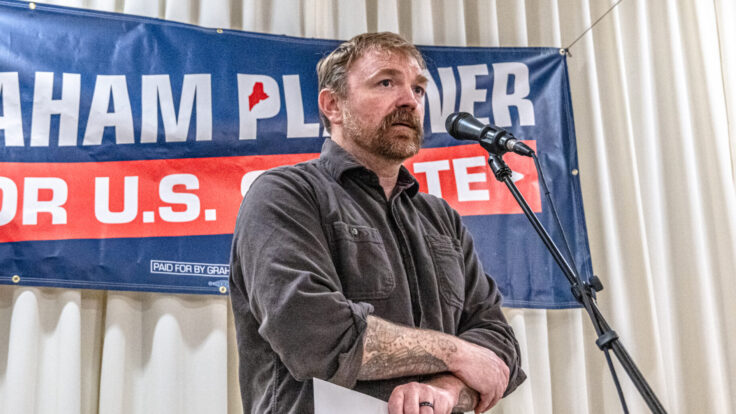
Graham Platner, who is running in the Maine Senate primary against Schumer’s hand-picked candidate, 77-year-old Janet Mills, posted a video this morning saying that Schumer “failed in his job yet again.” Rep. Seth Moulton, who is running to defeat Sen. Ed Markey in the Massachusetts Senate primary, called on the incumbent to “finally join me in pledging not to vote for Schumer.” Saikat Chakrabarti, the former
A.O.C. chief who is running in the primary to replace retiring Rep. Nancy Pelosi, said that Schumer—along with retiring Sen. Dick Durbin, his number two, who did support the compromise—“both need to step down from leadership.” - Pelosi’s non-successor: Christine Pelosi is not running for her mother’s House seat. In a video
posted today, she announced that she’s running for California State Senate instead. It had long been rumored that Christine wanted to run for her mother’s seat but failed to gain traction. Unafraid of the threat of the younger Pelosi, two other Democrats jumped into the race even before the speaker emerita announced her retirement. Others are expected to join, but Christine will
not be one of them.
|
|
|
After an election night upset defined by major swings with Hispanic voters, some Republican
operatives worry they shouldn’t have started a redistricting war with California—and that their own map may backfire. |
|
|
Back in July, when Gavin Newsom began floating his redistricting plan for California, it had
seemed like a long-shot corrective to the G.O.P.’s five-seat land grab in Texas. After all, the Republican effort in the Lone Star State appeared to be a fait accompli, thanks to the state’s compliant legislature. Meanwhile, Newsom’s counterattack required the approval of California voters who, polls showed, were lukewarm on what Democrats used to call gerrymandering. |
|
|
Last year, Instagram launched Teen Accounts, which default teens into automatic protections. Now, a stricter “Limited
Content” setting is available for parents who prefer extra controls. Instagram will continue adding new safeguards, giving parents more peace of mind. Learn more. |
|
|
But last week’s elections did more than just deliver a bluer California that could neutralize Greg
Abbott’s shenanigans in Texas—the results also called into question whether the new Texas map will even deliver the five seats that Republicans expected. Over the summer, many political operatives and observers assumed that Trump’s huge 2024 gains with Hispanic voters—especially in South Texas—might portend a permanent political realignment. Now, Republicans are contemplating elections in 2026 and beyond in which swing voters might… swing back.
Political
strategists have been scrutinizing a handful of consequential data points, in particular, during the days since the election. The first, of course, is the result in California, where voters came out 64 to 36 in favor of the anti-G.O.P. gerrymander—an unmistakable signal for other Democratic governors that redistricting can be good politics. Then there’s Passaic County, a New Jersey region that’s 45 percent Hispanic, which flipped from +3 for Trump in 2024 to +15 for Mikie
Sherrill last week. Could Jersey be a harbinger for Texas? “Yes,” said Mike Madrid, a Latino Republican consultant. “The common throughline is not ethnic, country of origin, language, or generational—it’s economic. Latinos are not monolithic by any of those things, but we are monolithic as working-class pocketbook voters.”
In fact, even before Tuesday, Trump’s promise of a five-seat gain in Texas wasn’t a slam dunk. Earlier this year, one Texas Republican
cautioned me that the party could gain as little as one seat in a blue wave. One of the newly drawn seats, near Dallas, is almost certain to turn red next year. Two others, in Central Texas and around Houston, should flip to the Republicans, but could become competitive if things break for Dems. The last two seats, occupied by Reps. Henry Cuellar and Vicente Gonzalez, are in South Texas—a longtime bastion for Hispanic Democrats in the pre-Trump
years. “I don’t think some of these seats are foregone conclusions,” a Texas Republican source told me. Another Republican from the state pointed to Tarrant County, where the party’s underperformance in a local race “finally has people waking up,” he said.
Meanwhile, in California, Democrats are in an even better position. Two Republicans, Reps. David Valadao and Darrell Issa, will face coin-flip races next year, while the new map makes reelection nearly
impossible for Reps. Doug LaMalfa and Kevin Kiley. In the Inland Empire, Reps. Ken Calvert and Young Kim will be pitted against each other in a miserable member-vs.-member race. But California Democrats didn’t just make things harder for their opponents. They also made reelection easier for their most vulnerable members: Adam Gray, Josh Harder, Dave Min, Derek
Tran, and George Whitesides. What began as a defensive measure is now looking more like an offensive play. |
Of course, Texas vs. California isn’t the only redistricting battle. Over the past several months, Trump has
been pushing Republican state legislatures across the country to redraw their maps. So far, however, the results have been mixed: Missouri complied (but that map faces legal challenges); Indiana Republicans are stuck in Hamlet mode (although my sources still expect the redraw to happen); North Carolina executed a swift redraw that may result in a one-seat pickup; and Florida may take action, but the rumor mill has quieted of late. |
|
|
Other anticipated Republican gerrymanders have also petered out or proven to be less severe than expected:
Kansas backed off from drawing Democrat Sharice Davids out of her district; Ohio didn’t deliver the full number of seats that Republicans had anticipated in a court-ordered redraw; and a series of lawsuits over the proposed maps might result in a two-seat gain for Dems in Utah.
One major wild card is the
Supreme Court. Last month, the justices sounded sympathetic to a case that would gut the Voting Rights Act, potentially decimating a dozen or so Southern Black districts and making it virtually impossible for Democrats to win the House in non-wave years. It’s unclear when the court will hand down a ruling, but the betting money is that, even if the V.R.A. were to take a hit, it would come too late to apply to the 2026 elections.
But Democrats are making redistricting plans with
2028 in mind—and with Newsom’s example, any Democratic governor with presidential ambitions may try to seize the moment to push new maps of their own. After the Republican rout on Tuesday, Virginia is poised to take up a redraw that wasn’t expected even a few weeks ago. Next term, House Democratic leader Hakeem Jeffries’s home state of New York will likely consider redistricting too, assuming Gov. Kathy Hochul defeats Elise Stefanik and Dems
hold the legislature. I’ve even heard some speculation that Democrats in New Jersey, where Mikie Sherrill and downballot Dems notched blowout wins on Tuesday, aren’t rejecting the idea of a redraw—even though the state constitution calls for independent redistricting.
After last Tuesday, I asked a Republican operative whether he felt the appetite
for redistricting would intensify as fears escalated about losing the House, or whether this war of attrition was exhausting enthusiasm. “There’s an argument to be made on both sides,” he said, “but for now, I see it dying down.” Alas, the option to deescalate may no longer be in the G.O.P.’s control. |
|
|
Join Emmy Award-winning journalist Peter Hamby, along with the team of expert journalists at Puck, as they let you in on the
conversations insiders are having across the four corners of power in America: Wall Street, Washington, Silicon Valley, and Hollywood. Presented in partnership with Audacy, new episodes publish daily, Monday through Friday. |
|
|
Unique and privileged insight into the private conversations taking place inside boardrooms and corner offices up and down Wall
Street, relayed by best-selling author, journalist, and former M&A senior banker William D. Cohan. |
|
|
Need help? Review our
FAQ page or contact us for assistance. For brand partnerships, email ads@puck.news.
You received this email because you signed up to receive emails from Puck, or as part of your Puck account associated with {{customer.email}}. To stop receiving this newsletter and/or manage all your email preferences, click here.
|
Puck is published by Heat Media LLC. 107 Greenwich St., New York, NY 10006 |
|
|
|