Welcome back to What I’m Hearing. On the day 12 states sued to block the sale of Warner Bros.
Discovery, nice to see C.E.O. David Zaslav is living his best summer life, hitting up the French Open and Wimbledon, Michael Rubin’s White Party, Sun Valley, and today cashing out another $59 million worth of Warner Discovery stock. As one does.
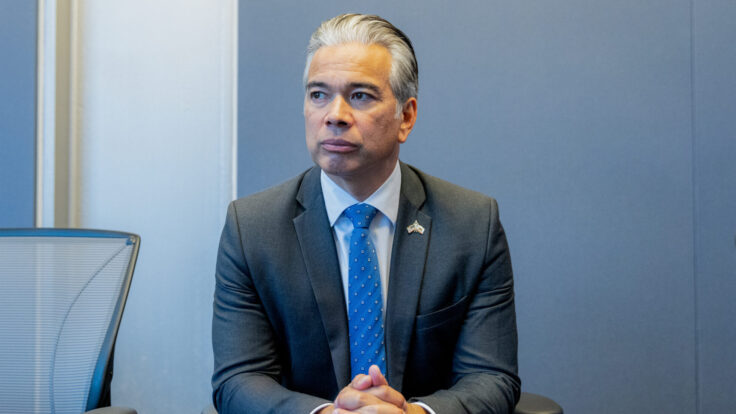
Speaking of that lawsuit, tonight I’ve got an exclusive interview with California Attorney General Rob Bonta on today’s bold, three-pronged challenge to the Paramount–Warner Bros. merger.
(Tomorrow, EriqGardner will be here with his full legal analysis.) Plus, a coroner’s report on Moana—fingers are pointed!
Programming note: This week on The Town, Lucas Shaw and I dove into the WarnerMount suit with a special guest, film commissioner Colleen Bellexplained why Disney animated movies are getting state production incentives, and producer Scott Glassgoldrevealed how to sell a horror movie based on a Reddit thread. Subscribe here and here. Plus: I co-hosted Pivot, and Kara Swisherrevealed which mogul “dressed like a
lesbian” at Sun Valley.
Not a Puck member yet? Just click here. Got a news tip or an idea for me? Just reply to this email, text me, or message me on Signal at 310-804-3198.
Discussed in this issue: David Ellison, Sean Bailey, Tim Burton, Josh D’Amaro, Emma Stone, Dwayne Johnson, Jon
Favreau, Bryan Lourd, Mark Zuckerberg, Jeffrey Katzenberg, Alan Bergman, Bob Iger, Nelson Peltz, Kara Smith, Rachel Zegler, Elizabeth Warren, Adam Pally, Larry Ellison, Beatrice Springborn, Byron Allen, Jake Tapper, Peter
Friedlander, Francesca Orsi, and… JimDolan’s “do not host” list.
But first…
Who Won the Week: Adam
Fogelson
The Lionsgate film chief’s Michael crossed $1 billion worldwide, an incredible milestone for a movie
all the major studios passed on making. The often-dismissed studio’s share price is up 130 percent since last June.
Runner-up: Bryan Lourd, whose CAA flexed this week with a fiery statement ripping the new Meta “Muse Image” A.I. video app, contributing to Mark Zuckerberg’s decision to “pause” its
rollout days later.
Dishonorable mentions: Two! First, the Disney publicist whose Sunday press email described the disastrous $95 million global debut for the $250 million-budgeted Moana as “a good start”; and Dwayne Johnson, who posted through the debacle with a video touting the “#1 movie in the world,” even including the tagline, “The audience has spoken.” Indeed they have.
More on this one…
No, this movie shouldn’t have been
made, not after only a decade since the original. (The average wait time for a Disney live-action remake has been 27 years, per FranchiseRe.) And definitely not at that price, without any new elements. But once it was greenlit by Alan Bergman and Sean Bailey, Disney essentially doomed it by refashioning its Moana streaming series into Moana 2, released just 19 months ago. Why? Bob Iger, when he returned as C.E.O.,
wanted to move past Lightyear and Strange World and Wish and generate safe animated hits as soon as possible. By late 2023, he was battling activist investor Nelson Peltz, and he knew the spring 2024 Pixar movie, Elio, was a turd. So Iger bumped Elio a year, and in February ’24, he personally announcedMoana 2 for release that November. It generated confidence with investors and $1 billion in quick box office cash, and prolonged the franchise to Moana 3 and beyond. But the shift risked sabotaging this 2026 movie, which is what happened. Iger rolled the dice—betting on the popularity of Moana, and that a too-soon misfire would be Josh D’Amaro’s problem, not his. Now it is.
And here’s Scott’s box office take…
Scott Mendelson
The Slow Death of
Live-Action Cartoons
After Moana’s performance this weekend, I think it’s safe to add Dwayne Johnson
tentpoles and live-action Disney remakes to the list of genres (alongside original animated features and comic book movies) that are nowhere near as safe in the 2020s as they were in the 2010s. To be fair, Johnson seems aware of this, with both The Smashing Machine and this family-friendly fantasy serving as parables for the former superstar confronting old age and irrelevance.
Of course, “Come see Dwayne Johnson metaphorically come to terms with his declining bankability” isn’t
exactly a draw for most general audiences. Neither are poor reviews; a property that isn’t old enough to generate much, if any, nostalgia; and Moana 2 grossing more than $1 billion theatrically less than two years ago. As a remake candidate, the original Moana was arguably too popular and too present. Maybe someone will find a way to blame this film’s $43 million domestic and $95 million worldwide debut on
Rachel Zegler, too?
I jest, but Moana ’26 does seem to mark the end of an era that began in March 2010 with Tim Burton’s Alice in Wonderland. That singular blockbuster banked on Burton-specific generational nostalgia and the post-Avatar appeal of 3D, and debuted when
films of that size and scale a) didn’t usually open so early in the year, and b) rarely centered on and/or were aimed at women and girls. It became the sixth movie ever to top $1 billion at the worldwide box office...
“We’re trying to have CNN go on a normal path.” —Donald Trump, suggesting on Sunday to
Jake Tapper that he’d return to the network once it was more Trump-friendly under new Ellison ownership.
The California attorney general, now the public face of the 12-state fight against David
Ellison’s Warner Bros. Discovery acquisition, explains his rationale for filing a much-anticipated lawsuit to block the deal.
For months now, Rob Bonta has been the center of attention in Hollywood. For many in town,
the California attorney general is seen as the last hope to stop the $110 billion merger of Paramount Skydance and Warner Bros. Discovery and the consolidation of two sprawling studio conglomerates by the Ellison family. To others he’s a political operative eager to attack a legally sound transaction to score points with Democrats in an election year. The lawsuit Bonta filed today on behalf of 12 blue states claims the WarnerMount transaction will harm three separate markets:
wide-release movies, tentpoles (a distinct market, Bonta argues), and cable TV channel distribution. Shortly after filing, Bonta joined me and Lucas Shaw on The Town to discuss the case. Curated excerpts of the conversation are below…
“This Is
About Affordability”
Matt Belloni: I’m sorry to say this, Mr. Bonta, but I’m afraid you are not
gonna get an invite to the Top Gun 3 premiere.
Rob Bonta: Who knows? I’m holding out hope still.
Matt: Three words are nearly entirely missing from this complaint: Amazon, Netflix, and Apple, three major players in entertainment. So how can you define these three markets for movies and TV without considering those major competitors?
As part of our due diligence, we looked
at the different markets impacted by these two very diversified companies, and applied the appropriate law. We determined that the law was being broken with respect to three markets. When it comes to wide-release theatrical films, their distribution; the distribution of top-grossing theatrical films—blockbusters, if you will; and also with respect to the licensing of cable channels to cable distributors. [Paramount] is trying to suggest that a merged company would help compete with Netflix and
Apple and other streamers. But we haven’t brought a lawsuit challenging the market concentration in the streaming market.
Lucas Shaw: How did you decide that the theatrical movies or blockbuster movies were a market unto themselves when you have a company like Netflix that releases dozens of original movies a year? Apple, Amazon also make movies that might not fit that definition, but would seem to be competing for the time and money of movie
fans.
Matt: One of the highest-grossing movies of the year in theaters came from Amazon, Project Hail Mary.
Great movie, by the way. We looked at the markets that we think the entertainment industry recognizes as different markets: wide-release theatrical films are different than select-release theatrical films. And a release of films straight to movie theaters is different than films
that get released to streaming platforms first. Blockbusters are, you know, an animal, a market, and we think that the entertainment industry recognizes those as separate markets. That’s where you see the biggest market concentration, but each of the markets as we’ve defined them creates a substantial limiting of competition that makes them presumptively illegal. Are there other markets that exist in the entertainment industry, as you rightfully point out? Yes. But these three are the focal
points of our lawsuit.
Matt: So it’s really just the amount of screens that you are putting your movie on? Because I’m sure if we opened up the books of Netflix and Amazon and Apple, they’re spending as much or more on the movies that go to their platforms as these studios are doing for movies that go to theaters. This seems like you’re defining this market essentially by what the theaters are getting, not necessarily by what the studios are actually
producing.
Right, it’s a relationship that the consolidation in the market has an impact on. When two previously competing distributors of theatrical films now merge, they have the market share, the negotiating power to dictate terms. They dictate them to the theaters where they release the films. And so that means that the moviegoers, the audiences, will pay more to see those films because of the poor negotiating power of the theaters, and that the experience will be eroded. You
won’t have premium screens, you won’t have comfortable seating, you won’t have the same quality and variety at concession stands.
For cable channels, the merged Paramount–Warner Bros. would have 50 of the most sought-after basic-cable channels in the nation. And when they negotiate with Xfinity, Comcast, AT&T, Spectrum, or Cox, they will also be dictating terms and they’ll be able to threaten them with a blackout and say, “If you don’t pay the terms we’re asking for, you’re not getting
any of these great channels,” from MTV to HGTV to Cartoon Network. And that means higher prices for cable and satellite subscribers. I don’t want it to be lost in the market definition and the variety of different ways that TV series and films arrive at audiences. This is about affordability.
Lucas: We’re now seven years or so out since Disney bought Fox’s studio. The risks that you’re warning about in this case, have you seen demonstrative evidence that
the combination of Disney and Fox led to higher prices for consumers and degraded the movie experience? Because in your suit, you also described the theatrical business as “booming.” So it would seem like those are at odds with one another.
What we wanted to point out about Disney-Fox, and what we set forth in the complaint, is that the content output decreases, and they will cut on content because they can and it’ll save them money. The Disney executive leadership said that; we
quote that in the complaint.
30 Movies a
Year…
Matt: I’m gonna read you the Nielsen Gauge numbers from last month: 48
percent of viewing in this country was on streaming services, 22 percent was on cable channels. Clearly, the overall market for watching content at home has moved beyond cable TV. That is a dying business. It’s not a nothing business—it still serves its audience, but it is not where consumers are going. So you’re essentially alleging an anticompetitive merger in an area of the business that, by most accounts, is going away. How can you not consider the
larger viewing ecosystem when looking at this consolidation?
The streaming market is different than the cable market is different than the theatrical release market. And each one has its own independent analysis. And where we landed was three clean markets where the impact of the merger is presumptively illegal based on a clear threshold that the law has defined.
Matt: Paramount says, “The practical effect of this lawsuit is to shield
those dominant streaming platforms like Netflix and the technology companies from much-needed competition.” Are you shilling for Netflix?
Obviously not. The statement is painful to hear, and I’ve heard it multiple times now.
Matt: Why is it painful?
I mean, like [Paramount] is helping consumers and creators and workers and the Hollywood ecosystem? That’s not what producers say. It’s not what the independent filmmakers say.
It’s not what directors say. It’s not what writers say. It’s not what SAG-AFTRA says, and the actors and the creatives. I’m not sure why their perspective is different from the actual people they’re trying to speak for.
Matt: Well, I can think of some reasons.
Obviously, it’s self-serving, and it’s just not true. They want to point to someone else who is a black hat. They want to point to
Netflix.
Matt: But there are these monoliths that are dominating Hollywood right now. Scale matters. And these are global, vertically integrated companies for the first time in the history of the entertainment business that can do it all: distribute film and television around the world instantaneously via the internet. And it has completely caught the rest of the entertainment business flat-footed. So the argument would flow from there, that by combining
forces of these two legacy companies, you could perhaps create a real competitor to Netflix or Amazon.
But we’re not challenging them based on that market. They’re missing the mark by a mile. We haven’t challenged their merger based on the impact on the streaming-service market. Their argument is almost like, “You have to allow us to do illegal things so that we can create a combined megacorporation that can compete with these other megacorporations.” That’s not how the law
works.
Lucas: Paramount has been adamant that they are gonna release 30 movies a year, and increase production for streaming. So do you just not believe them?
Yeah, and it’s not enforceable. It’s what an executive would say to get a merger done when history shows otherwise, Disney-Fox shows otherwise; output went down, not up, and [that] despite them saying that they were gonna maintain [the current level of production], or produce more.
These unenforceable statements by executives that are self-serving to get a merger done, I can’t credit them.
Lucas: What could they do to make you feel that they actually mean it? If they committed to a certain amount of output, committed to spending a certain amount in California for production, something like that?
These are “behavioral remedies,” when there’s a promise to do something, as opposed to a “structural remedy,” like a
divestiture, a breakup, a split-up of two corporate entities. The behavioral remedies just are tough to realize. And even in Ticketmaster–Live Nation, there were behavioral remedies in that case and a consent decree from years ago, and we ended up in court with them again for violation of antitrust law, and won on every single question posed to the jury. So behavioral remedies, I think, just are not as strong or successful historically as structural remedies, as a
divestiture.
Matt: In the complaint, you noted that David Zaslav, the C.E.O. of Warner Discovery, promised 20 movies in 2024. They ultimately released nine. So that is a good piece of evidence. I’m curious why your lawsuit does not focus on the labor markets. So much of the complaints about this merger focus on the thousands of jobs that are going to be lost and hiring for talent and all this. In the Simon & Schuster case recently, that whole monopsony
argument, about having fewer publishers for talent to sell their books to, was a key focus.
Our complaint has multiple references to impacts on workers, impacts on labor, job loss, loss in the entertainment industry of jobs and opportunities, of lower wages. And so that’s part of our overall contextualization of the case and something that’s very important to me. But we didn’t identify a specific labor market as one of the markets that we were going to bring a case
on.
Matt: The Ellisons are likely gonna extend their middle finger here and say, “Go with God, file for your injunction.” So ultimately this will be up to a judge on whether to enjoin this deal before it closes. You stated in the complaint that this case is related to an existing case in the Northern District of California. Does that mean that you are happy with the judge in that case, Araceli Martinez-Olguin?
Yeah, we like that judge as
someone who has experience on this issue already. That judge has a case in front of her brought by private plaintiffs challenging this merger. So the fact that the judge is already up to speed, is thinking about this, we like that. And so we related our case to the private plaintiff’s case.
Matt: Some may say this is a politically motivated challenge, not solid on the law. It’s all about standing up to Trump to win points for an election
year.
I just don’t see it. We have a history here. We’ve taken Amazon to court for price fixing. We’ve brought a bipartisan case against Ticketmaster–Live Nation and won on every single question posed to a jury. We already have a preliminary injunction in Nexstar–Tegna. That’s also bipartisan—red states and blue states side by side. Here, you know, it’s unfortunate that there are not red states engaged. I had heard that some red states had concerns about this proposed merger. And
you have to ask them why they’re not part of this case based on the facts and the law.
Lucas: Maybe the other states are holding out to be the new headquarters of Paramount-Warner Bros. when the deal goes through.
Matt: Exactly. Paramount is now considering moving out of California. Larry Ellison did that with Oracle, moved it to Texas. He is now residing in Florida to escape California taxes. The house is
probably big enough for David to move in with him. Do you worry that you’re driving an iconic business out of the state? Look, I always want companies and businesses to found here, grow here, create jobs, contribute to what is now the fourth-largest economy in the world. That’s my hope. And I insist that they follow the law. If their position is, “If you don’t let us break the law, we’re moving out of the state of California,” I don’t know what
to tell you. You got to follow the law. It’s not negotiable. The statement yesterday was the first time I ever heard it, that they were considering leaving.
Matt: Oh that can’t be the first time you heard it. Cause I’ve heard it, and they’ve been communicating with you.
They haven’t said it, or certainly it hasn’t been as clear and explicit a threat, which is what it seemed to be.
Matt: Let’s say
you can’t get the injunction, hypothetically, and certain settlement remedies are put on the table. If he agreed to sell CNN, would that be enough for you?
No. I don’t think I’ve ever said that. I don’t think that that is anywhere near sufficient to address the anticompetitive harms that we’ve been talking about.
Matt: But politically it would be something that Elizabeth Warren and the Democratic base
would get excited about. You don’t discuss news at all in the complaint, really.
Yeah, but also we’re not naive. We see what’s happening with respect to CBS and potentially CNN and what that would mean.
Matt: Well, Donald Trump was on with Jake Tapper this weekend and said “We are gonna fix CNN.” Who’s the we? Is it he and David Ellison?
I saw
that. I thought the we was very revealing.
Matt: Do you worry a little bit that if you lose this one, it’s gonna make it harder to bring similar antitrust cases in the future?
I don’t. Loss is always possible in litigation and in life. And I think about the facts and the law. I think about the strength of our case. I think about everyday people who just want to get a movie ticket for a special
occasion for a first date or an anniversary or a birthday party or someone who wants a cable bill that doesn’t break the bank.
Data of the Week
106 percent Increase in Kalshi’s female weekly active users on mobile devices from June 8
to June 28, thanks in part to wagers on Love Island USA. [Apptopia/Barron’s]
88 minutes Length of an ideal movie, according to a new survey, down from 92 minutes in 2024. [StudyFinds]
20.4
percent Share of major studio films released in 2025 that included LGBTQ characters, down from the 23.6 percent in 2024 and the third straight year of declines. [GLAAD]
Matt’s Reading List…
Great news for Hollywood: Nobody reads anymore!
[Atlantic]
Bill Cohan notes the market doesn’t think the WarnerMount merger will close until the end of the year. [Puck]
Are cheating scandals the new Emmy bait?
[Mashable]
Jim Dolan is tracking gay celebrities at MSG. (Also congrats to Adam Pally for getting on the “do not host” list.) [Wired]
$2 billion for U.S. rights to
the next World Cup seems like a bargain given the current ratings highs and FIFA’s willingness to manufacture ad time—sorry, give athletes a much-needed breather—with “hydration breaks.” My money’s on Netflix, which already has the next women’s World Cup, or Amazon. [CNBC]
Speaking of Amazon…: New-ish Amazon TV head
Peter Friedlander finally filled the number two executive role he’s been searching for, and it’s… just a drama head, Kara Smith, promoted from within amid yet another restructure. Friedlander talked to tons of execs about that job, from Francesca Orsi at HBO to Beatrice Springborn at NBCUniversal, but he never landed on an outside candidate who was a good fit and—importantly—would be okay with Amazon’s bizarre organization and
compensation rules. So now Smith, a longtime Amazon exec who oversaw The Summer I Turned Pretty, is running drama, and separate execs will head comedy and young adult programming… until the next reorg, at least.
With a month of Nielsen data, the Byron Allen block on CBS is retaining 38 percent of the Colbert audience. [LateNighter]
The Feedback…
My Thursday report on the suitors for Letterboxd (especially Netflix!) triggered a full cycle of internet
outrage from cinephiles fearful of interference. Here’s another one: I’m told A24 is also in the mix. I won’t reprint all the vitriol, but a note from an exhibitor was insightful…
“On the internet, nothing is real. When it comes to movies and the media that cover them, everything is manipulated. Journalists trade credibility for access, Rotten Tomatoes scores are inflated by fake critics, studio marketers now control the entire narrative. Except on Letterboxd. That is our safe space.
It’s not perfect, but in general the community can be trusted to reflect what people who love movies think about the latest movies, not what they are told or paid to think. That community would be destroyed if Netflix or one of the other studios bought Letterboxd. Rotten Tomatoes is owned by Comcast and massively inflates scores to help sell movies, both from its Universal studio and others. Comcast or any other studio would do the same to Letterboxd, and even the perception of bias would ruin
the entire vibe. Once that’s gone, it’s all downhill.” —An executive
Have a great week, Matt
Maya Tribbitt contributed research for this issue.
Got
a question, comment, complaint, or a fake logline for the new ‘Free Willy’ movie? Email me at Matt@puck.news or call/text me at 310-804-3198.
You received this email because you signed up to receive emails from Puck, or as part of your Puck account associated with {{customer.email}}. To stop receiving this newsletter and/or manage all your email preferences, click here.
Puck is published by Heat Media LLC. 107 Greenwich St., New York, NY 10006
Didn't get an email? Check your spam folder and confirm the spelling of your email, and try again. If you continue to have trouble, reach out to fritz@puck.news.
Didn't get an email? Check your spam folder and confirm the spelling of your email, and try again. If you continue to have trouble, reach out to fritz@puck.news.
Member Exclusive
Get access to this story
Create a free account to preview Puck’s full offering, including exclusive articles, private emails from authors, and more.