 |
|
Welcome back to What I’m Hearing, and congrats to everyone who’s checked out for spring break. Remember, I love news tips, insightful comments, and column ideas, just reply to this email. And as always, if you’ve been forwarded this, join the stylish WIH community by clicking here.
|
|
|
- First, a mini-rant: Can we please ignore the poverty rhetoric coming from the studios as the Writers Guild begins negotiating? Yes, the stocks are down, and no one has figured out streaming. Real issues. But here’s an undisputed fact: One after another, from the Art Deco Television Center to Television City to CBS Radford to even a facility planned at the former Sears in Hollywood, the studios and the companies that serve their productions have been frantically upgrading or breaking ground on new spaces to accommodate demand. Long term, entertainment is gonna be a good business.
- The Anonymous drama ends quietly: Fired Anonymous Content manager-producer Keith Redmon failed to get his desired public apology in today’s joint statement announcing a resolution of the lawsuit over his ouster. In addition to money, Redmon settled for an admission that he “made significant contributions on a number of award-winning shows and films and to the international division,” a sentence whose every word was negotiated by litigators. I’m told the public statement, more than the dollar amount, actually led Anonymous C.E.O Dawn Olmstead and C.O.O. Heather McCauley to quit in disgust a couple weeks ago, as the long-form settlement was nearing completion. (The case actually settled in principle months ago at a confidential mediation.) Remember, this is the same Laurene Powell Jobs-backed company that told me on the record last year that it “uncovered multiple incidents of sexual misconduct by Redmon, some physical in nature.” Since it didn’t retract that statement today, I asked Anonymous if the company still stands by it? No comment. Redmon lawyer Michael Plonsker, and Olmstead attorney Bryan Freedman also declined to comment.
- Anonymous addendum: I’m told Powell Jobs recently stepped down from the board of Anonymous. Job one for that board, which includes former Netflix exec Cindy Holland, attorney Matt Johnson, and Powell Jobs advisor Michael Klein, is now to find a new C.E.O.
- Speaking of fired people, was there anyone who seriously thought Marvel’s Victoria Alonso voluntarily walked on a Friday afternoon? Kevin Feige and Disney’s Alan Bergman had been trying to figure out for a while how to fix this situation. Yes, as head of VFX and post-production and a 17 year Marvel veteran, Alonso has been a trailblazing Argentinian and LGBTQ executive and vocal advocate for inclusivity in the inner circle at a key Disney division. But she’s also acted monstrously to colleagues and particularly to vendors, per multiple sources over the years, and the C.G.I. in Marvel projects has really suffered as it has ramped up the volume of projects. VFX quality should never be the story when a movie comes out, and Ant-Man 3 generated tons of negative press. Alonso had acolytes around town, especially in the media—she was always game for a quote or a panel—but the Disney C-suite wasn’t surprised by this move.
- Get excited to sit: I’m told Christopher Nolan’s July nuclear-bomb drama Oppenheimer clocks in at around 3 hours, depending on last minute tinkers, which would be his longest film. (Interstellar is 169 minutes.) Will be interesting to see how this summer’s blockbusters stack up amid all the recent criticism of length.
- Box office over/under: John Wick 4 (also with a 169 minute running time) is tracking for between $65 million and $70 million this weekend, an uptick from the $56 million the previous “chapter” (with Halle Berry) in 2019. I’ll still take the over, based on franchise goodwill and a 94 percent RT score.
|
|
|
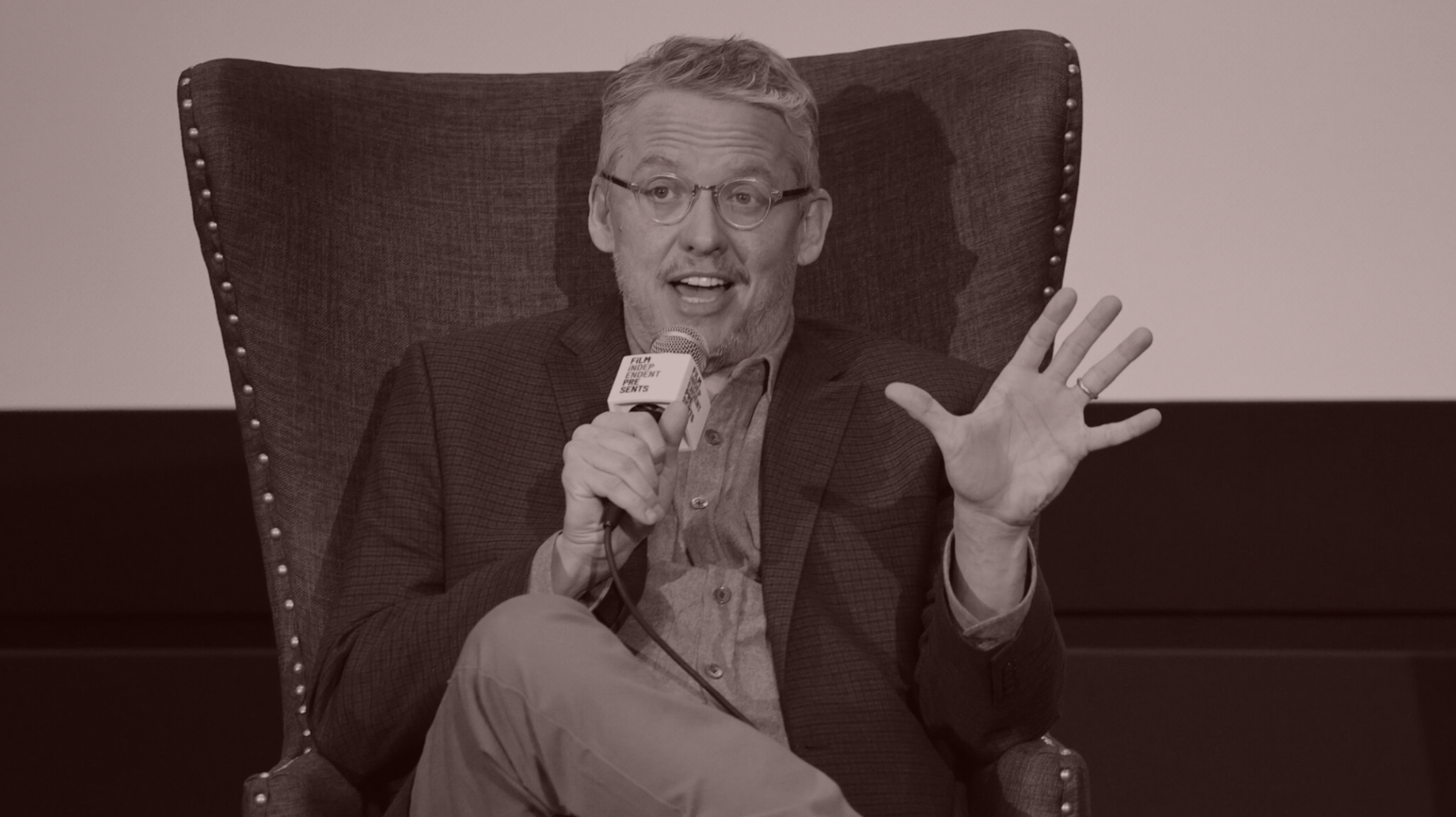
| Adam McKay has been making the rounds lately with a pitch for an allegorical dramedy, and it sounds pretty interesting. The film, dubbed Average Height, Average Build, is said to be about a serial killer who gets into politics in an effort to change the laws to be more, well, murder-friendly. McKay’s got Robert Pattinson attached to lead what will likely be a starry cast, with Robert Downey, Jr. and more in the mix. Good stuff.
But as with most McKay projects, the budget is high for a political dramedy, and despite the fact that his past three movies as a director have generated 17 total Oscar nominations, McKay hasn’t been a huge box office draw since he left studio comedies—though Don’t Look Up, starring tile-friendly Leonardo DiCaprio and Jennifer Lawrence, is Netflix’s second most-watched movie of all time, with 360 million hours viewed.
One executive who heard the pitch told me this week that he wanted to do it but then offered a version of, In this economy? The McKay project will almost certainly land, probably at a streamer (though a Netflix source told me they’re not currently bidding). But it’s the same issue we saw with the $150 million Nancy Meyers rom-com, which still hasn’t found a home and likely would have been a pretty quick yes at Netflix just a short time ago. Now, after years of offering veritable blank checks to top creators, nearly everyone is thinking twice about the bigger, riskier swings—the kind that lead to home runs yet just as often lead to strike outs. You can pick your reason: The Great Netflix Correction; the expectation that Bob Iger is about to drop Mickey’s Cost-Cutting Ax at Disney; a seemingly inevitable writers strike; franchise-mania; the fact that the L.A. weather now makes Seattle feel like South Beach. (That last one is just me.)
My point is that the overall financial health of Hollywood necessarily trickles down to which individual projects get made, and that makes the current retrenchment and general malaise especially urgent for anyone who wants to see the good stuff happen. A MoffettNathanson report this week predicted “industry content spending to be relatively flat or even decline in the outyears.” That’s pretty obvious to anyone paying attention—or sitting in pitch meetings. And it won’t likely recover until the industry figures out the streaming model and how it will replace the cratering television business, which has funded this whole party for the past 30 years.
To that end, there was a little ray of sunshine through the clouds this week, at least in my estimation, regarding new subscribers and churn. Remember in December, when Disney+ raised its price from $8 to $11 per month for customers who decline to sit through advertising? A new report from Antenna found that 94 percent of those subscribers accepted the price hike, just 5 percent canceled, and less than 1 percent chose to keep the $8 monthly tab with ads. Less than 1 percent. Translation: Existing customers either really found the Disney+ product valuable or weren’t paying close attention. Either way, they were willing to pay more for it.
The same Antenna report also revealed that when it comes to new streaming Disney+ customers—meaning people who are just now signing up—about 20 percent initially chose the cheaper ad tier, and by the third month, that number had risen to 36 percent. So more than a third of new Disney+ customers were seduced to subscribe via the cheaper option with ads. Netflix, which slow-launched its ad tier and only makes it available on its “basic” plan, has seen a slower uptick in members choosing the less expensive option—about 20 percent of new customers are taking ads. But Bloomberg reported on Sunday that Netflix’s ad tier reached about 1 million monthly active users in the U.S. after its second month and is growing significantly.
And, importantly for Netflix, a bigger percentage of people on the ad tier are new subscribers, who signed up for the tier, rather than existing customers who downsized, as I’ve previously feared in this space. We won’t know until the next earnings reveal just how many new customers have signed up for the Netflix ad tier (and how much that did, or didn’t, cannibalize existing customers), but at least for now, the ad experiments at Disney+ and Netflix appear to be doing what they were launched to do: bring in new price-sensitive customers while maintaining the revenue associated with people like me who are willing to pay higher prices for uninterrupted Mandalorian and Wednesday. |
| The “Multiple Paths” to Profitability |
|
| I was a bit surprised by those numbers, especially the tiny 1 percent of existing subscribers who chose the cheaper option, since it’s so easy to change or cancel your subscription—and Disney informed everyone that the price was going up. Conventional wisdom in the streaming business is that, at least in this country, where the median income is about $70,000 per year, low-income households will likely become ad-supported streaming video customers, and people who earn more are much more likely to pay for ad-free streaming. But at least this small data set suggests a lot of people who probably should have switched to the cheaper tier of Disney+ didn’t. At least not at first.
That shows a) Disney+ was a bargain to its users—underpriced initially to gain scale and now almost like a utility to busy parents like me—and thus Iger can continue to raise the price, as he has teased in interviews that he plans to do; and b) the Disney+ ad business, while additive to the overall pie, might be slower to take off than some anticipated, which might provide fuel to the argument that Iger should keep Hulu, Disney’s other general-interest streaming service, which already does have a robust advertising business. The upshot, wrote Antenna C.E.O. Jonathan Carson, is “that there may be multiple paths towards profitability for video streaming services to take.”
I’d say that’s good news, both for Disney and Netflix, and also for the entire entertainment industry. The path to sustainability, it seems, is becoming clearer. But I wasn’t sure my optimism was 100 percent warranted, so I called up Michael Kassan, the C.E.O. of MediaLink, the consultancy that advises studios and streamers on the advertising business. “Yeah, that was surprising to me as well,” he told me on Tuesday about the Disney+ and Netflix numbers. Overall, he said, streaming subscribers are behaving more like television subscribers, meaning they are slow to change habits—hence staying with their existing pricier tier despite being economically incentivized to switch—but will eventually bifurcate into those that want the lower cost with ads (the old broadcast or basic cable viewers) and those who are willing to pay more for convenience and quality (HBO and pay cable people). “It’s just taking a little longer to get there,” he noted.
Kassan recalled consulting in the early 2000s for Gemstar, which had both TV Guide magazine and those TV programming scroll channels, back when Rupert Murdoch owned the company. “We used to marvel at the fact that the older people were still receiving TV Guides [in print] when they had the channel,” he said. Habits are tough to kick. And, as is true in the cable TV business, people don’t always act in their own best interest. |
| “I Think That’s Called Television” |
|
| So how, again, does this impact Hulu? Maybe it doesn’t. More and more people I talk to at Disney seem to think Iger is a seller, presuming he can find a buyer, either Comcast or another company, to take on Disney’s two-thirds ownership position. (Comcast owns the other third, and Disney can choose to buy out that stake as early as next year for about $9 billion or so.) After all, Comcast kinda needs Hulu more than Disney does at this point, and the Biden Justice Department might not freak out because Comcast is already an owner of the asset.
But maybe, if the purpose of the Disney+ ads business is primarily to bring in new subscribers, and most of those existing 161 million subscribers want the premium product (until Iger prices it high enough to force many of them onto an ad tier), maybe that only increases the value of Hulu to Disney? After all, Hulu generates billions in ad revenue. Maybe that’s just in the short term, and Disney doesn’t see a need for a long-term ad machine like Hulu when Disney+ can eventually become that. But Disney+, with all its perceived value to customers, has not delivered nearly the viewership eyeballs that Netflix does. At least not yet. Presumably, this is all being modeled out by some overworked young strategy executive in Burbank, and I’m sure Brian Roberts’ decision will be similarly informed by his own internal data.
Kassan didn’t have an opinion on what Iger would or should do—or at least one he wanted to share on the record. But he was amused by the slow, gradual, and now pretty obvious shift of streaming to the business model of TV. “When Ted [Sarandos] and Reed [Hastings] made the decision to take advertising, everybody thought it was such a big deal,” he said. “But I said, ‘Gee, look at that.’ Bundling commercial messages and content. That’s a really new idea. I think it’s called television.” |
|
|
See you Sunday,
Matt
Got a question, comment, complaint, or an invite to your Succession party? Email me at Matt@puck.news or call/text me at 310-804-3198. |
|
|
|
| FOUR STORIES WE’RE TALKING ABOUT |
 |
| R.N.C. Bidding Wars |
| Notes on Psaki’s MSNBC debut, a media tug-of-war, and CNN’s ratings nadir. |
| DYLAN BYERS |
|
 |
| Ron’s Soft Touch |
| On the perils of ignoring the MAGA elephant in the room. |
| TINA NGUYEN |
|
 |
|
 |
|
|
|
|
|
 |
|
|
|
Need help? Review our FAQs
page or contact
us for assistance. For brand partnerships, email ads@puck.news.
|
|
|
|
Puck is published by Heat Media LLC. 227 W 17th St New York, NY 10011.
|
|
|
|