 |
 |
|
Welcome back to What I’m Hearing… We’ve got a winner in our Best Strike Sign contest! With more than 30 percent of the vote, congrats to “ChatGPT doesn’t have childhood trauma.” Two submitters will get Puck hats. Second place, thanks to Notting Hill fans, is “Just a writer, standing in front of a corporation, asking it to pay her.” That submitter gets a charity round of applause. Sorry.
Speaking of charity, you can now bid on lunch with… me! Charitybuzz has the link, with proceeds benefiting the Leukemia & Lymphoma Society. Everyone except publicist Kelly Bush is eligible to bid. Good luck!
Programming notes: Puck is partnering with NatGeo for an FYC screening of the limited series A Small Light, and I’m doing a Q&A with the cast and crew. It’s June 12 in L.A., and members can RSVP here to attend… This week on The Town, Lucas Shaw and I gave Bob Iger his six month report card, Erich Schwartzel explained the state of play in China, and Endeavor’s Karen Brodkin and Hillary Mandel argued why RSNs need to be replaced by a broadcast-streaming combo. Subscribe here and here.
Discussed in this issue: Bob Iger, Jen Salke, David Zaslav, Alan Bergman, Vin Diesel, Dana Walden, Rupert Murdoch, Eliza Clark, Peter Rice, Christine McCarthy, Scientology’s star donor… and the fake Carol Lombardini.
But first…
|
| Who Won the Week (Cannes Edition): Lily Gladstone |
|
| Scorsese’s 206-minute Killers of the Flower Moon is generating positive yet somewhat muted reactions among even the enthusiastic film-snob crowd. But Gladstone’s reviews have been euphoric, suggesting the Native American star is an early frontrunner for a supporting actress Oscar nomination.
Runner up: Filmmaker Jonathan Glazer, whose Holocaust drama The Zone of Interest, seems to be the toast of Cannes and a clear Oscar contender.
Not related at all, but interesting: Former Disney TV chief Peter Rice was spotted having a very public dinner at the Polo Lounge on Thursday night with Amazon Studios head Jen Salke. That’s amusing, considering the rampant rumors that Rice is in talks to either replace Salke or become her boss. In one telling I heard this week, Rice was supposedly making the rounds with Amazon executives in its infamous “loop” hiring process. But… that’s not the case, per sources familiar. Rice hasn’t even interviewed at Amazon, nor is he said to be interested, even if there were an open position. |
|
|
It’s a tie: “We don’t want you here!,” “Pay your writers!,” “Shut up Zaslav!,” and “Fuck you, you piece of shit!”
–Boston University student hecklers at Warner Bros. Discovery C.E.O. David Zaslav’s instantly-memed commencement speech, which, for reasons known only to him and his team, he didn’t cancel amid the writers strike.
A little more on this: Why why why did Zaz step into this 100 percent predictable situation? Yes, he committed two years ago, but Netflix’s Ted Sarandos had the sense to back out of his PEN American Spring Literary Gala honor, and with the exception of Shari Redstone’s Simon Wiesenthal Center honor (and WB film chief Pam Abdy’s Emerson commencement), the top executives have mostly avoided bad-look confrontations. At least Zaz isn’t personally hosting a blowout party in Cannes… oh no.
Not related at all, but interesting…: In the U.S., 68 percent of Netflix users that responded to a new BofA Global Research survey said that they would pay to continue password sharing, and 44 percent said they would take a discount for the ad-supported tier. That bodes well for Netflix’s coming crackdown, and perhaps for all the streaming ad tiers.
Now for the story of the week in streaming… |
 |
| Disney and the Great Streaming Purge |
| What’s going on at Disney is kind of nuts. If you told me that each of the Seven Dwarfs holding up the executive building in Burbank were being auctioned off to increase free cash flow, I’d probably believe it. Nearly every division has been asked to spend less, some way less. And titles are disappearing from Disney+ and Hulu as an entire industry retrenches. |
|
|
|
| Seems like there’s a lot of confusion, and certainly a fresh bit of outrage, around the latest Hollywood content purge, this time at Disney. That’s not surprising, I suppose, considering the streaming era taught both consumers of film and television and the people who make it to expect that everything on these services will live forever, like cockroaches and Rupert Murdoch. Now that the bottom has fallen out of these media companies, linear TV is failing faster than anticipated, and investors crave profits more than subscribers, it’s hardly a shock that the money-suck streaming services are being targeted. If Wall Street wants Disney+ to cost less, the easiest way to do that without impacting subs or engagement is to delete the old stuff nobody watches.
Still, it’s understandably hard for creators to accept that on May 26th, their art is just… vanishing. No DVDs at Target, no return to the platform after a little break, no nothing. “You work on something for years, pour your heart and soul into it, as do hundreds of other artists,” tweeted Eliza Clark, showrunner of Hulu’s Y: The Last Man, adding, “Then, it is disappeared…” Depressing, although what she’s describing is what happened to low-viewership shows for most of the history of the entertainment business. The DVD boom and then Peak TV just taught Clark—and all of us—to expect more. Our bad. |
|
A MESSAGE FROM OUR SPONSOR
|
 |
“With interviews, anecdotes, data visualization, and spectacular scenery, “Limitless” covers the greatest hits of documentary storytelling, with a humorous, intrepid, and surprisingly vulnerable star at the center,” celebrated Indiewire. For your consideration in Outstanding Hosted Nonfiction Series Or Special and all eligible categories, from visionary Darren Aronofsky and National Geographic, Limitless with Chris Hemsworth is streaming on Disney+. Check out the trailer here for the series that rewrites the rulebook on living better for longer.
|
|
|
| Plus, Disney C.E.O. Bob Iger and C.F.O. Christine McCarthy have told everyone for months now that this was exactly what was going to happen, all part of their increasingly frantic effort to erase $5 billion from the bottom line, including a reported $3 billion this year. What’s going on at Disney is kind of nuts. If you told me that each of the Seven Dwarfs holding up the executive building in Burbank were being auctioned off to increase free cash flow, I’d probably believe it. Nearly every division has been asked to spend less, some way less.
We all know that short-term cost-cutting was the real reason behind Iger canceling the Florida campus in Lake Nona, though poking Ron DeSantis in the eye is a nice bonus. Hell, they’re even cutting bait on the pricey Star Wars hotel at Walt Disney World after just two years, and that’s one of the most impressive feats of Imagineering in a long time—the kind of big swing that a company takes after ten years of steady growth, cheap money, and a booming economy. Now its closure was sheepishly announced right after the Lake Nona news to blunt the “Disney failed” narrative. Times have definitely changed.
So, yeah, the Great Netflix Correction has officially become the Great Streaming Purge. “We are in the process of reviewing the content on our D.T.C. services to align with the strategic changes in our approach to content curation,” McCarthy told investors on May 11. “As a result, we will be removing certain content from our streaming platforms and currently expect to take an impairment charge of approximately $1.5 million to $1.8 billion.” That’s C.F.O.-speak for Shit just got real, Hollywood people, so prepare to kiss your well-meaning passion project goodbye.
And this list—it’s not final—includes kids stuff like Big Shot and The Mysterious Benedict Society, the Turner & Hooch and Cheaper By the Dozen remakes, general entertainment titles like Dollface and The Hot Zone, and tons of shows I’ve never heard of and doubt you have, either. None of it would qualify as “core” content, or even something like Westworld, which HBO Max dumped because it identified free, ad-supported buyers in Roku and Tubi. Part of this is just Iger’s push for profitability, which the Street is demanding from him. But it’s also a recognition that people are using Disney+ differently than other streamers, most notably Netflix.
The well-known franchises and library titles are driving sign-ups and viewership, not whatever tween show or original movie can be pumped out each week. D+ isn’t really a “discovery” platform, at least not yet, and Hulu, while home to great originals and all the FX shows, is still primarily known for “catch-up” broadcast TV. As my colleague Julia Alexander has noted, not a single non-branded Disney+ general entertainment series or movie has charted on Nielsen’s Top 10 list. That’s probably why Iger was lamenting all that “undifferentiated content” back in February. He knows the truisms of the past decade—exclusivity, global D-to-C, unlimited spending—are all dated. Now he’s trimming the fat. |
| The Chapek (and Iger) Correction |
|
| Disney isn’t alone here, of course. Warner Bros. Discovery C.E.O. David Zaslav started the Great Streaming Purge last summer with Batgirl and several HBO Max shows. “We looked at it and we said: Most of this is not being watched,” Zaz said at a recent conference. “Or, we don’t think anybody is subscribing because of this.” Boom, gone, or sold elsewhere. Paramount Global’s wunderkind hatchet man Chris McCarthy is doing the same. “We will divert investment away from areas that are underperforming and that account for less than 10 percent of our views,” McCarthy told his team in January. Inspirational stuff.
But those companies are considered financially challenged. Disney is Disney, and it was supposed to be a winner in the streaming wars, or at least an early leader when Iger priced Disney+ so low and spent so lavishly that it shot to 100 million subscribers in just 16 months. Hulu was a prized acquisition in the Fox deal, not a potential $30 billion albatross, as it sometimes seems now. The Bob Chapek months notwithstanding, so much of what Iger is doing now is unraveling the strategies he put in place and championed in the final years of his first tenure. The landscape has totally changed, of course, but it’s rare and a bit odd that the new guy is course-correcting the old guy, who happens to be the new guy. And, for the most part in Hollywood, people just assume he’s got the right approach. Well, everyone except the market, which doesn’t seem to be convinced. Disney is down about 10 percent since the May 11 earnings reveal. |
|
|
| The Details and the Phone Calls |
|
| The mechanics are interesting here. First, many seem to think that artist residuals are the cause of the purge. Not really. Residuals make up a real but relatively small part of the cost of putting shows and movies on streamers. Such a small part, in fact, that the Writers Guild is on strike to improve them.
The major costs here are the license fees that must be paid by the distributor (Disney+ or Hulu, in this case) to the owner of the content. We may think of these shows as just sitting on a service, waiting to be discovered at 3 a.m. by your stoned cousin. But sitting on a streamer is the same thing, from a licensing perspective, as if the show were being syndicated on TBS or sold into a foreign territory. Disney+ is an exhibition, and fees must be paid. That’s the case even if the owner of the content is also Disney (or an affiliate), which must at least pretend to engage in an arms-length transaction.
The way it works is that the Disney people look at the library, figure out what’s not performing (and trust me, some of these shows were literally being watched by nobody), yank it off the service, and take an impairment charge. The cost of entertainment product is typically paid up front but amortized over time, yet when you take an impairment on an asset, you can write off the cost today, meaning you’re saying, This is not worth the money we paid. If it’s a Disney+ show, like, say, the Willow series from Lucasfilm, or whatever the heck Encore! was, D+ won’t have to carry that ongoing burden. The downside is that once you take the impairment charge, you can’t put that asset back on Disney+ again. It’s gone, at least for the full impairment period.
But it’s not necessarily a total loss. When you impair an asset, like a TV show, you then look at what value you might be able to gain from other sources: Electronic sell-through platforms (like purchases on Amazon or Apple TV), a FAST channel (PlutoTV, Tubi), maybe Netflix or Amazon bites, etcetera. If you do find a buyer, you subtract what you’ve earned there from the write-off, and the content lives on somewhere. If not, it disappears.
You do that enough and perhaps you get to a billion or two in savings, and the vast majority of your customers don’t notice. And Iger can say he’s “right-sizing” the Disney catalog—one of the worst words in corporate America because it never means increasing, only decreasing—while slashing his spending on new content, and retreating to the tentpole-only strategy that was a hallmark of his first tenure—until streaming came along.
But… it means that TV bosses like Dana Walden and Craig Erwich, and top film execs Alan Bergman and Sean Bailey and their teams have had to make a lot of uncomfortable phone calls lately to break the news to creatives that their hard work is going poof. (Note to creators: If you ask Disney to at least send you a DVD of your movie, you’ll get one, so there’s that…) And that’s the downside for Disney, obviously: The blowback. The talent relationships. The reversal of a decade of largesse in the content business that made us all think everything was forever, even if nobody was watching. |
|
|
| Why, exactly, did Disney bring Indiana Jones and the Dial of Destiny to Cannes? Yes, Harrison Ford in tears generated tons of global press, and the franchise has a history at the festival (pre-social media, though). Blockbusters often play the Cannes game, with mixed results. But those bad reviews are now gonna marinate for six long weeks, and the weaknesses (like the iffy VFX) will be dissected extensively. [RT]
As predicted, Fast X underpromised and slightly overdelivered, but I’m still doubtful Vin Diesel will get his desired 12th movie that he blurted out at the premiere, at least not at a $300 million budget. [IndieWire]
Congrats to CAA for its supporting role in the resignation of “Varsity Blues” U.S. Attorney Rachael Rollins, who stepped down after an ethics report revealed she took, among other things, an all-expense paid trip to the agency’s Amplify summit. [AP]
Speaking of CAA, Fred Specktor got some nice Journal love on the occasion of his 90th birthday. No mention of his wild Cabo celebration. [WSJ]
Ali Diercks, the Covington & Burling lawyer who leaked privileged information about Les Moonves, goes public in a fascinating podcast with Rachel Abrams. [The Daily]
Now that the Supreme Court has narrowed the fair use exception to copyright law, the impact on the music and burgeoning AI industries could be pretty significant. [New Republic] Note: Eriq Gardner will have more on this in tomorrow’s Rainmaker newsletter, which is free to Puck members. Just add him here.
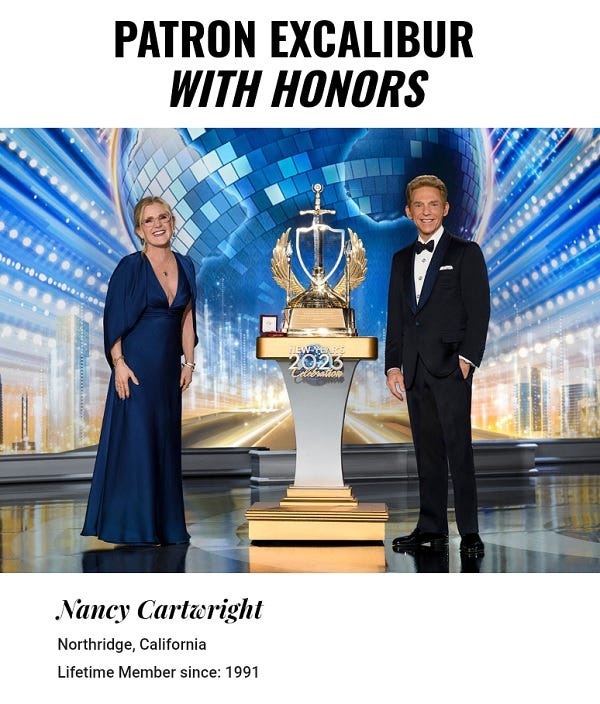
Scientology gave The Simpsons star Nancy Cartwright a massive trophy (and eternal life, of course), reportedly for donating more than $21 million. Congrats, everyone. [TonyOrtega]
I’m gonna need an interview with the sculptor that Jeff Bezos hired to create the world’s tackiest bust of his beloved Lauren Sanchez for the prow of his new $500 million yacht. [People]
Now for an anxiety-inducing dispatch from Jonthan Handel…. |
| Strike Update: Will the Actors Prompt a Tri-Guild Walk-Out? |
|
| With most attention focused on the writers’ strike and directors’ negotiations, I’m looking at the upcoming SAG-AFTRA negotiations, which start June 7, and at the June 30 contract expiration. My sources close to the situation are outlining a thicket of key issues.
On basic wages, the actors union will likely want increases that address inflation, like the DGA but unlike the WGA’s somewhat tamer proposal (that was nonetheless rejected by the studios and streamers). On streaming residuals, actors haven’t given up on transparency and a success metric, an implicit rejection of the DGA’s concession on this issue and a very sticky wicket for data-stingy streamers. The actors are also concerned about their pension and health plans, which are funded by employer contributions based on actors’ session fees and residuals. The problem is that only the first couple hundred thousand dollars a year in earnings count for this purpose, with no contributions levied on earnings above that amount, a ceiling that hasn’t budged in decades. That starves the plan of full-throated contributions based on the union’s higher earners—money that might have avoided the debacle from several years ago when the plan pushed many seniors onto Medicare.
Then there’s generative A.I., which poses an even more imminent threat to actors. A usable A.I. script is probably some years out, but A.I. is turbocharging audio and video deepfake technology. The studio counter to the WGA’s proposal for A.I. restrictions was annual meetings, which is absurd on its face: the technology is changing so quickly that monthly meetings and mid-course contract revisions are going to be necessary. As I told KCRW on Thursday, in response to a comment by Justine Bateman, “If you squeeze the soul out of entertainment and turn it into something that is simply generated by the ghost in the machine, there is something lost… in addition to the economic oppression that can result.”
The union wants guardrails on self-tape auditions, which puts three distinct technologies in play—streaming, A.I., and remote work. Can the companies and SAG-AFTRA reach a deal on all this, and more, in their three week window? I doubt it, and so do my sources. I expect a high turnout on the current strike authorization vote (where balloting strategically closes just two days before talks start) and likely authorization north of 85 percent.
Several days ago, I wrote that an actors’ strike was possible, but I now believe that one is likely. And if the directors don’t achieve a deal in the next several weeks—which would probably have to include a favored nations reopener, allowing the DGA to gain the benefit of any better terms achieved by either of the other two guilds—then we might just see directors walk out as well. A tri-guild Hollywood walkout? It’s never happened before, but this time it just might. |
|
|
| My messages continue to be dominated by the writers strike, especially after Jonathan previewed a possible DGA deal on Sunday and I noted some WGA misinformation on Thursday.
“I know you’re trying to be fair to both sides but highlighting some incorrect figures [sent out by the WGA] obscures the fact that this strike is hurting companies that can afford to pay what we are asking. That’s the point, not some dollar figure in a guild email.” –A writer
“The writers have done a good PR job, explaining why they are fighting for their future lives. The problem is, they are mimicking all of the unions who 10-20 years ago, faced with the tech boom, focused on preserving jobs for as many people as possible in a shrinking business, rather than on getting the best deal they can for those who will have jobs when things re-order for the future. And the studios cannot give into that and survive in the long run. The studios are facing just as much of an existential threat as the writers—their execs just can’t be overt about it because of the impact on stock prices.” –An executive
“The fact is, this all comes down to greed. There’s too much corporate money in Hollywood, and capitalists don’t understand creativity. This might be a business, but it doesn’t work like one, and they’re gonna learn that the hard way.” –A producer
“It’s common sense that AI is a more existential threat to the actors than to writers. If the AMPTP isn’t ready to budge on AI, I think the actors will strike as well. That brings us to the directors. At first blush, they seem less likely to strike. However. If the DGA believes SAG-AFTRA will ultimately strike and therefore shut down productions anyway, wouldn’t they decide they might as well strike, too, and extract bigger gains? Or at least strike until they see whether the actors make a deal or not? And imagine the concessions the guilds could extract if all three unions are on the picket lines?” –Another writer |
|
|
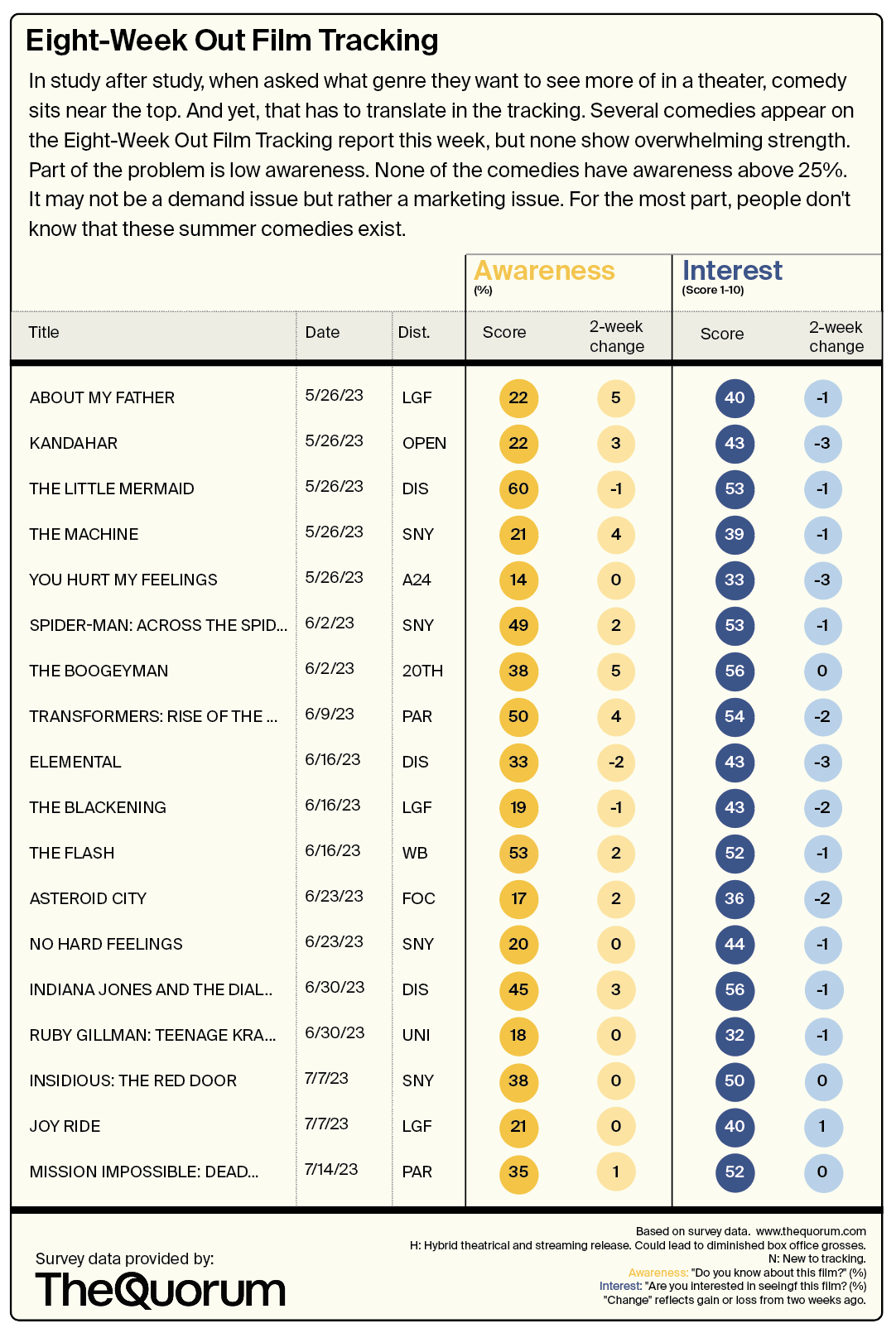
| Things aren’t looking great for the summer comedies, which people don’t seem to know exist. The latest Quorum early tracking survey shows big awareness problems… |
|
|
| Finally finally, one fun thing…
Perhaps the best Twitter account to emerge in the WGA strike is the parody of Carol Lombardini, chief negotiator for the AMPTP. I was curious who had hijacked her persona into a searing takedown of the studios (followed, amusingly, by at least one studio chief, Amazon’s Jen Salke), so I reached out and discovered that yes, it’s a WGA member whose name has appeared in What I’m Hearing. A short back-and-forth with “Carol” ensued:
So, how’s the strike going for you?
Well, the content pipeline has been completely cut off, the broadcast networks are propping up their fall schedules with Wayne Brady dancing and a few game show formats older than I am—and even the last few productions that CAN still be filmed are being shut down daily. Meanwhile SAG-AFTRA just called a Strike Authorization Vote before even TALKING to me, so yeah, everything is in a state of absolute chaos, which is to say it’s going exactly the way I planned. From where I’m sitting (at the Sherman Oaks Galleria), things are looking pretty good.
People seem to think some members of the AMPTP could do side deals with the writers if this strike drags on. Does that worry you?
Absolutely not, if there’s one thing I can say about the AMPTP it’s that we’re completely united in our singular purpose of making the lives of our creative partners an unmerciful, dystopian nightmare, while we completely ruin what was once a thriving and profitable business model. That’s solidarity, babe!
Got big Memorial Day weekend plans?
Probably a lot of self-care, so might binge a bunch of depressing documentaries that highlight various forms of human suffering. The big Succession finale, of course (the tough part is I’m #TeamEverybody). Also been hearing a lot of great things about this restaurant Horses! |
|
|
Have a great week,
Matt
Corrections: The Horizon film executive is Mark Gill with a K, not a C (as I wrote last Sunday). Also the 2007-08 strike loss was $2.1 billion, not million, obviously. Apologies.
Got a question, comment, complaint, or wild predictions for the Succession finale? Email me at Matt@puck.news or call/text me at 310-804-3198. |
|
|
|
| FOUR STORIES WE’RE TALKING ABOUT |
 |
|
 |
|
 |
|
 |
| One Shaheen Moment |
| Unpacking the upper chamber’s secret foreign policy scandal. |
| JULIA IOFFE |
|
|
|
|
|
 |
|
|
|
Need help? Review our FAQs
page or contact
us for assistance. For brand partnerships, email ads@puck.news.
|
|
|
|
Puck is published by Heat Media LLC. 227 W 17th St New York, NY 10011.
|
|
|
|