Hi, and welcome back to Line Sheet.
In today’s issue, I’ve got an update on the future of
Marc Jacobs now that the Authentic Brands Group deal has collapsed! In other news, I have the scoop on New York City Mayor-Elect Zohran Mamdani’s stylist. Tomorrow I’ll also have some notes on Olivier Rousteing’s unsurprising exit from Balmain.
For the main event, Rachel “Rachel@puck.news” Strugatz has the latest updates on the
Estée Lauder Companies turnaround effort. Plus, Sarah “SShapiro@puck.news” Shapiro is here to unveil this quarter’s Lyst Index, which ranks the 10 most discussed—and shopped—fashion brands and products online. There is drama, there is intrigue, there are insights about who is hot and who is not!
Programming note: I was on the Remarkable Retail
podcast, with Michael LeBlanc and Steve Dennis, talking about the future of luxury and plenty more. Listen here.
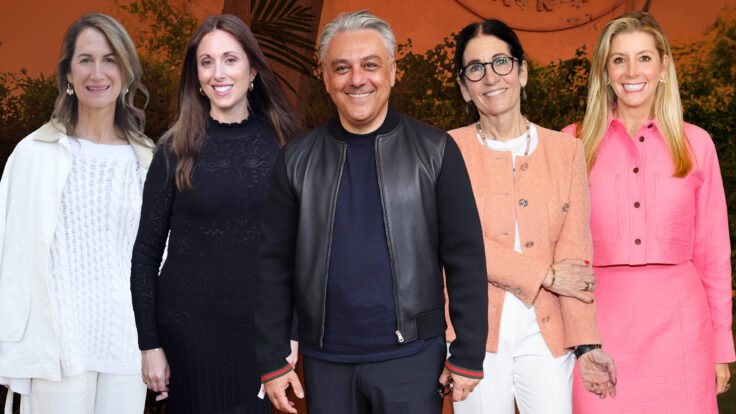
Mentioned in this issue: Stéphane de La Faverie, Estée Lauder Companies, Kering, Luca de Meo, Alexander
McQueen, Too Faced, Better Than Sex, L’Oréal, Katherine Power, Fabrizio Freda, LVMH, Bernard Arnault, Marc Jacobs, Zohran Mamdani, Pamela Anderson, Mary Kate and Ashley Olsen, The Row, Versace, and many, many more… |
Four Things You
Should Know…
|
- When
the best laid plans go awry: Just two weeks ago, Jamie Salter’s Authentic Brands Group was convinced they were the next owners of Marc Jacobs. The giant licensing firm, which owns the intellectual property of everything from Barneys New York to Sports Illustrated, was already recruiting for a brand president to manage the relationship with the
lauded designer. Alas, it was not meant to be, at least not right now. WWD is reporting that the deal fell through after negotiations stalled. (Of course, WWD failed to credit my reporting on the matter. Some people!)
I’m told that some of the tension revolved around plans for the brand’s
management. To remain involved, Marc Jacobs would want to continue to stage runway shows and produce the ready-to-wear collection, even in limited quantities. The designer still owns a minority stake in the business, which LVMH has had an interest in since the late ’90s, when they recruited Jacobs to design Louis Vuitton’s runway collections. This may have been a bridge too far for ABG. Last week, a person close to Salter told me that “there is no way Jamie is going to fund a
runway show.” Anyway, Sidney Toledano, Bernard Arnault, and other senior leaders at LVMH owe Jacobs a lot, and likely want this separation to be as amicable as possible.
So what happens now? LVMH can continue operating Marc Jacobs while the company reexamines the market. It’s also possible that Salter will come back to the deal, given the size of the opportunity. Most likely, though, a company like the manufacturer
G-111—the owner of Donna Karan International, another former LVMH brand—will swoop in. Or maybe another licensing firm with more experience running proper fashion brands, like WHP, will kick the tires. But there’s no denying this dead end has stalled the process significantly, and is a setback for both LVMH and Jacobs. Everyone deserves resolution. - Condé layoffs continue: As previewed yesterday, the annual autumn culling at Condé Nast has begun. First,
it was the demise of Teen Vogue. Today, there were other cuts in edit, including at least one director-level editor at Vogue.com (connected to Chloe Malle’s necessary restructuring). But I’m hearing that layoffs were significant and across departments, and that, at one point in the day, a group of union members walked into chief people officer Stan Duncan’s office to “demand answers.” I will update as I hear more. Right now, I have the
most information about the technology group, where Chris Chen, V.P. of global architecture and data governance, is out. So is Vikram Palicherla, S.V.P. of engineering. (Both were close with Sanjay Bhakta, the chief technology officer.) Someone connected to that group suggested to me this was a streamlining of Palicherla’s original grand plan to outsource much of the work to India, shaken up, in one case, by the decision to create a new
Vogue app with American company Rokmetro. Anyway, there will probably be more soon. (A Condé rep did not respond to a request for comment.)
|
|
|
A MESSAGE FROM OUR SPONSOR |
|
|
- Who’s
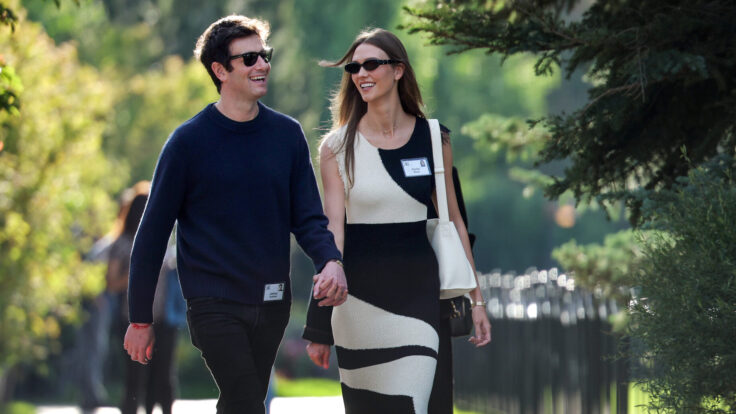
stylin’ Zohran: You won’t be surprised to hear that New York City Mayor-Elect Zohran Mamdani and his wife, Rama Duwaji, are working with stylist Bailey Moon, who also dresses former first lady Jill Biden, Tim Walz, and Pamela Anderson. Moon also works with the New York–based actor-couple Rebecca Hall and
Morgan Spector—he has experience with the doubles dynamic, too.
Moon would make for a fabulous Styles section profile. He’s whittled out a niche unlike any other, although so much of his appeal comes down to his discretion. He’s a bridge between his clients’ fields—politics, theater, Hollywood—and the fashion world, which is a tricky needle to thread. And with Mamdani and Duwaji, he once again hit the mark: Mamdani’s appearance—a dorky hipster under
simple, nicely fitting suits—certainly did not detract from the message. And Duwaji, dressed to look like she’d be best friends with Kaitlin Phillips—downright conservative in that old-timey, Desert Vintage sort of way—is making it work, too. There’s also the matter of ensuring that the wares reflect the message. You cannot really dress a socialist in Chanel… or maybe
you can.
|
|
|

| Sarah Shapiro
|
|
- The Olsens’ summer to
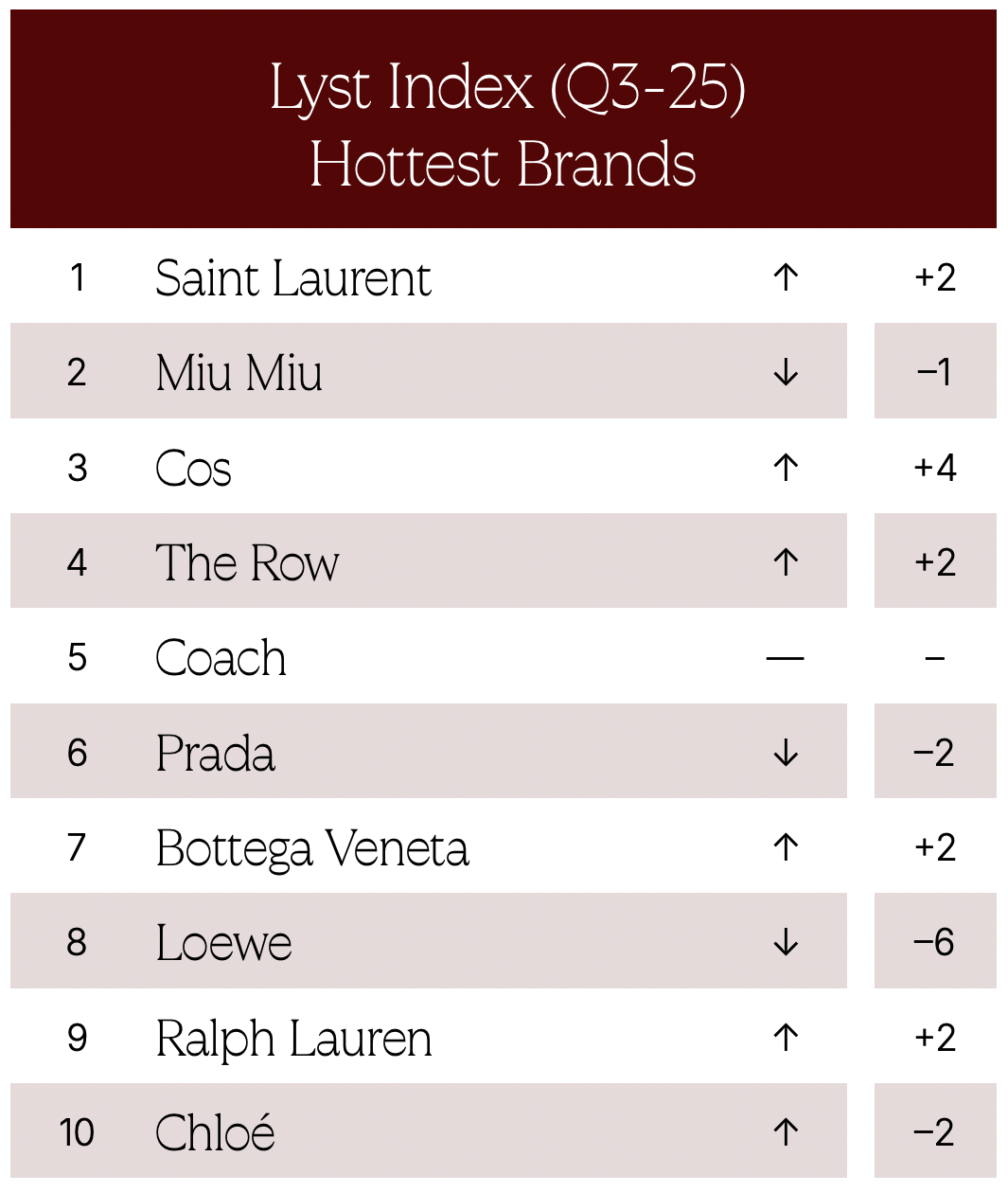
remember: The Row is continuing its steady march up the Lyst Index, the quarterly report that ranks fashion’s most popular brands and items. There’s much to pore over in the Q3 2025 report, which was just released, but one of the most notable developments is that Mary Kate and Ashley Olsen’s brand surged into the top five, after jumping
seven spots in Q3 2024 into the top 10—a fitting capstone to a week in which they collected their fifth CFDA American Accessory Designer of the Year award. The Row rounded out the top five alongside Saint Laurent, Miu Miu, Coach, and Cos. For its part, Versace moved up four spots to No. 12—an indication that there’s early excitement around the Prada acquisition.
|
- In terms of products, Havaianas’ flip-flops took the No. 1 item spot—it was a summer staple for many shoppers—a distinction that Alaïa’s mesh flats earned last year. Two loafers also made the top 10, both relaxed and ruched styles, from Saint Laurent
and The Row.
Meanwhile, a 7 percent demand increase for Nike this quarter is a promising sign for C.E.O. Elliott Hill. Two Nike sneakers made the top 10, including the Moon Shoe, a collaboration with Jacquemus, which dropped late Q3. (I
wrote about Nike’s collaboration strategy last Friday.) Skims also had an impressive 271 percent year-over-year demand increase, a sign that their product is hitting the right notes: The nipple push-up bra landed at No. 5 in the top 10 items.
Some other
developments of note: Nour Hammour’s perfectly cut leather jackets are up 49 percent this quarter, and Madewell’s denim, accessories, and flats helped the brand jump 34 percent after they partnered with Benjamin Talley Smith to rework the line.
|
|
|
Estée Lauder boss Stéphane de La Faverie seems to have ushered in a new era of common-sense
leadership and fiscal responsibility. But what if he took a page from Kering’s Luca de Meo and did something radical, like sell off the brands diverting attention from the priority businesses? |
|
|
Recently, someone close to The Estée Lauder Companies pointed out the practicality of newish C.E.O.
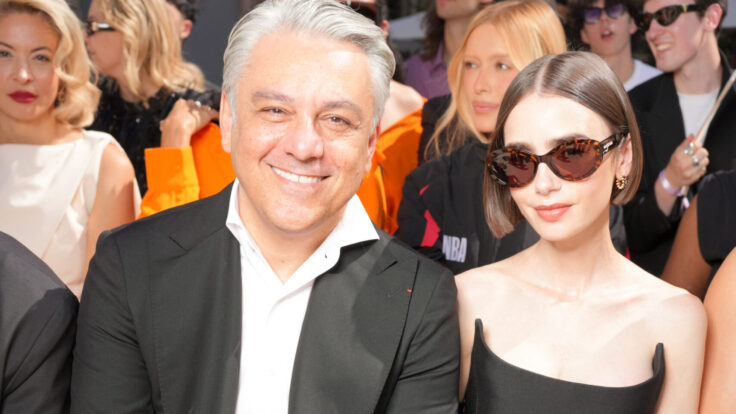
Stéphane de La Faverie. A handful of his recent initiatives, beyond his McKinsey-esque “Beauty Reimagined” strategy, involved simply acting on “the questions other people have asked for ages,” this person said—from why MAC Cosmetics wasn’t sold at Sephora in the U.S. to why the company hadn’t partnered with Shopify. But what if de La Faverie took a page from Kering C.E.O. Luca de Meo and also did something truly radical, like sell off the brands
diverting attention from the priority businesses? After all, less than six weeks after taking the reins, de Meo completely offloaded Kering’s beauty arm for $4.7 billion, and may be preparing to do the same with Alexander McQueen. Now, the luxury giant can focus on its core businesses while enjoying a much-needed cash infusion. |
|
|
A MESSAGE FROM OUR SPONSOR |
|
|
At the moment, there are at least inklings that de La Faverie is trying to move in the same
direction. According to a recent Axios
report, ELC is actively trying to find a buyer for Too Faced, better known as the maker of Better Than Sex mascara. (I’ve separately confirmed that Lauder’s efforts are real.) Too Faced probably won’t sell for much, and Lauder will inevitably wind up taking a huge loss on a company that it acquired for nearly $1.5 billion in 2016—its biggest deal ever at the time. But even a modest transaction would allow Lauder to reengage in M&A, and there
are plenty of attractive assets that make sense.
Alas, Summer Fridays is probably too expensive to acquire. But Lauder, whenever it’s able and willing, should get serious about Westman Atelier, which is probably the only newish brand to attain luxury status and would be a great addition to the makeup cluster. Meanwhile, Violette_FR has continued to optimize an already successful Sephora launch, and could eventually be a good fit at Lauder, too. (It would also be a homecoming for
Violette Serrat, the line’s C.E.O. and founder, who was once the global beauty director and a spokesperson for the Estée Lauder brand.) Perhaps quixotically, Lauder could buy Katherine Power’s Merit Beauty. Merit C.E.O. Philippe Pinatel was once MAC’s global brand president—not only is he fluent in Lauderese, but I’m told he’s equally skilled in operating a startup and a global brand.
Meanwhile, I’ve long
believed that ELC’s most prudent move would be to offload its haircare division. Aveda and Bumble & Bumble are both strong haircare brands, but they’ve struggled for relevancy amid a bounty of startups with better branding—although I’ve heard that recent haircare gains in the U.S. were led by Aveda, and that Lauder is “taking important steps to build Aveda back up.” For whatever reason, I’m told the board would be resistant to divesting haircare, even though Lauder isn’t a leader in hair
technology and won’t be anytime soon. |
All this speculation isn’t apropos of nothing. There’s a lot of momentum at The Estée Lauder Companies. Net
sales for Q1 were up by 4 percent and surpassed analysts’ projections, and growth for the fiscal year ending next June 30 could be as much as 5 percent. The share price is up over 21 percent year to date. And while cuts aren’t done yet—although the majority of a projected 7,000 layoffs have already occurred—de La Faverie is being heralded as the beauty savior that Fabrizio Freda, his draconian predecessor, wasn’t and probably never would have been. (He was too
singularly focused on skincare and China.)
Those rosy figures were connected to several discrete variables, including the fact that China is finally picking up, with seven brands seeing double-digit growth in the region. Sure, a few questions need to be answered—i.e., the fate of Bobbi Brown, Dr. Jart+, and Balmain Beauty, the latter of which very quietly reduced its prices by nearly 40 percent. But things are moving in the right direction. What the results
underscored is that Lauder really thrives in high-end fragrance and skincare, the current, dominant areas of growth. |
|
|
Lauder just opened a long-awaited fragrance innovation center in Paris, a signal that the company wants to
move much of that work in-house. A veteran creative director described the center, rather unflatteringly, as resembling a Marriott, but the process isn’t consumer-facing, so how it looks doesn’t really matter. ELC also just introduced a new “fragrance row” of boutiques in SoHo—including Tom Ford Beauty, Jo Malone London, Editions de Parfums Frédéric Malle, and Kilian Paris—which was inaugurated by a lavish outdoor dinner that took over an entire block on Prince Street. The industry watchdog
account Estée Laundry pilloried the dinner for being tone deaf, given the layoffs, but the smaller lines certainly benefited from a cross-branded event.
Then there’s makeup, which is perhaps the part of the business most in flux, and with the greatest potential for stabilization in the near future even if Bobbi Brown, Too Faced, and MAC are at vastly different points in their brand journeys. At Bobbi Brown, there’s been a clear pivot away from Gen Z marketing and toward the
over-40 crowd, as evidenced by new global ambassador Sara Foster. Too Faced, as mentioned, might be sold in the near future. And starting early next year, MAC will enter Sephora U.S.—the biggest shake-up to its distribution since the brand entered Ulta in 2017. “No one is expecting this to be a massive revenue play for the brand, but it’s incredibly important for a brand like that to have a presence at Sephora in the U.S.,” said a person familiar with the
matter.
The industry-wide consensus is that Lauder really needs to shake up its makeup portfolio. “They’ve not been capable of growing small brands in makeup effectively,” said a person close to the company, pointing to Smashbox—which Lauder should eventually, officially close—and Becca, which Lauder acquired in 2016 before shuttering it five years later. Lauder has never quite figured out “trend-led businesses,” and has struggled to connect with certain consumer cohorts.
Obviously, ELC needs to refine its strategy in these areas… maybe de La Faverie is the leader to figure it out. |
Until tomorrow,
Lauren
P.S.: We use affiliate links because we are a business. We may make
a couple bucks off them. |
|
|
Puck fashion correspondent Lauren Sherman and a rotating cast of industry insiders take you deep behind the scenes of this
multitrillion-dollar biz, from creative director switcheroos to M&A drama, D.T.C. downfalls, and magazine mishaps. Fashion People is an extension of Line Sheet, Lauren’s private email for Puck, where she tracks what’s happening beyond the press releases in fashion, beauty, and media. New episodes publish every Tuesday and Friday. |
|
|
An essential, insider-friendly Hollywood tip sheet from Matthew Belloni, who spent 14 years in the trenches at The
Hollywood Reporter and five before that practicing entertainment law. What I’m Hearing also features veteran Hollywood journalist Kim Masters, as well as a special companion email from Eriq Gardner, focused on entertainment law, and weekly box office analysis from Scott Mendelson. |
|
|
Need help? Review our
FAQ page or contact us for assistance. For brand partnerships, email ads@puck.news.
You received this email because you signed up to receive emails from Puck, or as part of your Puck account associated with {{customer.email}}. To stop receiving this newsletter and/or manage all your email preferences, click here. |
Puck is published by Heat Media LLC. 107 Greenwich St., New York, NY 10006 |
|
|
|