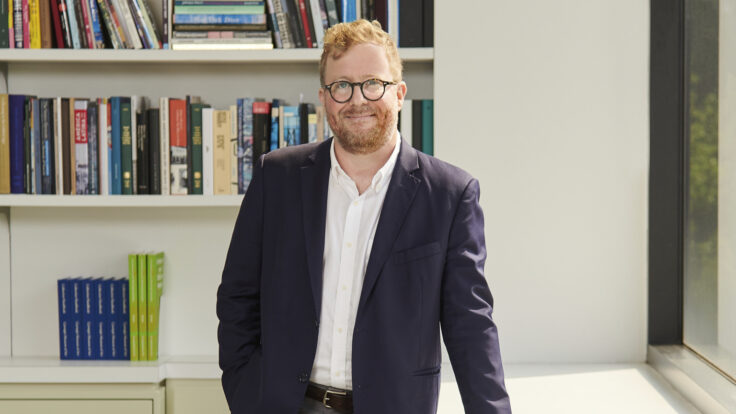
Welcome back to Wall Power. I’m Marion Maneker.
The great
Ingrid Abramovitch is back, and tonight she’s talking about Dutch designer Joris Laarman, an eco-sensitive entrepreneur who’s making 3D-printed benches that support moss and lichen growth. He also lives in a commune on a forested peninsula near Amsterdam, and his work is collected by tech bros and Jim Carrey, while the queen of the Netherlands counts herself a fan—quite a posse. Up top, I have some insight into the third-party guarantee game as
it’s playing out before the sales, and Hong Kong’s record auction for watches.
Also mentioned in this issue: Robert Mnuchin, Mette Sterre, Maarten Baas, Hella Jongerius, Sabine Marcelis, Job Smeets, Dennis Freedman, Queen Máxima, Philip K. Dick, Glenn Albrecht, Anita Star, Alan
Turing, Charlotte Perriand, Marc Benda, and many more…
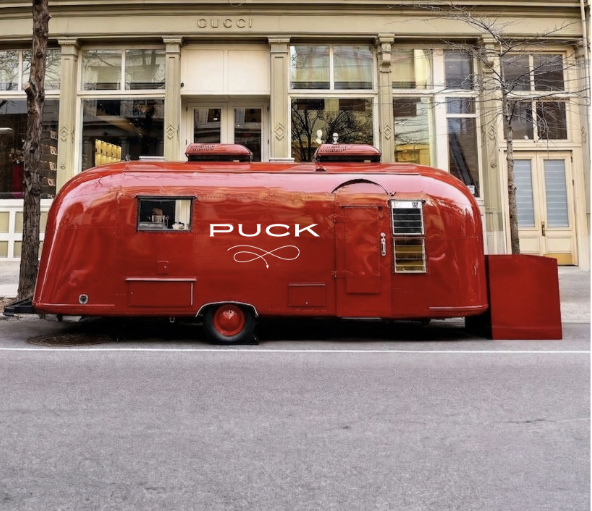
Before we get into it, have you seen the Puck Airstream? |
The May sales this week mark the most highly anticipated few days on New York’s art calendar, and
the Puck Airstream will be making stops at the three destinations defining the market moment: TEFAF, Christie’s, and Sotheby’s. Part rolling newsstand, part neighborhood ice cream truck, our red Airstream will be offering complimentary coffee or scoops depending on the time of day. I’ll be there for some of it, too, and look forward to seeing many of you. Catch us this Thursday between noon and 6 outside TEFAF, Friday morning between 9 a.m. and 12:30 p.m. outside Christie’s, and Friday afternoon
between 2 p.m. and 6 p.m. outside Sotheby’s. We’ve spent the past five years making Puck an indispensable read for the people who shape culture—in art, finance, media, entertainment, and beyond. Now, we also serve refreshments. Come say hello.
Let’s get started… |
-
Bacs & Russo sets a record for a watch auction: Phillips’s Bacs & Russo watch division notched $96 million in sales this past weekend in Geneva. That’s a record for a watch sale, according to the auction house, which also noted that 14 different lots in the sale attracted more than $1 million—four made by F.P. Journe and two by Patek Philippe. The auction house says 1,815 registered bidders from 74 countries participated.
- Business in the
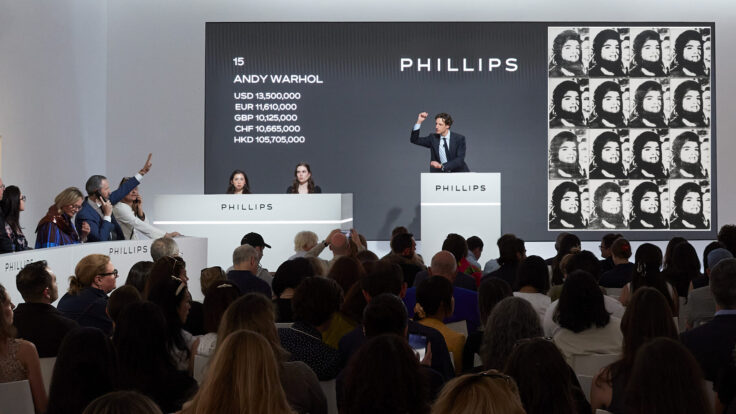
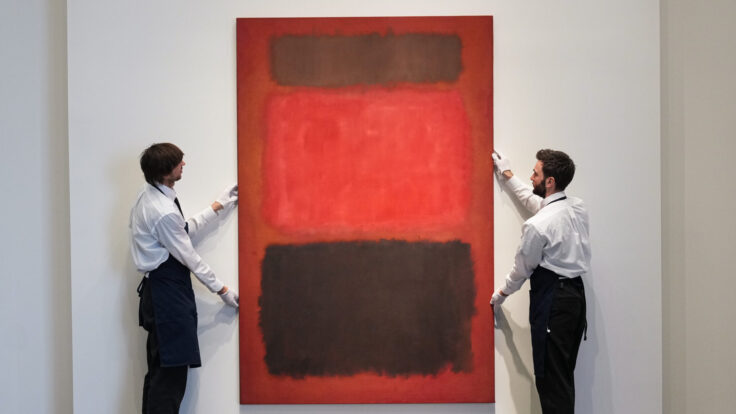
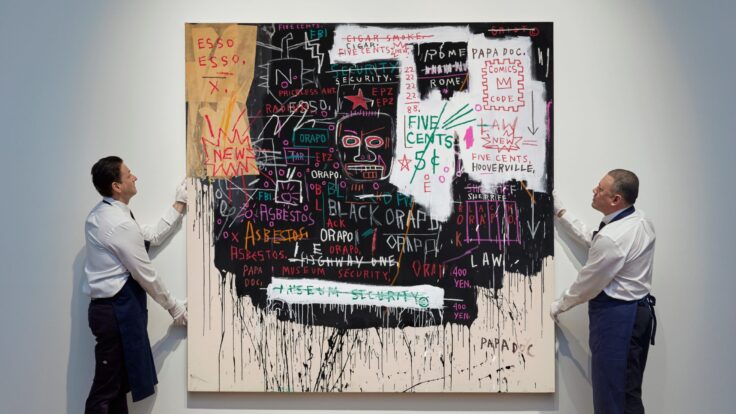
front, third party in the back: There’s still time for consignors to take third-party guarantees, but so far the number of evening sale lots at Christie’s, Phillips, and Sotheby’s that are backstopped by buyers stands at 100 out of 250 total, or 40 percent. That number, however, masks the differences among the houses: Phillips has only eight of its 40 evening sale lots presold—20 percent, for those of you who aren’t doing the division in your heads. At Sotheby’s, 10 of 11
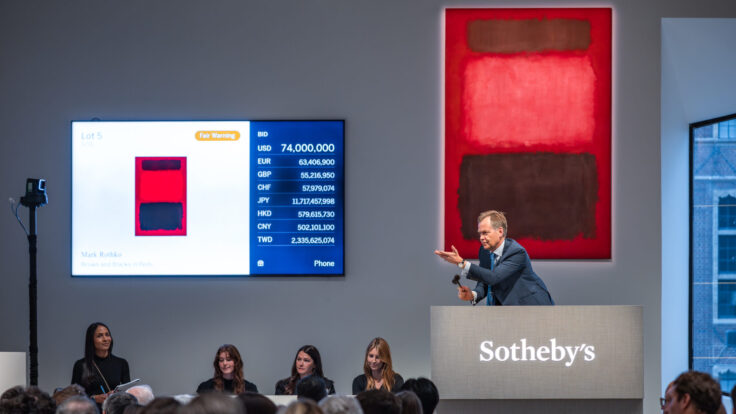
Robert Mnuchin lots are spoken for; 15 of 46 lots in the Now and Contemporary evening sale will definitely sell; ditto 19 of 45 lots in the modern evening sale. The backstopped lots amount to 43 percent of the total across those evening sales.
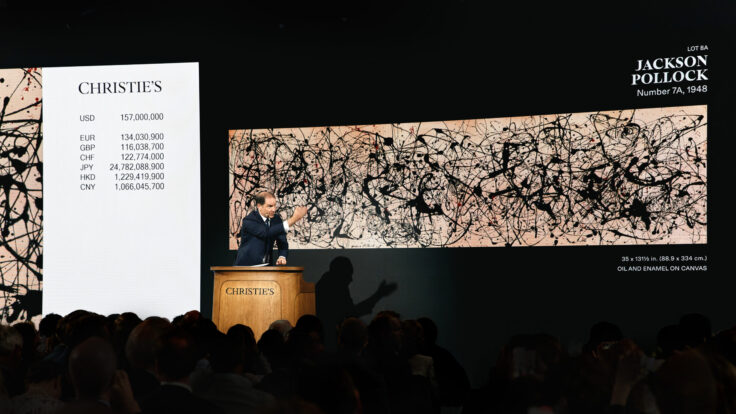
Finally, at Christie’s, the entire Si Newhouse sale of 16 lots has been guaranteed (plausibly) by a third party (or parties). Also guaranteed in the house’s evening sales are 21 of the 49 20th century lots, two of
the 12 lots in the McNeil minimalist collection, and nine of the 31 lots in the Marian Goodman and 21st century sales. That’s 44 percent of the lots across the sales. - A little more on third-party guarantees…: I was sitting in the café at Christie’s on Friday morning, writing my newsletter on my phone as one does, when I overheard the conversation between two men seated nearby. In my defense, it was impossible
not to hear the loud gentleman proposing that his client (partner?) offer significantly more than the estimate to get the guarantee on a work. Part of the discussion was about how much of the overage to ask for, considering the offer was well above the asking price. Still, when I last looked online, it did not appear that they’d managed to get the guarantee… yet.
Then when I was at Phillips over the weekend, I learned that the consignors of one of the most appealing paintings on
offer had also turned down a bid significantly above the estimate. Two lots don’t make an auction season, but it’s usually a good sign when bidders are trying to lock in a third-party guarantee above the estimate. An even better sign is when sellers are keen to take on the risk—and the possible reward—that comes from letting the market set the final price.
|
Now, here’s your Dutch treat… |
|
|
|
Joris Laarman, the sustainable-chic Dutch furniture designer, is back with his first
gallery show in more than a decade—and perhaps right when his market needs it most. |
|
|
|
If Milan’s Salone del Mobile is design’s most glamorous spectacle, Dutch Design Week, its Northern
European cousin, feels like its eco-conscious, no-logo counterpoint. When I traveled to the industrial city of Eindhoven to experience it in the fall of 2023, I found beer and mostly vegan snacks in lieu of negronis and antipasti, few known brands, and design that ranged from the otherworldly to the pointedly political.
That year, the festivities included a café featuring plant-based burgers on blue algae–tinted buns at a flying saucer–shaped museum called the Evoluon. The artist
Mette Sterre showed up at the opening party in an octopus suit engineered by robots to mimic cephalopod skin. The graduation show of the Design Academy Eindhoven—the legendary incubator for designers like Maarten Baas, Hella Jongerius, Sabine Marcelis, and Job Smeets—is an annual highlight, and that year it featured student projects as brilliant as they were biodegradable, from furniture made of discarded books
to a biomaterial generated from petrified egg yolks.
I was thinking about Eindhoven when I dropped by the Friedman Benda gallery in West Chelsea last week to see Joris Laarman put the finishing touches on his first gallery show in more than a decade. Laarman graduated from Eindhoven in 2003 and was a leading light of a generation of designers who viewed cutting-edge technology not just as a tool, but as a new philosophy of form. His breakthrough piece was Bone
Chair, in 2006, which he generated from algorithms that mimicked bone growth. His later designs included rococo metal furniture that drew on the pixelated style of early Nintendo games, and a pedestrian bridge built in midair using advanced robotic 3D printing.
Laarman’s chin-length hair, cropped beard, and blue jeans give him the look of an indie rocker—but his Promethean approach fusing technology and design can also, at times, conjure the kind of Scandi billionaire you might meet
on a tarmac in Succession. No surprise that some of his most enthusiastic collectors are tech bros, in addition to ex-Barneys and W creative director Dennis Freedman; Queen Máxima of the Netherlands is a noted fan.
Lately, however, the designer’s futurism reflects more the dystopian anxiety of Philip K. Dick than the techno-optimism of H.G. Wells, at least where our current built environment is
concerned. He is a devotee of the Australian philosopher Glenn Albrecht, who coined the term “Symbiocene”—a proposed future state in which humans reintegrate with nature. “It’s a new creative era that is sustainable and merges nature with technology and culture,” said Laarman.
In Architectural Digest in March, the writer Sarah Medford revealed that Laarman and his partner, Anita Star, were deeply shaken after learning that the
Australian bush they’d toured with their three children in 2018 had been decimated in a historic fire the following year. “It was awesome, beautiful, pristine, and then after we left the whole place burned to the ground,” he told me at the gallery. “It was shocking.”
The horror of that ecological disaster sparked a personal reckoning for the couple, who, with other families, helped establish a commune on a forested peninsula and former military base outside of Amsterdam, where they now
live. Their studio, in a former munitions factory, is where they design and develop new sustainable materials in collaboration with research institutes and cutting-edge startups. “I’m anti-‘technology for the sake of technology,’” he said. “It’s pointless.” |
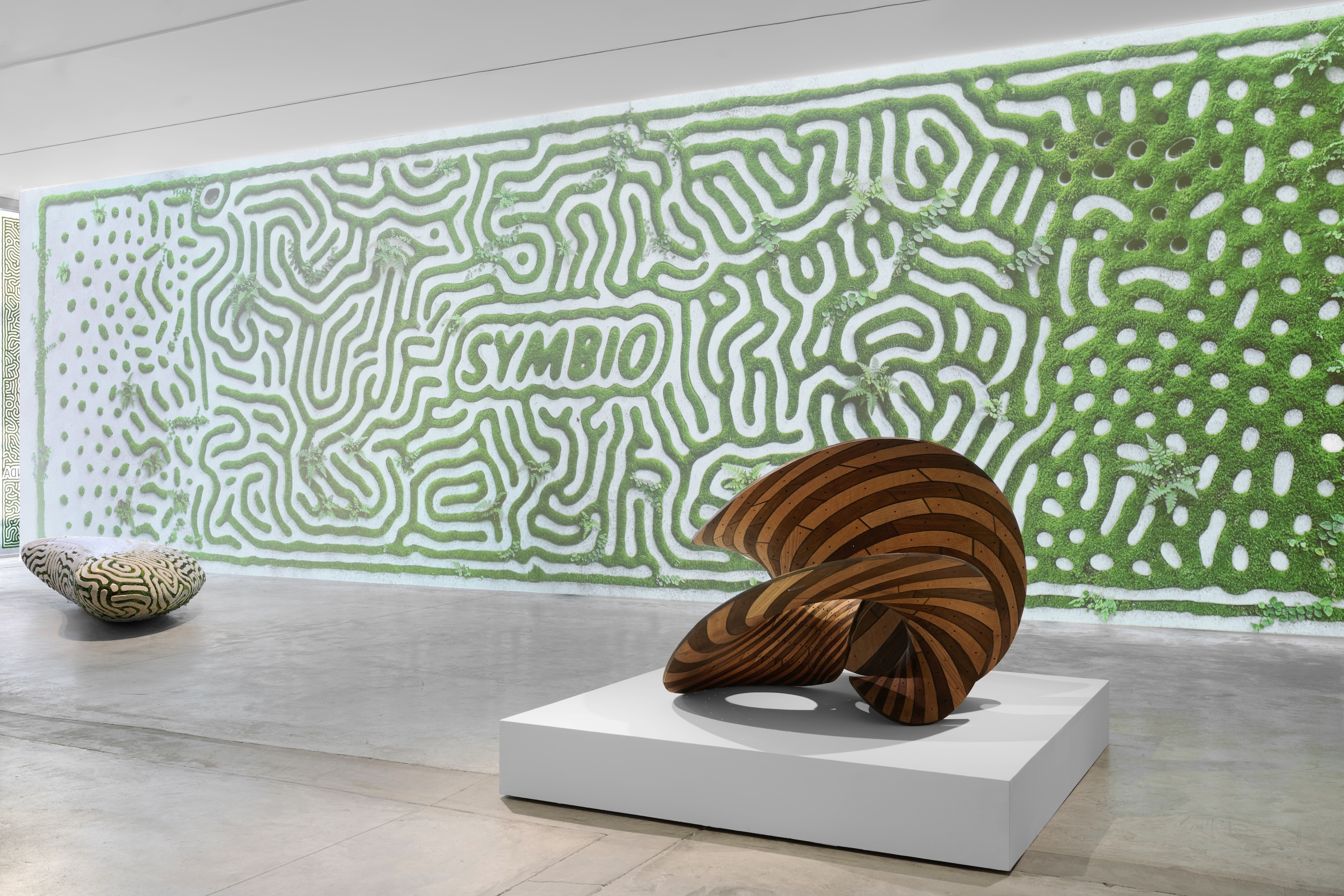
The Friedman Benda show, Symbio, reveals the designer’s new direction. A series of
rocklike benches are 3D-printed in recycled concrete, with patterns that look like coral but are drawn from algorithms developed in the 1950s by the computer scientist Alan Turing. The patterns are embedded with a bioactive substrate that supports the growth of mosses and lichens. The new material reuses concrete waste, captures carbon, attracts birds and insects, and can be used for building facades as well as furniture. Laarman’s lab has collaborated on the research with
Paebbl, a Rotterdam startup now commercializing the material at scale.
Net-carbon-negative objects are cool, but as collectible design, I’d rather live with one of the pieces in the second series on view, Ply Loop. The technology here is also remarkable. Laarman realized that industrial engineered wood often contains formaldehyde-based adhesives—which means, he said, that “there are gases coming from your walls, sawdust that is carcinogenic, and the wood is noncompostable.” He’s
creating plywood furniture using what he claims is the first thermoset bio-resin that’s biodegradable and recyclable. “You can actually eat it,” he told me. |
Joris Laarman, SYMBIO at Friedman Benda, New York. Photo: Izzy Leung/Courtesy of
Friedman Benda and Joris Laarman Lab |
At Friedman Benda, there are Ply Loop chairs, a swooping wall shelf, and my favorite
piece: an oak and walnut veneer bookshelf that quietly references the craft language of Charlotte Perriand’s 1960s work. Laarman still uses technology—yes, he has very much embraced A.I.—but there’s a distinct humanism and hand behind the work. “We’re a team of 15 people in the studio, from computer coders to craftspeople, including blacksmiths,” he said. “We’re not robots.”
Unfortunately, art collectors are similarly human, and there is no question that the market for
Laarman’s oeuvre has seen some wild swings. While a 2006 Bone Chair sold at Christie’s in 2019 for approximately $930,000, a 2008 version went unsold earlier this year when Sotheby’s offered it with an estimated value between $150,000 and $200,000. Even the actor Jim Carrey unloaded his carved marble Cumulus table by the designer at Bonhams in 2024 for $64,000—raising the question of whether the market for Laarman’s early work has peaked, and whether his new
sustainable creations will find not only admirers, but buyers.
From the start, Laarman has always managed to find the soul in the machine—even when the work is functionally designed by a robot. Now, by redirecting his tools toward ecology, collective living, and material sustainability, he may once again be aligning himself with a cultural mood. Certainly, the market is paying attention: Even before the show opened last Thursday (it runs until July 24), a major U.S. museum had already
acquired the bookshelf that I admired.
At a moment when the design world is obsessed with glitz and the tech industry has largely retreated from its utopian ambitions, Laarman’s pivot feels less like a stylistic change than a full-blown reckoning. “Joris has always looked forward, far into the future,” said his gallerist Marc Benda, who has represented him since 2010. “Instead of continuing on a predictable trajectory, Joris decided to start with completely new research
and reinvent his studio. It is incredibly rare for a successful artist in any discipline to be so fearless.” |
Thanks, Ingrid. That was great. I’ll be back tomorrow in the Inner Circle, looking at more of the
interesting lots on offer before the action starts on Thursday.
M |
|
|
|
Puck founding partner Matt Belloni takes you inside the business of Hollywood, using exclusive reporting and insight
to explain the backstories on everything from Marvel movies to the streaming wars. |
|
|
|
Unique and privileged insight into the private conversations taking place inside boardrooms and corner offices up and
down Wall Street, relayed by best-selling author, journalist, and former M&A senior banker William D. Cohan. |
|
|
|
Need help? Review our FAQ page or contact us for assistance. For brand partnerships, email ads@puck.news. You received this email because you
signed up to receive emails from Puck, or as part of your Puck account associated with {{customer.email}}. To stop receiving this newsletter and/or manage all your email preferences, click here. |
Puck is published by Heat Media LLC. 107 Greenwich St., New York, NY 10006 |
|
|
|
|