Welcome back to The Varsity, where irritation over Team USA’s performance last night
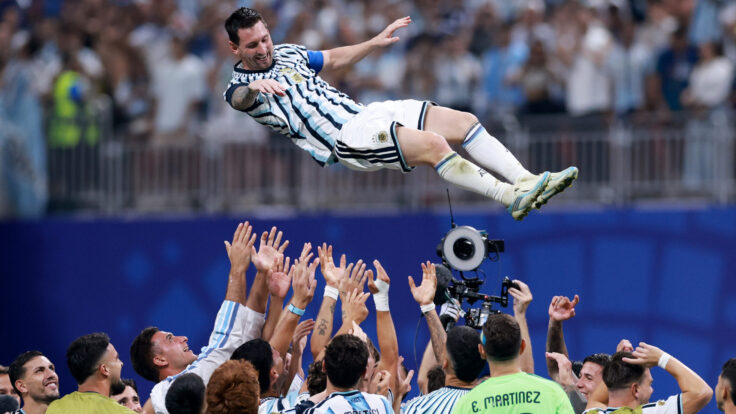
was almost immediately replaced by awe over Argentina’s wild comeback win this afternoon. As I discussed with Fox Sports C.E.O. Eric Shanks last week, the rights for the 2030 World Cup will be extremely competitive.
Speaking of last night’s game, it’s harder than it looks to get former athletes to criticize current players. So congrats
to Carli Lloyd, who provided the type of postgame commentary that we all wanted to hear after such a disappointing showing. Two of her more memorable quotes: “I felt like they lost the game before they even stepped out onto the pitch.” Also: “I was a bit disappointed with Christian Pulisic. Whether he wants to be a star or not, we didn’t see enough
from him.” We’d all prefer that real talk over the sort of silver-lining rhapsody that unfortunately still plagues too much of World Cup coverage.
Before we begin: This 17-second video of a solitary Roger Federer watching a Wimbledon match from an empty Royal Box is mesmerizing. Enjoy.
Also mentioned in this issue:
David Waldstein, Charlie Baker, Brett Yormark, Brendan Carr, Steven Cahall, Luis Fernández, Brian Roberts, Carolyn Tisch Blodgett, Eric Shanks, Jarrett Ramirez, Brendan Sorsby, and more. |
|
|
|
A MESSAGE FROM OUR SPONSOR |
MLB All-Star Week in Philadelphia will continue the celebration of America’s 250th birthday with a schedule
that includes fan events, a free drone show, themed merchandise and uniforms, and the continuation of a national volunteerism effort. Prior to the Midsummer Classic, baseball’s best will walk the Red Carpet at Independence Mall, footsteps from where the Declaration of Independence was signed 250 years ago. Fans can catch all the action when Netflix hosts its first T-Mobile Home Run Derby on Monday, July 13, and the MLB All-Star Game presented by Mastercard will take
place on Tuesday, July 14 on FOX. For more information, visit AllStarGame.com. |
|
|
|
- World
Cup windfall: Sure, in their wildest dreams, Fox Sports C.E.O. Eric Shanks and Telemundo boss Luis Fernández would have loved for the U.S. and Mexican teams to advance to the World Cup final on July 19. But neither executive could have really expected the 16th- and 10th-ranked FIFA teams to move much beyond the tournament’s second knockout round. For all the talk of tumult in the most myopic corners of TV land after all three host nations bowed out in
recent days, neither Fox nor Telemundo expected any sort of North American border battle later this month.
Anyway, the World Cup has already achieved financial escape velocity. Fox essentially found cash by selling those hydration breaks for upwards of $300,000 per 30-second spot. And the viewership for some matches has rivaled even the NFL playoffs; the USMNT’s disastrous showing against Belgium on Monday night drew 30 million viewers, Fox announced. It eclipsed the record for the
country’s most-watched soccer game set days earlier, when the U.S. beat Bosnia and Herzegovina in front of an average of 26.4 million viewers. (Another 9.8 million watched the Spanish-language feed via Telemundo and Peacock.) Also, last Thursday’s Portugal–Croatia game set a U.S. TV record for any World Cup game not involving the U.S. team, with 11.1 million viewers. That record will certainly be broken again in the coming days. - The Sorsby
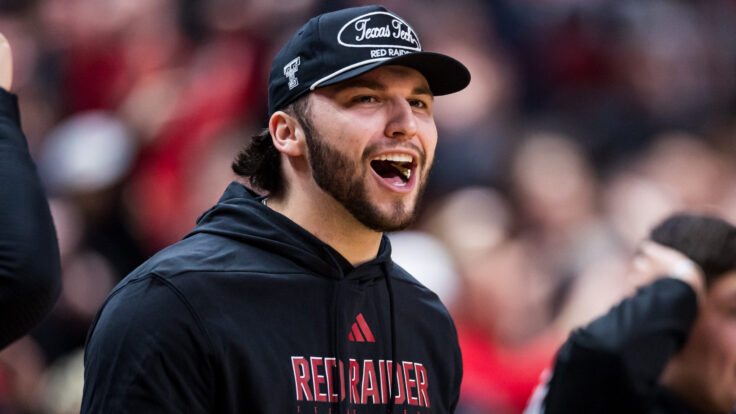
mess: Every summer, the big college conferences host media days to build anticipation for the upcoming football season. The Big 12 went first today in Frisco, Texas, and conversation inevitably turned to Brendan Sorsby, who has become perhaps the most famous quarterback in modern conference history despite the fact that he’ll never take a snap this season. On3 Sports reporter Jarrett Ramirez asked commissioner Brett Yormark
whether he had ever supported Texas Tech’s push to restore the eligibility of the former Cincinnati quarterback, who was suspended for illegal gambling on his own team. Yormark’s response: “Today is not the time to address that issue. Today is about celebrating the upcoming season of our 16 schools.”
Yormark’s dodge didn’t stop the questions. Reporters continued to press the commissioner on an issue likely to dog him well into the season. Of course, earlier this summer, the conference
filed a legal complaint against Texas Tech over the Sorsby case. - Welcome to New York: Defending NWSL champion Gotham FC is moving from New Jersey to Queens by 2028 in a further demonstration of the growing popularity of women’s pro sports. The team’s governing owner, Carolyn Tisch Blodgett, whose family has co-owned the New York Giants for decades, announced today that the club will play its home games at 25,000-capacity Etihad Park,
the same venue that will host NYCFC’s MLS games. Gotham will have its own locker rooms and game day signage when it makes the move. If all goes according to plan, this should help the team grow its fanbase. David Waldstein has a good write-up on this.
|
And now for the main event… |
|
|
|
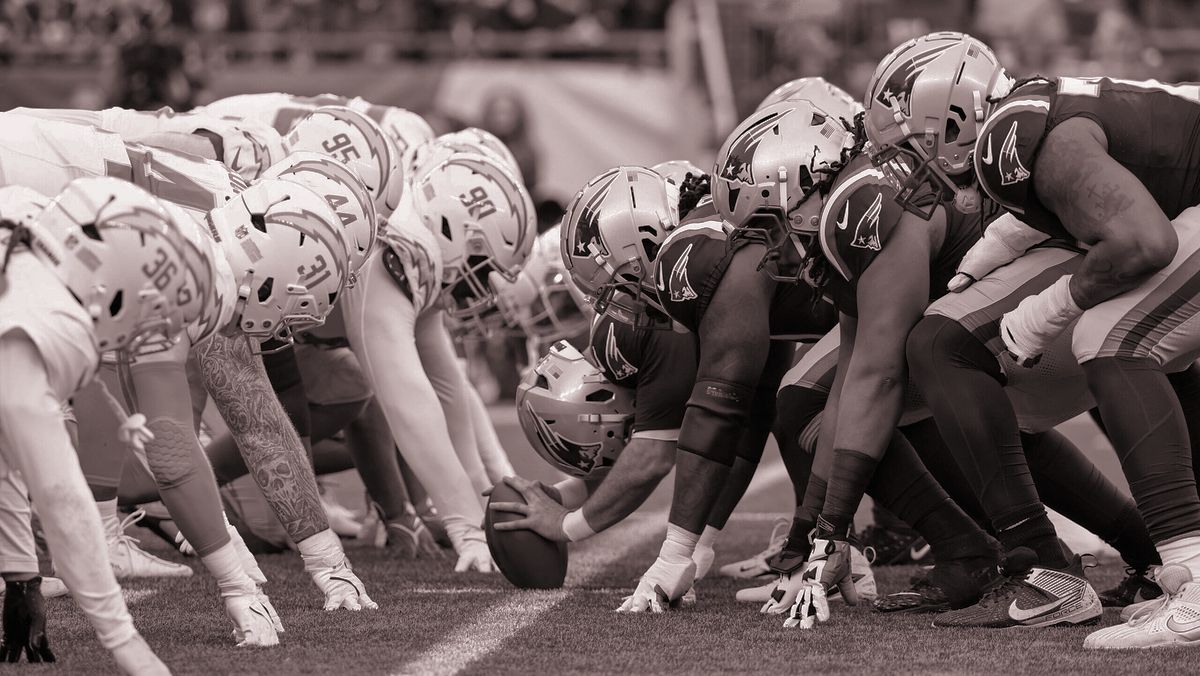
As talk of a new suite of NFL deals cools, analyst Steven Cahall
predicts a bruising rights fight that will reshape media economics, while casting doubt on blockbuster M&A scenarios for NBC and Fox. |
|
|
|
There’s enough happening on the sports-adjacent media M&A market of late to make
one’s head spin: Fox is buying Roku for $22 billion, Comcast is spinning off NBCUniversal’s entertainment assets, and the NFL—the single most valuable property in all of media—is still inching toward a renewal that could reshape the economics of every network and streamer in the country.
To help sort through all of it, Wells Fargo Securities stock analyst Steven Cahall joined me on the latest episode of The Varsity. The full episode will post tomorrow,
but, as usual, I’m giving an early preview to loyal Varsity readers. Steven and I got into an array of topics: why the linear networks can technically afford to pay more for the NFL, even as they insist they’re at the ceiling; how a sale of NBC is far less likely than the market assumes; the fact that the Fox–Roku deal, for all its scale, doesn’t “ooze industrial logic”; and more. Below are the highlights from our conversation, lightly edited for length and clarity. |
John Ourand: Let’s start with the NFL. Most people I speak to see NFL rights as
an existential need for linear networks. Do you agree with that point of view?
Steven Cahall: I don’t doubt that the NFL will have new media deals in place within the next 12 or 18 months. But my observation is that when those negotiations are at full tilt, or getting close to a conclusion, a lot will leak through the press—by one side or both. We’re not seeing that right now. Everyone is trying to get their ducks in a row to know what
they can and can’t do—both the league and the networks. So if not an existential threat to the networks, it’s something pretty close.
How much more can these networks realistically afford to pay?
None of the companies I cover have zero cashflow or EBITDA, which means they can all technically afford to pay more. If I’m the NFL, I’m thinking about a couple of things. One is continuing to meet the consumer where they are and where they’re headed—that’s the tension
between linear and streaming. The other is maximizing revenue, which goes back to meeting the consumer where they want to be while keeping your partners healthy, both on distribution and economics. It’s a balancing act, but we should expect some pretty significant changes by the time these rights are renewed. |
|
|
|
A MESSAGE FROM OUR SPONSOR |
MLB All-Star Week in Philadelphia will continue the celebration of America’s 250th birthday with a schedule
that includes fan events, a free drone show, themed merchandise and uniforms, and the continuation of a national volunteerism effort. Prior to the Midsummer Classic, baseball’s best will walk the Red Carpet at Independence Mall, footsteps from where the Declaration of Independence was signed 250 years ago. Fans can catch all the action when Netflix hosts its first T-Mobile Home Run Derby on Monday, July 13, and the MLB All-Star Game presented by Mastercard will take
place on Tuesday, July 14 on FOX. For more information, visit AllStarGame.com. |
|
|
|
When Comcast announced it will be spinning off its entertainment assets,
Brian Roberts made it clear that he has no plans to sell NBC. But that didn’t stop a lot of analysts from calling for a sale. What’s your read?
I think the press and some of my peers have made too much of near-term M&A for NBC. The argument has been that there were multiple buyers for Warner Bros., therefore there should be a buyer for NBC. Specifically, Netflix wanted Warner Bros., opted out when it became a bidding war against Paramount Skydance, so they would be the natural
buyer of NBC. The Comcast split is much more complicated, much more non-core, and most importantly, much more linear. What Netflix wanted from Warner Bros. had no linear. So I actually think the chance of a deal for NBC is pretty low.
Are there other potential buyers, other than Netflix, who would make sense?
I don’t think so. There are plenty of things that could make this company attractive, but it’s not a clean M&A story. You’ve got U.K. and European satellite
distribution and European sports rights, a Hollywood studio, a theme park business domestically and globally, a broadcast network, a cable network, and a subscale, slightly profitable streaming service. The pieces might fit into a few different companies, but what we’ve seen in media is that M&A works for pure plays, not conglomerates. And NBC will still be a conglomerate after this separation.
If I’m the Big Ten or the PGA Tour, with rights deals at NBC—really, anyone other than
the NFL, the NBA, or the Olympics—should seeing NBC become untethered from Comcast scare me?
I’d describe it as more concern than fear. Fox is a much smaller company than Comcast on earnings, but there’s no doubt about Fox’s ability to pay for its sports rights—and that’s really what the leagues care about. If I enter a 10- or 15-year deal, do I have to worry about their ability to pay me down the line? That risk is higher for smaller companies, but it really depends on
the balance sheet. Comcast hasn’t been specific about the capital structure of NBC-Sky, but if they do it without much debt on the new business, it’ll generate a lot of cash, and that shouldn’t impair its ability to keep pursuing major rights. |
What does NBC look like if there’s no buyer and the spinoff completes as
expected?
Not a lot different from today. Reasonably profitable, with probably pretty low leverage, because you can put more debt on a cable company than a media company. You could always argue that Comcast’s cable balance sheet made it more able to do things like the NBA contract, but Comcast would say they always looked at that deal on the media business’s capacity to underwrite it—not because they knew they’d separate the business, but because it’s just bad business to pay for
the media side with the cable side when there aren’t many linkages. Again, you don’t want to be in the loss-leading business assuming you’ll scale into something over time. That doesn’t typically happen in sports.
Another big story is Fox buying Roku for $22 billion. Who won this deal?
I actually think it’s kind of neutral for both. Fox is a family-controlled company that monetized a large amount of its assets to Disney in 2019 and nicely grew what was left, which
is sports and news. They have a very strong balance sheet. So what do you do with the excess cash? You can keep repurchasing shares, which they’ve done when they lacked other opportunities. But from the controlling shareholder’s perspective, do you really need more cash in the bank versus owning a company growing into the streaming era? Roku has very high share and much stronger top-line growth than Fox. So they used the balance sheet to get into an asset different from what they own now—that’s
pretty good business.
And from Roku’s perspective, they always face cyclical and market-share challenges, so they had a chance to monetize with a control premium. That’s why I say neutral for both sides. But the thing I should have started with is that this deal does not ooze industrial logic. Taking Fox and Roku and putting them under the same company doesn’t create a meaningfully different Fox or Roku. For Roku users, you’ll maybe see a bit more promotion of Fox content. And Fox gains
EBITDA and cashflow, so its ability to pay on something like an NFL renewal improves. But the business itself isn’t meaningfully different. One plus one equals slightly more than two. Contrast that with Paramount Skydance for Warner Bros., where there’s a ton of industrial logic.
Is there any case to be made for Netflix, Apple, or Amazon to get into the broadcast TV business?
The short answer is no. If a regulatory change required certain content like sports to
be on broadcast, we could have that debate. But even under Brendan Carr, I don’t think that changes.
Broadcast can be a very good business for other reasons—it generates a lot of cash, and the free-to-air component is particularly interesting. The leagues clearly see importance in broadcast; I think local NFL games will always be on broadcast even as national streaming windows get created, similar to Thursday night with Amazon and now Monday night. But the idea of a
streamer buying and managing a linear broadcast business is very unlikely. |
On the state of U.S. sports: “One takeaway from the World Cup is that American
pro leagues must step up their game dramatically in creating in-stadium atmosphere. Even for big games, the U.S. pro sports atmosphere is garbage compared to what we’re seeing in this World Cup. Only a handful of college football sites come close.” —A media executive
On World Cup coverage: “Fox’s coverage essentially ended Monday night at 7:30 p.m. PT, so I had to turn on Men in Blazers and then ESPN FC to get commentary.” —A journalist
On
college chaos: “What exactly has Charlie Baker accomplished outside of giving the Power Four conferences more power and unsuccessfully lobbying Congress? There’s a difference between ‘most of the conversations’ he’s had in total, and conversations he’s had with the Big Ten and SEC about realignment.” —A Varsity subscriber |
Have a great week. See you Thursday.
John |
|
|
|
Ace media reporter Dylan Byers brings readers into the C-suite as he chronicles the biggest stories in the
industry: the future of cable news in the streaming era, the transformation of legacy publishers, the tech giants remaking the market, and all the egos involved. Also featuring a weekly dispatch from Puck’s crack streaming/media analyst, Julia Alexander. |
|
|
|
Join Emmy Award-winning journalist Peter Hamby, along with the team of expert journalists at Puck, as they let you
in on the conversations insiders are having across the four corners of power in America: Wall Street, Washington, Silicon Valley, and Hollywood. Presented in partnership with Audacy, new episodes publish daily, Monday through Friday. |
|
|
|
Need help? Review our FAQ page or contact us for assistance. For brand partnerships, email ads@puck.news. You received this email
because you signed up to receive emails from Puck, or as part of your Puck account associated with {{customer.email}}. To stop receiving this newsletter and/or manage all your email preferences, click here. |
Puck is published by Heat Media LLC. 107 Greenwich St., New York, NY 10006 |
|
|
|
|