{{ 'now' | timezone: 'America/New_York' | date: '%b %d, %Y' }} |
|
|
Hi, and welcome back to Line Sheet. There is so much going on.
Last night, after
drinks with a friend, I stopped by the Tory Burch flagship on Rodeo Drive to celebrate the launch of All the Cool Girls Get Fired with Laura Brown and Kristina O’Neill, as well as Tory herself, who took a group of us out to dinner at Mr. Chow afterward. It was great to catch Laura and Kristina in action, doing
everything they can to make their book a success. (It’s an exhausting process, and they and power-promoter memoirist Mark Ronson—who’s been equally present in my Instagram feed lately—deserve all the flowers. Who knew?!) Tory flew out for the party, which added the requisite gravitas. As one friend texted me afterward, “I gotta say, there’s no one in America like Tory Burch.” And it’s true. She is the reason for New York Fashion Week.
I was supposed to go to several other
things—including Daniella Kallmeyer’s party/performance over at the Dresden to celebrate the launch of Drafting, the first publication to come out of Run-a-Muck, former Condé Nast president Pam Drucker Mann’s new media company. (Former Paper magazine editor-in-chief Justin Moran is running the newsletter, which aims to publish rough-ish ideas from cultural luminaries in the hopes of laying out “what’s next in culture.”) I
didn’t make it in the end, but everyone I know had a great time.
Kallmeyer, whose star is rising fast, might not be trying to build a lifestyle business like Burch, per se, but she knows who she is. And if there is one lesson Tory Burch can offer young fashion entrepreneurs, it’s that staying true to yourself—without getting in your own way—is how to survive this wild business.
Speaking of survival, Sarah
“SShapiro@puck.news” Shapiro is here today to discuss the psychological recession that’s happening in the U.S. right now, and whether brands and retailers should be really worried. Up top, I have two updates: a scoop on the future of undies disruptor Parade, and the latest in the Ty Haney saga. (Never ends. Not my fault!) Also: Sarah checked in with resellers to see if
Grace Wales Bonner’s Hermès appointment has affected secondhand sales of her collection.
Mentioned in this issue: The Row, Proenza Schouler, Chanel, Coach, Tyler Haney, Outdoor Voices, Parade, Grace Wales Bonner, Hermès, The RealReal, Depop, Marie Kondo, and many, many more… |
|
|
A MESSAGE FROM OUR SPONSOR |
With new tariffs, shifting trade routes, and rising costs, resilience is the new growth strategy.
Swap’s Resilient
Commerce Report reveals how leading brands are strengthening global operations through agentic planning, smarter returns, and adaptive pricing — turning volatility into opportunity.
Inside, you’ll learn:
🌍 How tariff changes are reshaping supply chains
📦 Why returns strategy = margin strategy
🧠 Where AI is driving peak-season readiness
💡 What resilient leaders are doing differently
👉
Download the full report
|
|
|
Three Things You Should Know…
|
- The Parade is over?: I’m hearing that Ariela & Associates, the bra manufacturer that acquired Parade from founder Cami Téllez and investors in August 2023, plans to close the brand imminently. No word on whether Ariela will be selling the I.P., but it’s an unfortunate outcome for something that once felt like it could be a real challenger to Victoria’s Secret among young consumers. Shortly after the acquisition, Parade launched in Target
(planned before the sale), but the partnership fizzled out. And without the marketing prowess of Téllez, Parade fell completely out of the conversation. I reached out to Ariela & Associates owner Ariela Esquenazi for comment but have yet to hear back.
- Ty-ed up… in a lawsuit: The Outdoor Voices diaspora is still obsessed with founder (and current operator) Tyler Haney, and so it’s no surprise they made sure to drop the
news of her current legal issues into my D.M.s. According to a report in The Denver Post, Haney is being accused by Boulder-based investors Dustin and Sina Simantob of essentially saying she would grant them a certain amount of equity in her energy drink startup, Joggy, and then
reducing that amount from 20 percent to 3 percent. “Haney and Joggy intentionally or recklessly engaged in this fraudulent conduct in connection with the offer, sale or purchase of a security,” the lawsuit reads.
Joel Magnus-Bridge, Joggy’s C.O.O., sent me a statement this morning about the suit, noting that “the small group of investors who asserted the claims in this lawsuit were previously trusted by the Joggy team to invest and help build the company. Despite that
trust, they failed to fulfill their obligations and now seek an unwarranted payout through a baseless lawsuit. This lawsuit is nothing more than a shakedown, and it will not succeed. Joggy’s robust defenses will be presented in court at the appropriate time.” If I learn more, so will you.
|
|
|

| Sarah Shapiro
|
|
- The Grace
Wales Bonner boomlet: Perhaps unsurprisingly, shoppers rushed to the secondhand market after it was announced that Grace Wales Bonner would be appointed the next creative director of Hermès menswear. Last week, searches on The RealReal for Wales Bonner jumped 55 percent over the same period last year, led by shoes and ready-to-wear, followed by sweaters,
jackets, t-shirts and long-sleeve tops. Meanwhile, over on Lyst, Wales Bonner’s appointment led to a 165 percent increase in searches versus the week prior, led by polo shirts, zip-up track tops (including her Adidas collab), and t-shirts. Obviously, Wales Bonner items are not priced in the same realm as most goods from Hermès. But it shows early
interest and excitement for what she will be bringing to the storied house in advance of her debut collection in January 2027.
|
|
|
Is the deceleration of consumer spending, and the resurgence of Rent the Runway
and The RealReal, a leading indicator of economic doom? Or is this simply an indication that shoppers are changing how they fill out their wardrobes? (This is not investment advice!) |
|
|
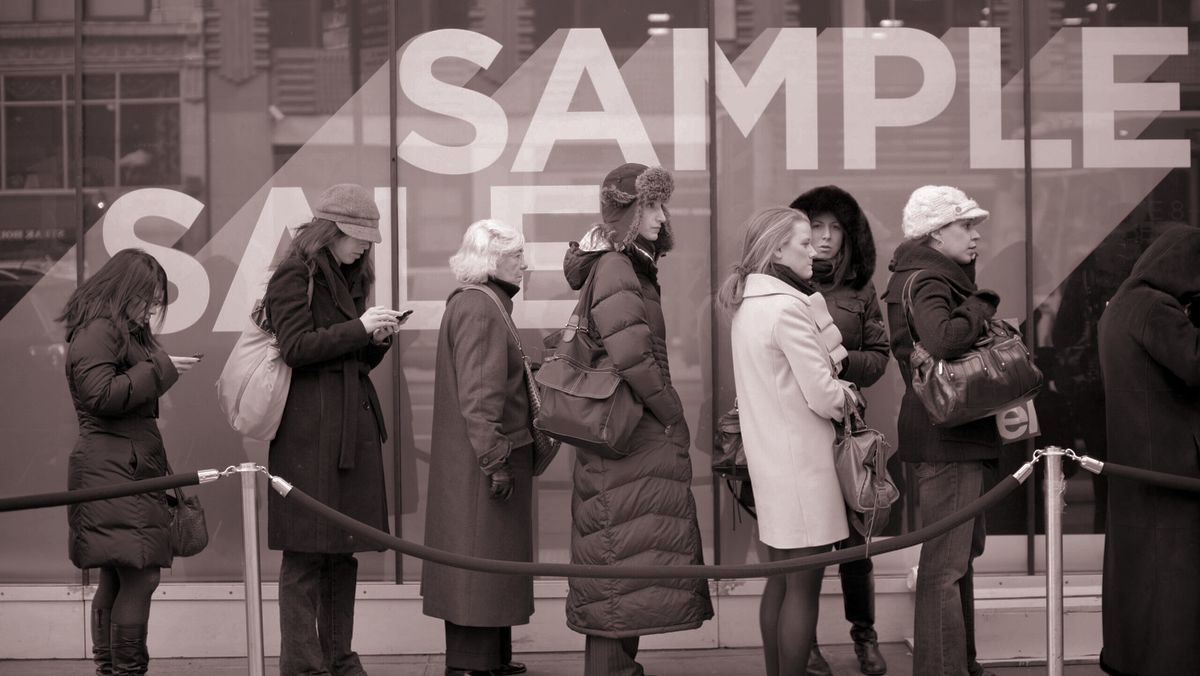
This week, hundreds of New Yorkers waited in a line that wrapped around 18th Street for
the chance to buy $1,200 jackets, marked down from $4,950, at The Row’s annual fall sample sale. Later, on TikTok and Instagram, shoppers posted hauls that might have been equivalent in value to an annual entry-level salary before the markdown. |
|
|
A MESSAGE FROM OUR SPONSOR |
The rise of agentic AI is transforming how people discover, decide, and buy — and most brands aren’t ready for what’s
next.
Swap’s latest report breaks down how AI agents will reshape product visibility, payments, and consumer trust across the entire shopping journey.
Inside, you’ll learn:
🤖 What agentic AI actually means for commerce
🔍 How to optimize for GEO (Generative Engine Optimization)
💳 Why payments are going agent-native
📈 10 reasons to act now
👉
Download the full
report
|
|
|
Of course, none of these shoppers was in any kind of financial distress—even the wealthy
and wealthy-adjacent tend to enjoy a good deal. And yet, there’s no doubt we’re living through an unusual economic moment: U.S. retail spending is holding strong, but luxury is under pressure amid persistent price inflation, which is driving consumers toward resale channels.
Anything can look recessionary if you squint hard enough. But the reality is more nuanced: Consumer spending on retail and apparel isn’t declining, it’s decelerating. Most Americans aren’t broke, they’re just
changing how and where they shop. At Rent the Runway, active subscribers grew 13.4 percent year over year in Q2—after all, you can rent a Proenza Schouler White Label jacket for one month for $89, splash it on your Instagram feed, return it, and achieve the same status boost you used to get from buying the piece for $795. Meanwhile, at The RealReal, where a Chanel jacket can live five lives in three years, consignor inventory was up 22 percent year over year in Q2. Meanwhile the number of active
buyers increased to 1 million, up 6 percent, and average order volume rose to $581, from $538 in Q2 2024.
That’s not to say that the TikTokers tracking recession indicators through Depop prices, unadorned nails, grown-out roots, and miniskirts aren’t onto something. Consumer sentiment continues to drop—the latest survey out of the University of Michigan, released this morning, shows that confidence in the economic climate is at its lowest point since the almost-recession in 2022.
But data from Klarna shows that delinquency rates continue to fall even as more people are using buy-now, pay-later services.
Instead, consumers are changing their relationship with clothes—becoming more discerning about what is worth full price, and what they actually need in their closet. When affluent shoppers are Marie Kondo-ing their Hermès Picotin and The Row
handbags while strategically using credit card points for vacations and B.N.P.L. services for a new Prada leather jacket, we’re not witnessing a typical financial dip. |
|
|
This psychological shift is happening amid a perfect storm of retail confusion—tariff
uncertainty, credit tightening (as my colleague Bill Cohan has detailed), consumer fatigue, etcetera. As a result, it can be hard for brands to diagnose whether customers have pulled back on spending due to tightening budgets, exhaustion, price confusion, or simply sobering up from decades of overconsumption. To some retail executives, the slowdown feels like a
personal affront—they built their careers on the premise that consumers could be nudged, gamified, or algorithmically manipulated into perpetual motion. Now, those same consumers are treating marketing like spam and algorithms like noise.
Meanwhile, the real and imagined impact of Trump’s tariffs has roiled the retail prediction market. Back in June, for example, Morgan Stanley
forecast that spending growth for this year would slow to 3.7 percent, from 5.7 percent in 2024, after a surge in pre-tariff purchases was followed by a pullback. Shipments from Shein, the Chinese fast-fashion e-commerce giant, were down around 8 percent in September versus a year prior, according to Bloomberg, one of its worst monthly performances over
the past three years. Meanwhile, brands are raising prices—jackets and outerwear are 24 percent more expensive this year, according to AlixPartners—despite the president’s demands that retailers accept lower margins. The average price for a dress is up 20 percent, and bags are 15 percent more expensive than last
year.
Retailers can’t tell if their problems are cyclical, structural, or self-inflicted. That uncertainty can be dangerous, because they don’t know what problem to fix and might be tinkering in the wrong area. For now, they’re mostly acting as though the problem is cyclical—that sentiment will rebound, and volume will follow. But what if the real story is structural? This isn’t a temporary chill in spending; it’s a cultural repricing of consumption itself. If the last decade was defined
by abundance—cheap capital, infinite content, two-day shipping—the next may be defined by calibration. Retailers are no longer competing for attention, but for justification. Every purchase—especially that $90 white tee—must now defend its existence. That’s a scary proposition for anyone who built their empire on excess. |
Have a great weekend,
Lauren
P.S.: We use affiliate links because we are a
business. We may make a couple bucks off them. |
|
|
Puck fashion correspondent Lauren Sherman and a rotating cast of industry insiders take you deep behind the scenes of
this multitrillion-dollar biz, from creative director switcheroos to M&A drama, D.T.C. downfalls, and magazine mishaps. Fashion People is an extension of Line Sheet, Lauren’s private email for Puck, where she tracks what’s happening beyond the press releases in fashion, beauty, and media. New episodes publish every Tuesday and Friday. |
|
|
Puck’s daily art market email, anchored by industry expert Marion Maneker, offers unparalleled access to the
mega-auctions and galleries, elite buyers and sellers, and the power players who run this opaque world. Wall Power also features Julie Brener Davich, a veteran of Christie’s and Sotheby’s, who provides unique insights into how the business really works. |
|
|
Need help? Review our FAQ page or contact us for assistance. For brand partnerships, email ads@puck.news. You received this email because you signed up to receive emails from Puck, or as part of your Puck account associated with {{customer.email}}. To stop receiving this newsletter and/or manage all your email preferences, click here. |
Puck is published by Heat Media LLC. 107 Greenwich St, New York, NY 10006 |
|
|
|