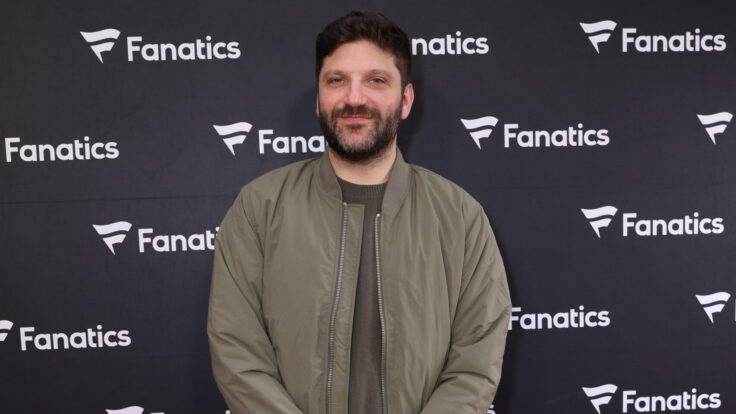
Welcome to The Varsity. By the time this hits your inbox, I’ll be celebrating my Puck
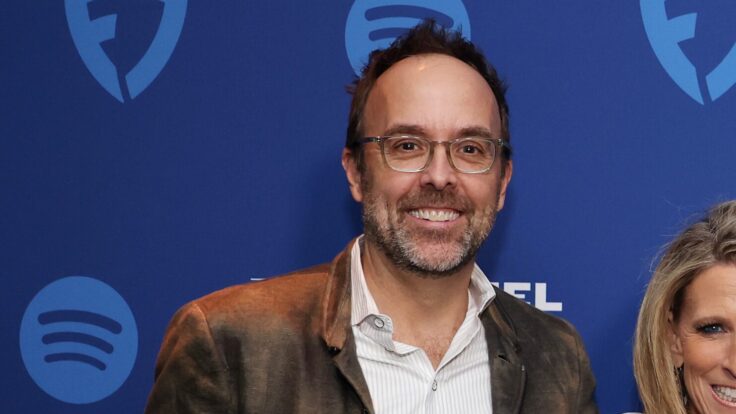
partner Peter Hamby at a hip cocktail bar in downtown Washington. Peter has been a mainstay in The Best & The Brightest, Puck’s industry-leading product for political junkies, for as long as I’ve been here. And he’s hosted our flagship podcast, The Powers That Be, since the company’s immaculate conception. But it was only a couple of weeks ago that he left Snap and fully took his talents to Puck full-time. We’ll be toasting him tonight, sans the Jim Gray
interview.
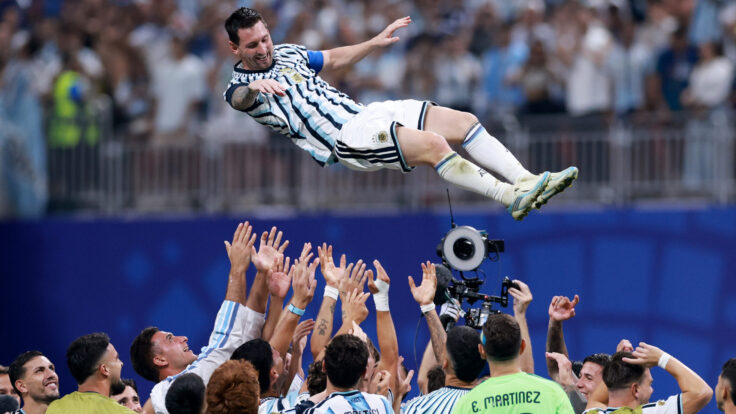
First off: I’m hearing that early Nielsen viewership figures indicate yesterday’s Spain–Argentina World Cup final will be the most-watched soccer telecast in U.S. TV history. Check out these preliminary numbers, per sources: a peak audience of 47 million viewers on Fox and an average audience of 37 million–40 million, also on Fox. Final viewership—which will include the Big Data component that counts viewers via set-tops, smart TVs, and viewer panels—should be
released tomorrow afternoon. Fox Sports declined to comment, given that these are preliminary numbers.
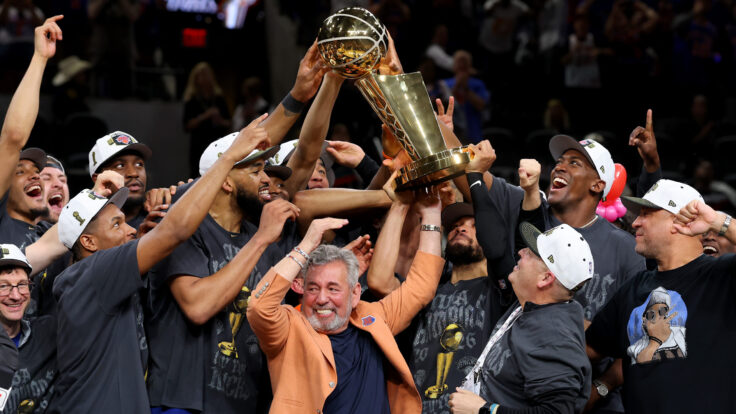
A couple of other stories to note…: The feds are investigating financial improprieties at three companies owned by Lakers and Dodgers owner Mark Walter—two insurance companies, plus his life’s work, Guggenheim Partners. Zachary Mider and Ava Benny-Morrison have the
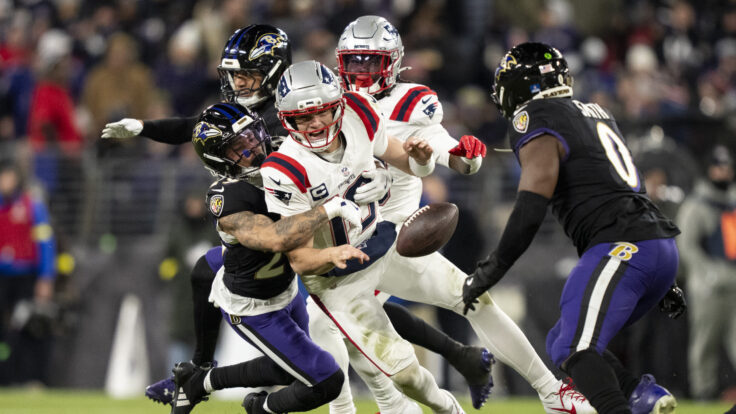
details. Also, we’ve been talking about Roger Goodell’s contract extension since the day he signed his current deal three years ago. Mark Maske
says a new one will be inked “in the coming months.” It better be—his current deal ends in March.
Pod alert: In the wake of a very successful World Cup, I asked U.S. Soccer Federation C.E.O. and secretary general JT Batson to join America’s most creatively titled podcast, The Varsity. We spent a lot of time talking
about how the U.S. can capitalize on all the popularity around the sport right now. And make sure to listen to yesterday’s episode: The Athletic’s Evan Drellich artfully handicapped baseball’s labor situation.
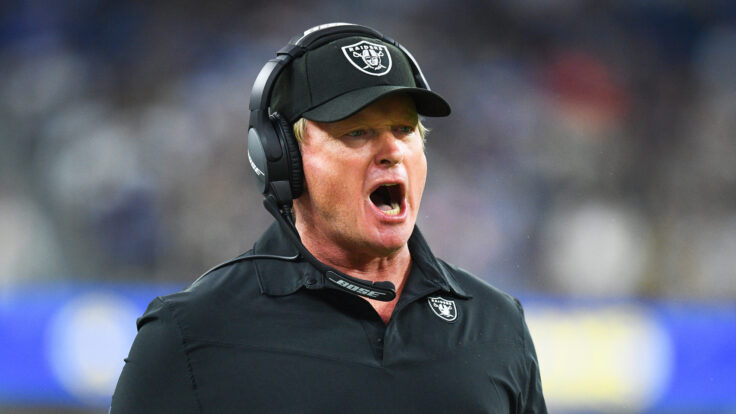
In tonight’s issue, Eriq Gardner offers a nuanced look at Jon Gruden’s $150 million lawsuit against the NFL
that’s still winding its way through the courts. Ironically, this could be one of the most significant free speech cases in a long time. Plus, an update on Paramount’s acquisition of Warner Bros. Discovery, the latest on MLS’s search for a new commissioner, and Bryson DeChambeau’s British Open hijinks.
Also mentioned in this issue: Araceli Martínez-Olguín, Paraag Marathe, Larry Berg, David
Nathanson, Don Garber, Trump, Joe Hardy, Brad Karp, Daniel Snyder, Steve Ballmer, Kawhi Leonard, Adam Silver, and more. |
- Everybody’s happy: My first phone call after hearing that a federal judge temporarily paused Paramount’s acquisition of Warner Bros. Discovery was to our legal hero and Monday M.V.P., Eriq Gardner, who maintained that Judge Araceli Martínez-Olguín’s 14-day restraining order is a rare legal ruling that should satisfy everyone. “The states’ attorneys general will be relieved because the judge sees a case there,” Eriq said. “Paramount will be relieved
because the 14-day time frame guarantees a sped-up timeline. The states probably see some language in the ruling that is somewhat favorable to their position, but it’s not so long that Paramount should freak out. The takeaway from today is that everyone is really relieved.”
- The next commish: Last week, I broke some news on X about how the
search for the next MLS commissioner had been whittled down to three names. Hours after that tweet, 49ers exec Paraag Marathe withdrew his name from consideration, leaving LAFC co-owner Larry Berg and former Fox executive David Nathanson as the Newsom and Shapiro of this race. Berg has been considered the frontrunner since the earliest days of this search, overseen by Korn Ferry. He’s well connected and already
commands a powerful voice in the league. Nathanson will be helped by his sports media background—he’s the one most widely credited for Fox’s lucrative FIFA World Cup deal—and his operational experience. He ran channels like FS1 and Fox Soccer during his Fox stint.
MLS holds its annual All-Star Game next Wednesday in Charlotte, but don’t expect movement that week. Instead, Berg and Nathanson are expected to present to the league’s board of directors the following week, which means that a
decision on who will replace Don Garber will follow shortly thereafter.
Of course, this bake-off comes as the league looks to embark on what it calls MLS 3.0—a new phase of growth that will see it flip the calendar next year to mirror other international leagues and likely increase teams’ salary caps. One question that both Berg and Nathanson should prepare to answer: what to do about the league’s Apple deal, which expires after the 2028–29 season. - The dreaded glitch: The story of this year’s British Open centered on Bryson DeChambeau, the LIV Golf player who was visibly upset after being assessed a two-stroke penalty on Friday, and subsequently tried to get Trump to intervene before refusing to commit to staying in the tournament over the weekend. Late
Friday, he relented and said he would, indeed, play the last two rounds.
This was the dominant storyline on Saturday morning, and should have led to a dramatic TV moment as DeChambeau teed off in the third round. But as the golfer made his way to the first tee, NBC was inexplicably showing a commercial as part of its “Playing Through” split screen, which had no audio from the course. Big miss.
|
|
|
|
The former coach’s $150 million lawsuit against the NFL has evolved into perhaps
the strangest free speech battle in sports: Can the league deny leaking his emails while simultaneously claiming legal immunity for doing so? |
|
|
|
You might not think of Jon Gruden’s long-running legal battle against the NFL as a
free speech case, but the league certainly does. It’s arguably the strangest First Amendment dispute still working its way through the courts: whether Roger Goodell cost Gruden his job as head coach of the Las Vegas Raiders by leaking his racist, misogynistic, and homophobic emails to The Wall Street Journal and The New York Times—and whether, if the NFL actually did that, they were exercising their right to free speech.
Remarkably,
that’s where this litigation now sits. Gruden alleges that NFL executives intentionally disclosed those offensive emails, triggering his resignation and costing him tens of millions in salary and endorsements. He already beat back the league’s push to force the dispute into arbitration. Now the $150 million tortious interference case is in discovery, on track for a May 2027 trial.
One skirmish along the way, though, has slipped almost entirely under the radar. After losing on arbitration,
the NFL pivoted to Nevada’s anti-SLAPP statute, arguing that Gruden’s suit targeted truthful speech protected by the First Amendment and should have been tossed outright. District Judge Joe Hardy wasn’t persuaded—he rejected the motion as untimely and, more importantly, found that Gruden had shown a probability of prevailing on the merits. The NFL is now effectively asking the Nevada Supreme Court for an instant replay. (The league is represented by Brad Karp,
the former Paul Weiss chairman who stepped down last year after his own correspondence with Jeffrey Epstein surfaced.)
In a recent appellate brief, Karp argued that Gruden’s emails concerned a matter of undeniable public importance. At the time they surfaced, he noted, the NFL was under intense scrutiny over workplace culture during its investigation into the Daniel Snyder–owned Washington franchise, while the league had spent years publicly championing
anti-discrimination and diversity initiatives. The fact that virtually every major news organization covered the emails, he argued, underscored their public significance. If the NFL disclosed them, Karp went on, those disclosures were “good faith communications” on an issue of public concern in a public forum—precisely the sort of speech that Nevada’s anti-SLAPP statute was designed to protect. And the NFL, he added, shouldn’t lose the benefit of that protection simply because it first tried to
send the dispute to arbitration.
Gruden responded that the NFL was fighting the wrong case. His lawsuit, he said, isn’t simply about leaked emails, but rather the alleged campaign to force the Raiders to fire him—privately pressuring the organization, supplying it with materials from the Washington investigation, and dangling the threat of additional disclosures until he resigned. And as for the NFL’s claim that the emails themselves were a matter of public concern because they
addressed race, gender, and sexual orientation, Gruden’s lawyers offered a provocative rejoinder in their own brief filed just last week: “Before the NFL Parties’ publication of Gruden’s emails, there was no public interest in his private emails with friends,” they wrote. “This standard would mean any email between private individuals about these topics could become a matter of public concern.” In other words, the First Amendment can’t turn a leak into protected speech. |
Gruden has a point. The ugliness of his emails seems to have obscured his unusual but consequential
claim that the NFL weaponized confidential investigative material collected for one purpose to achieve another. After all, the Gruden emails surfaced from a totally separate scandal. The NFL opened a confidential investigation into workplace misconduct within Washington’s football franchise, then allegedly plucked a handful of Gruden’s emails from roughly 650,000 documents and used them to bring down one of Goodell’s most outspoken critics.
Right now, the NBA has retained
Wachtell Lipton to investigate whether Steve Ballmer’s Los Angeles Clippers circumvented the salary cap by arranging a no-show endorsement deal for Kawhi Leonard. Imagine if, after that investigation concluded, Adam Silver combed through the files, found embarrassing emails involving an entirely different owner, and selectively leaked them to force that owner into line. That, in essence, is Gruden’s theory.
Viewed through that
lens, the case looks less like a dispute over offensive speech than an alleged abuse of investigative power. The leak becomes the means rather than the wrong itself, and motive assumes far greater importance. That’s one reason Judge Hardy concluded that Gruden had shown enough to proceed. Even if Karp persuades the Nevada Supreme Court that the anti-SLAPP motion should have been considered despite its extraordinary lateness, the league still faces the tough task of convincing the justices that
Gruden stands little shot of ultimately prevailing.
As for the merits, however, the NFL has said that Gruden still can’t establish that the league was actually responsible for leaking his emails to the press. For his part, though, Gruden responded that the league was dodging half the case—it has never really denied communicating with the Raiders or trying to influence the team’s decision. And when it comes to the alleged leaks themselves, his lawyers posed a more conceptual objection: How
could the NFL simultaneously deny making the disclosures while also claiming immunity for them? As Gruden put it, the league can’t have it both ways—disclaiming responsibility while claiming protection for the same act.
The Nevada Supreme Court may ultimately resolve this appeal on procedural grounds. But the underlying issue isn’t going away. Professional sports leagues increasingly rely on sprawling internal investigations that collect enormous volumes of confidential emails, texts, and
other communications. The NFL now finds itself invoking a statute designed to protect speakers from frivolous lawsuits that chill First Amendment activity. Gruden, by contrast, points to a darker implication: If organizations can later repurpose those confidential investigative materials to satisfy ulterior motives, the documents become repositories of future leverage rather than tools for uncovering misconduct. Whatever happens to his lawsuit, that’s a tension with a much longer shelf life than
Gruden himself. |
Thanks, Eriq. See you all tomorrow.
John |
|
|
|
Join Puck’s chief political columnist, John Heilemann, as he roams the corridors of power and influence in America on
this twice-weekly interview show, taking you beyond the headlines with the people who shape our culture: icons and up-and-comers, incumbents and insurgents, moguls and machers in the overlapping worlds of politics, entertainment, tech, business, sports, media, and beyond. The conversations are rich and revealing, unrehearsed and unexpected… and reliably impolitic. A Puck-Audacy joint, new episodes drop every Wednesday and Friday. |
|
|
|
The ultimate fashion industry bible, offering incisive reportage on all aspects of the business and its biggest
players. Anchored by preeminent fashion journalist Lauren Sherman, Line Sheet also features Rachel Strugatz, who delivers unparalleled intel on what’s happening in the beauty industry, as well as Malique Morris on retail, D.T.C., and more. |
|
|
|
Need help? Review our FAQ page or contact us for assistance. For brand partnerships, email ads@puck.news. You received this email because you
signed up to receive emails from Puck, or as part of your Puck account associated with {{customer.email}}. To stop receiving this newsletter and/or manage all your email preferences, click here. |
Puck is published by Heat Media LLC. 107 Greenwich St., New York, NY 10006 |
|
|
|
|