{{ 'now' | timezone: 'America/New_York' | date: '%b %d, %Y' }} |
|
|
Hi, and welcome back to Line Sheet. Did you hear that it’s raining in Los
Angeles?
Sarah “SShapiro@puck.news” Shapiro is here with the top 10 most shopped-for products in October, plus some thoughts on The RealReal, the resale market, and why profitability is so tricky. Up top, Rachel Strugatz has a huge scoop about Victoria Beckham Beauty, following her in-depth report earlier this week. The New Consumer’s Dan Frommer (a.k.a. my husband) also has an essential report on what the GLP-1 crowd is eating (and buying). And I’m wrapping up this month of earnings with some takeaways from Richemont and Burberry.
Mentioned in this issue: Victoria Beckham, Hailey Bieber, Rhode, The RealReal, Staud, Jamie Haller,
Julia Berolzheimer, eBay, Van Cleef & Arpels, Joshua Schulman, Burberry, Ozempic, beef jerky, and many more… |
Three Things You
Should Know…
|
|
|

| Rachel Strugatz
|
|
- Beckham is for sale:
It turns out that Victoria Beckham may not need Sephora, after all. Victoria Beckham Beauty, which has popped in the last year for a number of reasons—increased wholesale distribution, a successful entrée into foundation, newish C.E.O. Lauren Edelman, etcetera—is actually a far bigger business than most people think. I’ve learned that the brand is on track to hit $100 million in net sales this year, about 70 percent of which come from its
website—an impressive stat considering a limited wholesale distribution that will total only about 200 doors by year’s end.
All of that sale chatter makes sense now. I’d heard recently that Victoria Beckham, inclusive of its fashion and beauty businesses, was either in market or planning to go to market, but a person who’s viewed the relevant financial materials confirmed two things: Victoria Beckham is indeed for sale, and the company has engaged Rothschild & Co to
facilitate a process.
The same person shared that fashion and beauty combined are expected to hit about $165 million in net sales in 2025, basically confirming that beauty is the breakout business here and will be the main attraction for a potential acquirer. The potential in beauty for the Beckham brand is meaningful, similar to Hailey Bieber’s Rhode, which was acquired by E.l.f. Beauty in May. Rhode had been entirely direct until entering Sephora in September, where its
publicly traded parentco will help with wholesale partnerships and establishing a global presence. (Victoria Beckham Beauty did not respond to requests for comment.)
|
|
|
A MESSAGE FROM OUR SPONSOR |
The refined BMW 7 Series is all luxury. With the ability to define your design, the ultimate glamour is yet to be.
Learn more at BMWUSA.com. |
|
|
- Ozempic
users are craving beef jerky, fries, and handbags: Americans’ wide-eyed embrace of Ozempic and other GLP-1 weight-loss drugs hasn’t torpedoed the food and consumer packaged goods industries the way some had feared. But GLP-1 users are showing up at supermarkets, restaurants, and retail stores, eating and shopping in new ways, according to new data from Circana. There’s no official tally, but Circana estimates that 23 percent of U.S. households—about 30 million—had at least
one GLP-1 user in September, and that GLP-1 use is increasing overall. Those following a GLP-1 regimen, according to the report, are eating more protein to help preserve muscle mass while shedding weight. The top-gaining categories among active GLP-1 users, as tracked by Circana, include prepared deli meats; snack bars and granola; refrigerated lunches, seafood, and yogurt; sports drinks; fresh citrus; gum; and dried meat snacks like beef jerky. Balancing sensible foods with treats,
weight-loss-focused GLP-1 users overindex on eating eggs for breakfast (20 percent of the time) and chicken for lunch, but they way overindex on ordering fries at lunch (12 percent of the time) and cookies at dinner. Respect.
Oddly, GLP-1 users were also overindexed on shopping for clothing, shoes, and accessories before starting the meds, with roughly 25 percent to 40 percent higher spending than the average household. That only increased during active GLP-1
usage—notably on handbags, with smaller (but still meaningful) increases on casual athletic wear, boots, active shorts, casual pants, and jeans, according to Circana. Of course, some fear that prolonged GLP-1 usage will suck the life out of everything and kill all desire—Allison P. Davis reported in The Cut this week that
increasing her GLP-1 dosage made her life bland and boring. My guess is that dosing will just become more tailored to each individual so that doesn’t happen, but let’s see how it goes as the cost of GLP-1s decreases. —Dan Frommer (read more on GLP-1s and consumer spending at The New Consumer) - A
happy ending to Big Fashion’s earnings season: Richemont and Burberry rounded out what was a cautiously optimistic season with genuine good news. Tariffs and the price of gold are making selling jewelry and watches harder than ever, and yet Richemont blew past analyst estimates, with year-over-year sales at the bread-and-butter jewelry business jumping 14 percent in the second half of its fiscal year. Among other things, I would peg the success to a deep understanding of how to
serve local markets and create best-in-class products that also somehow resonate with mass audiences. (There’s a reason all the MLB stars are wearing Van Cleef & Arpels.) In the small but relevant fashion division, sales were up as the direct-to-consumer channel grew. The company noted strong performance at Alaïa and uptick at Chloé. (Although I think Richemont still has a shoes and bags problem at Chloé that needs to be fixed.)
Over in London, Burberry C.E.O. Joshua Schulman
must be pretty proud of how his turnaround plan is playing out: The company announced a return to growth in the second quarter of its fiscal year, once again beating analyst estimates. (Burberry shares got a 6 percent bump on the news.) Of course, a lot of this has to do with the remerchandising of the product—everyone loves a table of happy scarves—as well as the refresh of the marketing, which has taken on an undeniably British sensibility. (Someone compared one of their recent ads to
a Waitrose commercial, and they meant it as a compliment.) It also helps that the Chinese consumer segment does seem to be reengaging. Anyway, not a bad way to end the season. Let’s see how the holidays go.
|
|
|
Shoppers continue to pillage influencers’ closets, while The RealReal proves that scaling
“unique” is a great way to grow everything except actual profit. |
|
|
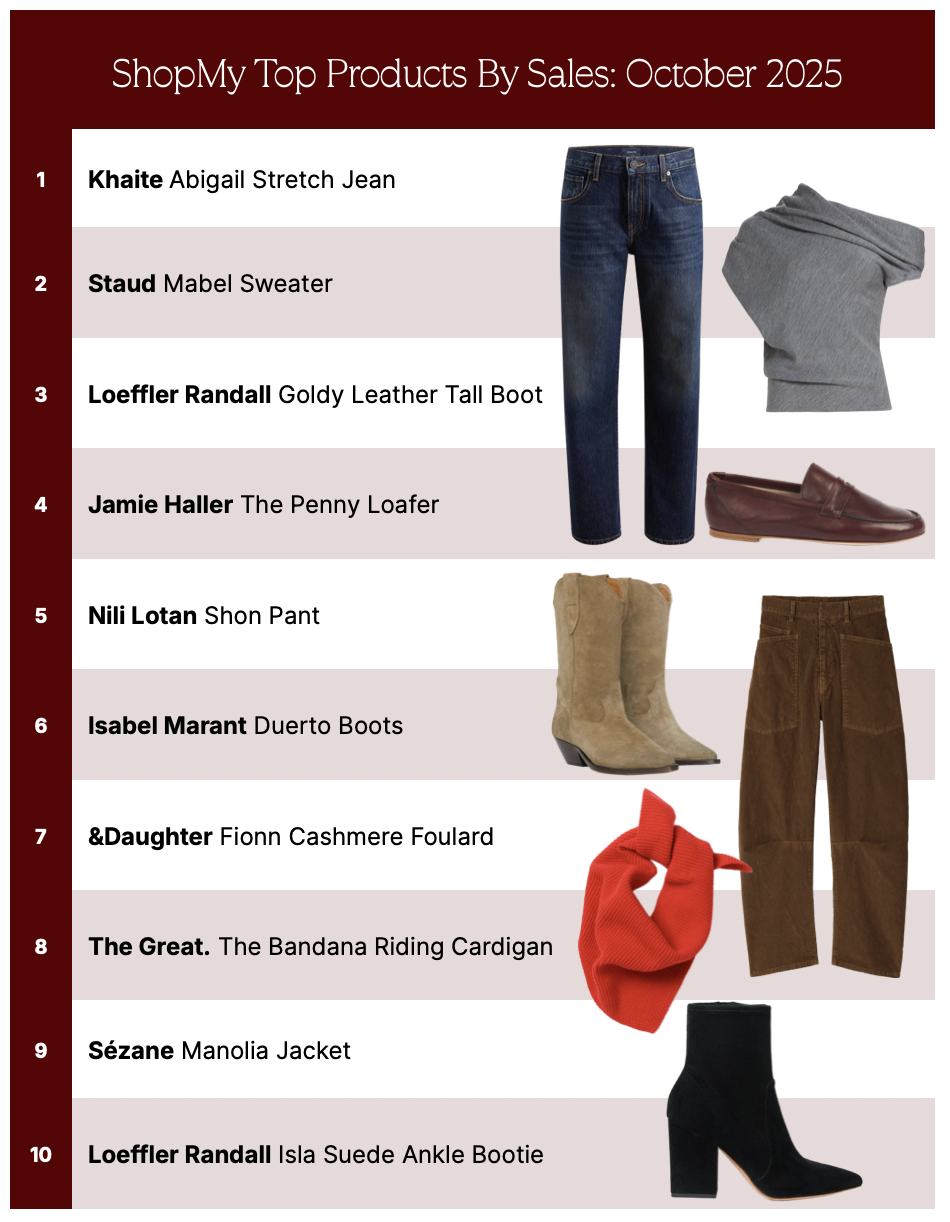
Just a glance at ShopMy’s top 10 this month will confirm what you already know: We just can’t quit Khaite
denim, whose Abigail jeans led the field. Scrolling through our exclusive recap of the platform’s top affiliate drivers in October, there are several repeat brands, such as Staud’s off-the-shoulder Mabel sweater, as well as options like Sézane’s suede cinched-waist jacket, Isabel Marant’s western Duerto boots, Nili Lotan’s Shon pants, and The Great’s Bandana Riding
cardigan. |
|
|
A MESSAGE FROM OUR SPONSOR |
The refined BMW 7 Series is all luxury. With the ability to define your design, the ultimate glamour is yet to be.
Learn more at BMWUSA.com. |
|
|
The brands crushing it are those truly connecting with the influencer market. Creator-approved, accessibly
priced, nothing too trendy—essentially, pieces that somehow manage to feel like they’re both of-the-moment and a closet staple. Loeffler Randall (another repeat brand), which has seen consistent, double-digit affiliate growth this year, landed two boots on October’s list (the Goldy knee-highs and Isla ankle booties). The company’s boot sales are up nearly 100 percent from September through November versus last year, with more than half of the proceeds coming from new customers—evidence that influencers’ voices are breaking through and driving meaningful impact. |
Jamie Haller’s Penny loafers, a Substack style staple, made their debut on the list. Their rise was fueled by three October drops (greige, white, ponyhair), plus the return of a previously waitlisted croc version. The oxblood shade of her buffalo leather version remains the most popular.
Other observations: Nili Lotan’s utilitarian Shon pants—now in wool, leather, and denim alongside the original cotton and corduroy, with a new camo print—continue to be a universal favorite (the
“size down” directive and promise of a “universally flattering” fit certainly doesn’t hurt). The only hint at colder weather, outerwear-wise, came in the form of the Sézane suede jacket: According to ShopMy, it was shared by more than 90 creators. And the cozy L.A. aesthetic turned up with The Great’s cardigan, which more than 100 creators shared, driving 7,700 clicks in just a few weeks. (The navy colorway sold out immediately.) Its higher luxury price point still feels accessible at under
$500. Another knit item, the Fionn ribbed cashmere scarf, from a partnership between &Daughter and creator/influencer Julia Berolzheimer, has become a top seller for the brand as it pushes into the U.S. market. |
This week, resale player The RealReal announced its quarterly earnings—another round of “profitable growth”
that still didn’t quite lead to profitability. Gross merchandise value was up 20 percent year over year, revenue grew 17 percent, and adjusted EBITDA margin increased ever so slightly to 5.4 percent—yet it was all teetering atop a reported $54 million net loss. Building a profitable luxury business, as we’ve seen time and again, is not for the faint of heart.
In the case of The RealReal, the stubborn fact is that growth in resale doesn’t guarantee profit, despite mainstream
shoppers’ increasing migration to the fizzy, high-risk, high-reward resale market. The RealReal is efficient on the surface, but its model—acquiring sellers, authenticating, photographing, pricing, and shipping thousands of one-of-one merchandise—is almost the opposite of efficiently scalable. It’s a business built on expertise and trust, not volume and repeatability. |
|
|
That’s the paradox at the center of the resale boom—and rental, too, for that matter. eBay, which reported a
20.4 percent operating margin last quarter and had $525 million in advertising revenue, thrives because it’s a low-touch, peer-to-peer marketplace. Sellers upload their own photos and descriptions to the site, and eBay outsources time-consuming tasks that aren’t scalable. They can also rely on an advertising cushion as a revenue stream—not quite apples to apples, but akin to the model and profitability-structure differences between social media companies and legacy media
businesses.
The RealReal trades in uniqueness. Every item tells its own story and has to be handled like a miniature retail operation. When a content creator or influencer promotes an item they bought on the site, they’re not selling the item so much as they are endorsing the idea of shopping at The RealReal. If they link to an item that’s still available, a follower will snap it up within seconds, and it’s pretty much gone for good.
So what’s the path forward? The
RealReal is hoping that Gen Z’s comfort with thrift culture will lead them to adopt their Millennial siblings’ resale addiction, where the online resale experience is as much about entertainment as it is utility—with some portion of them becoming flywheelers who buy and sell constantly, creating supply and demand.
But will that be enough? Maybe
the answer isn’t a better margin, but a broader vision. Uber became profitable not by perfecting rides, but by expanding into food delivery and outsourcing logistics. Could The RealReal do the same and move into categories that scale, instead of putting all their chips on one-and-dones? The RealReal’s challenge isn’t just financial, it’s existential—building a profitable business out of the one thing luxury isn’t built for: scaling unique. |
Have a great weekend,
Lauren
P.S.: We use affiliate links because we are a business. We
may make a couple bucks off them. |
|
|
Puck fashion correspondent Lauren Sherman and a rotating cast of industry insiders take you deep behind the scenes of this
multitrillion-dollar biz, from creative director switcheroos to M&A drama, D.T.C. downfalls, and magazine mishaps. Fashion People is an extension of Line Sheet, Lauren’s private email for Puck, where she tracks what’s happening beyond the press releases in fashion, beauty, and media. New episodes publish every Tuesday and Friday. |
|
|
Puck’s daily art market email, anchored by industry expert Marion Maneker, offers unparalleled access to the mega-auctions and
galleries, elite buyers and sellers, and the power players who run this opaque world. Wall Power also features Julie Brener Davich, a veteran of Christie’s and Sotheby’s, who provides unique insights into how the business really works. |
|
|
Need help? Review our
FAQ page or contact us for assistance. For brand partnerships, email ads@puck.news.
You received this email because you signed up to receive emails from Puck, or as part of your Puck account associated with {{customer.email}}. To stop receiving this newsletter and/or manage all your email preferences, click here. |
Puck is published by Heat Media LLC. 107 Greenwich St., New York, NY 10006 |
|
|
|