{{ 'now' | timezone: 'America/New_York' | date: '%b %d, %Y' }} |
|
|
|
Greetings from the San Juan Islands, and welcome back to In the Room. I was busy
cracking crab on Friday evening and—mercifully—missed President Trump’s insult-laden White House Correspondents’ Dinner speech against the press, including his predictably juvenile shot at Kaitlan Collins. In the aftermath, some journalists have started calling for a wholesale “rethink” of the dinner. Of course, the issue here isn’t really the dinner, though that could certainly be improved—it’s the president.
📈 Meta, Microsoft, Apple, and
Amazon all report earnings this week, which should yield some insights into how the industry’s biggest spenders are thinking about the next phase of the A.I. race.
In tonight’s issue, my partner Ian Krietzberg talks to A.I. artist and filmmaker Zack London and producer Edward Saatchi about their new project, Gods Don’t Give Gifts—the first “A.I.-built” film to hit Hollywood. Its success (or failure) this fall could have
profound ramifications for the application of A.I. in all creative pursuits—including, yes, journalism.
🎙️ Plus, on tomorrow’s episode of The Grill Room, I’ll connect with Puck’s resident political expert Peter Hamby to discuss this week’s BuzzFeed layoffs and the rise of the TBPN copycats, one of which just raised a $1.6 million seed round. Follow The Grill Room on
Apple, Spotify, or wherever you prefer to listen.
Lastly: My partner John Ourand’s outstanding sports business conference, In
the Arena, will officially return for a second installment in New York on October 1. This year’s growing lineup already includes Netflix chief content officer Bela Bajaria, NBCUniversal Media Group chairman Matt Strauss, and NCAA president Charlie Baker. Look for Puck to announce many more names in the next few weeks. Make sure you secure your
ticket now. I’ll see you there!
Also mentioned in this issue: David Ellison, Mathias Döpfner, Fidji Simo, Byron Allen, John Coogan and Jordi Hays, Curry Barker, Luke Knight, Maurice Saatchi, Ronan Chambers, Jeffrey Kessler, Tilly Norwood, and more. |
-
Trial of the century: David Ellison sent an internal memo assuring his staff that he remains “highly confident” in the Paramount–Warner Bros. merger, following his decision last week to bypass the recent trench warfare with Democratic state A.G.s and take them on in court. “We believe this is the right path because the facts and the law are on our side, and a full hearing will demonstrate why the plaintiffs’ arguments should not prevail,” he wrote.
David’s move,
made at the counsel of his former top trial lawyer, Jeffrey Kessler, sets the stage for a megawatt media antitrust trial. Obviously, the future of CNN, CBS, HBO, and the modern Hollywood studio system is at stake,
as is state A.G.s’ ability to regulate media consolidation. In the process, the Ellisons will likely endure hundreds of millions—if not a billion or so—dollars in ticking-fee delay payments.
It's an intriguing gamble: Rather than spending months bogged down in procedural skirmishes over injunctions, discovery, and scheduling, David has effectively decided to bet his merger on the deal’s merits. If he wins, Ellison will emerge not only with the biggest legacy media company in the business,
but also a landmark victory that could narrow the ability of activist A.G.s to derail mergers. If he’s wrong, he’ll lose the deal and a shit ton of money, and set a legal precedent that could reshape the rules of consolidation across Hollywood for years to come. Here we go...! - The ‘TBPN’ copycats: European Technology Network, the London-based copycat of John Coogan and Jordi Hays’s TBPN, has
raised a $1.6 million seed round from Powerhouse Capital, Mathias Döpfner’s Axel Springer, and angel investors from OpenAI and DeepMind. Like TBPN, ETN is a fast-growing livestream devoted to Europe’s startup and A.I. economy, and is hosted by two similarly young and self-assured thirtysomethings, Luke Knight and Ronan Chambers. The pair very openly acknowledge TBPN as an inspiration, and even keep a photo of the
American co-hosts behind them on set. “My thinking was, if we can have an ITV and a BBC, why wouldn’t we have a regional version of this?” Ronan told TechCrunch.
As you know, OpenAI recently acquired TBPN for more than $100 million. The ETN co-hosts and their investors no doubt dream
of a similar exit, though that’s almost certainly not going to happen. One thing people seem to miss about the OpenAI–TBPN deal is that it’s not so much about the livestream as it is about John and Jordi’s appetite and aptitude for marketing. Indeed, Fidji Simo only reached out to the TBPN guys after seeing their marketing campaign around the Super Bowl. When their show ends at 2 p.m. each day, their real mandate is advising OpenAI on their comms and marketing
strategy, particularly ideating campaigns that can appeal to tech Twitter. (Yes, yes, I’m sure Lehane and Altman have them on speed dial…) The copycats who are only capable of hosting a livestream are not going to deliver similar value for buyers, but second-comers rarely do. - Byron’s Buzz cut: Byron Allen has started implementing layoffs at BuzzFeed, Huffington Post, and Tasty, all of which he now owns
thanks to his acquisition of a controlling stake in BuzzFeed Inc. earlier this year. Some 180 employees are expected to be let go, per THR, accounting for roughly 35 percent of the company. No surprises here: Byron obviously didn’t buy BuzzFeed to preserve its existing cost structure. As he told me when he closed the deal in May, the acquisition was really about buying the brand and using it to market his free streaming app, LocalNow, as a small-time YouTube competitor. Alas, the BuzzFeed and
HuffPost editorial product is almost entirely irrelevant to that effort. And, frankly, just irrelevant in general.
- And finally… More proof, as if it were needed, that YouTube TV is the new cable bundle: NBCUniversal and YouTube have landed a deal to put all of Peacock’s streaming content, including its NFL
and NBA rights, onto YouTube Premium.
|
|
|
|
The first “A.I.-built” film is coming to theaters in October, with the pioneering
ambition of demonstrating how the technology can propel a human-scripted underdog project to the big screen. I spoke with creator Zack London and co-producer Edward Saatchi about how it was made—and whether anyone will see it as “just a movie.” |
|
|
|
A year ago, I
hopped on a call with Edward Saatchi, the C.E.O. of Fable Studio, to discuss his efforts to build the “Netflix of A.I.” Saatchi, the scion of legendary adman Maurice Saatchi, had just secured a fresh round of funding from Amazon, and was intent on creating an entirely new content platform—one where A.I., licensed I.P., and
original I.P. could exist in endless, personalized iterations akin to a video game. For major Hollywood studios and rights-holders, however, Fable was the perfect illustration of the threat posed by A.I.
Saatchi’s contention at the time was that the tech would enable “non-Hollywood creators to be able to create their own story—and their own story world.” He described it as something that would supplement, rather than displace, the traditional film and TV industry. And for the past few
months, he’s been working on enacting that vision, backing an indie film project from the popular A.I. artist/filmmaker Zack London, known by his online moniker Gossip Goblin. On YouTube, London describes his work as “crafting stories scripted from the human brain, curated through vision, and rendered by the machine.”
London had built a career as a designer and
illustrator—but, he said, A.I. “spelled the end for any kind of burgeoning illustration career I thought I might have.” So he started using the technology to tell stories. A year ago, he launched his studio, got some investors on board, and started building out the Gossip Goblin universe. On Wednesday, London and Saatchi announced that Gods Don’t Give Gifts, the film they’ve been working on, will enjoy a limited theatrical release in October. Inspired by recent
theatrical successes from other YouTube creators, like Curry Barker’s Obsession, they’re hoping to leverage London’s 1.4 million YouTube subscribers to fill a few hundred theaters. The crucial difference is that their movie will be the first “A.I.-built” movie to receive a theatrical release.
Last week, I spent an hour chatting with London and Saatchi, who’s one of the co-producers, about how Gods Don’t Give Gifts was made, and how they hope it’ll be
received. It’s out on October 30, and I plan to see it in theaters myself. The duo released a clip of the film yesterday, which you can watch here. I’d be very curious to hear what you think. As always, the following conversation has been lightly edited for clarity. |
“The
Exact Opposite of Tilly Norwood”
|
Ian Krietzberg: What do you mean when you say “built by A.I.”?
How exactly was this film made?
Zack London: I’ve been a writer my whole life. So I was already writing stories, and the past few years I’ve been writing stories specifically to be adapted to A.I. I think they read as normal screenplays, but in the back of my head, it’s like—I’m not just a writer, I’m the whole production crew. I’m writing the script, but I’m also chasing down the voice
actors to do this. We used artists for the SFX. We used four different musicians to score the whole film, and all the audio—from the music to the SFX to the voices—are real people. The writing is me, and a good friend of mine who’s a co-writer. What’s left is the visuals.
Obviously, there are companies that try to suggest everything can be automated with a Claude integration. To some extent, that’s true—it is getting more and more automated—but what differentiates us, and why we have such
a huge mindshare relative to any other creator in the space, is how manual the process is for us. An A.I. naysayer would love to collapse it all into one. Like, You used A.I.—you cheated. But it’s incredibly hands-on.
How so?
London: So, we always start with a huge kind of visual exploration phase, exploring everything from lighting environments and interiors to objects and characters. It’s basically generating
hundreds if not many thousands of assets and photo-bashing them together to arrive at what we want. I would say there’s a tremendous amount of manual intervention—five people spending a month iterating on tiny elements, like interrogation-room lighting, and then bashing it together to arrive at what that environment looks like. We want anything that shows up onscreen to be intentional and not just a weird, messy artifact of what A.I. happened to come up with when we said “handcuffs” or
whatever.
Everyone’s trying to chase a solution of, Now you can automate editing. Now you can automate X, Y, and Z. But the outcome is pretty terrible when you automate all that away. I feel like we found a really good balance where the most impactful things—the script, the voices, and the sound—are human. And the editing has to be human. |
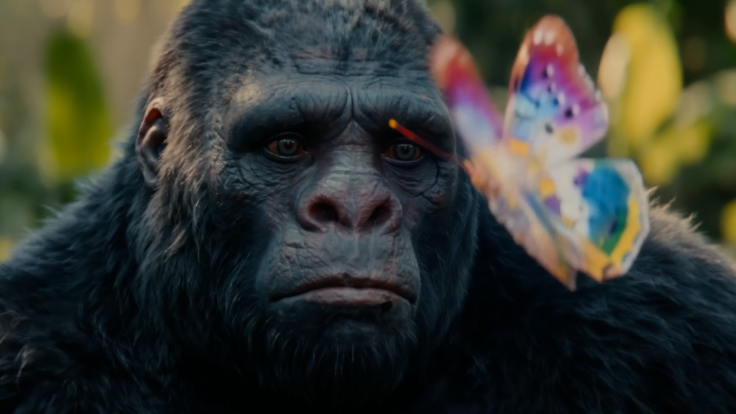
A still from Gods Don’t Give Gifts, directed by Zack London. Photo: Courtesy of Gossip
Goblin |
Edward Saatchi: We’re asking an audience to give us two hours of their time in the
theater. Lights down, no phones, no distractions. It has to be perfect, and so Zack has to be making those decisions. Seeing the acting—seeing a proper performance that is sustained and has an emotional journey—that’s something that, when you and I talked last, Ian, I felt was just not close. It has to work as a performance, and I think it does now.
We think of this as an experiment. We think of this as an underdog, a fun thing that’s about showing the possibilities. It’s opening up a
door such that eventually—I think by next summer—the majority of major films that you see will contain A.I. That’s different from a fully A.I. film, and still pretty radical and subversive.
Are you going to advertise this as an A.I. film?
Saatchi: No, it’s a movie. Frankly, I hadn’t actually thought of that question. People who go to see it will be Gossip Goblin fans. That’s our audience. And then you know, if it expands
from there, then that’s great. But there is an audience that likes this already.
London: Anything relating to A.I. sucks all the air out of the room, and understandably so. It’s what people want to hear about, so they can get angry or excited or self-righteous about defeating Hollywood or whatever. But either way, the discourse is always A.I.
I don’t think we’re gunning for some giant windfall of cash from this. This is an experiment of planting a flag in the ground—a nice
milestone to get to. But I think the real metric of success is, Can people talk about this without mentioning A.I.? Are people going to talk about it, like, This is a cool movie? I’m not shying away from it being A.I., and maybe that’s a selling point because it’s controversial, so people will go see it because it’s taboo. Who knows? But ultimately, I would like its legacy to not be about A.I.
This was an insane film, and it could’ve never been made without A.I., because
this narrative was too expensive and too risky and too weird to do otherwise. It would’ve never gotten greenlit for how much it would’ve cost to make.
Saatchi: The trailer is not going to be like, For the first time, an A.I. film! It’s going to show you the story.
London: Whatever the exact opposite of Tilly Norwood [the A.I. actress] is—where the narrative is the message is the medium is the fan base.
There is no Tilly Norwood. It doesn’t exist. There is no fan base. It is controversy packaged up into a poorly generated Nano Banana character and sold to the press. Maybe we are trying to make a few statements here, but the statement isn’t to be shoving A.I. in your face and saying, Look what it can do. I don’t want it to end up being just a showcase of the technology. |
I know you don’t expect this to make a ton of money, but do you have a baseline ticket
sales expectation?
Saatchi: It’s a mad experiment, and the numbers are going to be totally visible. It’s not at all the reason why we’re doing it. If you’re a fan of Gossip Goblin, bring your friends. That’s what it should be about.
London: Candidly, because there’s no point beating around the bush—given the cost of production, relative to what we recoup when we make these shorts and release them on YouTube, we’re not
making money. We’re a money pit. If you want to do it right and do it well, and use actual talent as opposed to try to optimize for speed and efficiency at the expense of anything else—we’ve already been losing money, and that’s partially why I had to raise [funding].
By now, do you see A.I. as an inevitable filmmaking tool?
London: Every single streamer and studio is heavily invested in A.I. Whether they’re transparent
about it is another story, but it is coming in some way, shape, or form. This is happening. I see Gossip Goblin as at the forefront of validating this, as opposed to pontificating on what it could be. We’re actually making the stuff, and we have audiences. We’re not teasing proof of concepts or speaking on panels. We’re releasing it, and we’re getting millions and millions of views on narrative stuff, not memes or clickbait or softcore porn. The movie feels like an extension of that.
We’re not being mavericks for the sake of it. We’re validating, Is this possible? There’s a lot of symbolism to it as much as there is any kind of monetary win. |
|
|
|
A professional-grade rundown on the business of sports from John Ourand, the industry’s preeminent journalist,
covering the leagues, players, agencies, media deals, and the egos fueling it all. Plus, the latest intel from Eriq Gardner on the sports legal beat. |
|
|
|
Join Puck’s chief political columnist, John Heilemann, as he roams the corridors of power and influence in America on
this twice-weekly interview show, taking you beyond the headlines with the people who shape our culture: icons and up-and-comers, incumbents and insurgents, moguls and machers in the overlapping worlds of politics, entertainment, tech, business, sports, media, and beyond. The conversations are rich and revealing, unrehearsed and unexpected… and reliably impolitic. A Puck-Audacy joint, new episodes drop every Wednesday and Friday. |
|
|
|
Need help? Review our FAQ page or contact us for assistance. For brand partnerships, email ads@puck.news. You received this email because you
signed up to receive emails from Puck, or as part of your Puck account associated with {{customer.email}}. To stop receiving this newsletter and/or manage all your email preferences, click here. |
Puck is published by Heat Media LLC. 107 Greenwich St., New York, NY 10006 |
|
|
|
|