Hi, and welcome back to Line Sheet. I’m still in New York, where dinner reservations are scarce but coffee shops open before 7 a.m. are plentiful. Today, Sarah Shapiro is here to walk you through this tariff business, and she also offers an assessment of the current situation at Nike, where Elliott Hill has been running the show for a few months now. Be sure to email her at SShapiro@puck.news with all your feedback. Up top, I have a quick dispatch from last night’s Marc Jacobs show at the New York Public Library.
🛍️ For those of you with the Shoppies: A lot of people have been asking me about the exit of well-regarded C.E.O. Marco Gobbetti from Salvatore Ferragamo on Monday. I’ll get into this some day soon, but a few thoughts did cross my mind while wearing a Ferragamo dress ( this, which also comes in red) and shoes ( these) designed by its 28-year-old creative director, Maximilian Davis, to last weekend’s 15 Percent Pledge Gala in Los Angeles. Ferragamo is an extremely challenging gig—the business is family run, independent, and operates largely out of Florence, which makes putting together a strong team incredibly hard. (The departure of Gobbetti, a seasoned luxury exec whose last two gigs—Burberry and this—are two of the toughest jobs in the business, underscores this.) And yet, Davis is making thought-provoking, if imperfect, moves. Each season, the collections get better. If I lived in New York, I would buy this blouse.
Mentioned in this issue: Elliott Hill, Nike, Phil Knight, Bill Bowerman, Mark Parker, John Donahoe, Marc Jacobs, Beka Gvishiani, the de minimis exception, Hillary Kerr, Halie LeSavage, DSW, Zappos, Dillard’s, Simeon Siegel, Foot Locker, Adidas, Under Armour, Donald Trump, Shein, Temu, Ssense, LVMH, Sidney Toledano, and many more…
|
|
|
|
A MESSAGE FROM OUR SPONSOR
|
PERFORMANCE UNLEASHED
With a distinct sporting personality, the Range Rover Sport is a
peerless performer.
EXPLORE
|
|
|
|
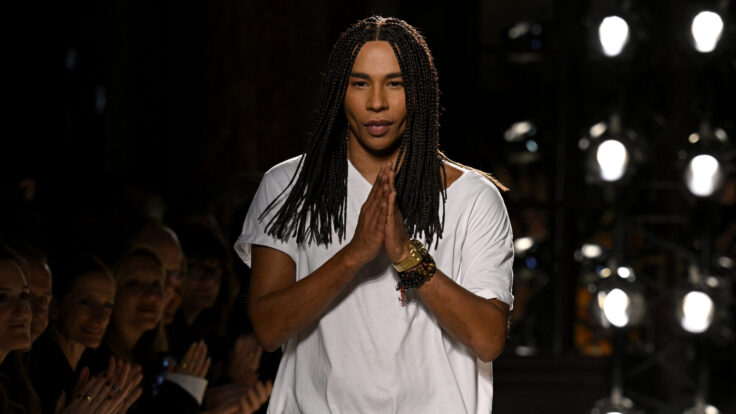
The entire New York fashion community and beyond, everyone from Style Not Com’s Beka Gvishiani to LVMH’s very own Sidney Toledano, showed up for Marc Jacobs’ Fall/Winter 2025 collection at the New York Public Library on Monday night—days before the official start of the shows. And yet, right on time by every other measure: The models started walking just a few minutes after 7:30 p.m. and were done by 7:39.
|
But efficiency is table stakes for Jacobs these days. Harper’s Bazaar’s Lynette Nylander and I shared our near-instant reactions to the clothes on the latest episode of Fashion People, and by now you’ve combed through enough Instagram Stories to see that Jacobs continued interrogating the exaggerated paper doll silhouette, this time inflating each garment into something bulbous and unafraid to take up space. Lynette mentioned how much Jacobs loves fashion—loves clothes—and I’ve always admired his ability to nod to other designers while being totally original. Yesterday, though, I liked the moments when he referenced himself. His flat-to-the-body sweater sets, corduroy trousers, and lace slip dresses—reminiscent of various collections from the past three decades—were zhuzhed into something more voluptuous; his signature pointy-toe flats elongated to near-oblivion. What’s great about Marc Jacobs is that the runway not only still matters to the entire operation, but it’s really the secret ingredient.
Jacobs also writes the best show notes in the business—I hope he’s working on a memoir—and Monday’s were no exception. “Courage… I have come to understand that fear is not my enemy—it is a necessary companion to creativity.” I keep very little from shows—just a few invites and catalogs culled from nearly 20 years of attending these things—but one of my most prized possessions is Jacobs’ final note from his last bow at Louis Vuitton. Last night’s missive, which also included a masthead featuring every member of his design team, earned a place in my slim file of fashion ephemera.
Now, here’s Sarah…
|
|
|
 |
Sarah Shapiro |
|
Three Things You Should Know… About Tariffs
|
- The de minimis exception: The ubiquitous buzzwords sustainability and capsule collection have a new companion in the modern argot of the industry: the de minimis exception, which refers to imports or online orders valued at $800 or less that are able to enter the United States without the recipient paying tariffs or going through formal customs procedures and protocols. Shein and Temu have built their entire businesses around shipping inexpensive products from China that are covered by the de minimis exception. It’s obviously another story for luxury retailers, like Ssense. When you order that Dries Van Noten slip dress for $975, you’re going over the $800 threshold, so additional import taxes apply.
Now, amid Trump’s new tariff era, the de minimis exception is toast. For Mexico and Canada, tariffs have been paused for 30 days, but 10 percent levies are scheduled to go into effect for China today, and they include a provision that closes the de minimis loophole. All these goods will incur a tax on top of the purchase, likely causing retailers to meaningfully adjust their sales forecasts, prices, and more.
- Resizing the cost stack: Meanwhile, retailers, analysts, and consumers are trying to decipher how the tariffs will impact prices and be passed on to buyers. Indeed, tariffs are just another cost input, albeit one wrapped in political drama, and retailers can manage them in three main ways. They can always just raise prices, which is the inflationary option. Or they could technically accept the reduced margins and try to offset them with increased volume—a practical challenge for any fiscally responsible company operating at scale. The third option would require cutting costs elsewhere in the operating stack (supply chain, manufacturing, packaging, etcetera).The likely result of these tariffs is that strong brands, which offer beloved or essential products, will more easily be able to pass some of the new cost on to the customer. Others will be maneuvering through a game of margins, carefully reducing costs in nonessential areas—say, paring back a splashy new marketing campaign or postponing a store renovation. But everyone is hoping that these new taxes are temporary, perhaps a negotiating lever with trade partners, and not the new status quo. (It’s also not entirely clear that this is, strictly speaking, legal.)
- Survivor: Retail Edition…: Executives at the highest level of the fashion industry are always factoring exogenous risks, like recessions and natural disasters, into their business models and long-term planning. And these tariffs, while shocking, shouldn’t have caught any C-suite totally off-guard, given that Trump talked about tariffs constantly during the campaign. There are a number of best-practice protocols for black swan economic environments, like this one, and I expect you’ll see some of these initiatives rolled out across the retail industry, depending on how long this trade war lasts.
- First, retailers will consider diversifying their supplier base. Over the years, we’ve seen companies de-lever their relationship with, say, China or Mexico by finding partners in South East Asia and South America. I expect this to continue, although it’s a time-consuming and laborious process. One strategist I spoke with recalled the era when “tube tops” were taxed differently than “shirts,” an economic wrinkle that led to a profusion of the garment entering the country. In the A.I. era, retailers can more easily leverage data analytics to identify sweet spots in pricing where even a significant increase won’t significantly impact sales volume, ultimately boosting profits despite potential tariff pressures.
Also, I expect retailers will become more communicative about tax implications with their customers, perhaps by adding more FAQs or details to the shipping and returns section. Rather than allow customers to wonder if they’re going to be impacted by customs or taxes when ordering from overseas, brands and companies should be forthcoming about the downstream economics. In the end, it will remove a hurdle before purchase. Who knows, maybe the de minimis exception will end up on a campaign poster one day. (Let’s hope not…)
|
|
|
|
And now for the main event…
|
|
|
|
The $51 billion behemoth is staging a comeback with a new-old C.E.O. and a playbook they’ve been running since the ’80s: innovate through imitation and use the competition as a catalyst for growth. Can they regain the market value of the past? Hoka, you’ve been warned.
|
|
|
|
It’s hard to distill the historic multidecade rise of Nike down to just a few sentences, but humor me. Back in the early ’70s, co-founder and former University of Oregon middle distance runner Phil Knight collaborated with his former coach Bill Bowerman on the so-called “Moon Shoe,” which quickly became the ne plus ultra product for serious joggers. Nike carefully expanded on its success in the performance running space by dominating the burgeoning sneaker industry and then subsequently moved into new
categories, applying the same strategy each time: aligning itself with the professionals at the apex of each sport before moving downstream to capture all the value among the amateurs and hobbyists and other aspiring classes.
In the process, Knight helped architect an oft-imitated brand playbook for seizing markets from the top down, a distinctly novel idea in the era of mass market corporate icons like McDonald’s and GE. In the ensuing decades, it’s been deployed by companies as varied as Starbucks and Uber, Amazon and Tesla.
|
|
|
|
A MESSAGE FROM OUR SPONSOR
|
PERFORMANCE UNLEASHED
With a distinct sporting personality, the Range Rover Sport is a
peerless performer.
EXPLORE
|
|
|
Nike expanded its purview from running to basketball to training, and then to pretty much every conceivable athletic activity and market sector—golf, tennis, baseball, football, fashion, swimming, even leisure. At the dawn of this decade, its market cap peaked at more than a quarter-trillion dollars, making it significantly larger than every other business in the space combined. And that, of course, is where this story takes a slightly interesting turn.
In 2020, Knight’s disciple Mark Parker stepped down as C.E.O. He was replaced by John Donahoe, an unflinchingly qualified executive and company board member, who had previously run Bain and eBay. One of Donahoe’s first decisions—perhaps fueled by the pandemic-accelerated flight to e-commerce—was to end the company’s distribution relationship with several key partners (Zappos, DSW, Dillard’s, and Amazon) and go all-in on D.T.C.
On paper, it was a logical idea: Donahoe’s plan would allow Nike to amass more data, control its channels, and dominate the end-to-end experience. And yet, as Lauren Sherman noted a few months ago in her excellent piece Sneakerheadaches, it was ultimately ill-fated. Unlike the luxury market, where multibrand retail continues to contract, venues like Dick’s offer an essential service for a company like Nike.
Anyway, long story short, Donahoe had the wrong strategy, and implemented it too quickly. Nike’s market cap is now down to $113 billion as it rebuilds, and Donahue is gone. (The company’s annual revenue for the fiscal year ending in May 2024 was $51 billion—interestingly, a $6 billion-plus improvement from the pandemic peak years.)
The good news, of course, is that Nike is still way larger than everyone else, as BMO analyst Simeon Siegel recently reminded me, and is already making the appropriate pivots under new C.E.O. Elliott Hill, a former company lifer who was brought out of retirement about two months after Lauren’s piece was published.
|
Based on my many conversations, Nike’s path forward is pretty simple. First, the company needs a new dominant performance shoe, something on par with Bowerman’s initial innovation. (Nike hasn’t had a true breakthrough since the Flyknit sneaker, which debuted in 2012. In the same period, Adidas introduced its “Boost” technology and the Yeezy.) Second, they need to balance their legacy products, particularly Jordan sneakers, by creating scarcity without sacrificing scale. (I’m constantly amazed that my 9-year-old son is obsessed with a shoe that debuted more than three decades before he was born.) The current “ Unbannable” campaign suggests that Nike is once again leaning into the lore of the Jordan brand.
Consequentially, Nike also needs to push more deeply into the lifestyle category that it appears to have ignored for years, and which is now the domain of, among others, Lululemon, Alo, and even Vuori. These brands recognized that performance gear is an annual purchase, but consumers refresh their lifestyle wear much more often.
|
|
|
Perhaps most importantly, Hill needs to reestablish Nike’s deep relationships with retail partners and an understanding that great global brands require multiple channels to thrive. Hill, who previously led Nike’s consumer, sales, and North American businesses, knows that the next stage of growth can’t come from D.T.C. alone. While Nike’s D.T.C. push made sense on paper five years ago, retail is ultimately a business where you need to meet customers where they are shopping.
Nike may have been forged as a performance brand, but it’s a company built on design and distribution. Sure, they have their own stores, but they ultimately act as massive marketing billboards and experiential retail. Their Well Collective concept stores, for instance, transform traditional retail spaces into wellness hubs where customers can explore fitness journeys through interactive digital experiences—and, of course, still pick up their online orders in-store. Hill gets this.
He’s already rebuilding bridges with key wholesale partners, like Dick’s and Foot Locker. During a recent channel check, in fact, Nike still had more than 50 percent of the selling floor in Foot Locker, including an entire annex room, “House of Hoops,” that felt like a shrine to Jordans. After being notably absent for a spell from The Running Event, an industry-wide trade show in San Antonio, Nike strategically returned this year with a shoe that seems to have learned a thing or two from its competitors. The Zoom Fly 6 features Hoka-like cushioning, a move straight from the company’s historical playbook of observing, improving, and scaling successful innovations.
After all, in Nike’s history, the company doesn’t always move first, but it almost always finds a way to offer a superior product. A perfect example, one former Nike insider pointed out, is the Nike Pro line, a $2 billion business that started as a response to Under Armour’s successful introduction of “spandex,” a.k.a. compression, into the men’s performance category. Under Armour may have pioneered compression wear, but Nike’s ability to scale and normalize the category turned an innovation into everyday athletic wear.
|
What We’re Reading… and Listening To…
|
Once again, Hillary Kerr’s interview with ShopMy co-founder and C.O.O. Tiffany Lopinsky showcased her gift for getting people to give actionable business advice. (Not easy in this over-media-trained world.) Lopinksy offered an incisive explanation of the changing dynamics between creators and brands, and how ShopMy is making it easier for both to make more money. [ Second Life]
Writer Halie LeSavage is a Copenhagen Fashion Week expert at this point, and this season, she unearthed dead-stock Chanel tweed from Caroline Bille Brahe and gave the city high marks for runway model diversity. [ Marie Claire]
The Met Gala’s dress code is essentially… wear a suit. [ AP]
Apparently, a lot of women find the presence of men at Solidcore annoying. (Just don’t sit next to them?) Also, it’s dark in there, and it’s not a sweaty class, so it doesn’t smell the way SoulCycle does when there are men in the room. [ The Cut]
On the GLP-1 beat: Dan Frommer, Lauren’s husband, analyzed some stats around Ozempic usage and spending. Essentially, spending on food and related things goes down the first year, but then creeps back up. Perhaps a lot of people stop taking the drugs after a year? The point: GLP-1s might curb cravings overall, but the effects are short-term, for now. [ The New Consumer]
|
That’s it from Sarah and me. R.I.P. to Biologique Recherche P50 1970, which was finally banned in the United States thanks to new F.D.A. regulations that don’t allow the exfoliating agent phenol in skincare. (The other versions are still good.) Congrats to all the romantic partners of the people who used P50 1970 because they will finally rid themselves of that notorious smell. (I likened it to the burn-off from a barbecue. My husband says embalming fluid.) Get yours here while you still can.
Until tomorrow,
Lauren
P.S.: We are using affiliate links because we are a business. We may make a couple bucks off them.
|
|
|
|
An insider-friendly tip sheet from Matthew Belloni, who spent 14 years in the trenches at The Hollywood Reporter and five before that as an entertainment lawyer. Subscribers also receive What I’m Hearing+, a companion email focused on entertainment law, the streaming industry, and more.
|
|
|
Need help? Review our FAQ page or contact us for assistance. For brand partnerships, email ads@puck.news.
You received this email because you signed up to receive emails from Puck, or as part of your Puck account associated with . To stop receiving this newsletter and/or manage all your email preferences, click
here.
|
|
Puck is published by Heat Media LLC. 107 Greenwich St, New York, NY 10006
|
|
|
|