Welcome back to the Sunday edition of Wall Power. I’m Marion
Maneker.
Julie’s in charge tonight, and she’s got details on a sale of George Ohr at Rago that should spark interest in the modernist potter’s work and legacy. While she’s at it, Julie also catches you up on a photography exhibition of Julia Margaret Cameron. Plus, the latest evidence of Caitlinsanity in the collectibles market.
Take it away, Julie…
|
|
|
 |
Julie Brener Davich |
|
- Caitlinsanity
comes to collectibles: Caitlin Clark’s impact on the WNBA has been incalculable—driving record viewership, ticket sales, and an overdue conversation about inadequate player salaries. Now she has also broken her own record for a trading card. A one-of-one signed Clark rookie card sold last week for $660,000, an auction record for a woman’s sports trading card, on the site Fanatics Collect. The previous record was $366,000, set by a different one-of-one Clark rookie card that
sold at Goldin Auctions in March. (Before that, the record belonged to a Serena Williams NetPro tennis card that sold for $266,400 in 2022, also at Goldin.)The $660,000 card is a Rookie Royalty Flawless, printed by Panini, with a jersey patch and an autograph, including the inscription, “769 pts and counting,” referencing Clark’s rookie season statistics with the Indiana Fever. As Travis Landry of Landry Pop Auctions explained to me, card makers release
“booster boxes” containing several packs of First Off The Line cards directly on their site in Dutch auctions, pricing them in the thousands of dollars and slowly decreasing the price until they’re sold out. Collectors typically pay up for these FOTL cards, knowing that the special releases are more likely to contain good cards. Collectibles influencers also get in on the action, livestreaming themselves “breaking” new cases on Fanatics Live and WhatNot, another online auction platform. Another
autographed one-of-one patch Clark card, inscribed “ROY 24,” is currently on offer at Goldin—and there is chatter it might set another new record.
- Cameron’s camera work: For those who missed its
opening last month, the traveling exhibition of works by 19th century portrait photographer Julia Margaret Cameron has landed at the Morgan Library & Museum, where it will be on view through September. Joel Smith, the Morgan’s head of photography, saw the show in 2023, when it was at the Jeu de Paume in Paris, and was determined to bring it to New York.Cameron, who didn’t pick up a camera until she was nearly 50, is remembered today as one of the first art photographers.
But unlike other recent exhibitions of works by late female artists, Cameron’s does not represent a case of rediscovery. She was well-known in her day—she sold her work through Colnaghi gallery—and her stature has never wavered. Hailing from a well-connected family, Cameron was able to photograph the likes of Charles Darwin; Alfred, Lord Tennyson; and Henry Wadsworth Longfellow. (She is, however, better known for her images of young
women.)
Cameron used a wet-plate process that resulted in a glass negative that could be used to make multiple prints, as opposed to earlier daguerreotypes that were one and done. She also left scratches and fingerprints on the plates that some contemporaneous critics considered flaws, but are now believed to be intentional. “She liked artifacts of the process,” said Allison Pappas, assistant curator of photography at the Morgan. “She was arguably the first photographer
who didn’t allow the mechanism of the camera to dictate the way a picture looked. She pushed the medium to make it look a certain way.”
|
Julia Margaret Cameron, ‘No. 5 of series of Twelve Lifesize Heads’ (Kate Keown), (1866). Photo:
Courtesy of Sotheby’s
|
- The images she created remain highly
valuable, too. After Sotheby’s global head of photographs, Emily Bierman, saw the show at the Morgan, she called every one of her clients who owns a Cameron and asked if they wanted to sell. They all turned her down. “People who have them are really attached to them,” she told me. Bierman was part of the team that sold the world auction record for Cameron—a circular albumen print of her niece, Kate Keown, which made $461,000 against an estimate of $250,000 in
2014. A less impactful version of the photograph, with the sitter’s eyes downcast, sold at Swann in 2016 for $106,250 against an estimate of $50,000.Bierman told me the number of top-notch Cameron works in circulation is decreasing as more end up in permanent collections. With 19th century prints, the quality is determined not only by the physical condition, but also the chemistry. She said her team looks for really rich, dark tones and creamy highlights. “My hope is this show will
inspire a slew of great buried treasures to come to market, or a new generation of people to become interested in collecting her work,” said Bierman. “She’s just such a vibe.”
|
|
|
Now let’s get to the main event…
|
|
|
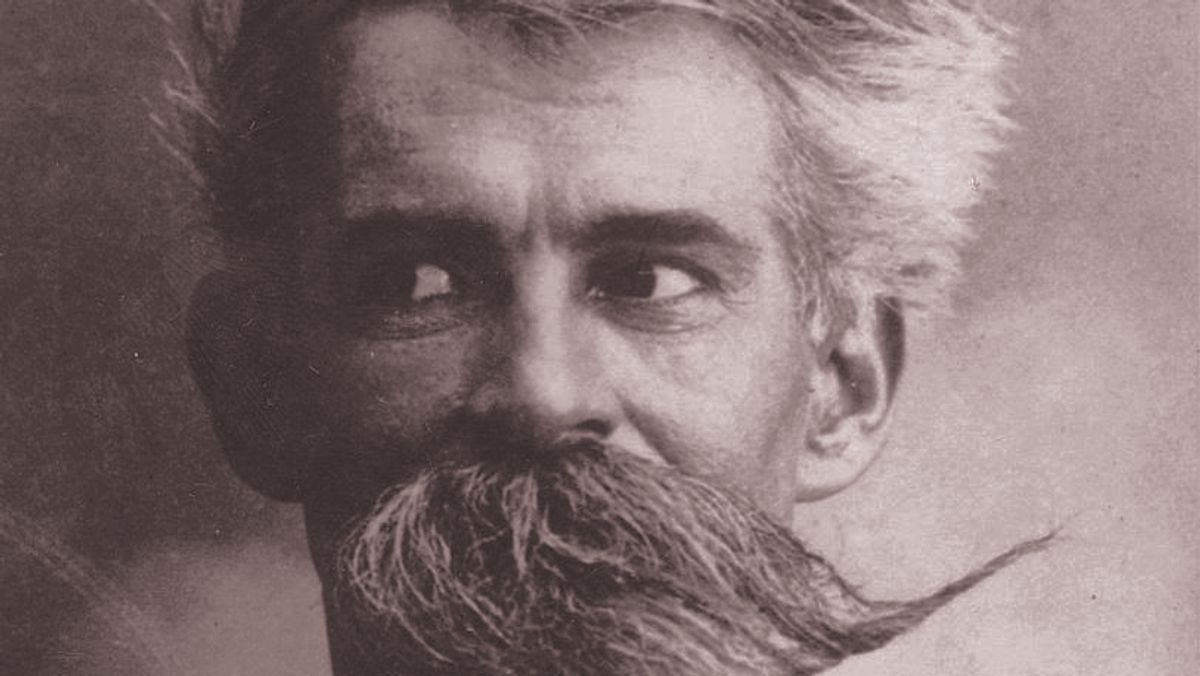
Unheralded during his lifetime, ceramicist George Ohr later drew praise from museum curators
(and Warhol and Johns) for his abstract expressionist teapots and vases. This week, several of his works from the Donald Hecht collection are up for auction.
|
|
|
A couple years ago, David Rago, of Rago Auctions, and David Leiber, of
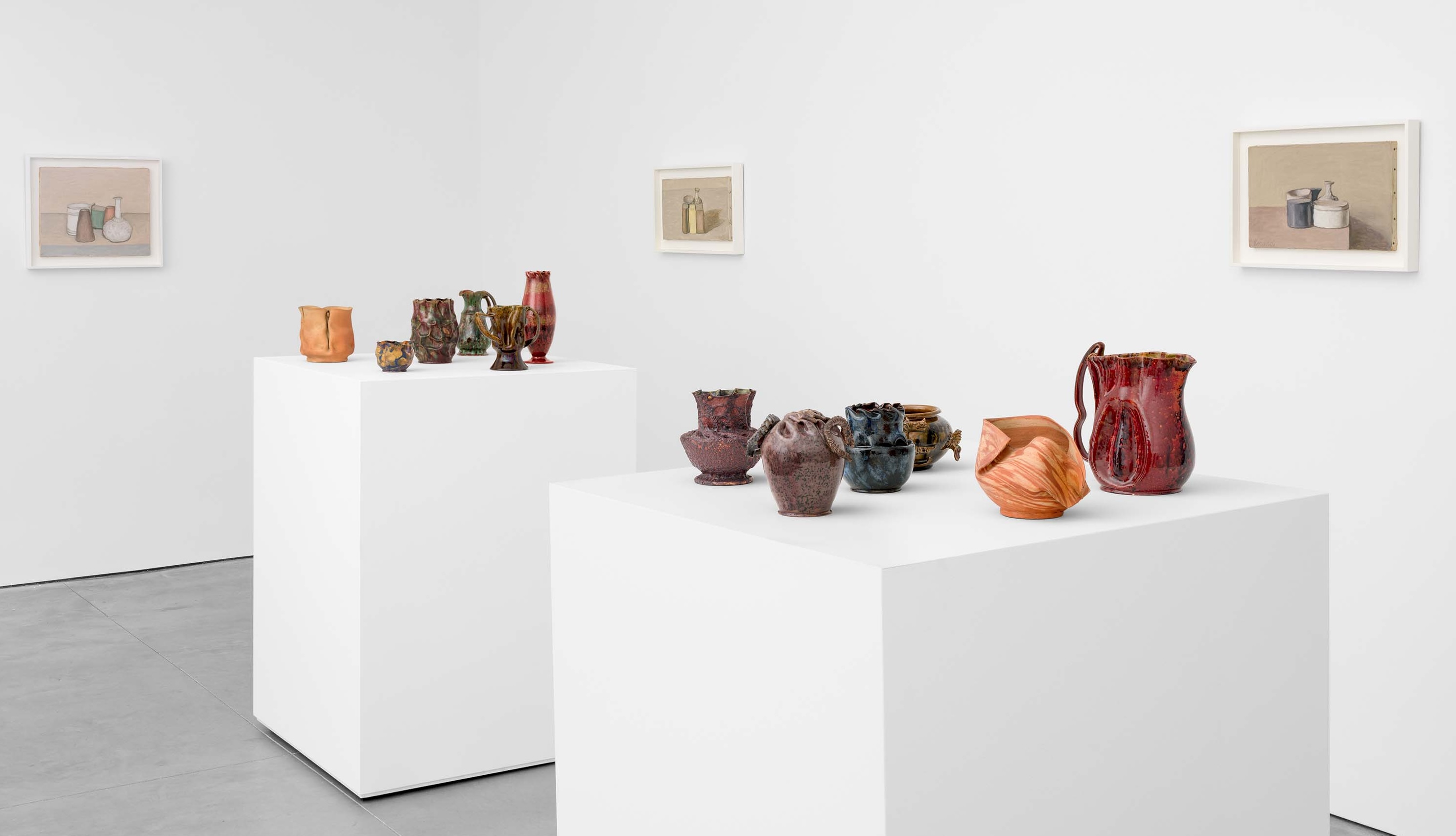
David Zwirner gallery, were having dinner at the Manhattan home of Laura Mattioli, the founder of the Center for Italian Modern Art, which shuttered last year after a decade in SoHo. She was displaying an eye-catching pairing of Giorgio Morandi paintings alongside ceramics by George Ohr, the late-blooming fin de siècle sculptor from the boondocks. Leiber, who was inspired by the combination, later re-created it in Zwirner’s booth at
TEFAF New York: Zwirner supplied the Morandis; Rago, who has long been at the forefront of the Ohr market, supplied the ceramics. Priced at $15,000 to $150,000, about half of the 19 Ohr works sold.
Rago is presumably hoping for a better sell-through rate this Thursday, when the auction house will hold a dedicated sale of 20 ceramics by the artist, 16 of which are from the collection of Donald Hecht. Market demand for Ohr, after all, has been somewhat mixed over the years.
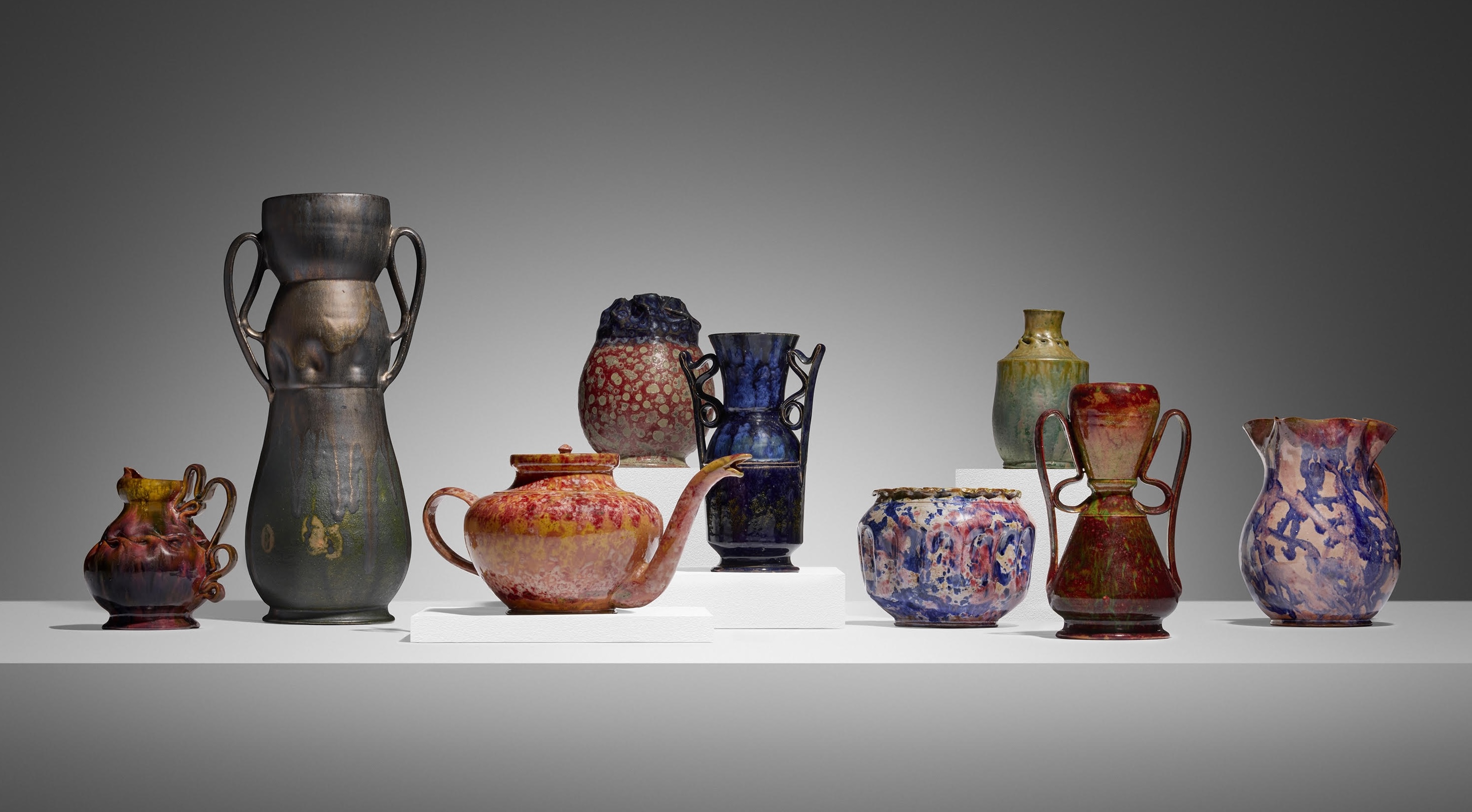
Known as the “Mad Potter of Biloxi,” he created brilliantly kooky forms—small vessels like teapots, vases, and pitchers with in-body twists, ruffling, and ribbon-like handles. Somewhat prefiguring the abstract expressionists, he glazed with splatter and sponge in combinations like blister pink and cobalt blue, at a time when other art potters were using flora and fauna motifs.
Ohr, like many artists, was underappreciated in his time, meagerly supporting his family by making functional
pottery, like pipes and flower pots, from mud he dug up in the nearby Tchoutacabouffa River. He had a prolific art pottery practice but chose to sell almost none of it. When he died, in 1918, he left behind several thousand pieces that he’d made in the 15 years between 1894, when a fire destroyed his studio and its contents, and 1909, when he put away his potter’s wheel for good. And yet, the work of modern ceramicists like Takuro Kuwata, Grayson Perry, Peter
Voulkos, and Betty Woodman all demonstrate his influence.
|
Installation view, Giorgio Morandi and George Ohr (2024), David Zwirner, TEFAF New York. Photo:
Courtesy of David Zwirner
|
Until recently, Ohr has been featured in museums primarily in the context of folk art, including a permanent
display in the American Wing at the Met. There is also a dedicated Ohr museum in Biloxi designed by Frank Gehry, who reportedly told the curator and dealer David Whitney that Ohr’s vessels reminded him of his own buildings. But the institutional community appears to be reconsidering Ohr’s work. In 2021, MoMA displayed Ohr’s vessels alongside contemporaneous masterpieces by van Gogh and Cézanne, showcasing his growing stature as
a pioneer of modern abstraction.
Meanwhile, at auction, Ohr’s prices have remained stagnant. His record of $132,000 was set back in 2006, at Sotheby’s, for a 10-inch, two-handled vase from Whitney’s collection. (Rago, however, told me he has sold pieces privately for $200,000.) Hecht collected only the very best examples of Ohr’s work, but has let Rago price the pieces in this week’s sale at levels to entice bidders. There are four two-handled vases—considered the pinnacle of Ohr’s
work—estimated between $45,000 and $60,000, but with the starting bids set at only $35,000 and $40,000. One of them is glazed a raspberry color on one side and emerald on the other, with indigo around the rim. There’s a volcanic vase with a twist in the neck estimated at $25,000, and a rare cadogan teapot with a snake-head spout estimated at $15,000. “Ohr has always been underpriced at auction,” said Rago. “But people are catching on.”
|
Ohr’s most sought-after works combine a colorful glaze and interesting form, with an aspect of funk or
folly—like the half vase and the red, ring-shaped bottle that the Crystal Bridges Museum of American Art acquired from Rago in 2023 for $63,000 and $69,300, respectively, from the collection of Robert Ellison Jr. Ohr’s unglazed bisque pieces that show the natural marbleization of the clay, once considered unfinished, are now regarded as among the best of his practice, reflecting the maturation of the market. The highest auction price for a bisque piece is $69,300, achieved in
that same Rago sale.
One factor that might be keeping Ohr’s prices depressed is the diminutive scale of the works. Almost all of the top prices at auction have been achieved for examples that are six inches or taller. But, as Rago told me, “Scale doesn’t make them better.”
After Ohr gave up pottery, he stored his artworks in the attic of his studio, which his sons later turned into an automotive repair shop. Sixty years later, Jim Carpenter, a New Jersey antiques
dealer and barber (he cut hair amidst old cars and bicycles), paid the sons $30,000 for all but a few hundred pieces and drove the cache of work north in a semitruck. Given that some of the pieces are as thin as potato chips, their survival up to that point is a marvel.
Carpenter started selling them out of his shop for between $50 and $200 apiece, benefitting from a surge in interest in the arts and crafts movement in the early 1970s. Jordan-Volpe Gallery brought Ohr’s work to SoHo, then
the center of the art market, across from Leo Castelli’s gallery. Some of the art intelligentsia, including Whitney, Irving Blum, Andy Warhol, and Jasper Johns, bought them. But at the time, Ohr’s market was mostly arts and crafts collectors, like Rutgers professor Martin Eidelberg, who just donated his trove of European ceramics to the Met.
|
Works by George Ohr from the collection of Donald Hecht. Photo: Courtesy of Rago Auctions
|
Today, Ohr’s buyers include modern art collectors and museums like the Met, LACMA, MoMA and the de Young in
San Francisco. “That’s why Ohr’s market keeps going,” Rago told me. “New people are entering the market.” In 2023, Rago sold 140 ceramics from Ellison’s collection that were not included in his donation of some 600 works to the Met. A grouping of 20 pieces by Ohr in the sale made $795,060, more than five times the aggregate estimate of $157,500. Two works sold for more than $100,000 but did not beat the 2006 record.
In 2021, the New National Museum of Monaco featured Ohr in the exhibition
Artifices instables, Stories of ceramics, highlighting the diversity of practice in the medium. Among the works on view was a rare miniature vase by Ohr that the Fiorucci Foundation bought from Rago for $10,625 in 2020. “His work is now in museums in London, Amsterdam, and France,” said Rago. “Just like how the Brits discovered American blues, I think Ohr has to be discovered by [more] non-Americans.”
|
Thanks, Julie. More on Tuesday,
M
|
|
|
Finally, a media podcast about what’s actually happening in the media—not the oversanitized,
legal-and-standards-approved version you read online. Join Dylan Byers, Puck’s veteran media reporter, as he sits down with TV personalities, moguls, pundits, and industry executives for raw, honest, sometimes salacious conversations about the business of media and its biggest egos. New episodes publish every Tuesday and Friday.
|
|
|
The industry’s go-to source for unflinching reporting on the trillion-dollar business of artificial intelligence - perhaps the
single most important technology of our time. Ian Krietzberg, the powerhouse journalist behind The Deep View, delivers twice-weekly insights into the latest dealmaking and breakthroughs in A.I., and how the intersecting worlds of finance, entertainment, media, and politics are being transformed in its wake.
|
|
|
Need help? Review our FAQ page or contact us for assistance. For brand partnerships, email ads@puck.news.
You received this email because you signed up to receive emails from Puck, or as part of your Puck account associated with {{customer.email}}. To stop receiving this newsletter and/or manage all your email preferences, click here.
|
Puck is published by Heat Media LLC. 107 Greenwich St, New York, NY 10006
|
|
|
|