Welcome back to The Varsity. Today, we turn our main event over to Bill Cohan, who, earlier this week in Dry Powder, analyzed why Netflix had to stand down in the wake of Paramount Skydance’s raised bid for Warner Bros. Discovery. Lo and behold, Ted Sarandos & Co. did just that as we closed tonight’s issue. Absolutely prescient stuff from Bill below. [Ed. note: In tonight’s edition of What I’m Hearing, Matt Belloni and Bill, who have been go-to voices on the sale for months, will discuss the news and the ins and outs of Paramount’s highly leveraged victory. Sign up here to ensure you’ll get it in your inbox.]
We’ve also got news from me on Zuffa Boxing’s big U.K. deal that’s about to be signed, and Eriq Gardner’s preview of the many
sports figures set to take the stand next week in U.S. v. Live Nation–Ticketmaster.
Before we begin: A quick note of congratulations to six former Washington Post journos who just landed at The Athletic: Barry Svrluga, Spencer Nusbaum, Candace Buckner, Ava Wallace, Adam Kilgore, and Jason Murray. The Post’s loss is the Times’s
gain.
Pod alert: We are just over 100 days away from the start of the World Cup, so I rang up Roger Bennett, one of the top soccer commentators, to join the Varsity podcast this week. Bennett hosts the popular Men in Blazers podcast, and his new book, We Are the World (Cup): A Personal History of the World’s Greatest Sporting Event, arrives next month. Also, make sure to listen to yesterday’s episode as well. Marchand and I discussed the media rights situation for both MLB and NFL over a zesty (crisp, not tart!) sancerre.
Mentioned in this issue: Don Garber, David Zaslav, Brendan Sorsby, Messi, John Abbamondi, Terence Crawford, Susan Rice, Trump, Matthew Caldwell, Eben Novy-Williams, Kenny Moelis, Mark
Shapiro, George Hanna, Arun Subramanian, Conor Benn, Canelo Alvarez, Doug Dawson, Larry Ellison, Amol Rajan, and more…
|
Player of the Week: Don Garber
|
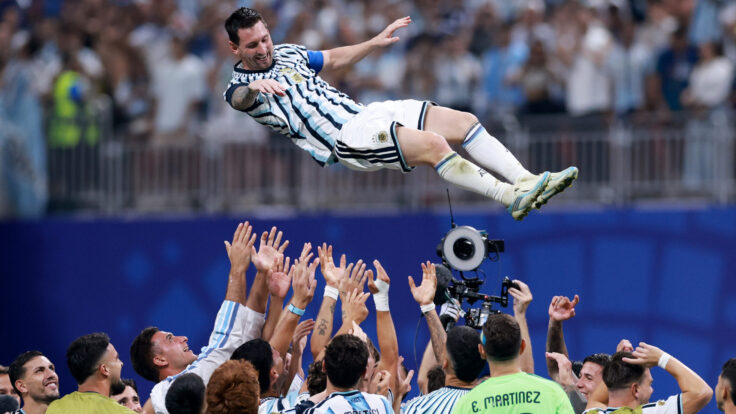
MLS kicked off its 31st season in a big way on Saturday: 75,673 fans packed the L.A. Memorial Coliseum to watch LAFC play Messi and Inter Miami. It was the second-largest attendance in MLS history—just behind a July Fourth game in the Rose Bowl three years ago.
It’s a nice start for a league that is about to embark on what it’s calling “MLS 3.0,” a phase that includes switching its schedule to mirror international leagues. Garber, who has been the MLS commissioner since 1999, is overseeing the initial phase of this push, but the 68-year-old’s contract ends in 2027. As Eben Novy-Williams reported, the league has brought in Korn Ferry to open a search for Garber’s successor.
|
Down to the J.V.: Brendan Sorsby
|
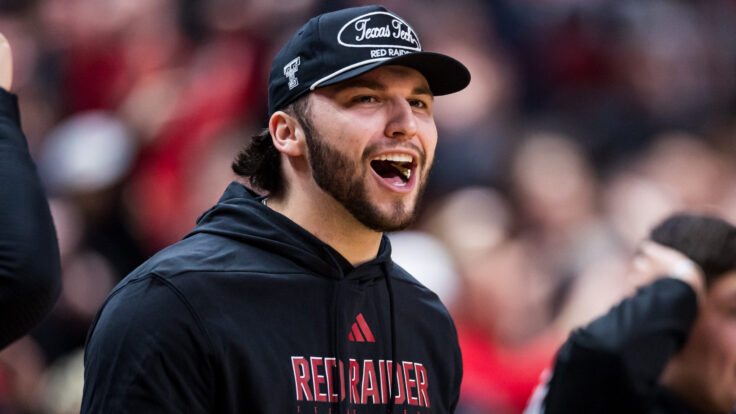
Another week, another N.I.L./transfer portal controversy. This time, it’s the University of Cincinnati, which sued its former QB Brendan Sorsby for breaching his N.I.L. contract. Per the school, Sorsby refused to pay a $1 million exit fee after he transferred to Texas Tech. If past is prologue, this suit will be settled well before it goes in front of a judge. (Sorsby’s agent said in a statement that the lawsuit is “misguided.”) But these types of stories will continue to portray the current state of college sports as the Wild West, which will give Congress more impetus to step in.
|
- Zuffa’s U.K. deal: Less than a week after signing British welterweight Conor Benn, TKO’s Zuffa Boxing is on the precipice of concluding a media rights deal with Sky Sports for the U.K. market, per a bunch of sources. Deal terms are hard to come by, but TKO has had conversations with media companies in several international markets. Zuffa already has a deal with Paramount+ for the United States, Canada, and Latin America. And it should be noted that Zuffa’s sister company, UFC, is in the middle of a U.K. deal with TNT Sports.While nobody would confirm the pending Sky Sports deal, TKO president Mark Shapiro discussed the Benn signing, saying that the boxer is signed for one fight, that does not include anchoring one of the “super fights” that Zuffa will stage each year, similar to the Canelo Alvarez–Terence Crawford fight last fall. “Now let me be clear. We signed him for just one fight. That’s all we’re talking about here,” Shapiro said on TKO’s earnings call yesterday. “Of course, we hope, eventually, he’ll fight in our Zuffa boxing series exclusively on Paramount+.”
- Ball in court: When the U.S. government opens its trial against Live Nation on Monday, there will be enough brass in the building to program the MIT Sloan Sports Analytics Conference for years to come. In attendance will be senior executives tied to the Dallas Cowboys (including senior vice president of stadium revenue Doug Dawson), the Cleveland Cavaliers, Inter Miami, and nearly a dozen other franchises, as well as a roster of Live Nation’s own sports executives. That lineup reflects a quiet but important shift in the case: While the public still associates the fight with the soaring cost of live music, the sports ecosystem has become just as central to the government’s effort to prove that the Live Nation–Ticketmaster monolith is anticompetitive. That’s especially true after Judge Arun Subramanian’s February 18 summary judgment ruling trimmed back parts of the government’s concert-promotion theories, while allowing it to press forward on its claim that Live Nation foreclosed competition in the venue-facing ticketing market.With the case now anchored in that upstream venue battle, large teams and arena operators—sophisticated buyers of primary ticketing services—will be in the spotlight. Expect executives like Minnesota Timberwolves C.E.O. Matthew Caldwell and Los Angeles Clippers C.T.O. George Hanna to walk the court through what it’s actually like to negotiate with ticketing platforms. And if there’s a potential star witness for the government, it may be John Abbamondi, the former Barclays Center chief whose résumé runs through the NBA league office, Major League Baseball, multiple club front offices, and Madison Square Garden. In his deposition, Abbamondi testified that there was “widespread fear in the industry that if you were to [switch from Ticketmaster to SeatGeek], that Live Nation might retaliate against you.” On the eve of trial, Live Nation moved to keep that testimony out, arguing that speculative fears have no place before the jury, but Subramanian wasn’t persuaded. —Eriq Gardner
|
[Ed. note: For tonight’s main event, we’re running Bill Cohan’s prescient Dry Powder column from earlier this week, which laid out the financial case for Netflix to drop its bid to acquire Warner Bros. Discovery. In a special edition of What I’m Hearing coming later tonight, Matt Belloni and Bill, who have been go-to voices on the sale for months, will discuss the news and the ins and outs of Paramount’s highly leveraged victory. Sign up here to ensure that you’ll get it in your inbox. Now on to Bill’s earlier story…]
|
|
|
Even if Ted Sarandos can charm D.C. into blessing his Netflix–Warner Bros. deal,
the savviest M&A move at his disposal is to let the Ellisons win the trophy, overextend their balance sheet, then sit back and wait for the sequel.
|
|
|
I have a simple piece of unsolicited advice for Ted Sarandos regarding his merger with Warner Bros. Discovery: Walk away now and let the desperate boneheads at Paramount Skydance get the Pyrrhic victory on this one. In fact, there are many good reasons that Ted should ignore his highly respected M&A advisor Kenny Moelis, who I’m sure is telling him to raise his $27.75-per-share, all-cash bid for WBD’s Streaming & Studios business to something that—along with the value of the Global Networks equity stub—matches or exceeds PSKY’s latest $31-per-share, all-cash bid for all of the company. But Moelis may get paid either way, whereas the Netflix team will need to justify this deal to multiple governments, Sarandos’s shareholders, and Wall Street analysts for months to come. Ted should let PSKY have it—otherwise he’ll regret overpaying for a business that has singed everyone who’s owned it in the past 50 years.
I imagine that Ted’s ego may be caught up in the deal heat at this point, as evidenced by his impressive media campaign over the
past week to convince both the industry and the markets that Netflix is devoted to winning WBD. But the best deals are often the ones you don’t do, and there are now too many good reasons to drop the pen and walk away. Just because PSKY is badly overpaying for WBD—kudos to David Zaslav for running a brilliant M&A process—doesn’t mean that he has to top its bid. (Usual disclosure: Through a recent transaction, Zaz is a de minimis investor in Puck; RedBird Capital, a partner in Paramount Skydance, is a minority shareholder.)
First, if Netflix declines to match or exceed the PSKY bid, the WBD board would likely switch its allegiance to PSKY, triggering a $2.8 billion breakup fee to the streamer. (In one of the recent rounds of negotiations, Zaz got the Ellisons to agree to underwrite that fee.) Yes, that’s funny money for a company with a $350 billion market cap that already spends $20 billion a year on content. But
Netflix’s stock is down more than 30 percent since this mishegas began, and a nearly $3 billion cherry could go toward more shows, theaters, or capex—like the studio the company is building in New Jersey.
Let’s not forget, these are deep waters for Netflix to be swimming in. The biggest M&A transaction in the company’s nearly 30-year history was its $700 million deal for the Roald Dahl Story Company in 2021, which gave Netflix access to content including Charlie and the Chocolate Factory and James and the Giant Peach. But that deal is a pipsqueak compared to what Netflix is proposing for WBD, which would likely exceed $90 billion—inclusive of more than $60 billion of debt—if Netflix matches or exceeds the new PSKY bid. (This is not investment advice.)
My faithful readers don’t need reminding that $60 billion is a lot of debt. When Zaz took on $55 billion of debt in his acquisition of WarnerMedia from AT&T, it almost sank the whole WBD enterprise. The mere fact that it didn’t is a testament to Zaz’s financial engineering dexterity, though it won him no friends in Hollywood along the way. At the moment, Sarandos is Mr. Hollywood. But the contortions Netflix would need to undergo to service and to pay down that $60 billion won’t be pretty, and Ted’s moment in the Brentwood sun would fade faster than a Sunset Boulevard billboard.
|
Why Sarandos & Co. would want to gamble with Netflix’s pristine balance sheet has remained an open question for me during this process. The company’s net debt is now around $5.5 billion, and its net debt-to-EBITDA ratio is roughly 0.5x, an enviable investment-grade credit rating. Buying WBD’s Streaming & Studios business would lard billions more debt onto the company and increase its leverage ratio to in excess of 4x, putting it close to the BBB cliff and potential junk territory. Going from $5 billion of debt to more than $60 billion isn’t a walk in the park. Ask Zaz.
There’s been plenty of chatter lately that the Netflix–WBD deal will never get regulatory approval during Trump II, while others insist Sarandos will be able to charm the pants off the president and his crony regulators. Maybe Washington will buy Netflix’s argument that the new entity would represent a vertical, not a horizontal merger, and that its real competitors are YouTube and TikTok rather than just Disney, Peacock, and Paramount+. And perhaps Sarandos has insight into the regulatory process that the rest of us don’t. (For what it’s worth, he didn’t get a lot of love during the overwrought, though meaningless, Senate hearing a few weeks ago, and who knows what to make of his rival David Ellison sitting cheek-by-jowl with Sen. Lindsey Graham at the State of the Union.) But aside from whatever deal Sarandos can cut with Trump, getting this approved sure seems like a long putt.
If regulators block it, Netflix will owe WBD a cool $5.8 billion. Sarandos may see that as money well spent to tie up the deal in courts for some 18 months, as I discussed on Sunday, allowing Zaz to complete the spinoff of Global Networks. That, in turn, would make WBD less attractive to the Ellisons, who are desperate to get Global Networks’ cashflow so they can pay down what will be their own highly leveraged behemoth if they get all of WBD.
But stepping back to read the tea leaves, it’s clear the Justice Department is investigating whether the Netflix–WBD combination will create a monopolist—as is bound to happen when you combine the number one and four streamers to create a giant with 450 million subscribers. Less clear is whether Justice is also investigating Netflix as a monopolist regardless of the WBD outcome. Either way, one has to wonder what Trump meant when he wrote on Truth Social the other day that Netflix needed to fire Susan Rice “IMMEDIATELY” from the board of directors or else “pay the consequences.”
|
In short, between the Senate sentiment, the letters that Justice has sent to Netflix, and Trump’s unhinged late-night ramblings, it sure doesn’t sound like the regulators are lining up in Netflix’s favor. Instead of paying $3,000-an-hour lawyers and then handing WBD $5.8 billion after losing these legal battles, why not keep the Netflix juggernaut going without WBD? When I first met Sarandos a dozen or so years ago in his Hollywood bungalow, he told me about House of Cards, the first TV show Netflix was going to produce. He struck me as smart and politically savvy. Today, he strikes me as a man who doesn’t need WBD.
Maybe Sarandos and Reed Hastings don’t care that their combined roughly 22 million shares have lost nearly $800 million in value, but I suspect their collective shareholders care deeply that some $110 billion has been flushed since December. I also suspect they would love it if Netflix used this fork in the road to walk away, collect the $2.8 billion breakup fee, and cut a content distribution deal with WBD and PSKY. Netflix’s share price would soar—perhaps higher than when the company embarked on the hunt for Zaz’s white whale.
Ted said as much in his Monday interview with the BBC’s Amol Rajan. When Rajan asked whether Netflix was prepared to raise its bid, he replied, “I don’t want to do hypotheticals. So, this is part of the process. We very much like the deal where we’re at right now. We’re very disciplined buyers, and we always have been. I think this is a spectacular opportunity at a price.” Exactly right. This is the moment to show that discipline.
In fact, if the past is any guide, pushing PSKY to overpay for WBD and create one of the largest L.B.O.s in history could mean that Sarandos will get another bite at the WBD apple down the road. By my count, there have been some nine changes in ownership of WBD and its predecessors since Warner Bros. was founded as an independent studio in 1923. Unfortunately for Netflix and its shareholders, the PSKY revised bid of $31 per share is pretty lame, some 10 percent below the $34 a share I thought it would need to win. (I do give PSKY points for its “ticking fee,” now moved up to the end of September, which adds 50 cents per share for every quarter that the deal doesn’t close; its $7 billion regulatory breakup fee; and the agreement by Larry Ellison to put more equity into the deal if there is a solvency issue at or near closing.)
So if Netflix wants to match it, or beat it, it won’t take
much. WBD has all but said its board will deem the $31-per-share bid “superior”—although that’s not a certainty yet. If it does, that will give Ted four days to abandon ship while he still can.
|
We’re running long, so no Cheap Seats today. Have a great weekend. See you Monday.
John
|
|
|
Join Puck’s chief political columnist, John Heilemann, as he roams the corridors of power and influence in America on
this twice-weekly interview show, taking you beyond the headlines with the people who shape our culture: icons and up-and-comers, incumbents and insurgents, moguls and machers in the overlapping worlds of politics, entertainment, tech, business, sports, media, and beyond. The conversations are rich and revealing, unrehearsed and unexpected… and reliably impolitic. A Puck-Audacy joint, new episodes drop every Wednesday and Friday.
|
|
|
An essential, insider-friendly Hollywood tip sheet from Matthew Belloni, who spent 14 years in the trenches at
The Hollywood Reporter and five before that practicing entertainment law. What I’m Hearing also features veteran Hollywood journalist Kim Masters, as well as a special companion email from Eriq Gardner, focused on entertainment law, and weekly box office analysis from Scott Mendelson.
|
|
|
Need help? Review our FAQ page or contact us for assistance. For brand partnerships, email ads@puck.news.
You received this email because you
signed up to receive emails from Puck, or as part of your Puck account associated with {{customer.email}}. To stop receiving this newsletter and/or manage all your email preferences, click here.
|
Puck is published by Heat Media LLC. 107 Greenwich St., New York, NY 10006
|
|
|
|