Welcome back to Wall Power. I’m Marion Maneker.
The design sales
take place this week in New York. Let’s hope there’s enough interesting auction action for a results roundup on Friday. In the meantime, we have a piece by Jamie Lincoln Kitman on a surprising trend in classic cars: buyers flocking to sports cars made only for the Japanese domestic market. Some models are limited editions produced in the 1960s, back when Japanese automakers were climbing from obscurity toward global relevance; others come from the last few decades; and almost
all are exotic in some way, with an interesting provenance.
Up top, I have a quick note on the Jackson Pollock private sale that wasn’t, and a drive-by of Karma’s show of Jeremy Frey’s extraordinary Wabanaki baskets.
A reminder: If you’re not already a subscriber, you can sign up here. Better yet, join the Inner Circle
here. And if you want to comment on anything you read here, especially if you think I got something wrong, just hit reply. It goes straight to my pocket. Or send me an SMS text, WhatsApp, or Signal message at +1.917.825.1391.
Please do not D.M. me on Instagram to tell me something I’ve written is “laughable.” Instagram D.M.s are not a good venue for discussing your views of my work.
Just use text or email if you want to insult me. I’m happy to discuss there.
Also mentioned in this newsletter: Arne Glimcher, Si Newhouse, the Macklowes, Carroll Shelby, Paul Walker, Giorgetto Giugiaro, Eric Minoff, Andrew Obright, Bill Gates, Paul Allen, Ramsey Potts, Dave
Kinney, and more.
Let’s get into it… |
-
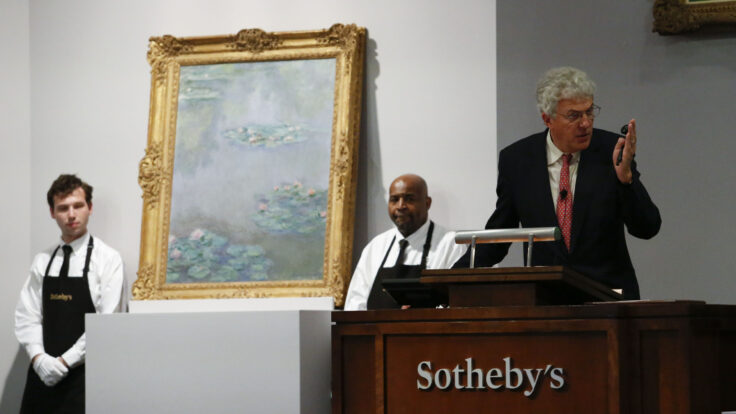
Pace’s Pollock: I started hearing about Sotheby’s attempted private auction of a Jackson Pollock “black painting” early Friday morning, mostly as a reaction to The New York Times’s recent story about Pace’s restructured business. The paper revealed that the Glimcher family’s gallery would be parting ways with 50 artists and another 50 employees who supported them. By Friday, however, the gossip network had started talking about
Arne Glimcher selling Number 19, 1951, with an estimate of $50 million, through a private Sotheby’s auction. Taken together, the news story and the rumor set off speculation that the Glimcher family was trying to raise cash.
Just before 9 p.m. on Friday, however, ARTnews posted a story noting that the auction at Sotheby’s never took place. (Neither Sotheby’s nor Pace is
commenting on the matter.) The only non-surprise here is that anyone would try to sell a Pollock painting loosely related to Number 7A, 1948 following its $181 million sale last month. Selling art is all about timing, of course, and it’s a reasonable assumption that some of the underbidders might still be interested in owning a not-dissimilar Pollock at a fraction of the price. Remember too that Si Newhouse had previously owned Number 17, 1951, another
black painting that he sold to the Macklowes. Five years ago, that painting set Pollock’s previous record auction price at $61 million. The bet that another black painting might reprice higher after a record sale seemed like the kind of calculated risk that sellers take to maximize value.
ARTnews says the auction was called off due to lack of interest. That may be true, but I’ve also been told the problem was that the private auction leaked—and everyone was
talking about it—which put off some of the potential bidders. Either way, there are not a lot of Pollock paintings out there to test the proposition that the artist’s market has repriced. And so, we wait…
|
|
|
|
A MESSAGE FROM OUR SPONSOR |
|
|
|
-
Basket case study: What’s the opposite of déjà vu, when you see something and then see it again—say, on someone’s Instagram story—and it hits you like something you’ve never seen before? I had that experience recently with Jeremy Frey’s baskets at Karma in Chelsea. I saw the show when it opened in May but had to go back after seeing Frey’s
complementarily colored, geometrically patterned, urn-like baskets appearing repeatedly in my feed.
A MacArthur Fellowship–winning Indigenous weaver from the Passamaquoddy tribe who lives in a small town in Eastern Maine, Frey is trying to innovate a craft that has been in his family for generations. He’s also evolving the weaving technique into new materials—even after it already migrated from producing sturdy storage vessels into “fancy baskets” to be sold to tourists—which he’s now
elevating into an art form. That includes using synthetic dyes to generate vivid colors more associated with pop art than a native craft thousands of years old. But he is also experimenting with other materials—cedar, copper strips, bronze—as the black ash tree historically used by the Wabanaki people to make baskets is threatened by climate change and invasive species. You don’t need to know any of that to be impressed by his
work, which appeals easily to contemporary art collectors now enthralled by ceramics and design objects. - Prince price check: A plugged-in reader noted that I did a poor search of Richard Prince’s auction records for Sunday’s newsletter and misidentified the top price for one of the artist’s car hoods as
$1.9 million. The actual high-water mark for a hood at auction was $2.8 million, set in 2018, though that work subsequently retraded at $1.9 million in 2023. But it was my mistake to have missed it. Barbara Gladstone’s hood
sold this morning for slightly more than $1 million with fees.
|
Now, let’s get to Jamie and the cars… |
|
|
|
The collectible car market is finally moving past its beloved Boomer classics as a
younger, Nintendo-raised generation chases high-performance Japanese rarities never meant for the American market. $2 million for a 20-year-old Nissan? That’s just the beginning. |
|
|
|
To truly comprehend the collector heat around Japanese cars, make a trip, as I did recently, to
Port Newark, whose dockside parking lots are crowded with Japan-born Supras, Skylines, and NSXs waiting to clear customs. The volume attests to steady demand—albeit blunted of late by tariff-related confusion—for Japanese cars that were never sold in the U.S., or are sportier or more coveted versions of what arrived stateside. For those old enough to remember when Japanese cars were derided for poor quality, economy pricing, and peculiar styling, the volume of activity is jaw-dropping, as are
the prices of rarer high-performance models over the past several years.
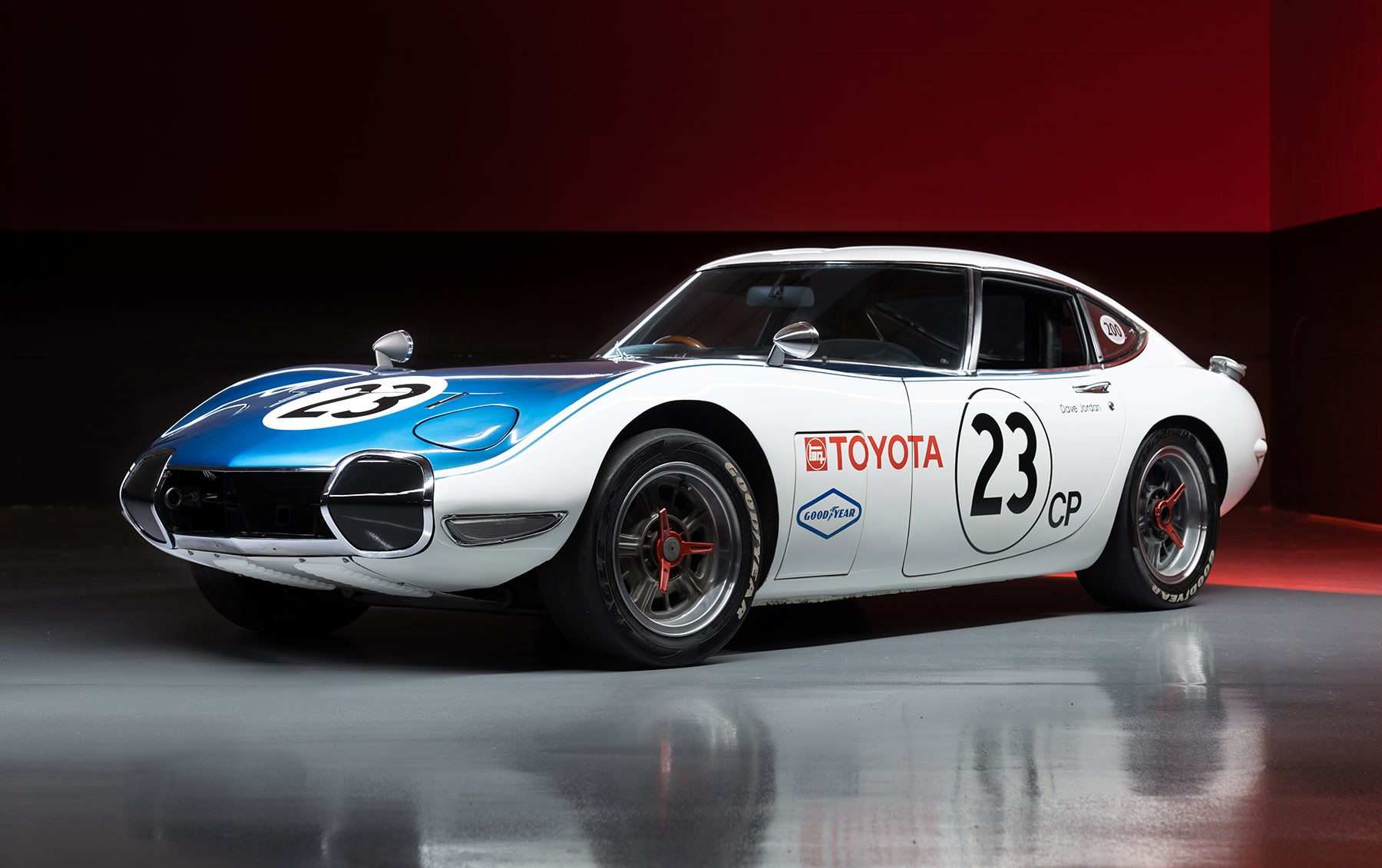
Leading the charge is the 1967 Toyota 2000GT. When one changed hands at a Gooding auction in 2022 for $2.535 million, it became the most expensive Japanese car ever sold. In its day, this six-cylinder, fast-backed two-seater was a bold statement of then-young Toyota’s ambition, a direct and credible retort to Britain’s curvaceous and widely celebrated Jaguar E-Type. Only 351 of the 2000GT supercars were built,
between 1967 and 1970, and only 62 were exported to America. All 2000GTs are rarities, but the sale price at Gooding was likely nudged skyward by the fact that this particular example began life as a race car campaigned by Carroll Shelby’s team. The magic association with Shelby—the LeMans-winning former chicken farmer turned low-volume car manufacturer, race team owner, driver, and industry consultant—likely helped jack up the price. |
The 1967 Toyota-Shelby 2000 GT. Photo: Courtesy of Gooding Christie’s |
An arguably more impressive demonstration of strength in Japanese Domestic Market (a.k.a. J.D.M.)
cars has been the Nissan Skyline. This long-running model line was first offered in 1957 by Japan’s Prince, a smaller carmaker acquired by Nissan in 1966. It lived on at Nissan, where it remained in continuous production through an astounding 13 generations, with a new one expected in 2027. |
|
|
|
A MESSAGE FROM OUR SPONSOR |
|
|
|
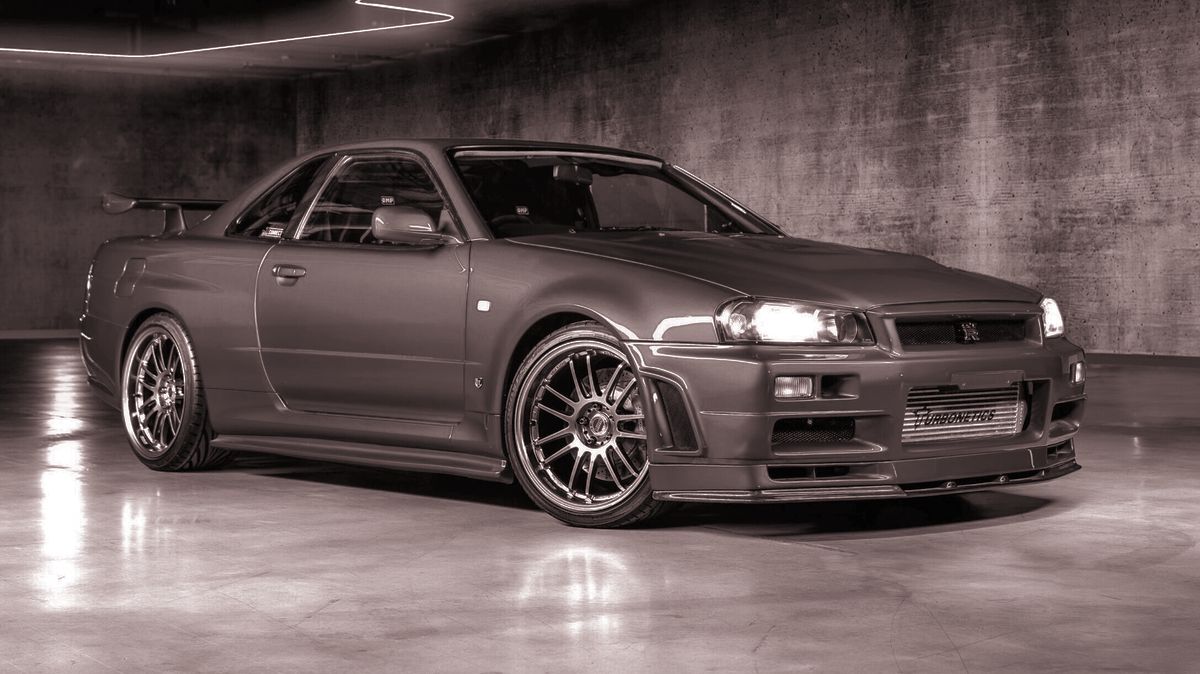
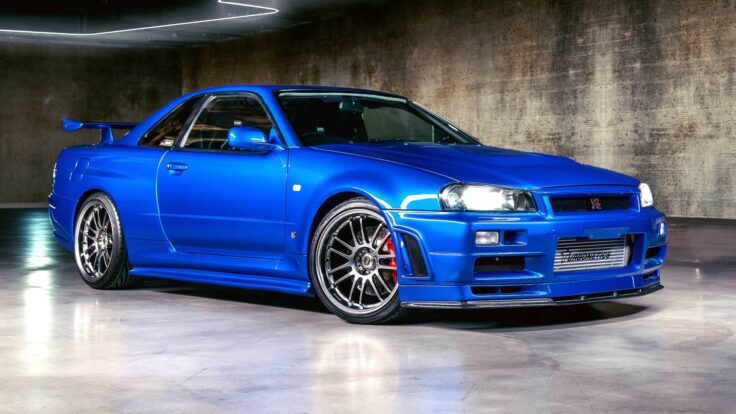
Consider the 2006 Nissan Skyline R34 GT-R NISMO Z-Tune, a rare bird (one of 20) that sold at
auction to a U.S. buyer for $1,985,000; or the 2000 Nissan Skyline R34 GT-R by Kaizo Industries that hammered at $1,357,000 in a 2023 Brussels auction, with bidding from all over the world. Turbocharging its price is its history: It was driven by the late Paul Walker in a 2009 Fast & Furious installment, which tells you something about the demographic now driving the J.D.M. craze. |
Although many of us admired 1960s Japanese style—often the work of the best Italian designers like
Giorgetto Giugiaro, and houses like Pininfarina—many of today’s collectors became interested in Japan’s automotive brilliance via more recent developments. Japanese automakers embraced high performance in the 1990s, and a newly hyper-connected international automotive culture has emerged to celebrate this legacy at their keyboards and on their phones. When illicit Tokyo midnight drifting becomes a popular youth activity in American cities, you know there’s some next-level
cultural exchange going on.
Eric Minoff, a senior specialist director and vice president at Bonhams, the British auction house, believes the guard is changing. “There’s been an obvious generational shift that, not surprisingly, aligns with supply and demand,” he told me. “Many collectors who were part of the Baby Boomer generation are aging out. It’s hard to practice the hobby when you’re dead or infirm. As a result, we’re seeing a large number of collector cars that were
the core of the hobby coming to market with prices flat or depressed as a result of the [high] supply, and also the fact that younger enthusiasts value newer cars.”
While interest is waning in former blue-chip classics—from 1950s Chevys to 1960s T-Birds—Minoff sees a new wave of collectors expressing its own enthusiasm. “There’s an entire generation of people who grew up playing video games like Gran Turismo, the granddaddy of them all,” he said. “It introduced them to a world of
cars that were pretty unknown at that time outside of Japan and, to a lesser extent, the U.K.—these really wild Japanese-market-only cars that were exciting versions of things that we got, or things that we never got.” He pointed to Skylines as the obvious superstars, but also J.D.M. Mitsubishi Evos and Honda (Acura to us) Integras. “Younger enthusiasts,” he said, “are going out and snapping these things up, and the Japanese market is more than happy to provide them.”
At the near top of the
food chain, the mid-engine Honda NSX supercar—which was produced for 15 years (1991-2005) and sold in the U.S. as the Acura NSX—has seen considerable price gains. Whereas $20,000 might’ve gotten you a decent example a decade ago, last year a late model NSX residing in Colorado sold for $377,500. At a lower price point are the comparatively rare Toyota Supras sold here when new from 1993 to 1998, while their J.D.M. counterparts soldiered on until 2002. Prices for both have multiplied exponentially.
Some fans revel in the discovery that the Supra’s six-cylinder motors are unusually stout—tough enough to withstand the modifications necessary to pump out as much as 1,000 reliable, and ridiculous, horsepower.
But originality and provenance still matter. In 2021, a Supra that appeared in the first and third Fast & Furious movies sold at a Barrett-Jackson Las Vegas auction for $550,000, a price that might now be considered cheap, if not especially rational. Earlier this year, a
stock, fourth-generation 2002 twin-turbo Supra—a J.D.M. import sporting a mere 320 horsepower—sold at a Mecum auction in Kissimmee, Florida, for a record-setting $232,000. |
It’s perhaps useful to note: J.D.M. cars have their steering wheels on what Americans (excluding
postal delivery drivers) might call the “wrong side.” This has historically been an impediment to U.S. sales, but one largely overlooked in the case of these J.D.M. heroes. Fortunately, right-hand drive cars are legal in the U.S. and not too hard to get used to if you’ve a mind to do it. |
|
|
|
Another crucial element of the American market for J.D.M. imports is that cars are only now legally
importable if built at least 25 years ago to the day. Prior to this regulatory fiddle, no car that had not been certified by its manufacturer for sale in the U.S. could be imported to the U.S. without time-consuming, and often expensive, modifications to meet our once-stringent emissions and safety laws. “People want what they can’t have,” as Andrew O’Bright, president of JDM Imports-CT, in Connecticut, told me.
Since 1999, there has been a “show and display”
exemption—adopted at the behest of Bill Gates and Paul Allen, who both wanted to legally import Porsche’s landmark 959, a model never homologated for sale in the U.S. The revised regulation allows individuals to apply to the National Highway Traffic Safety Administration to import such cars if they can prove that the car will meet current emissions standards, agree to drive no more than 2,500 miles annually, and make a compelling case that their car is rare or
historically significant enough that it will serve the public interest to let the car be operated on U.S. roads. It’s a hassle best left to the lawyers, but if you get the exemption, it adds considerable value to the car.
Beyond those regulatory hurdles, there are Trump’s capricious tariffs: You used to reliably pay a blanket 2.5 percent import duty on purchase price for imported cars over 25 years old. According to West Coast Shipping of Richmond, California, in 2025 you
might have been charged anywhere from 2.5 to 37.5 percent in import duties, depending on what country of origin the car was deemed to have. The effects are real. According to O’Bright, sales of cars at the lower end of the spectrum have suffered because of tariffs and related uncertainty. “When you’re importing something and it’s getting tariffed at an extra, say 20 percent, it definitely hurts that end of the market,” he said. “People looking for super-high-end cars obviously have expendable
cash, so that doesn’t affect them quite as much.”
When investing in collector automobiles, uncertainty is a given. Bonhams’ Minoff believes supply is improving, though this might have the effect of driving prices down. “The Japanese market has become much more receptive to selling cars for export,” he said. “Because, look, everyone has their price.”
Ramsey Potts, senior sales specialist and V.P. of sales at the newly formed auction house Broad Arrow, recognizes the
potential for an old-fashioned market correction. “The supply is beginning to catch up with the demand,” he said. Someone who bought a Toyota Supra for $5,000 15 years ago might notice that three of them just sold for $100,000 and get it out of the storage shed, get it running, and bring it to market, he noted. “I think the market is as feverish as it has ever been,” he continued, “but the price fluctuation has more to do with the supply-and-demand aspect of it than the enthusiasm for
it.”
“The only constant in the automobile world is change,” said Dave Kinney, a respected classic automobile appraiser, even as he cautioned that values likely can’t head upward forever. “That’s a good thing, because it’s a sign that the market is getting revived and getting younger and staying attuned to its time.” |
Thanks, Jamie. This was fascinating. I’ll be back tomorrow in the Inner Circle with an interview
with Cybele Maylone, whose Aldrich Museum has just opened its first decennial survey of Connecticut artists.
'Til then,
M |
|
|
|
Puck founding partner Matt Belloni takes you inside the business of Hollywood, using exclusive reporting and insight
to explain the backstories on everything from Marvel movies to the streaming wars. |
|
|
|
Unique and privileged insight into the private conversations taking place inside boardrooms and corner offices up and
down Wall Street, relayed by best-selling author, journalist, and former M&A senior banker William D. Cohan. |
|
|
|
Need help? Review our FAQ page or contact us for assistance. For brand partnerships, email ads@puck.news. You received this email because you
signed up to receive emails from Puck, or as part of your Puck account associated with {{customer.email}}. To stop receiving this newsletter and/or manage all your email preferences, click here. |
Puck is published by Heat Media LLC. 107 Greenwich St., New York, NY 10006 |
|
|
|
|