Welcome back to The Varsity, our thrice-weekly private email on the business of sports.
I’m still in D.C., where the locals are experiencing an unpleasant déjà vu now that our NFL team is back in the news for reasons we thought were already litigated. More on that below.
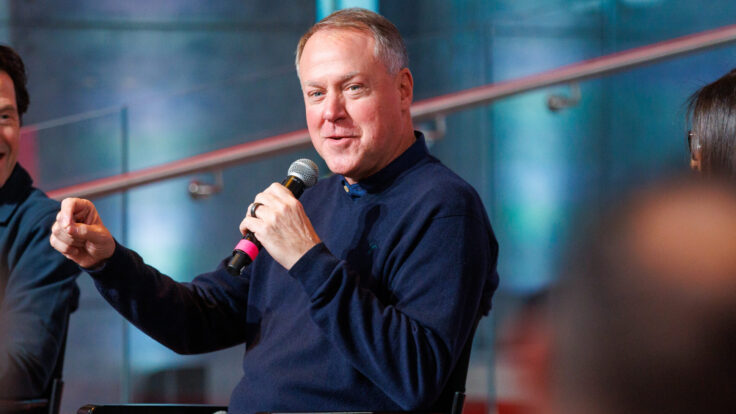
🚨 Pod alert: As media money appears to flatline for all but the mighty NFL, team owners are increasingly preoccupied with building out entertainment districts. To get at the truth behind the trend, I checked in with my old SBJ colleague Bret
McCormick for this week’s pod, which posts on Wednesday. Also, make sure you download yesterday’s conversation with MoffettNathanson’s Michael Nathanson on where sports media is headed. Listen here and here. More on Michael’s prognostications later on in this email, too. |
- Josh Harris’s Gulf of America: While Larry Dolan’s people immediately brushed off Trump’s push to rename his Cleveland Guardians back to the Indians, Josh Harris & Co. haven’t responded to the president’s demand on Truth Social that the team change its name back to the Redskins—perhaps because Trump followed up his initial post with a threat to kill the Commanders’ new $4 billion stadium if Harris doesn’t
change the name. But could Trump actually derail the stadium, which would be built on federal land, on the R.F.K. Stadium site?
In a comment to The Washington Post, D.C. city council chair Phil Mendelson said that he doesn’t know what kind of leverage Trump actually has to kill the deal, noting, “I haven’t heard a single suggestion that the council should condition the deal for a new stadium on a name change.” That’s not entirely surprising: Voters in D.C.—where
Kamala Harris won 90 percent of the ballots—would look askance at any councilmember who might indulge Trump’s latest naming obsession. Also, Josh Harris’s team may be waiting for the president’s Epstein or tariff troubles to blow over so that he’s less inclined to look for a media distraction to throw the attention off himself. (The team did not respond to a request for comment.) - WNBA union blues: The WNBA’s rise is
not without some hiccups. At the ESPYs the other night, Shane Gillis mocked the uneasy crowd for not knowing who “Brittany Hicks” was. (Of course, Gillis completely made up the player; she doesn’t exist.) Meanwhile, the women’s pro basketball league seems to be careening toward a work stoppage this fall. The two sides met face-to-face for
the first time in six months on Thursday, and despite the viral moment of commissioner Cathy Engelbert dancing with players, the vibe coming out of All-Star Weekend in Indianapolis was pessimistic.
The league and players are far apart on revenue sharing and salary
structure, and Caitlin Clark et al. are holding the line for a bigger piece of the pie, in light of the league’s impressive growth and its $200 million-per-year media rights deal. League executives, however, insist that growth will plateau if they’re not allowed to maintain financial flexibility. In other words, everyone is already digging into their corners.
- P.E. and goal: As Varsity readers know, leagues have been pursuing private equity capital for a host of reasons: to provide liquidity to limited partners, professionalize the capital structure of teams, and, sure, help influence valuations northward by accessing new gobs of cash. Arctos Partners, CVC Capital Partners, Elliott Management, Oaktree Capital Management, and Ares Management have set up funds. In May, TPG launched a sports investing business in
partnership with Rory McIlroy. Now Apollo and Ares are considering setting up media and entertainment funds that will accept debt and equity investments in leagues and teams, per Bloomberg, which noted that the companies “have been pouncing on opportunities to invest in sports teams, boosted by the NFL’s
landmark decision last year to allow P.E. firms to own teams.” (Disclosure: TPG is an investor in Puck.)
- The Colbert calculus: Matt Belloni’s unparalleled reporting on the real story behind CBS’s decision to cancel Stephen Colbert’s late-night talk show articulated a harsh reality about
the media business: Besides the NFL, there are no sacred cows left in broadcast television. As Matt wrote, “I’ve sensed that the networks have all been reluctant to be the first to pull the trigger on a cancellation in the historic [late-night] time slot. CBS has now fired the opening shot, and it’s reasonable to suspect that NBC and ABC will follow. So no, I wouldn’t sleep well tonight if I were Kimmel or Fallon, though both have larger digital footprints and
do a lot more for their respective networks.”
Generally speaking, TV network executives are still reluctant to pull the plug on any kind of live sports programming that brings in viewers—but fast-forward five years, and it’s easy to envision these same executives turning out the lights on the rights packages they can no longer afford. ESPN’s decision to remain disciplined on F1 could be a harbinger of deal choreography to come. - People news: It’s
a time-honored tradition in the media business: Executives who parse TV ratings gain celebrity in their own right, even if only inside the building. Fox has Mike Mulvihill; NBC had Alan Wurtzel; Turner had Jack Wakshlag; and ESPN has Flora Kelly, who was just promoted today to senior vice president of ESPN Research, reporting to C.F.O. Chara-Lynn
Aguiar. … WaPo’s excellent soccer reporter Steven Goff took a buyout and is leaving the paper after 40 (!) years. “I’m not necessarily done at The Post,” Goff wrote on LinkedIn. “I might continue writing (far less frequently) on contract. Or latch on elsewhere as the 2026 World Cup nears. Or launch my own project.” … The former Baltimore Sun and ESPN writer—and proud Montanan—Kevin Van Valkenburg is
leaving the golf blog No Laying Up.
|
Now, on to the main event… |
|
|
A candid conversation with Michael Nathanson, the exalted media analyst and MoffettNathanson
namesake, who offers some scintillating hypotheses and observations about the NFL’s next auction winners, ESPN’s economics, and Apple’s sports media portfolio. |
|
|
As the streaming industry’s largest players continue to build out their advertising tiers, they are,
unsurprisingly, following the old broadcast model of leaning into sports programming—truly the last vestige of the monoculture, and the most eventized live content for highly engaged fans and future buyers of automobiles, soft drinks, low-calorie beer, consumer packaged goods, and erectile dysfunction medication, alike. This at least partly explains why Amazon bid on the NFL, then went all in on the NBA, and why Netflix paid nine-figures to host its Christmas Day games and broker a deal
with WWE—to say nothing of its extended recent foray into boxing.
Of course, this trend will only accelerate in the coming years, further neutering legacy media companies during future rounds of rights negotiations—particularly in ’28, when MLB, the NHL, and even, possibly, the NFL come to the market. Michael Nathanson, one of the most prominent media analysts in the business—and namesake of equity research firm MoffettNathanson—recently told me that he believes
the streamers will only get more aggressive as Apple and YouTube engage more fully and sharpen the competition. Nathanson discussed this situation in detail on the Varsity podcast yesterday, and I wanted to share some of the highlights in narrative form.
During our chat, Nathanson made clear that it’s not simply the legacy cable
players, like Versant and GunnarCo, that will become vulnerable in this environment. To wit: Nathanson thinks that when the NFL exercises an out in its media deals in 2029, or perhaps sooner, Disney and Comcast will be hard-pressed to hold on to their rights to Monday Night Football and Sunday Night Football, respectively. “If I’m a streamer, I’m going after one of those two primetime packages,” Nathanson told me. “What’s changed since the last NFL deal is just the growth of
ad-supported streaming. The last time around, Amazon was just playing around with advertising, and Netflix did not have an ad tier. Next time around, these new ad-supported streaming tiers will cause the streamers to get more aggressive, because they realize that the way you bring the ad dollars in is using sports, and sports dollars have only been going up while everything else in linear has been going down.”
Nathanson continued: “In the world of fragmentation we’re living through now,
having a show with the best game of the week on Sunday, or Monday Night Football, brings traffic. It basically makes your platform an automatic tune-in for 20 weeks a year. I would put odds that the streamers show up for one of those packages. Why wouldn’t they?”
The NFL has already blurred the lines between its AFC (CBS) and NFC (Fox) packages. Eventually, Nathanson believes, the league will transform its strategy to align with the realities of the business: While networks have
traditionally required tonnage to fill their schedules and maximize inventory, streamers want events. In a sports context, that means they don’t necessarily need the most games, but they do want the best ones. These days, each league is looking to optimize for both revenue and relevance, but the truth is that rights-acquirers also have more-refined objectives regarding minimizing churn and managing ad revenue.
To that end, Nathanson imagined a multi-tranche scenario in
which, say, an A-tier package (made up of rights to the most-popular teams, like the Chiefs and Cowboys) could be sold to the top-bidding streamers, while a B-tier product (the Jags, the Titans, and the perpetually rudderless Jets) would be more affordable to a linear partner. “The streamers don’t need run-of-the-mill schedules,” he said. “They don’t give a damn about a Jets-Jaguars [game]. They want events where people gather around to watch.” Then, of course, the NFL would still be able to
maintain Thursday Night Football and its Christmas product, and potentially sell a package of international games—the last of which should be particularly interesting to streamers that operate globally. |
Nathanson, who covered Disney for years before bequeathing the assignment to his colleague Robert
Fishman, also shared his thoughts on Disney’s recent decision to toe the line on its $80 million to $90 million-per-year F1 offer—even though Apple offered a $150 million bid. “We’re holding a parade for ESPN,” Nathanson said, applauding the cost discipline after years in which the company spent hyperactively on rights acquisitions. “Holding your line on programming costs is a great sign for investors at Disney. Formula One is nice to have, but it’s not going to change the direction of
ESPN or Disney at this point.” For his part, Nathanson wondered aloud why Apple would pay a combined $400 million per year on F1 and MLS and not simply bid for Thursday Night Football. Alas, maybe it will one day soon.
Indeed, ESPN’s forthcoming service isn’t purely a hub for its rights. Like Amazon, the business is hoping to create a veritable homepage of sorts in the streaming space for sports fans to find their game—whether it’s on ESPN or another service—or place a
wager, etcetera. ESPN executives have also been up front in their desire to pick up local sports rights from MLB and the NBA as they build out the property. ESPN has also continued to kick the tires on a deal with NFL Media, in the hopes that it can have RedZone on the service when it launches. And it floated a plan whereby ESPN app users could pay extra to buy sports streams from, say, Fox Sports or Warner Bros. Discovery.
But Nathanson suggested that ESPN’s talks with rival media
companies have stagnated, especially as they build out their own D.T.C. services. “I talked to a head of sports at one of the major networks who worried, How do we know that ESPN doesn’t discount our sports low enough that it basically creates a negative arbitrage for distributors?” After all, that’s been the M.O. for some distributors during carriage battles with networks: Earlier this year, YouTube TV encouraged subscribers to sign up for Paramount+, which carries CBS programming, if
the Paramount channels went dark on their service. YouTube even offered $8 monthly rebates for subscribers to pay for Paramount+.
“Since the beginning of the streaming wars, we’ve been hypercritical of some of these stupid strategies that launched NFL-enabled streaming services at, like, $4 per month,” Nathanson told me. “Now, Peacock had news just last week that it’s going to $11. It’s taken them forever to get the memo. But I think they’re very afraid of creating another deflationary
cycle when it comes to sports. So they want control over that.” |
|
|
On Netflix’s ad tier: “This is a genuine question: Does Netflix’s ad business out-bill local cable
ad sales at this point?” —A media executive
On Dave Portnoy and Fox: “Saying the Barstool/ESPN deal fell apart because of ‘un-P.C.’ comments undersells what happened. Dave Portnoy is a misogynist who has made abusive comments about women and, specifically, female talent at ESPN. Sam Ponder called him out publicly, and there was a massive outcry from employees, who did not want Barstool on the network. Fox seems to have no issue with
Portnoy, or the toxic bro culture he champions. They deserve each other.” —A former ESPNer
On F1: “The NASCAR fan who wrote in to From the Cheap Seats was overly dismissive of the quality of F1 racing; it’s certainly below other competitions, but this year has been quite exciting, with a genuine two-man title fight between the McLarens. Plus, there’ve been many different winners and pole-sitters this season; minimizing it to a McLaren procession each week is unfair.
Plus, next year’s big rules changes should switch up the pecking order again.” —An editor
On MLB.TV rights: “Why wouldn’t MLB be going all out to align with YouTube for their next TV rights? I feel like execs are missing the core reason why YouTube is so popular: It’s free! All you need is an internet connection! How is it any different than having it on a broadcast channel like Fox? If you want to watch for free, you still need to purchase an antenna! The next
generation of fans lives on YouTube. Failure to realize that YouTube is broadcast television now is a mistake that MLB can’t afford to make in the next negotiations.” —A producer |
|
|
Finally, a media podcast about what’s actually happening in the media—not the oversanitized,
legal-and-standards-approved version you read online. Join Dylan Byers, Puck’s veteran media reporter, as he sits down with TV personalities, moguls, pundits, and industry executives for raw, honest, sometimes salacious conversations about the business of media and its biggest egos. New episodes publish every Tuesday and Friday. |
|
|
The industry’s go-to source for unflinching reporting on the trillion-dollar business of artificial intelligence - perhaps the
single most important technology of our time. Ian Krietzberg, the powerhouse journalist behind The Deep View, delivers twice-weekly insights into the latest dealmaking and breakthroughs in A.I., and how the intersecting worlds of finance, entertainment, media, and politics are being transformed in its wake. |
|
|
Need help? Review our FAQ page or contact us for assistance. For brand partnerships, email ads@puck.news. You received this email because you signed up to receive emails from Puck, or as part of your Puck account associated with {{customer.email}}. To stop receiving this newsletter and/or manage all your email preferences, click here. |
Puck is published by Heat Media LLC. 107 Greenwich St, New York, NY 10006 |
|
|
|