Hello and welcome back to The Best & The Brightest. I’m Leigh
Ann Caldwell, hoping you had a fun and safe Fourth. If you’re still reading a preview version of this email, you’re missing out on all the exclusive reporting from me and my brilliant partners Peter Hamby, Julia Ioffe, John Heilemann, and Marianna Sotomayor. You can fix that by clicking
here.
In today’s issue, I share exclusive focus group data from Breakthrough Campaigns and GS Strategy Group, which tracked the same voters for nearly two years and subsequently provided revealing insights into the anxieties shaping the electorate at a moment of profound political division. Happy 250th birthday!
Plus, some notes from me on the latest Graham Platner revelations (Peter will have more on this fast-moving story tomorrow), and Marianna has the
latest on the Democrats’ identity crisis in the wake of the D.S.A. victories in New York and Colorado.
Also mentioned in this issue: Gianni Infantino, Nicolás Maduro, Kamala Harris, Diana DeGette, Will Marshall, Donald Trump, Matt Bennett, Folarin Balogun, Don Campbell, Melat Kiros, Darializa Avila
Chevalier, and more.
|
-
Platner fasciitis: Another story about Graham Platner’s treatment of women has emerged—and it could spell the end of the U.S. Senate candidate’s short, rocky campaign in Maine. According to a new report in Politico, a 41-year-old woman named Jenny Racicot has alleged that Platner entered her
home uninvited and sexually assaulted her in 2021. Racicot, who said she and Platner started dating on and off in 2019, told Politico that she cut off all contact with him after the incident. She was among several women who spoke to The New York Times about Platner’s behavior last month.Platner, who told supportive senators at lunch last month that nothing else would come out, has denied the allegations and released a
video saying he wanted to address the “troubling, serious, and false accusations,” but also hinting that this could mark the end of his campaign. “We are taking the time to reflect on the best path forward,” he said. But the decision might be made for him. The D.S.C.C., which reluctantly got behind him, has dropped support, and its affiliated super PAC, Senate Majority PAC,
announced that it is redirecting money and resources from Maine so long as Platner is on the ballot. Rep. Ro Khanna and Sen. Ruben Gallego have dropped their endorsements, and the Pod Save bros, who cautiously defended Platner during previous allegations, are now urging him to call it quits. Plus, things might only get worse: One Republican source said that the G.O.P. opposition research hasn’t even been unleashed yet.
If Platner drops out before
July 13, according to Maine law, the party can replace him. One Democratic source said the state party could hold a micro-convention to find a new candidate. Gov. Janet Mills was among the names mentioned, along with candidates who lost the Maine Democratic gubernatorial primary, including Dr. Nirav Shah, Troy Jackson, and Democrats who lost the 2nd congressional district primary, such as Joseph Baldacci and Jordan
Wood. (Patrick Dempsey, a native of Lewiston, is a long-shot Dem dream candidate, but it’s really retired Rep. Jared Golden whom they’re trying to wishcast into the race.) Either way, it’s a good day for Sen. Susan Collins.
|
|
|
|
 |
Marianna Sotomayor |
|
- Democratic déjà
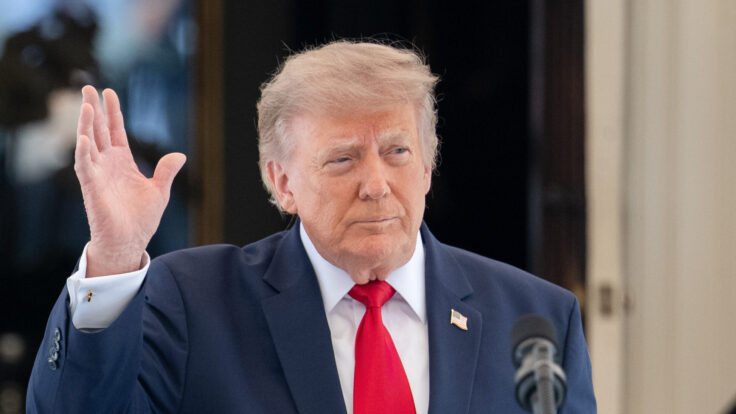
vu: Donald Trump commemorated July Fourth by warning of a “communist” uprising, citing the primary victories by democratic socialist candidates. For Democrats, the attack brought back painful memories from 2018, when the party tried unsuccessfully to brush off Republican warnings of a socialist takeover—a narrative reinforced by the party’s leftward drift following the Blue Wave. Now, many Democrats fear that history is repeating itself. “We feel like we’re yelling into the
wind,” Matt Bennett, the executive vice president for public affairs at the centrist think tank Third Way, told me. “Democrats are not doing a good job of pushing back. It’s been a huge failure on the part of everybody in the party.”Several strategists suggested that the D.S.A. wins aren’t necessarily a prevailing trend. Will Marshall, president of the center-left Progressive Policy Institute, argued that midterms “disproportionately empower activists
and ideologues in both parties”—a dynamic magnified under Trump. But he also noted that the growing divide between the largely white coalition backing D.S.A. candidates on one hand and both Hispanic and Black voters, who continue to support less-polarizing Democrats, on the other could shape different outcomes in 2028.
Moreover, weak state Republican parties in blue states such as Colorado and New York often encourage intraparty battles in which Democratic incumbents absorb voter
frustration. In Colorado last month, many lifelong Democrats embraced D.S.A. candidate Melat Kiros because they believed Washington’s status quo had failed them, strategists told me. They directed their frustration at 30-year incumbent Rep. Diana DeGette, a Denver Democrat who had supported Medicare for All and the Green New Deal.
At the same time, many Dems are exasperated that party leaders have done little to distance the party from self-described
commies like Darializa Avila Chevalier. And, Bennett argued, the party can’t simply delay the infighting until it picks a presidential nominee in a couple years: “I would like [Hill leaders] to speak up and say, Listen, we’re a very big tent, but just to be clear, this is not where mainstream Democrats are going.”
|
|
|
|
Now, a word from the American voter…
|
|
|
|
Exclusive focus group data suggests that Americans across the political spectrum
have soured on Trump’s second term—with inflation, Iran, and political dysfunction eclipsing the postelection optimism that once buoyed his supporters.
|
|
|
|
This past weekend, the raucous and jubilant celebrations for the country’s 250th
anniversary belied a national mood that is undeniably… bleak. Between sluggish job growth, persistent inflation, elevated gas prices, a record-setting wealth gap, an aimless conflict with Iran, and a president who’s enriched himself and his family to the tune of several billion dollars over the past 17 months, unease seems to be the prevailing emotion within the American psyche.
The mood in D.C. is equally sour. Democrats are scrambling as primary voters reject
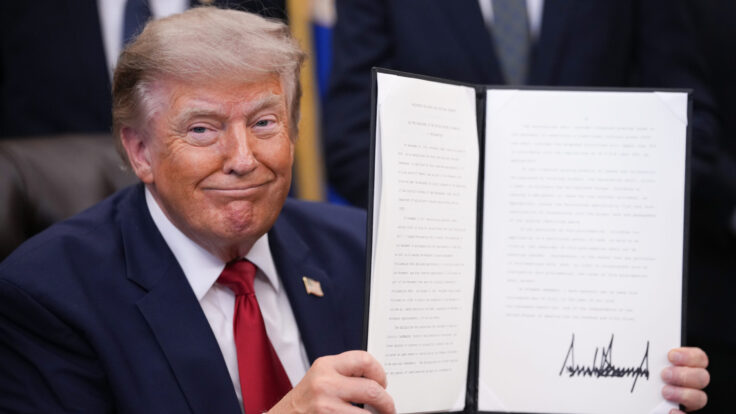
incumbents who represent the party’s old guard, while Republicans who stray from Donald Trump are shunned and voted out. Over the weekend, in a pair of campaign-style speeches at Mount Rushmore and the National Mall, the president used his bully pulpit for political fearmongering, warning of a communist threat posed by “enemies within.” And, in a surreal coda, he even called FIFA president Gianni Infantino to dispute Folarin Balogun’s
game-suspending red card—a move that overshadowed one of the few genuinely unifying stories of the summer: Team USA’s unexpected and inspiring World Cup run.
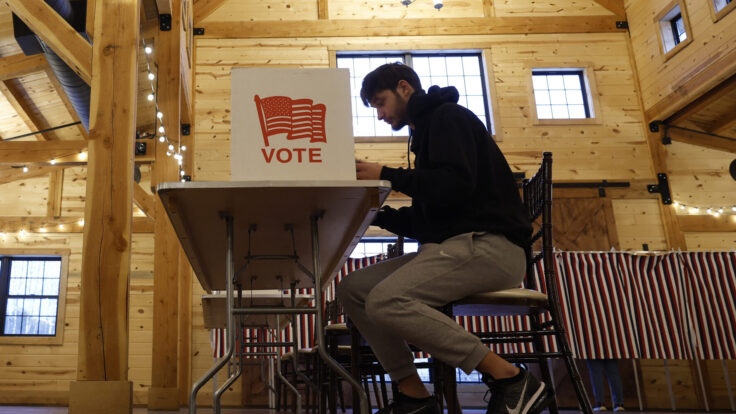
Amid that dizzying backdrop is an increasingly angry and disillusioned electorate, according to exclusive survey data provided to Puck by Center Forward, a bipartisan solutions focused organization, and conducted by Breakthrough Campaigns and GS Strategy Group. Before the 2024 election, the firms began tracking a group of 36 voters who reflect a range of genders, races, geographic regions, and political affiliations. Indeed, in the survey’s most recent iteration, conducted between April 16 and 21, nearly every participant—including Trump supporters—expressed dissatisfaction with the country’s direction, using words such as “frustrated,” “anxious,” and “angry.” Not a single voter described feeling “happy” or “proud.” Even those who called
themselves “hopeful” explained that their optimism was based on an expectation that the political environment would change.
However, the survey’s most striking revelation was how dramatically attitudes have shifted against the president during his second term. At the beginning, his supporters were fired up: As recently as last September, many remained enthusiastic about the president’s executive orders, his closure of the southern border, and his general flurry of activity. Back then, one
white Southern woman over 65, a college graduate who voted for Trump, responded that she was “thrilled with common sense returning to the USA! Every day, Trump is doing something great to return this country to normal again.” A white Republican man under 45 said, “The country is in a better state than it was prior to Election Day.”
By this April, both had changed their tune. The woman said she was “really disappointed that our president isn’t focusing much on the domestic situation with
inflation and costs out of control.” Meanwhile, the younger man said, “I don’t agree with us going to war with Iran and protecting foreign interests. I’m also disappointed with the immigration enforcement and the targeting of working families, as opposed to aggressively targeting gang members and criminals.” These sentiments were reflected ubiquitously in the survey.
|
Of course, those changing attitudes track closely with public opinion. Last September, Trump
enjoyed a 45 percent approval rating, according to RealClearPolitics’ polling average. By November, days after the president demolished the East Wing to make room for his ballroom, his numbers started to backslide. Since then, he ordered a nighttime raid on Venezuelan President Nicolás Maduro, resisted releasing the
Epstein files, and launched a deeply unfocused war against Iran. ICE also killed two U.S. citizens. “I am horrified at how poorly Trump has been mishandling things,” said a white, college-educated female Trump voter under 45 who participated in the focus group. “The economy is terrible. Now there is a war going on. What a mess!”
To get a clearer picture of the frustration, I called Don Campbell, one of the survey participants. Campbell is a lifelong
Republican and three-time Trump voter who moved from California to Boise during Covid. He still supports the president, but he told me that his “biggest disappointment” has been Trump’s preoccupation with overseas conflicts. “I wish they would have concentrated on domestic issues,” he said.
And yet, while Trump has largely failed to address voters’ domestic anxieties, he is proving more adept at channeling their angst toward the familiar boogeyman of communism. After two
democratic socialist candidates won congressional primaries in New York and another prevailed in Colorado, he seems to have found a new political foil, seizing on these victories as evidence of a budding ideological and existential threat. It’s a well-timed, perfectly pitched message to rally an increasingly disillusioned base ahead of a critical midterm election. “Every day, I turn on the news and I see just stuff getting crazier and crazier,” said Campbell, who watches Fox News daily. “And
with the new socialist movement, or communist movement, whatever you want to call it—I mean, I’m starting to become super fearful of that side.”
|
The survey also indicated that voters in both parties believe the country’s system of checks and
balances is buckling under strain. Participants said Trump has accumulated too much power as Congress has essentially become a feckless extension of the executive branch. But the nature of the respondents’ gripes diverged by party affiliation: Liberal voters generally declared the courts a necessary restraint on presidential authority, while conservatives expressed frustration that judges have blocked some of the president’s agenda.
The survey was also conducted before the Supreme Court’s
recent round of decisions, which expanded Trump’s authority over independent federal agencies while blocking his effort to overturn the 160-year-old interpretation of the 14th Amendment guaranteeing birthright citizenship. “The president is the strongest because in one pocket he has Congress, in another he has the D.O.J. and F.B.I., and in a third pocket he has the Supreme Court ruling granting him immunity,” said a white, college-educated Kamala Harris voter
between the ages of 45 and 64.
A white, college-educated Trump voter under 45 identified the executive branch as “the most powerful” arm of government, pointing to Trump’s decision to launch the war with Iran without seeking congressional approval. A college-educated Latino who voted for Trump but described himself as independent said, “[The system of checks and balances] is not working too well today. We have given way too much power to the executive branch over the years. … We keep on
allowing the executive branch to overreach their powers and creating bad precedents that future presidents could use.”
Despite their various frustrations and concerns, some voters have not entirely abandoned hope. When optimism did appear in the survey, it rested on a belief that Americans can find ways to once again engage with one another. “We need to be more involved with our own communities, learning to step up and actually care for one another,” said a white male voter who
was undecided when the firms spoke to him before the 2024 elections. “It’s easy to disassociate when we sit behind a cellphone or a TV screen all day and not know your neighbors anymore.”
For his part, Campbell told me his greatest concern was not inflation, immigration, or even foreign policy—it was political violence. “I'm starting to see more and more rage from both sides,” he said. “I’m worried something’s going to escalate.” He told me remorsefully that he’s grown more distant from friends in California
whose politics differ from his own. “We’ve got to figure out how to get back to talking to each other. We’ve got to stop hating each other for having differences of opinions, right?” he said. “ Agree to disagree—that needs to be the slogan going forward.”
|
|
|
|
Join Emmy Award-winning journalist Peter Hamby, along with the team of expert journalists at Puck, as they let you in
on the conversations insiders are having across the four corners of power in America: Wall Street, Washington, Silicon Valley, and Hollywood. Presented in partnership with Audacy, new episodes publish daily, Monday through Friday.
|
|
|
|
Ace media reporter Dylan Byers brings readers into the C-suite as he chronicles the biggest stories in the industry:
the future of cable news in the streaming era, the transformation of legacy publishers, the tech giants remaking the market, and all the egos involved. Also featuring a weekly dispatch from Puck’s crack streaming/media analyst, Julia Alexander.
|
|
|
|
Need help? Review our FAQ page or contact us for assistance. For brand partnerships, email ads@puck.news.
You received this email because you
signed up to receive emails from Puck, or as part of your Puck account associated with {{customer.email}}. To stop receiving this newsletter and/or manage all your email preferences, click here.
|
Puck is published by Heat Media LLC. 107 Greenwich St., New York, NY 10006
|
|
|
|
|