Welcome back to What I’m Hearing, coming from my secret summer getaway house far from D.C., so I
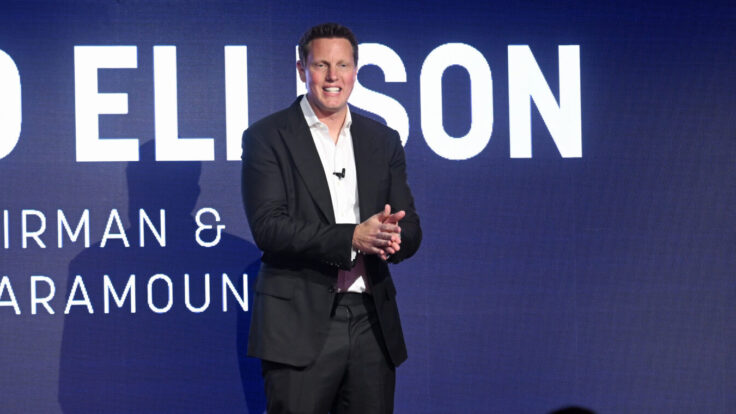
was sadly unable to make last night’s big Trump birthday spectacle. I’m sure when David Ellison decided to go after Paramount, he dreamed of someday sitting ringside next to his wife on the White House lawn as his streaming service aired a UFC fighter screaming “Michelle Obama is a man!” Congrats, America.
Tonight, a look at the best box office battle of the summer—best, because there will likely be no loser. Plus, my thoughts on Fox’s $22 billion ticket
to the streaming wars, and much more.
Programming note: This week on The Town, Lucas Shaw and I parsed the winners and losers in Fox’s Roku deal, professor Mynette Louie walked
me through the revenue waterfall on an indie hit like Obsession, and pollster Kevin Goetz explained what Gen Z wants from movie theaters. Plus a bonus episode! My full intestinal
meltdown with Hot Ones host Sean Evans at the YouTube FYC event. Subscribe here and
here.
Not a Puck member yet? Just click here. Got a news tip or an idea for me? Just reply to this email, text me, or message me on Signal at 310-804-3198.
Discussed in this issue: Ted Sarandos, Spike Lee,
Seth Rogen, Matt Stieb, Jordan Lonner, Jason Blum, Curry Barker, Chris Meledandri, Bo Burnham, Aaron Sorkin, Brian Roberts, Taylor Swift, Steven Spielberg, Mark Zuckerberg, Andrew Stanton, Mike Cavanagh, Lorne Michaels, John Fogerty,
Jesse Eisenberg, and… the real Ferris Bueller.
But first… |
Who Won the Week: Anthony Wood and Charlie Collier
|
The Roku founder and his media head brought the streaming device maker/ad platform back from a post-pandemic
stock slide, paving a path to 100 million users and today’s massive $22 billion deal to be acquired by Fox.
A little more on this…
I guess we all have to cut the jokes about the Murdochs cosplaying as media moguls while mostly selling adult diapers and reverse mortgages to elderly Fox News fans. They’re still doing that, and $14.6 billion in cash and the rest in stock for Roku is a lot to pay for the privilege of joining the streaming ad wars
against the likes of YouTube and Amazon.
But combining Roku’s huge user base with Tubi’s own 100 million monthly active streaming users and the NFL-sized audience on the Fox linear platform instantly transforms the company into the third-largest distributor in U.S. connected television by share of viewing, per Nielsen. The deal means Fox will control around 14 percent of all ad spend on U.S. television, per a Madison and Wall analysis. And it will offer a far larger
platform to existing and future Fox programming. If this deal closes next year, the Murdochs will elevate themselves from largely a content provider to a gatekeeper in an age where those gatekeepers make the rules. Not bad for a company many wrote off after Rupert sold most of it to Disney in 2019.
Still, the Fox stock dropped 15 percent on the news this morning, largely due to how expensive and potentially dilutive the deal is for the company. The Fox debtload
could double, per Bloomberg Intelligence; smart TVs increasingly bypass Roku entirely; and, as Martin Peers pointed out, the streaming ad market is relatively small and crowded, with basically every platform pivoting to ads to spark growth in a maturing landscape. Against that backdrop, it’s unclear how much Fox
will be able to grow the Roku business. Plus, while Roku can give prime promotion in the coveted Roku City to Fox’s “premium” programming (scare quotes intended) like Nation’s Dumbest and The Quiz With Balls, that promo would come with a cost in dollars and to its “Switzerland” status as a neutral platform.
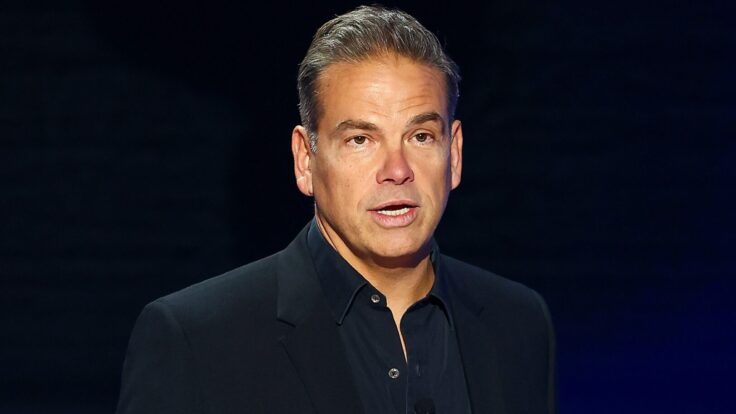
But for Lachlan Murdoch, the deal represents a loud escalation of his ambition for a modern digital-first media company. Fox was an also-ran,
counting down the days until cord-cutting came for Fox News and the NFL became prohibitively expensive. Fox-Roku (Rox? Foku?) may not ultimately work, but it’s the kind of bold, risky, transformative deal via which his father built an empire.
Related: Where you at, Comcast? Roku seems like the perfect upgrade for a stagnant connectivity company with a dwindling linear TV distribution business and a streaming service, Peacock, that could use a major boost. Yet two sources say
co-C.E.O.s Brian Roberts and Mike Cavanagh didn’t formally bid. There’s gotta be something else afoot, guys, right? Right? |
“I got two. I would trade the honorary one and keep the one for screenwriting for BlacKkKlansman.
Trade that in a second.”
—Spike Lee, when asked by CNN which Oscar he’d trade for a Knicks championship two days before they won it.
Runner-up: “I had a plan, and that plan was I outlived all those sons of bitches!”
—John Fogerty, revealing in his Songwriters Hall of Fame speech how he got ownership of his music
catalog.
Second runner-up: “He doesn’t like kids coming up to him in airports with business cards that say ‘I’m C.E.O., bitch’ for him to sign.”
—Aaron Sorkin, explaining to Vanity Fair why Jesse Eisenberg refused to return as Zuckerberg in The Social
Reckoning.
Honorable mention: “I remember [Lorne Michaels] taking me aside, because he was clearly hearing it. He said, ‘What makes you and Norm so certain that O.J. is guilty?’ And I just went, ‘Lorne, come f---ing on.’”
—Jim Downey, the former SNL head writer, telling People about the mid-’90s pressure from then-NBC head Don Ohlmeyer over the relentless O.J. jokes that eventually got Norm
Macdonald fired. |
Nearly 16 million
U.S. viewers who tuned into the English-language broadcast of Team
U.S.A.’s World Cup opener against Paraguay, up 106 percent from America’s first match, against Wales, in 2022. [Fox Sports]
$60 billion
Expected wagers on the World Cup through legal sportsbooks. [Puck/MoffettNathanson]
500
million
Subscribers to MrBeast on YouTube, the first individual account to reach this milestone. [YouTube] |
|
|
|
A MESSAGE FROM OUR SPONSOR |
STRANGER THINGS: The Final Season, |
|
|
|
400 million
Estimated subscribers to Netflix by 2031. (Netflix reported 325 million subs
at the end of 2025.) [Omdia/MPN]
Now here’s Scott on Toy Story vs. Minions… |
|
|
|
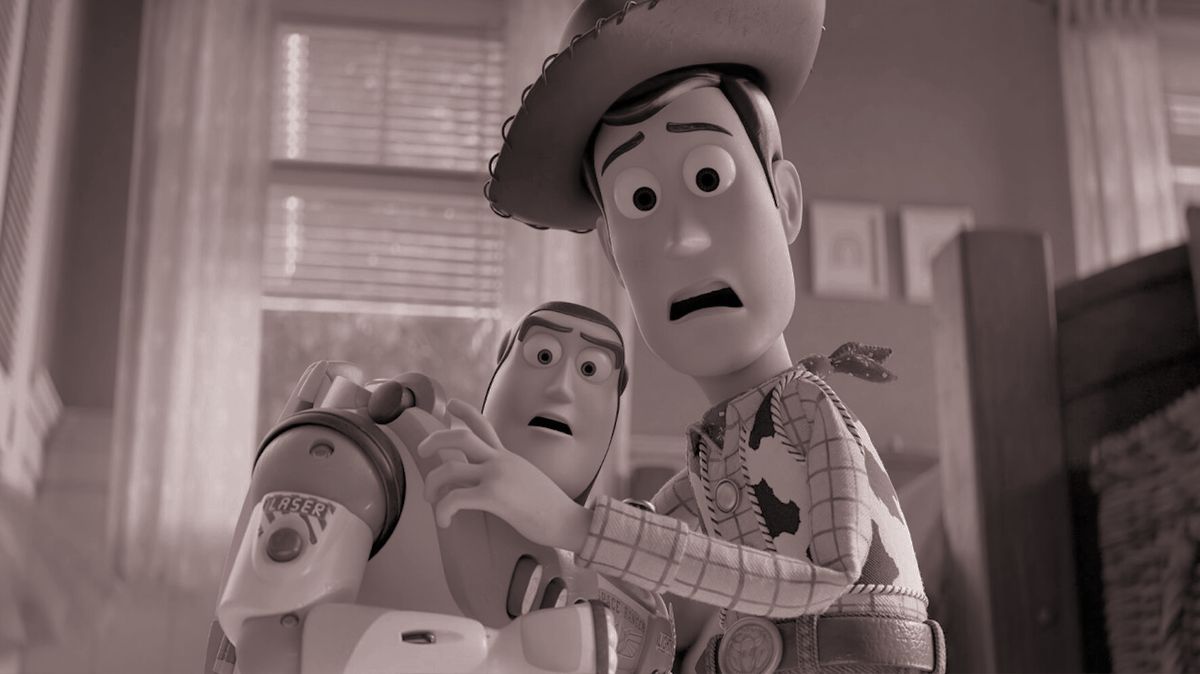
The marquee Pixar and Illumination franchises are up against each other this summer, but a
look at previous face-offs suggests that a rising tide lifts all boats. |
|
|
|
After weeks of chatter that YouTube zoomers might be remaking Old Hollywood, we’re on the cusp of a
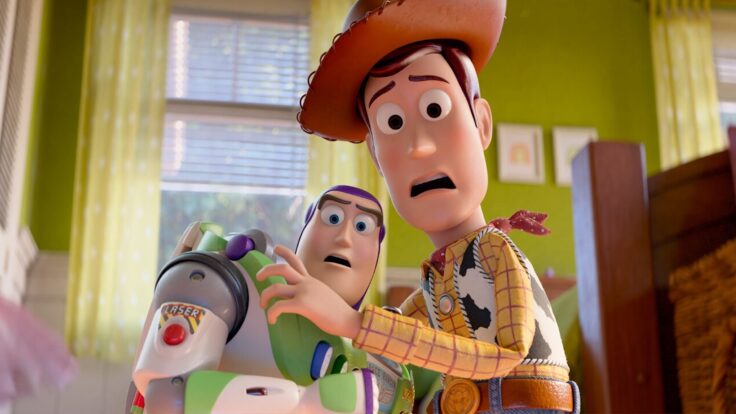
mid-summer set to be dominated by familiar I.P., including Supergirl, Jackass, Evil Dead, Moana, and new installments from the two most successful animated franchises of the past few decades: Toy Story and Despicable Me. Pixar’s Toy Story 5, tracking for a ~$160 million domestic debut, opens Friday, followed on July 1 by Illumination’s Minions & Monsters, which is headed for roughly $100 million over its Wednesday–Sunday
opening frame.
While this will be only the third summer in which a Toy Story and Despicable Me have debuted within weeks of each other, it will be far from the first time that an Illumination biggie has opened alongside a Disney or Pixar rival. In the vast majority of cases, both studios won. Mortal Kombat II and The Mandalorian and Grogu can attest that this has not been a hospitable year for wellworn movie brands, but a number of data points—from
reliably steady box office metrics to past head-to-head performance—suggest that Pixar and Illumination will buck the trend.
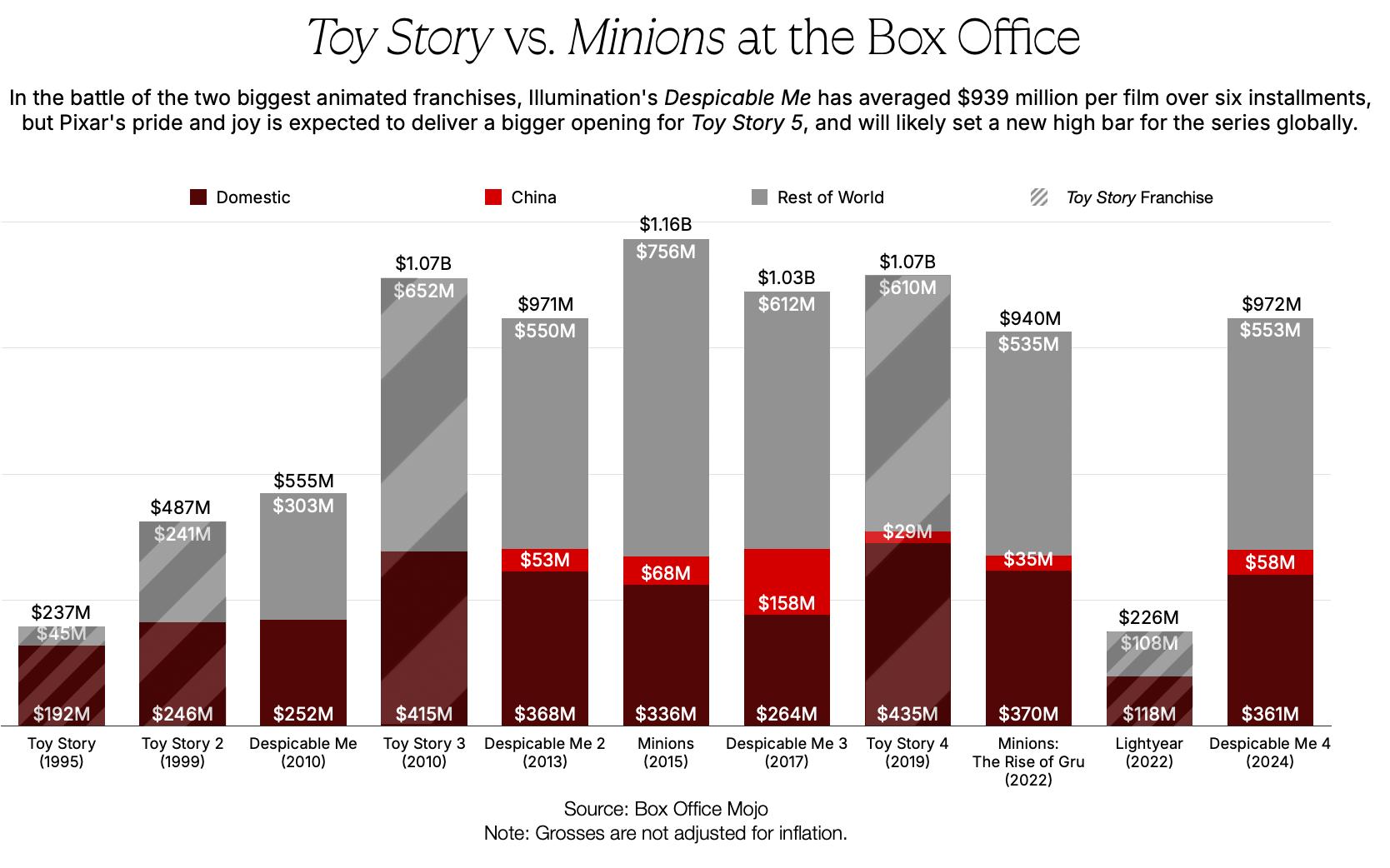
The original Toy Story grossed $191 million in North America to become the largest domestic earner of 1995, even if its $237 million global cume (on a $30 million budget) paled in comparison to the $350 million-plus totals for Die Hard: With a Vengeance and GoldenEye that year. Toy Story 2 opened four Thanksgivings later and
earned $246 million domestically and $436 million globally.
But in truth, our story here begins 10 and a half years later. In June 2010, Pixar’s first summertime sequel—reuniting Tom Hanks and Tim Allen with Toy Story 2 breakout Joan Cusack—opened just weeks before Universal’s original Despicable Me. Both films were monumental successes. Toy Story 3 grossed $415 million domestic and became just the
seventh film ever to pass $1 billion globally. Despicable Me, which landed a key trailer spot on Toy Story 3, would make as much of a splash with barely half the global box office. The Steve Carell caper about an aging supervillain who adopts three young girls announced to the world that producer Chris Meledandri’s Illumination had arrived. It opened just after Independence Day with $55 million, then legged out to $251 million in North America
and $544 million worldwide.
Even while earning less globally than Shrek: Forever After ($756 million in May 2010), the upstart had stolen the pop culture buzz from the previous non-Pixar animated world beater. (Ironically, Shrek studio DreamWorks Animation was later acquired by Universal, which releases the Illumination movies. Next year, Universal will attempt to relaunch Shrek.) By the time Despicable Me 2 opened like a breakout sequel—$140 million in
its five-day launch over the 2013 July Fourth holiday weekend—the torch had been passed.
Indeed, both franchises have not been overprogrammed and enjoyed consistently stable returns. Toy Story 4’s box office cume was almost identical to its predecessor’s. Since Despicable Me 2, we’ve had two more sequels and two Minions spinoffs, all of which have opened on or very near the extended July Fourth weekend. Even amid changes in the moviegoing ecosystem,
including inflation and the vicissitudes of the Chinese market, the four follow-ups have been shockingly reliable earners. Each respective Minions movie and Despicable Me sequel has netted between $940 million (Minions: The Rise of Gru in 2022) and $1.16 billion worldwide (Minions in 2015). |
There is also little evidence that films from either franchise have cannibalized returns from their rival’s
other major animated releases. Minions didn’t stop Inside Out from notching $858 million worldwide in 2015 (a record for a Pixar original, not counting rereleases) any more than Finding Dory’s $1 billion gross prevented Illumination’s The Secret Life of Pets from earning $875 million worldwide in 2016. Ditto the summer of 2013, when Monsters University earned $752 million, opening just weeks before Despicable Me 2. They both
flourished.
Moana and Sing both opened in late 2016, with the Disney musical arriving over Thanksgiving and the Illumination jukebox ensemble debuting over Christmas. They essentially tied, earning $248 million and $271 million, respectively, in North America, and $635 million and $643 million worldwide.
Are there exceptions? Yes, but more often than not they were related to one studio releasing a film that was, shall we say, not great. The fact that Despicable
Me 3 earned $1 billion didn’t cause Cars 3 to fail to reach $400 million in summer 2017 any more than Toy Story 4’s $1 billion-plus run in summer 2019 led to Secret Life of Pets 2 barely cracking $425 million. Disney initially blamed the Toy Story prequel Lightyear’s miserable performance in June 2022 ($226 million worldwide) on kids not returning to theaters after Covid. Two weeks later, though, the TikTok-powered Rise of Gru approached
$1 billion globally. (I doubt that Pixar will try any more Toy Story spinoffs, and hopefully live-action is off the table as well…)
|
|
|
|
A MESSAGE FROM OUR SPONSOR |
"A Cross-Generational All-Timer." |
STRANGER THINGS: The Final Season, |
|
|
|
Yes, there are caveats, disclaimers and the like. From the start, Illumination’s films have cost between $75
million and $100 million, far less than Pixar’s and Disney Animation’s $150 million–$200 million offerings (at least in modern times). The past two Woody ’n’ Buzz team-ups have earned a combined $2.14 billion, for a per-movie average of $1.07 billion each. Meanwhile, just counting sequels and prequels, the five Illumination movies have earned a combined $5.077 billion worldwide, for a per-movie average of $1.015 billion. However, considering that the latest run of Disney animated sequels (Inside
Out 2, Moana 2, Zootopia 2) is currently averaging $1.5 billion a pop, I’m pretty sure that Toy Story 5 will come out ahead of Minions & Monsters. |
Both films will have at least the opening weekend benefit of Imax auditoriums and, to varying degrees, other
P.L.F. screens. (Angel Studios would love to have some of those for Young Washington over America’s 250th birthday.) This time out, Toy Story 5 might get a modest boost from teaming with Taylor Swift for an original tune, “I Knew It, I Knew You,” which brought the house down at the film’s L.A. premiere. But the Jessie-centric song, a momentary return to Swift’s country music-for-tweens roots, is nowhere near as much of a heartbreaker as Sarah McLachlan’s “When She Loved Me” from Toy Story 2.
This time around, both Pixar and Illumination made many considered choices. The decision to position Jessie as its protagonist differentiates Toy Story 5 from previous Woody-focused installments. Minions & Monsters is selling itself as an ode to silent Hollywood, set in the ’20s—a decision that might not have the kids frothing with anticipation, perhaps, but also one that cleverly separates it from the
rest of the Despicable series. Crucially, this fifth Toy Story is helmed by Andrew Stanton, who previously directed Finding Nemo and Wall-E, while this third Minions flick sees Pierre Coffin serving as the solo director after co-helming the first three Despicable Me movies and the first Minions. Both directorial choices at least suggest the studios are not phoning it in or banking solely on the
I.P.
The nearly universal success of both franchises has also been partially about specificity, exclusivity, and marquee characters. Woody, Buzz, and Jessie are butts-in-seats movie stars on par with Zootopia’s Judy and Nick or Frozen’s Anna and Elsa. Mainly, both properties have maintained their theatrical status. If you want to see the Minions saving the world while trying to destroy it, or watch Woody or Jessie suffer another existential breakdown, Peacock
and Disney+ just won’t do.
They also benefit from generational ownership. The Despicable Me/Minions franchise is the definitive 2010s example of what’s possible with an original creation aimed at and claimed by young(er) moviegoers. Sure, the #GentleMinions, groups of teen moviegoers who showed up on the opening weekend for Minions:
The Rise of Gru wearing suits, were merely a drop in the film’s record $122 million Friday–Monday holiday launch bucket in July 2022. However, noting that the film skewed 89 percent under-25 that weekend, it was representative of an audience that had come of age with these ridiculous mischief-makers and was welcoming their delayed theatrical
return.
The Toy Story films, meanwhile, stretch back three decades. Credit to the consistent top-notch quality, the ease of playing catch-up (watching four approximately 90-minute comedies is easier than marathoning the MCU), and the once-a-decade release schedule. Each new Toy Story is the first for the current youngest demo or, for the second-youngest demo, the first to be seen in a theater. Regardless of which film earns more, history shows that both Toy Story
5 and Minions & Monsters will win at the summer box office. |
Obsession Credit GrabWatch: We’ve reached the point in the discourse where Curry
Barker’s agent is available to talk publicly about his own brilliance. [IndieWire]
No big deal, just the Justice Department approving the WarnerMount deal before its own staff attorneys could weigh in with concerns.
[WSJ]
The best part of a late-stage Spielberg movie is the pre-release articles about the heyday of Spielberg movies. [Vulture]
On
the 40th anniversary of Ferris Bueller’s Day Off, John Hughes’s high-school pal Ed McNally is claiming to be the “real Ferris.” [Chicago Tribune]
Tons of gems in Seth Rogen’s Times interview, but I’ll highlight the lesson he learned from the Scientology exposé Going Clear: Actors are
insanely, insanely insecure. [The Daily]
Matt Stieb figured out how to game RottenTomatoes to make money on prediction markets. [N.Y. Mag]
More: I won $73 taking the under on an 87 RT score for Disclosure Day (it came in at 81 percent), and I didn’t have to bribe any critics.
Teens love The Rookie. Huh. [Vulture]
More: Looking at the full TV season numbers, where Netflix had the
biggest non-sports show (Stranger Things) but only two others in the top 25 (Bridgerton and the limited series His & Hers), it’s easy to see why Ted Sarandos wanted to buy Warner Bros.
I didn’t know Warners almost merged with Paramount… in 1929. [The
Atlantic]
Taylor Swift unironically quoted Yellowstone in her Songwriters Hall of Fame speech. [Town & Country] |
Last week’s discussion of recent YouTube filmmaker hits drew pointed responses. Some
examples…
“Stop it with these comparisons to the ’70s. The difference is the studios were run by risk-taking mavericks who bet their careers on the artists they loved. Now after a few flukes we are about to see three to five years of YouTube slop dressed up as auteur cinema by executives who don’t understand what they’re doing and don’t even like movies in the first place.” —A producer
“Congrats to Jason Blum for reinventing cinema.” —An
agent
“You will love this. My boss has me ‘scouting YouTube’ even though I’m fairly sure he’s never actually been on YouTube.” —An assistant
“One thing that makes me laugh is these Gen Z geniuses thinking they discovered the business model of cheap horror. It’s always been the least risky model in theatrical, almost 100 years old: 1.0 is Universal monster movies, 2.0 is Samuel Z. Arkoff, 3.0 is Jason Blum, 4.0 is these YouTubers. The first clue was
July 2021, when Iconic released Bo Burnham’s Netflix special into theaters—after it was already on Netflix—as an event film for three days and it killed, about $1 million from only 600 screens.” —An investor |
Have a great week,
Matt
Maya Tribbitt contributed research for this issue.
Got
a question, comment, complaint, or questions for my Thursday mailbag edition? Email me at Matt@puck.news or call/text me at 310-804-3198. |
Need help? Contact us for assistance. For brand partnerships, email ads@puck.news. You received this email because you
signed up to receive emails from Puck, or as part of your Puck account associated with {{customer.email}}. To stop receiving this newsletter and/or manage all your email preferences, click here. |
Puck is published by Heat Media LLC. 107 Greenwich St., New York, NY 10006 |
|
|
|
|