{{ 'now' | timezone: 'America/New_York' | date: '%b %d, %Y' }} |
|
|
|
Welcome back to this special edition of What I’m Hearing, our final Wednesday
email of the season. Tonight, Julia Alexander is here with her breakdown of Fox’s $22 billion Roku deal, and how the creation of another streaming power will impact the entire landscape. Plus, an eye-opening chart on how dependent the non-Netflix streamers are on their library catalogues.
All yours, Julia… Discussed in this issue: Jordan Schwarzenberger, Neal
Mohan, Rupert Murdoch, Martin Scorsese, Lachlan Murdoch, Anjali Sud, Rich Greenfield, Keir Starmer, David Ellison, Taylor Sheridan, and more. |
|
|
|
A MESSAGE FROM OUR SPONSOR |
“A clever, sweet and charming comedy with an excellent cast.” |
“Delightful. Your New Comfort Show.” |
“Excellent. A love letter to journalism and the news.” |
|
|
|

| Julia Alexander
|
|
- YouTube’s “age gate”
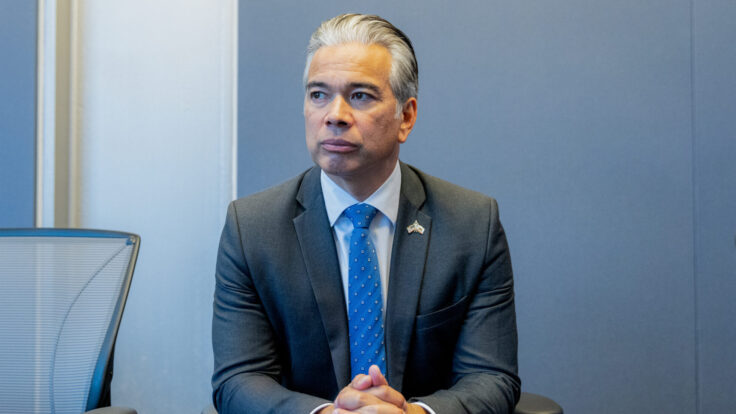
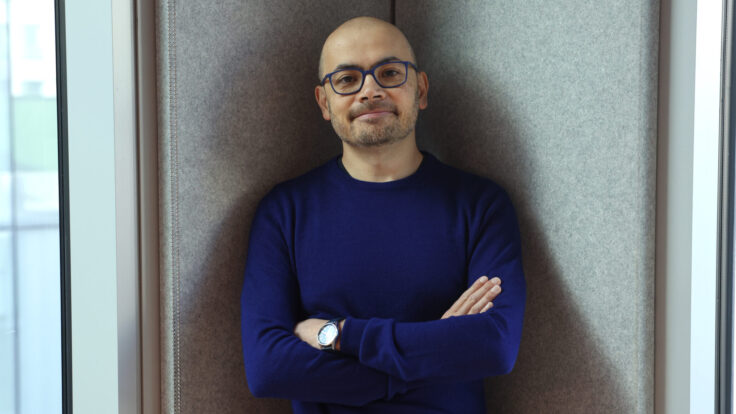
fight: Executives at social media companies were probably hitting the Maalox pretty hard this week after the U.K. became the latest country to ban their services for kids under 16. But perhaps no one has taken a keener interest in the growing regulatory trend than YouTube C.E.O. Neal Mohan.
His platform often gets lumped into these conversations—indeed, it was covered by the U.K.’s new law, though YouTube Kids was marked “safe”—despite the fact that it’s not
exactly a social media platform akin to Instagram and TikTok. Mohan’s team and creators on the platform have spent years trying to convince Hollywood and advertisers of exactly this point. Jordan Schwarzenberger, who co-founded the Arcade management agency, which reps many YouTubers, recently downplayed the social media moniker: “It’s an
intentionality platform based on play-listing and curation—a well-curated search engine and a tool of immense educational value for young people,” he told Deadline.
It’s also an advertising gold mine. More than half of U.K. audiences watch YouTube via their TV sets, per a Barb report released in February. (Barb is the U.K. equivalent of Nielsen.) In the U.S., just under 30 percent of all YouTube viewing comes from kids under 18, and this group can allocate up to nearly 22 percent
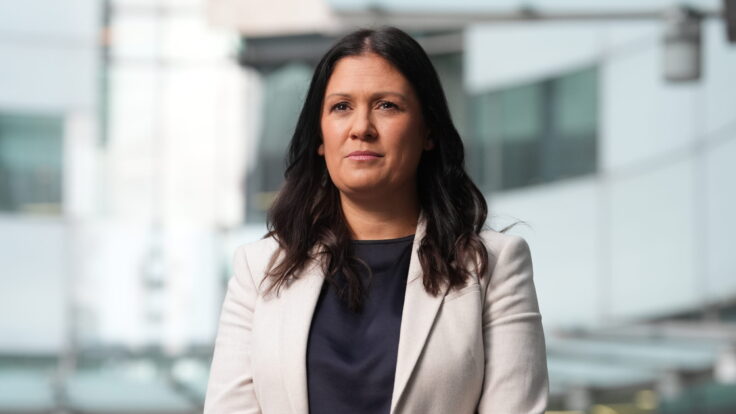
of their daily viewing to YouTube. No wonder creators and YouTube executives are trying to figure out how to continue reaching these audiences. Of course, it’s one thing to institute a ban and another to implement it. Good luck to Prime Minister Keir Starmer. - Disney+’s catalog needs and Netflix’s originals win: We’ve known for a while that classic TV shows and discount-bin movies keep people streaming long after they’ve binged
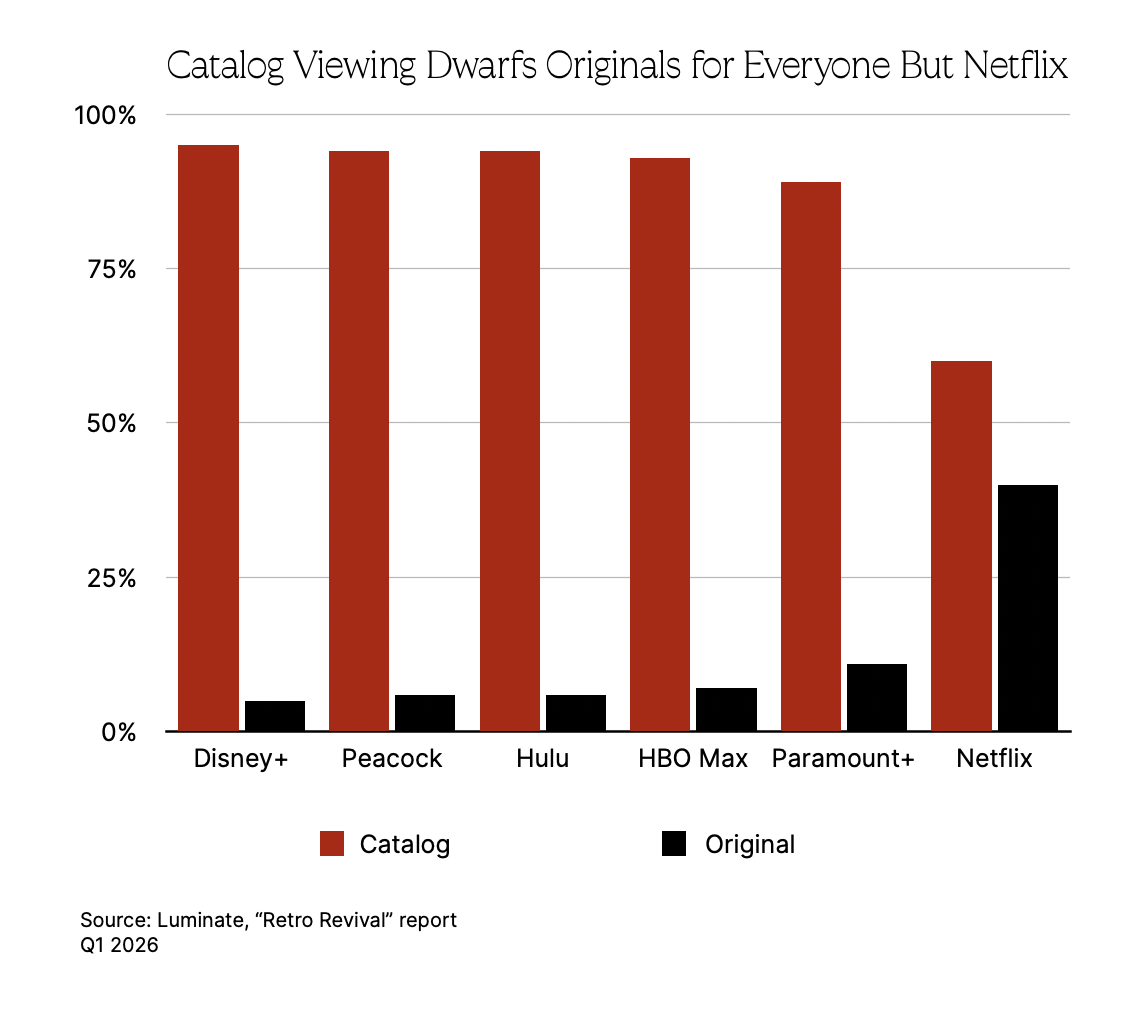
the latest season of House of the Dragon or Love Island. Tubi, Pluto, and the Roku Channel’s entire strategies are premised on amassing enough such titles to pull in—and retain—viewers. But it’s still striking to see just how important those catalogs are to the biggest S.V.O.D. players.
According to Luminate’s latest Retro Revival report, catalog consumption drove nearly all viewing across Disney+ and Hulu in Q1. Yes, these numbers are skewed by the fact that
Disney+ has struggled to produce a definitive hit over the past year, with critically acclaimed shows like Daredevil failing to make the Nielsen top 10. Hulu, on the other hand, has found success with unscripted fare (The Secret Lives of Mormon Wives) and scripted originals (Tell Me Lies), but those still aren’t producing the same level of engagement as The Simpsons, Family Guy, Law & Order, etcetera, which top Nielsen’s streaming charts each
week.
|
- The only
outlier is Netflix, where catalog titles account for only about 60 percent of viewing. This data point suggests that Netflix is less reliant on its catalog to keep engagement rates high and churn rates low—the two key metrics for success in streaming. But that also means that Netflix has less of a robust library to lean on if engagement with original titles starts to slow or, say, if there’s another strike that impacts the content supply chain. There’s an enormous cost that comes with constantly
refreshing the homepage with new shows and movies, but Netflix’s originals are working while many of its competitors’ are struggling. Maybe there’s an argument that the company should one day reconsider its eternal decision not to license its own I.P.?
Also notable here is the Paramount+ split: 89 percent catalog and 11 percent originals, good for (a distant) second place behind Netflix in terms of engagement with new series. All those Taylor Sheridan shows and Dexter
spinoffs are working better than I thought.
|
|
|
|
And now, we fire up the connected TV… |
|
|
|
Fox’s $22 billion acquisition will do more than just add a third streaming option to pair
with Tubi and Fox One. It would also give the Murdochs a foothold in the distribution business at the exact right moment. |
|
|
|
A few months ago, I asked media analyst Rich Greenfield why no one had bought Roku, the
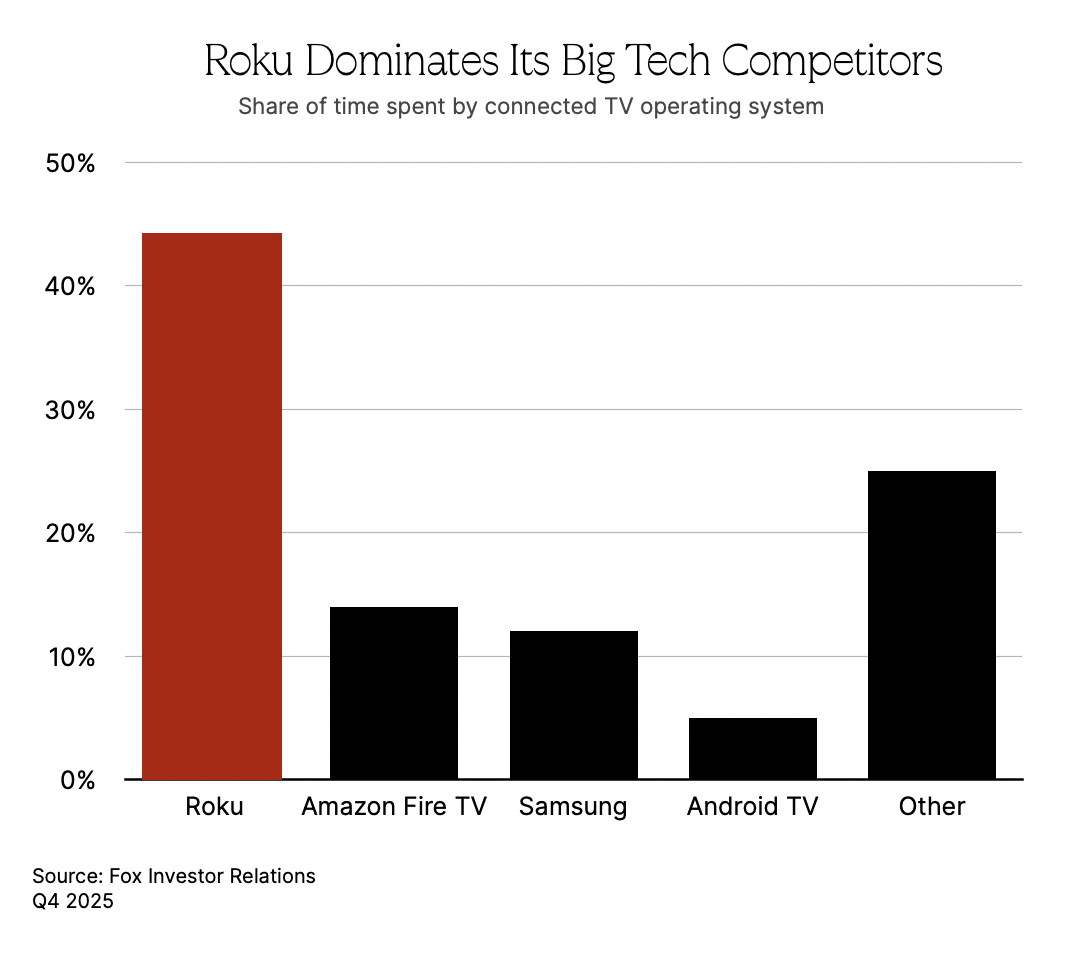
ubiquitous streaming-device maker whose operating system controls smart TVs in more than 100 million households globally—far ahead of competitors like Amazon and Apple. Rich was confounded, too. As of March, the Roku Channel accounted for 3 percent of all connected TV viewing in the U.S., according to Nielsen, ahead of both Paramount+ and HBO Max. It’s also now the fastest-growing platform behind YouTube, per Nielsen and Roku. More than 145 billion hours were streamed in 2025—the same
year Roku swung into profitability. I figured that made Roku a pretty good M&A target. |
|
|
|
A MESSAGE FROM OUR SPONSOR |
“A devilishly fun, deliciously camp and addictively thrilling reality competition series.” |
“Alan Cumming is worth the price of admission.” |
“The best running reality show on TV.” |
All episodes of THE TRAITORS are streaming now, only on Peacock. |
|
|
|
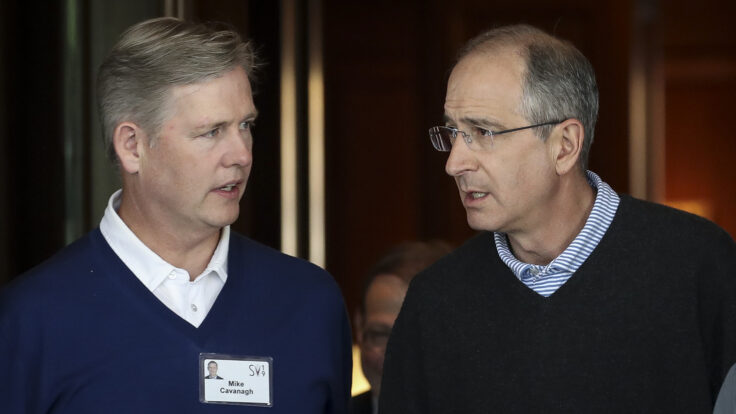
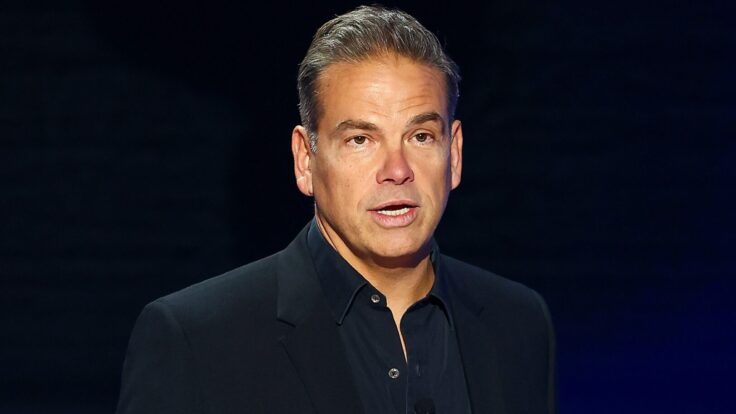
Little did we know that Lachlan Murdoch agreed. On Monday, Fox announced that it was buying
Roku in a deal valued at $22 billion, just a bit more than I had proposed it was worth. The younger Murdoch’s strategic patience was practically Rupert-esque: When everyone else was rushing into the streaming wars, investing tens of billions of dollars into technology and content, Fox stood pat. Of course, it helped that Disney agreed to pay $71 billion for Fox’s “non-core” assets in 2019, giving Lachlan and his dad plenty of breathing room to figure out their long game while
waiting to see how the streaming wars shook out for everyone else. (Neither Fox One nor Fox Nation is designed to compete with the largest general entertainment streamers.) It was only after the playing field became clear—a combined Paramount+ and HBO Max, a profitable but declining Disney, Peacock losing billions—that Lachlan made his move.
Roku should fit nicely inside Fox’s streaming portfolio, which has prioritized advertising revenue drawn from non-prestige content. In 2020, Fox
acquired Tubi, a free, ad-supported service that generates significant viewing share from cheaply licensed titles (and some originals) that hyper-target demographics not being served by premium S.V.O.D.s. (As Tubi C.E.O. Anjali Sud has said, “People want great storytelling, but they don’t want to pay.”) Then there’s Fox Nation, which also doesn’t have a strong library of originals—your mileage may vary on Martin Scorsese’s documentary series
about Catholic saints—but leans on its base of devoted Fox News fans. As Lachlan told analysts on a Monday call, “We chose, and continue to choose, focus over scale for scale’s sake, deliberately sidestepping the arms race that defined—and challenged—the subscription streaming industry.”
Roku is also more than a mere streamer. Similar to Amazon Prime Video Channels, which is one of the fastest-growing segments in Amazon’s video business, Roku is a distributor for other streaming
services, with a lot of advertising upside. In that way, it may be more appropriate to compare it to Comcast or Charter’s cable systems, in terms of its potential to serve as an entertainment hub. As consultancy Madison and Wall noted on Monday, Fox “would become an even bigger player in the U.S. advertising industry, with $9 billion of pro forma advertising revenue, or around 14 percent of all spending on U.S. television.” |
Now, with Roku in the portfolio, Fox may have its path into the business of distribution at the exact right
moment. Last month, Hub Entertainment Research found that nearly 50 percent of U.S. consumers believe that streamers are raising prices more frequently, up five percentage points from 2025. Meanwhile, 50 percent of consumers also “strongly agreed” that budget is the main factor in selecting their subscriptions, up nearly 10 percentage points. Not to mention that general “subscription fatigue” continues to trend up as people believe that it’s getting much more difficult to find programming.
Services like Roku, which bundle and distribute content and streaming apps inside one platform experience, purport to fix those problems. |
Theoretically, there should be plenty of synergies across Fox’s advertising business, which will now offer
far more scale and better targeting for its partners. As Wolfe Research analyst Peter Supino explained in a client note on Tuesday, “Fox can use Roku’s consumer data to add value to Tubi’s ad products, and Fox’s premium ad inventory and powerful ad sales capabilities can enhance Roku’s ad sales,” while also creating “opportunities to privilege Fox and Tubi programming on Roku to boost engagement and subscription.”
I would include in that analysis both Red Seat Ventures,
the podcasting company that Fox acquired last year, and Supercast, the podcast monetization platform it acquired in February. Although Fox isn’t necessarily competing with YouTube for those creators’ exclusivity, a discovery platform like Roku helps center all of the company’s video ambitions in one space. As podcasts and creators become more integrated with TV, there’s an opportunity for Fox to use Roku as a marketing platform for those creators, a distribution channel to drive audiences to
certain shows, and a vehicle to advertise along each part of the user’s journey. It’s unlikely that Fox is going to become any kind of giant in streaming, but after years on the sidelines, this may just be the move it needed to become a real force in the space while staying true to its strategy of monetizing eyeballs from inexpensive content, personalities, and sports. |
Thanks, Julia. I’ll be back tomorrow evening.
Matt |
|
|
|
Puck sports correspondent John Ourand and a rotating cast of industry insiders take you inside the executive suites and owners
boxes where the decisions that shape the entire sports business are made. You’ll hear interviews with players, network execs, and everyone in between. The Varsity is an extension of John’s private email for Puck by the same name. New episodes publish every Wednesday and Sunday. |
|
|
|
Ace media reporter Dylan Byers brings readers into the C-suite as he chronicles the biggest stories in the industry: the future
of cable news in the streaming era, the transformation of legacy publishers, the tech giants remaking the market, and all the egos involved. Also featuring a weekly dispatch from Puck’s crack streaming/media analyst, Julia Alexander. |
|
|
|
Need help? Review our
FAQ page or contact us for assistance. For brand partnerships, email ads@puck.news.
You received this email because you signed up to receive emails from Puck, or as part of your Puck account associated with {{customer.email}}. To stop receiving this newsletter and/or manage all your email preferences, click here. |
Puck is published by Heat Media LLC. 107 Greenwich St., New York, NY 10006 |
|
|
|
|