 |
 |
| Welcome back to What I’m Hearing, anxiously awaiting the end of this tropical storm/earthquake hellscape, and for Ronan Farrow’s opus on Elon Musk to drop tomorrow.
Programming note: This week on The Town: Lucas Shaw and I debated the best path for ESPN, and profit participation expert John Mass explained how Mission: Impossible 7 will make money. Subscribe here and here, and tomorrow we’re making predictions for the “September surprise” in Hollywood, so email me if you’ve got good guesses.
Was this email forwarded to you? Click here to become a Puck member.
Discussed in this issue: Carol Lombardini, Ron Meyer, Bela Bajaria, John Powers Middleton, Barry Diller, Tiffany Haddish, Burke Magnus, Kim Harris, Michael Lewis, Jason Sudeikis, Bryan Freedman, Bradley Cooper’s nose, and… Jadon the intern.
But first… |
| Who Won the Week: Rachel Maddow |
|
| Trump Indictment IV happened to drop on a Monday night, which is when Maddow appears on MSNBC, giving her chat with Hillary Clinton nearly 4 million viewers and the most-watched show in all of television that night.
Dishonorable mention: Tiffany Haddish, who with Haunted Mansion and this weekend’s Back on the Strip and Landscape with Invisible Hand, managed to appear in three major theatrical bombs in one month.
Speaking of Landscape with Invisible Hand (actual title): The Plan B/Annapurna production opened to just $93,000 on 304 theaters ($305 per theater!) and cost nearly $30 million, I’m told—another gleaming turd that MGM’s previous regime left for the Amazon folks.
Speaking of turds: All four of summer’s R-rated comedies have now dropped, so let’s check in on their domestic openings (spoiler: yikes):
No Hard Feelings: $15 million
The Blackening: $6 million
Joy Ride: $5.8 million
Strays: $8.3 million
Quiz: No disrespect to The Marvels or Wish, but as summer wraps, it’s a good time to ask: Besides 2020, what was the last year Disney didn’t release the No. 1 or No. 2 movie? (Answer: 2011, thanks to Harry Potter 8 and Transformers 3). |
| Strike Update: Curb Your Enthusiasm |
|
| The rumor of a WGA deal that went around on Friday turned out to be false, but at some point—hopefully soon—it will be real. I talked to one TV producer whose studio told him last week to begin preparing so he can go into pre-production on his finished scripts when a deal happens. That suggests the C.E.O.s are finally engaged.
But let’s be realistic: The WGA has dozens of open issues with the studios, and SAG-AFTRA’s interim agreement, which lays out its demands, runs to 70 pages. Negotiating deals with these unions is going to be a matter of weeks, not days. And after terms are reached comes a vote of each guild’s board, preparation of ballot materials, and then a roughly three week voting process before formal ratification. It’s unlikely that writers or actors will be permitted back to work, or even to promotional duties, until a deal is actually ratified by the membership.
And after that, many productions will face a scheduling nightmare as they compete to secure showrunners, directors, stars, locations, soundstages and crew. Throw in the fall holidays and the likelihood is that even under the most optimistic assumptions, a lot of production won’t resume until January. —Jonathan Handel |
|
|
| “Everybody should be mad at the Hollywood studio system. Michael Oher should join the writers strike. It’s outrageous how Hollywood accounting works, but the money is not in the Tuohys’ pockets.”
—Michael Lewis, attempting to explain to The Washington Post that no one involved in The Blind Side book benefitted from the $309 million-grossing movie, even as the Tuohys made millions as motivational speakers thanks to Lewis’s adoption story that Oher now says is false. Eriq Gardner will have more on the Blind Side battle in tomorrow’s Rainmaker. Sign up here. |
| Bryan Freedman Targets Reality TV NDAs |
|
| Some quiet movement this week in the battle over working conditions for reality TV performers. Litigator Bryan Freedman, who’s been waging war for possible unionization on behalf of Bethenny Frankel and other Bravo stars, sent two nasty letters to NBCUniversal general counsel Kim Harris demanding that employees of the company and its outside producers “are released from any contractual provisions that interfere with their ability to freely disclose unlawful conduct in the workplace.”
Freedman means NDAs, which are typically used in reality TV to prevent leaks of spoilers, but which also can be wielded “like a sword” (his words) to keep quiet unsafe or oppressive conditions. “This culture of fear and silence is no doubt responsible, in part, for the disproportionate rate of suicide among reality TV participants,” Freedman writes in a scathing letter sent today.
Would NBCU release its reality stars from NDAs? A rep declined to comment when I asked, but back in 2019, amid the Matt Lauer scandal and the #MeToo reckoning at NBC News, the company here employees to break NDAs if they believed they experienced sexual harassment. It’s a little different here because many NBCU reality stars are actually contracted with third-party producers, but… producers are made to comply with NBCU policies, and NBCU entities are often named in the production company agreements. It’s all bluster until Freedman actually sues, but he’s threatening a class action or multi-plaintiff lawsuit for injunctive relief, so let’s see how NBCU responds..
Now for a concerning update on Puck’s Official Streaming Service Hierarchy… |
 |
| Streamers Are Turning Off Their Customers |
| Puck’s second original research study reveals consumers are souring on their streaming services, from Apple’s ‘Ted Lasso’ familiarity deficit to the HBO Max/Discovery+ divide and more. |
|
|
|
| Remember the good old days, back in… January? A.I. was barely a twinkle in the Writers Guild’s eye. Avatar 2 hadn’t yet caused its financier to sue Disney for allegedly stealing profits. And this very publication debuted its first original research study: The Official Streaming Service Hierarchy. I had a humble goal: Beyond subscribers and churn rates and ARPU, I wanted to determine brand attachment—how people actually feel about each service.
That meant enlisting The Quorum and its pollsters to interview 2,500 streaming customers, and calculating each streamer’s Net Promoter Score—i.e., asking people to rank their impression of a brand from 1-10 to determine how likely people are to evangelize about it. We also determined scores on metrics, like “trust” and “quality,” for both subscribers and those who were merely familiar with the brands. (We excluded those who weren’t familiar.) You can click here and here to read the January results, but here’s a quick summary: |
|
A MESSAGE FROM OUR SPONSOR |
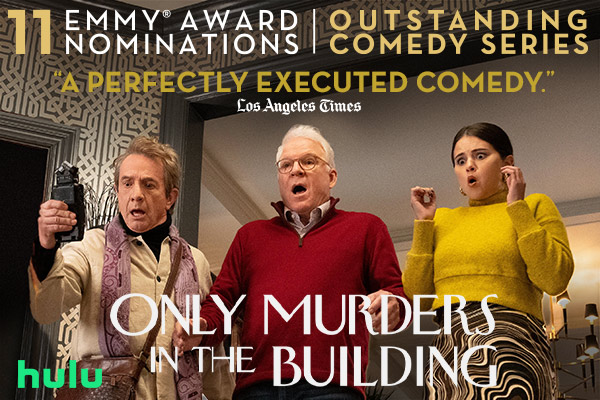 |
| Hulu’s “Only Murders in the Building” starring Steve Martin, Martin Short and Selena Gomez is nominated for 11 Emmy Awards, including Outstanding Comedy Series. Hailed as “TV’s perfect comedy” by The Los Angeles Times, the series follows a hilarious ensemble of neighbors, including Emmy-nominee Nathan Lane, who come together to solve - or commit - murder. “Only Murders in the Building” is for your Emmy consideration for Outstanding Comedy Series, Outstanding Lead Actor in a Comedy Series for Martin Short, and all other eligible categories. Visit FYC.HULU.COM for more information. |
|
|
1. Netflix—No. 1 in every “attachment” metric, but the company’s N.P.S. score of 49 among subscribers (the highest in the study, but well below ballast-like brands such as Starbucks or Costco) was concerning.
2. Disney+—Familiarity was high, and “quality” and “trust” scores were near the top. Subscribers skewed younger and more male.
3. HBO Max—Scored very high in “quality,” “trust,” and “admiration” metrics, and it scored second in N.P.S., behind only Netflix. Interestingly, Discovery+ scored at or near the bottom in those metrics, setting up a potential clash when they were merged as Max in May.
4. Amazon Prime Video—A middle-of-the-road brand, per its N.P.S. score (33 among subscribers). Its viewership was relatively evenly distributed across demos and income levels.
5. Hulu—Despite a high score in “familiarity,” it scored in the middle of the pack for all the attachment metrics. This was a surprise for me, an avid Hulu viewer.
6. Peacock—It scored on the low end in everything, including N.P.S. But Peacock is strong with older women and lower-income subscribers.
7. Paramount+—It scored last in “admiration” among subscribers, and performed poorly in “trust.” But shows like 1923 had a high rate in the “recall” polling, meaning people knew they were on Par+. Audience skewed female.
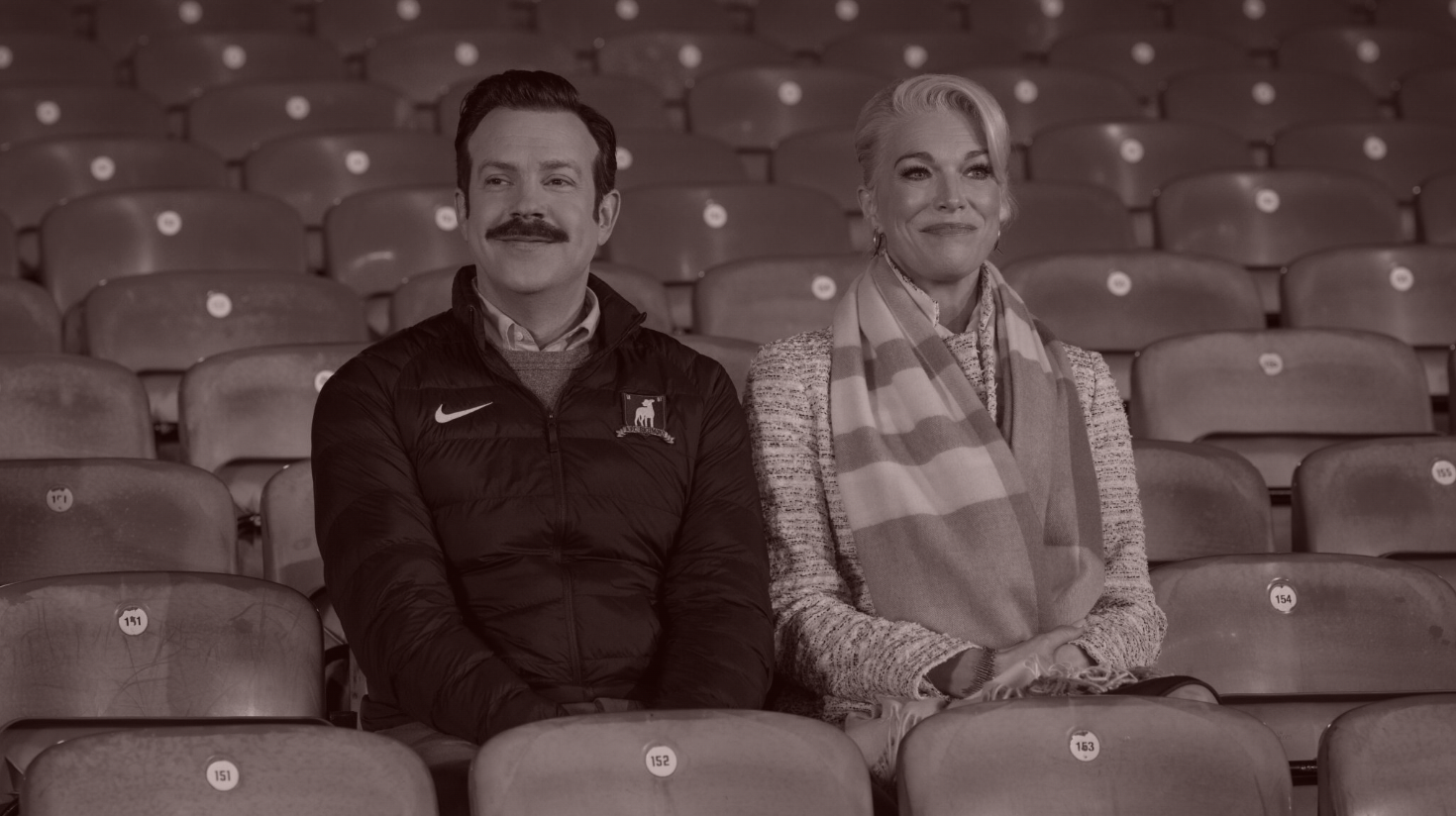
8. Apple TV+—Lowest in “familiarity” and the attachment metrics, but it over-indexed among affluent people. Only 20 percent of its own subscribers knew Ted Lasso was on Apple TV+. Kinda amazing.
That was then… now, six months later, we sent Quorum researchers to do another survey of 2,000 people, evenly split between men and women over and under 35, and some interesting takeaways emerged:
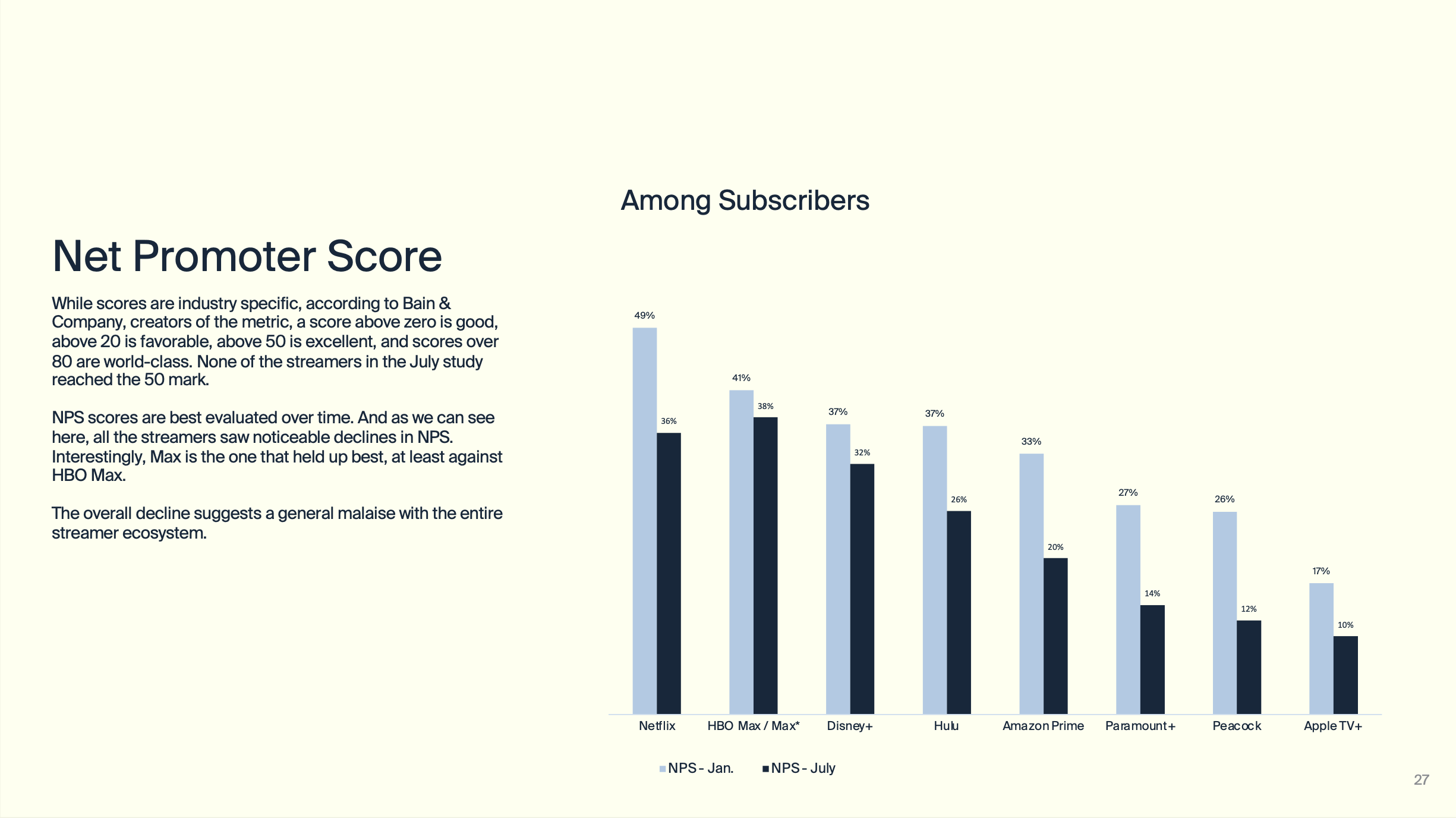
- Disappointment in the Category: All the streamers saw sizable decreases in Net Promoter Scores. That suggests a significant decline in goodwill towards streamers as a category.
The question is why? Recent price increases? Password-sharing crackdowns? Pulling shows without notice? Markedly worse content? Maybe all of the above. Most streamers saw a drop of more than ten points from January to July. Even Apple TV+ fell seven points despite the return of its biggest hit, Ted Lasso. Disney+ slipped five points despite the fact that the Disney brand is in the name. “This study shows that consumers are already feeling the effect of shrinking libraries,” lead researcher David Herrin told me today. “Among the 2,000 people surveyed, 45 percent have said they have noticed the removal of some programs and they don’t like it.”
At the same time, notably, the service that held best was Max, which was down only three points from the HBO Max number in January, and which has pulled several shows from its roster and licensed a few HBO series to Netflix. Here’s the full chart showing the drops:
|
|
|
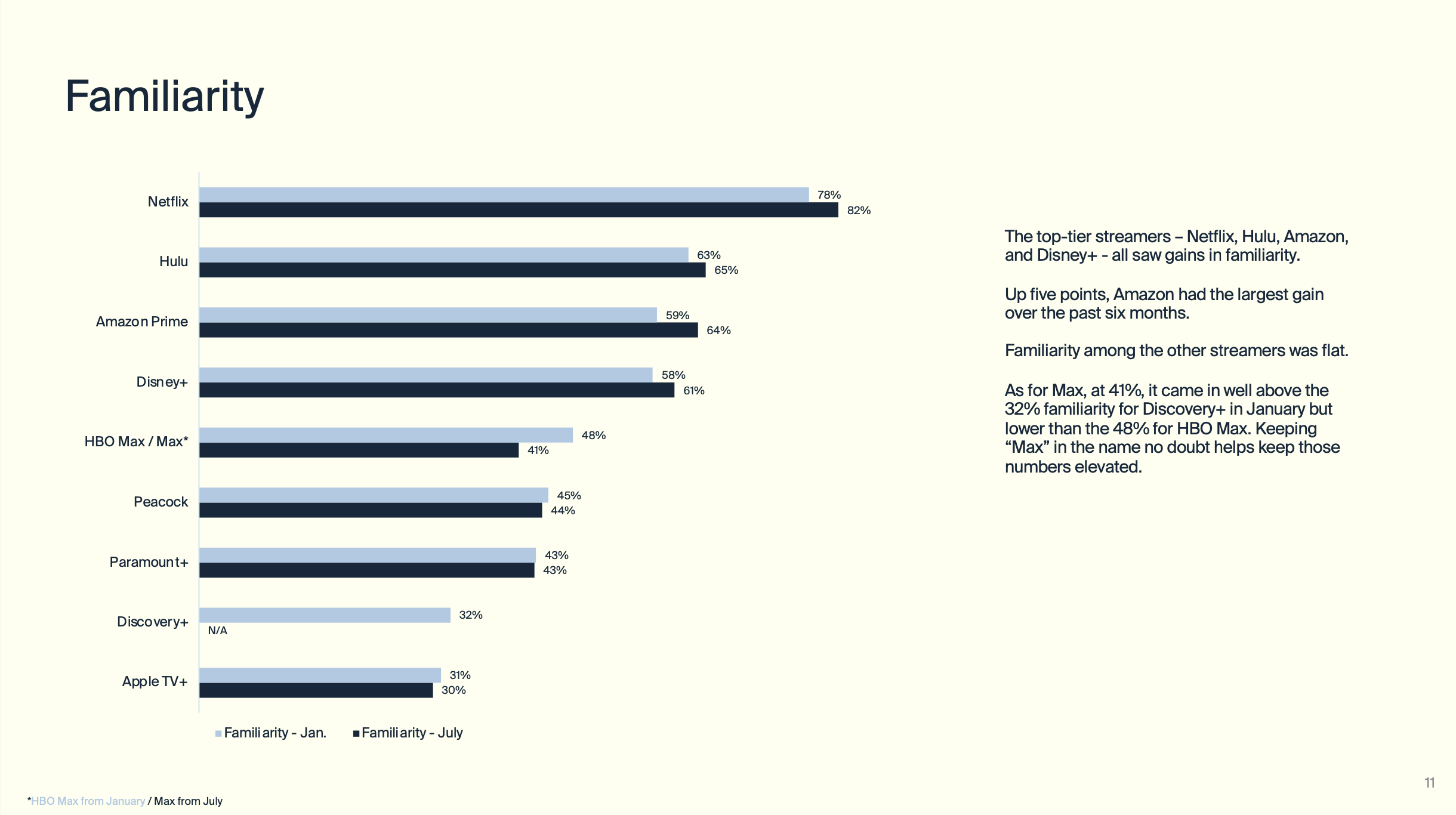
- More Apple Challenges: Apple TV+ continues to struggle in our survey, despite the perception around town that its content offering is improving, and the return of Jason Sudeikis’s mustache. The number of subscribers who know that Ted Lasso is on Apple TV+ has risen to 33 percent; that’s better than 1 in 5, but still surprisingly low. “Bottom line,” Herrin told me, “it’s hard to build meaningful and lasting attachment when consumers can’t even recall a streamer’s programs.” The Apple platform saw its numbers decline in all brand equity metrics, including “familiarity,” where it ranks last:
|
|
|
- Amazon Inertia: While Amazon Prime Video saw growth in “familiarity” and overall subscribers, it still ranks toward the middle of the pack in “quality” and “trust.” That’s despite its 45 Emmy nominations in July across Prime Video and Freevee.
- The Max Riddle: Remember, in January, HBO Max ranked second in the “quality” and “trust” categories, and Discovery+ was near the bottom of the list. Having since been combined, Max seems to be benefiting most from its ties to HBO, as it ranks second in both those attachment metrics, behind only Netflix. We’ll have a deeper look at Max later this week.
- The Coolness Factor: For the first time, respondents were asked which streamers they would describe as “cool.” Netflix was tops with 54 percent, but Max came in a close second at 52 percent. It’s interesting to see that Amazon was near the top in subscribers, but people don’t see it as a “cool” streamer. Clearly, they don’t watch Bosch.I’ll get into the specific Max results in a forthcoming issue, but clearly the big takeaway is that consumers aren’t happy with their streaming services—or at least they’re significantly less happy today than they were back in the good old days of January. It’ll be interesting to see if this turn in sentiment begins to impact subscriber numbers.
|
|
|
|
|
| My Puck partner Bill Cohan has more on Shari Redstone’s desperate dance with Tyler Perry and why she’d be smart to sell BET now, even for a lower price. [Puck]
Any list of the “50 Worst Decisions in TV History” is gonna have Cop Rock, The Swan, that Geico Cavemen show, ESPN hiring Rush Limbaugh, and James Franco co-hosting the Oscars. But where is “Networks Decide to Sell Library Shows to Netflix”? And Quibi didn’t even make the Top 10? [Rolling Stone]
The longer the strikes go, the more momentum builds for antitrust action against the studio-streamers. Lawyer Miles Mogulescu argues for breaking them up. [LA Times]
Anyone pissed about Vice Media backing away from coverage critical of Saudi Arabia since its MBC Group became a backer should check out the Jay Penske outlets’ fawning coverage of the “Red Sea Film Festival.” [Guardian]
Mark Harris shoots down the Bradley Cooper Maestro “Jewface” backlash (aka “Schnoz-gate”). The bigger problem: How f-ing pretentious is that trailer?? [Slate]
ESPN chief Jimmy Pitaro makes his content head Burke Magnus walk the media plank to say they really, really want to keep NBA and the other A-list leagues, even if the economics increasingly don’t make sense. [Athletic]
Amazon’s Jen Salke un-renewing a couple shows is definitely due to the strike and definitely not because she and boss Mike Hopkins are under new scrutiny from C.E.O. Andy Jassy. [THR]
The Times tries to figure out why the Cinerama Dome is still closed and comes up with… it just is? [NYT]
Now Jonathan proposes a solve for the strike’s success-based residual standoff… |
| A Solution for Success-Based Streaming Residuals |
|
| As the Writers Guild negotiations with the studios and streamers drag on, I’ve been thinking about one of the roadblock issues: success-based residuals for content exhibited on streaming. The surprising performance on Netflix of Suits, which originally aired on USA Network, highlights that this is not just an issue for streaming originals but also moved-over library content as well.
As you’ll recall, the WGA and SAG-AFTRA both want a success-based overlay in addition to the current residuals formulas—and by current I mean presumably including improvements that the DGA just achieved in made-for-streaming formulas. The studio and streamer response has been a resistance to disclose viewership data, which the WGA proposal would require, and a refusal to use third-party data either, which SAG-AFTRA would require.
In addition, the companies object to the notion that SAG-AFTRA’s approach would involve sharing platform revenue; the streaming distribution platforms themselves are not technically the signatory parties, that’s the producers. This is not a terribly compelling point, however: non-party distributors already sign what are called assumption agreements that make them directly liable for residuals, and there’s even a federal assumption statute that buttresses this liability.
The companies simply don’t want to share revenue, especially since most services other than Netflix aren’t showing a profit. But I think they, and lead negotiator Carol Lombardini, may have to give on this point since the unions are unlikely to squander their once-in-a-lifetime dual strike without some share of revenue. SAG-AFTRA wants a two percent pool, but that should be negotiable, particularly since the WGA (and DGA? IATSE?) will need a piece as well. One could even envision a smaller pool for newer and/or smaller platforms, and a larger one for the likes of Netflix.
So where do things stand on the ground? The latest media reports have been a bit confusing—they suggest that the companies are now willing to share viewership data with the WGA but are not willing to agree to a residual based on such data. Why would the WGA want to simply look at data if it doesn’t translate into payments? That’s like pressing its nose against the window of a forbidden candy shop. But we can’t exclude the possibility that the reports on this point are garbled or incomplete, and that the companies still don’t want to share data.
Assuming that data transparency is still an issue, I think there’s a solution: each platform can provide viewership data to a trusted third party, bound by confidentiality, such as an accounting firm like PwC. Use whatever reasonable viewership metric the particular platform prefers—minutes watched, percentage of completion of episodes, etcetera—so long as the platform employs the metric consistently across the measurement period, which could be a calendar year, for instance.
Since this additional residual is supposed to be a success overlay, what the accounting firm would do next, on a platform-by-platform basis, is discard the lowest performing series and movies, retaining, say, the top 30 percent on each platform and calculating the relative performance of product in that cohort. The accountants would then disclose to the guild not raw viewership numbers but simply the percentage coefficients that indicate how much of the revenue pool, for instance, Suits is entitled to versus Stranger Things versus Wednesday. The platform or payroll house would then calculate the success-based revenue share based on those coefficients and publicly reported data regarding subscriber revenue. Within a given show, the revenue share would be divvied up amongst the director, credited writers, and principal performers (non-extras), just as residuals are today.
There are complexities, of course. What if PwC makes a mistake? Perhaps we’ll need auditors to audit the accountants. Each platform would have to sign an assumption agreement making the platform directly liable for the success-based residual. In addition, platforms that are sold as a bundled service, such as Amazon Prime, would argue that not all subscriber revenue should be included in the calculation of the revenue pool. But this issue is already addressed with Amazon Prime in determining how many Prime members are considered Prime Video subscribers for residuals purposes, so perhaps the same figure would be used.
Granted, in an environment where most of the companies other than Netflix are not making a profit on streaming, a revenue share is a tough pill to swallow. But so is a dual strike, and it seems unlikely that the labor disturbance will end without some sharing of the fruits of growth. |
|
|
| My Thursday plea for showrunners to CHOOSE if they want to hire the guild-negotiated minimum writers drew lots of responses from WGA members. One did a nice job arguing the other side (I disagree with a few assessments here but it’s called “feedback”). Plus, the interns have spoken!
“Few thoughts on why this was a dumb take:
1. Your plan about minimum staffing makes no sense in practice. Your proposal about Jen Statsky getting a minimum and Taylor Sheridan doing it on his own is nonsense, and would never work on a new show. If a first-time showrunner is asked by a studio, ‘Hey, it would help the budget a lot if you did this yourself or with fewer writers,’ do you really think the new showrunner will have the power to push back? Of course not. There’s no question they will be pressured into going below the room size they’d prefer. It’s already happening this way. That internal pressure is exactly why this ask is so important to almost all of us.
2. Directors have minimum staffing for ADs in their contract. IATSE has minimum staffing requirements too. It’s not an overreach or a new idea. People acting like it is are either exec-pilled or dumb to how TV works. Maybe both!
3. Why do you think studios are fighting minimum staffing so much? Do you really think it’s because they are worried about the 7 creators who like having no writers? Do you think studios care about their creative freedom? Or do they want to make sure they get to pay as few writers as possible? What do you think is the more logical answer?
4. The anti-minimum staffing push in the trades is causing writers to dig in on the issue. It was literally all anyone was talking about on the line and in group chats today. People are furious that like 7 anonymous sources in Variety are trying to derail something 97 percent of us voted for, and if people weren’t on board with minimum staffing last week, they sure as hell are now. This push is backfiring like crazy.
5. Most importantly, I found the tone of your piece strange and off-putting. It felt quite disdainful towards the newer and more working-class members of our guild. Do you think the point of a union is to protect the most wealthy or the least? In labor actions, the top always sacrifices to help those who are newer or poorer or struggling to find work. A union action is NEVER about helping those who are doing well. Literally no one on our board or NegCom is out of work, so saying we are being led by the poor out of work members is not only elitist but it’s wrong. You’re smarter than that.” –A writer
“That was a wonderful interview with the interns. It’s sad that unless something changes they will spend 10-20 years at those desks, and several will quit the business. There really isn’t much space between a 20 year old intern and a 38 year old project manager in the business today.” –A filmmaker
“Jadon is my hero! He will be my first hire when I take over for my boss… in 2045.” –An assistant
“The studio risk aversion… also seems to have ushered in a steep rise in execs who graduated from either an elite private university or a top five film school. It’s a worrisome trend, considering that Hollywood's history is written by high school and college dropouts like Ron Meyer, David Geffen, Jeffrey Katzenberg, and Barry Diller. Execs from working class backgrounds who knew their audience and were willing to buck convention. I meet few execs who went to public school, let alone dropped out. It even seems rare for companies to hire interns from nearby Cal State Northridge, Cal State L.A., and Cal State Long Beach (where Spielberg dropped out from). No disrespect to anyone with a prestigious degree. If you’re a doctor, I prefer you have one. But greenlighting a movie? It’s irrelevant.” –A writer
“I wonder if the next ten years of films will look more like the post-Pulp Fiction ’90s.” –A video producer
“Well done on the Cheeseburger ending of the Intern chat. Bela Bajaria is smiling.” –An executive |
| Finally… one ridiculous thing… |
|
| Did anyone else notice this local news item about “squatters” taking over and trashing an abandoned Sunset Plaza mansion? It’s not in the story, but producer John Powers Middleton (Lego Movie, Neighbors 2, the Poltergeist remake) has owned that house for more than a decade. He’s also the son of billionaire Philadelphia Phillies owner John S. Middleton, so maybe John Jr. isn’t really incentivized to care about his $10 million L.A. spread.
Have a great week,
Matt
Correction: On Thursday, I misspelled the Korean company HYBE as HYPE. Damn autocorrect!
Got a question, comment, complaint, or some pre-filled sandbags? Email me at Matt@puck.news or call/text me at 310-804-3198. |
|
|
|
| FOUR STORIES WE’RE TALKING ABOUT |
|
|
|
|
|
 |
|
|
| Need help? Review our FAQs
page or contact
us for assistance. For brand partnerships, email ads@puck.news. |
| You received this email because you signed up to receive emails from Puck, or as part of your Puck account associated with . To stop receiving this newsletter and/or manage all your email preferences, click here. |
| Puck is published by Heat Media LLC. 227 W 17th St New York, NY 10011. |
|
|
|