Welcome back to What I’m Hearing. I hope you submitted your Oscar ballot before today’s 5 p.m.
deadline. The fate of the world depends on it.
💫💫 Congrats to Andrew Ross Sorkin, the busiest man in business media, who was honored last night at Puck’s annual First Amendment celebration at the French ambassador’s residence in D.C. I couldn’t make it but the pictures look nice.
Tonight, some news on the coming WarnerMount mashup straight
from Paramount board member and RedBird dealmaker Gerry Cardinale, including how he hopes to cut $6 billion without firing thousands of people. Plus more details on what might become of the Paramount and WB studio lots.
Mentioned in this issue: Rob Bonta, Ben Affleck, John Legere, Gerry Cardinale, Matt Damon, John Malone, Larry
Ellison, Mohammed bin Salman, David Ellison, David Zaslav, and… a Godfather whacking exhibit.
Not a Puck member yet? Just click here. Got a news tip or an idea for me? Just reply to this email, text me, or message me on Signal at 310-804-3198.
Let’s begin… |
- Zaslav’s
$114 million investment in Zaslav: Everyone seems to want me to crap all over Warner Discovery C.E.O. David Zaslav for filing to sell $114 million worth of company stock as he preaches patience to his many employees that will be fired as soon as this Paramount merger closes. Sure, yes, it’s gross. But unexpected? The real tragedy of late-stage Hollywood isn’t that corporate vampires are feeding upon great but wounded institutions at the expense of the creative
people who made them great, but that so few mechanisms exist to prevent broad daylight heists like Zaslav’s coming $800 million payday for flipping the company. Warner shareholders have voted against his unorthodox pay packages. The media continues to shame the WBD compensation committee for enabling the value extraction. Even Zaslav’s friends have raised the salary issue with him. It all falls on deaf ears because, with rare exceptions, shame does not exist in the C-suite. It can only be forced
upon someone like Zaslav.
- Speaking of Zaz…: Yes, that was him lunching on the WB lot today with David Ellison, his new B.F.F. No matter that Ellison and the Paramount people spent three months screaming that Zaslav and the Warner Discovery board conducted a “tilted and unfair” auction that was “rigged.” Bygones! (Usual disclosure: Due to a recent transaction, Zaslav is a de minimis investor in Puck.)
- Two studio lots… but for what?: Fans of L.A. architecture and golf cart transportation can rejoice now that Paramount board member Gerry Cardinale has told me both the Paramount lot in Hollywood and the Warner Bros. spread in Burbank will be retained, rather than sold for condo development or the world’s largest Costco. But both Cardinale and David Ellison are still being coy on exactly what will become of those lots amid the consolidated
staffs and decline in physical production in L.A.
I’m told an idea being discussed internally is to use one of the lots for a theme park–style experiential destination that would appeal to movie-loving tourists. Both Paramount and Warner Bros. already offer studio tours, so this would be something more expansive, akin to the Netflix House immersive experiences (a Godfather whacking exhibit?) rather than a traditional, Universal-style theme park. Cardinale perhaps hinted at that
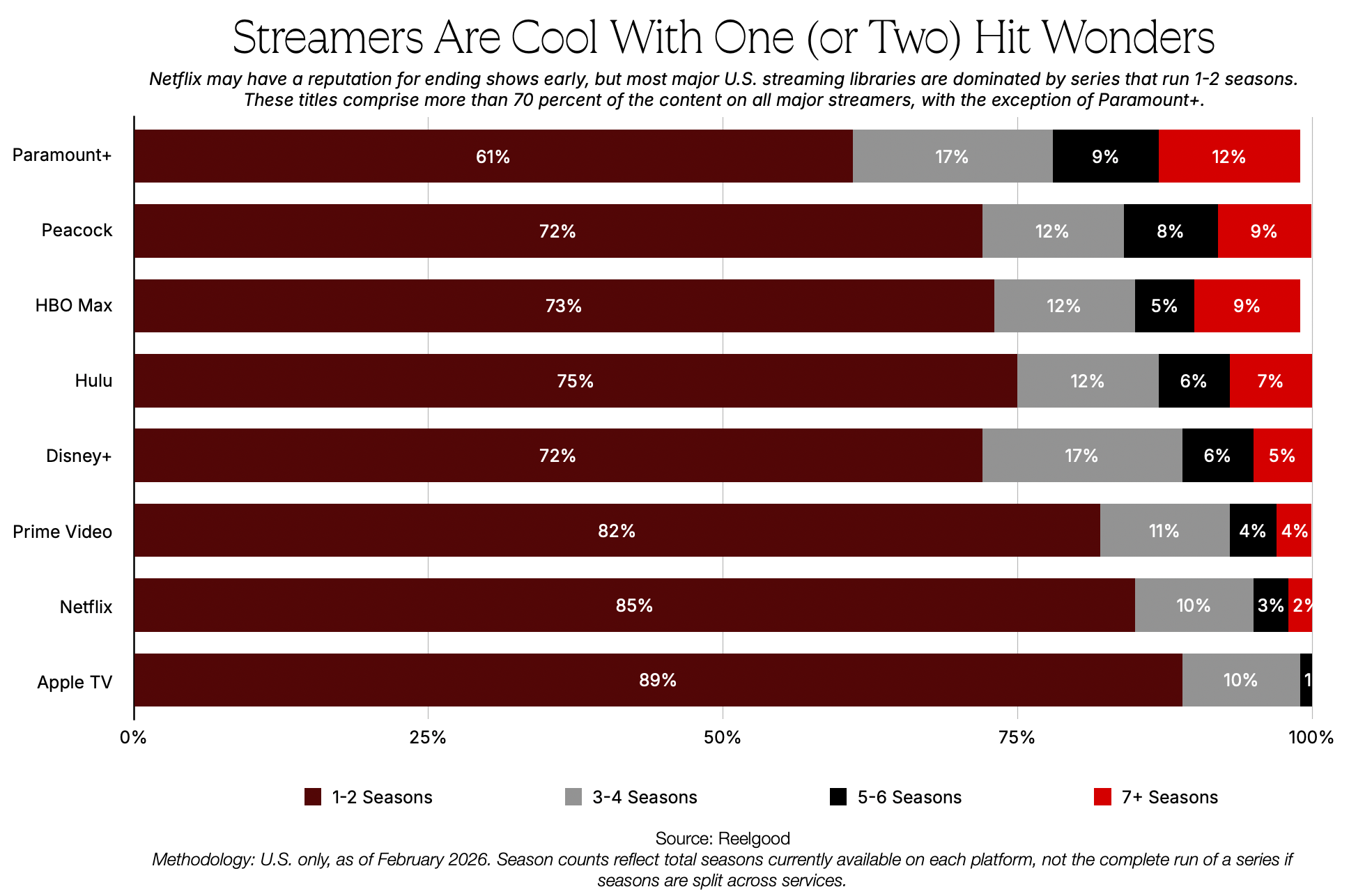
future in my recent chat with him: “You should assume that we’re keeping that [real estate] footprint and it’s all going to be utilized for the benefit of I.P. monetization across the whole flywheel of I.P. monetization.” - Streaming’s shallow well of shows: Most people only watch a couple seasons of TV series, and streaming platforms are becoming good at reflecting those preferences. New data from Reelgood reveals that all the major U.S. platforms
except Paramount+, home to the legacy CBS shows, carry more than 70 percent one- or two-and-done shows, or at least only one or two seasons of longer-running shows…
|
- Box
office over/under: Disney/Pixar’s Hoppers tracking has grown to about $39 million domestic, per NRG, and I’ll take the over. Conversely, Warners’ $92 million-budgeted The Bride! (note! The exclamation mark title hasn’t worked since Mamma Mia! in 2008!) is now down to $14 million, and I’ll take the under.
|
Now for the latest in the WarnerMount saga… |
|
|
|
Paramount’s board member and chief dealmaker insists his $111 billion acquisition of Warner
Discovery will make financial sense without the mass layoffs Hollywood fears. But can the cashflow of CBS, a combined streaming platform with 200 million subscribers, and the backing of the Ellisons succeed where past debt-fueled mergers have not? |
|
|
|
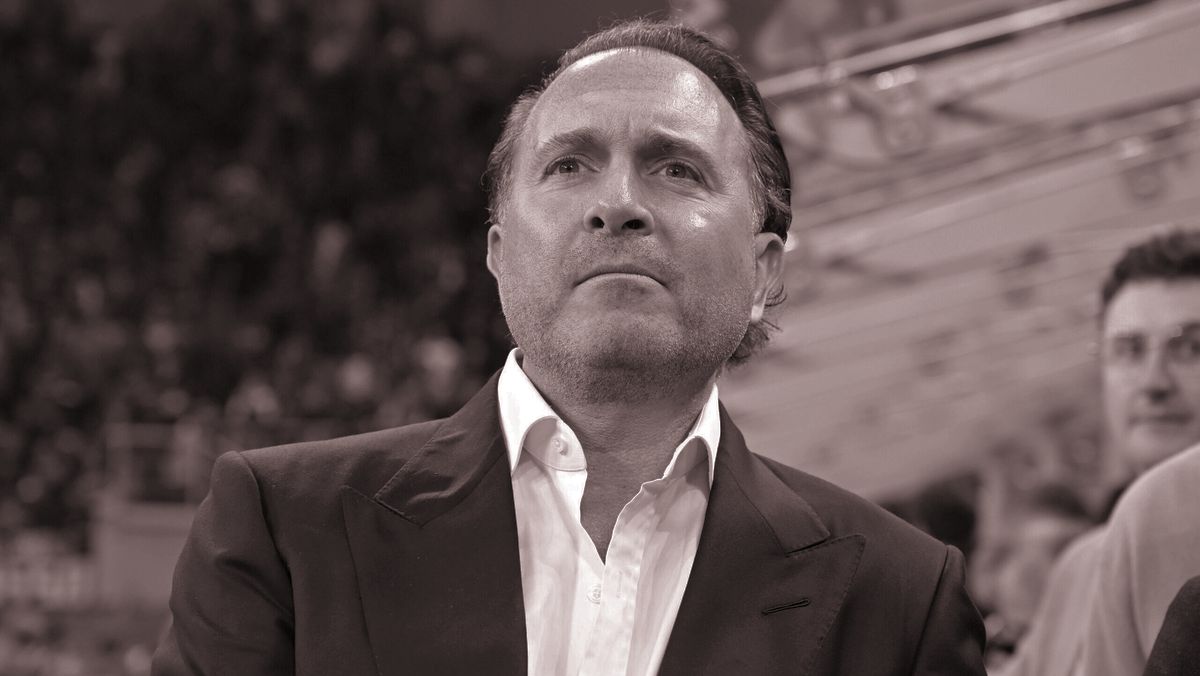
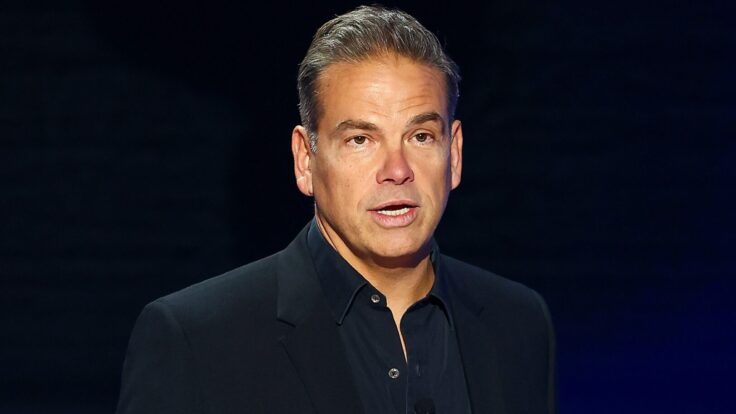
Talking to Gerry Cardinale these days, you get equal doses of offense and defense. The
RedBird Capital dealmaker and chief architect of Paramount Skydance’s $111 billion acquisition of Warner Bros. Discovery is simultaneously basking in the biggest media deal of his 30-plus-year career while also kinda feeling the need to explain—and, yes, defend—that same transaction to many jaded skeptics in Hollywood. I’m one of them.
The Warners megadeal—along with the just-announced $8 billion combination of reality TV juggernauts Banijay and All3Media, via the RedBird IMI
joint venture, and the new partnership between Ben Affleck and Matt Damon’s RedBird-backed Artists Equity and Netflix—has helped make Cardinale arguably the most prolific dealmaker in this period of Big Tech disruption and legacy consolidation in entertainment, the era I’ve dubbed “late-stage Hollywood.” But it’s also put him in the public eye, especially as the Ellisons have greased the Trump machine to help get this deal approved. Which is why
I asked the former Goldman Sachs banker to explain to the town how—despite the, uh, mountains of evidence—the WarnerMount combination won’t mirror AT&T, in 2018, when it paid $109 billion (including debt) for Time Warner. Or repeat what happened four years later, when John Malone and David Zaslav created Warner Bros. Discovery and it nearly collapsed under the weight of crushing debt and cratering TV revenue, only to be passed along to another
optimistic rich guy willing to take on… wait for it… nearly $80 billion in debt.
Thankfully, Gerry was game to talk. “On the surface, that amount of debt is a large amount of debt for any company,” Cardinale acknowledged in a 40-minute chat yesterday (you can watch or hear it here). “But our cashflow is also a large amount of cashflow for any
company.” Indeed, as my colleague Bill Cohan has explained, WarnerMount is being funded by $79 billion in debt, including new commitments from Apollo, Bank of America, and Citigroup, and $47 billion in equity from Larry Ellison and Cardinale’s RedBird, with likely help from Middle East investors (more on that in a moment). Larry and
his Oracle stock are backstopping the whole Hollywood thing—much to the chagrin, I’m guessing, of his family office.
Warner Discovery initially predicted that its EBITDA would reach $14 billion by 2023. Instead, its profits had nosedived to $8.7 billion by 2025. But Cardinale told me that the cash coming from the combined WarnerMount, which will generate a little less than $12 billion in EBITDA this year, will soon rise to $18 billion after $6 billion in cost cuts. “It unlocks
tremendous cashflow and synergies,” he told me of the deal. “That all gets reinvested back into content, and it also helps us de-lever.” On CNBC today, David Ellison said that unlike Zaslav, he’s wise to the TV “decline curve” and that, “We’ve taken a very, very conservative view to that in our models to ensure that we never get into a position where that’s not manageable.”
To that end, despite the melting iceberg of TV, where both of these companies make most of their
money, and the fact that the Fitch ratings agency just downgraded Paramount to junk status, Cardinale said he’s relying on a key profit driver that Zaslav never had. “CBS is the crown jewel in the linear portfolio,” he told me. “And that is why we’re different than what Warners and Discovery had to deal with when they did their deal.”
Indeed, CBS still throws off tons of cash, remains home to the NFL (though football rights are about to get a lot more expensive) and other lucrative sports
assets, and is a big reason why the combined WarnerMount would account for an industry-leading 13.7 percent of TV viewing on linear and streaming—more than YouTube (12.5 percent), Disney (11.9 percent), and Netflix (8.8 percent)—per Nielsen. On streaming only, that WarnerMount percentage drops to 8 percent, less than a third of YouTube (27 percent) and less than half of Netflix (19 percent), which indicates the relatively small audience on Paramount+ and HBO Max—and the power of CBS within that
portfolio. If the Ellisons can start spreading UFC, golf, and all those top 10 shows that nobody you know watches across the various combined platforms, maybe that keeps the linear cash cow out of the slaughterhouse long enough to elevate the combined Par+/HBO Max and its nearly 200 million subscribers into a legitimate Netflix competitor long-term. Cardinale and the Ellisons seem to be banking on it. |
“Nothing
to Do With Firing People”
|
Understandably, the creative community—and those who manage the larger L.A. economy—are less concerned with
EBITDA than the coming jobs massacre across the merged WarnerMount. Those $6 billion in cost cuts must come primarily from people, right? But it was surprising to hear Ellison on CNBC this morning, and Cardinale in our chat, say that won’t be the case. “The majority of our synergies that are cost-related have nothing to do with firing people,” Cardinale told me.
Hmm. That seems implausible, given that Paramount Skydance just finished a $3 billion-plus cost cut at the
combined company that included a ton of duplicative people. So how will it be possible? “Number one, we’re going to consolidate our streaming technology stacks and our cloud providers across Paramount+ and HBO Max,” he told me. “Number two, we’re going to optimize the combined real estate footprint and corporate overhead.” That means better utilization of office space globally, not selling off one or both of the L.A. studio lots, he said. Instead, “We’re going to develop them
more efficiently.”
I’ve heard that could include adding theme park–style experiential entertainment on one of the lots, à la Universal Studios, but Paramount declined to confirm or comment. In addition, Cardinale said, “there’s a lot of global efficiencies we can drive in procurement and in general business services”—meaning I.T., travel, marketing agencies, that kind of stuff. “And then importantly, we’re migrating the combined company to a single enterprise
resource-planning system.”
Okay… so boring, back-office efficiencies, mostly. But does that really save billions of dollars and allow the company to slash debt while also making and marketing 30 theatrical movies a year and a larger TV slate and investing in a world-class tech platform and not firing half the population of Burbank? Are you convinced? Maybe? Hopefully Cardinale isn’t just downplaying the coming bloodbath to quell the
proletariat.
When T-Mobile merged with Sprint in 2019, then-CEO John Legere promised the $26.5 billion deal “will be a tremendous jobs creator at New T-Mobile,” and he committed to adding 11,000 positions by 2024. But in April 2023, an investigation found that T-Mobile had 9,000
fewer employees than the two companies did before the merger. T-Mobile then announced an additional 5,000 layoffs. By then, Legere had exited the company with a $137 million severance package. |
The other area of concern, of course, is that $24 billion from sovereign wealth funds in Saudi Arabia, Qatar,
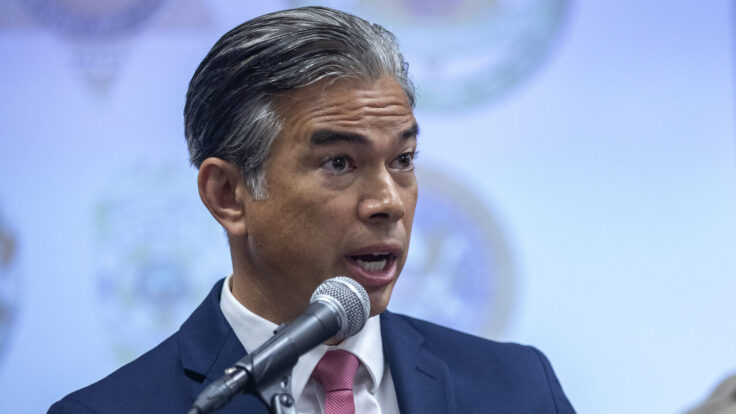
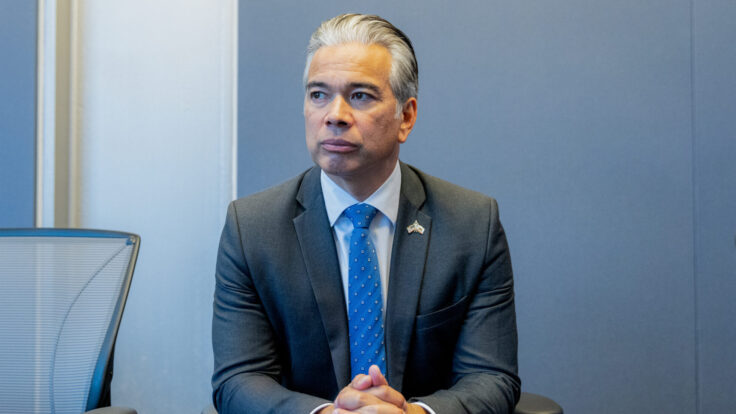
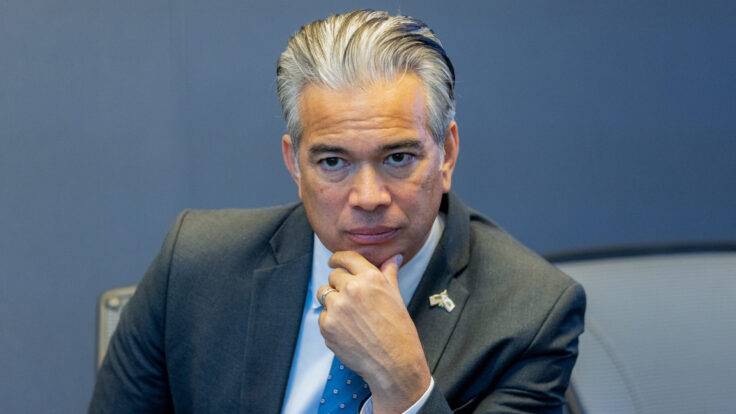
and Abu Dhabi that Paramount said in December would be part of this transaction. Still happening? After all, the FT reported today that the war in the region could cause the oil-rich countries to reconsider their U.S. investments. Plus, lots of people—including many blue state attorneys general who, according to California A.G. Rob Bonta, are
deciding whether to sue to block this transaction—would like to know whether Crown Prince Mohammed bin Salman and other Middle East leaders who may or may not have murdered journalists will soon claim a stake in the owner of CNN and CBS News. Cardinale wouldn’t say, but he strongly hinted yes. “We haven’t syndicated anything at this time,” he told me. “We do expect to syndicate with strategic, domestic, and foreign investors. But that alchemy shouldn’t matter because it’ll be
done in the right way.”
By the right way, he seemed to mean that the investors won’t have any operational involvement, which Paramount said in December, and therefore the investors’ identities don’t really matter because the Ellisons are ultimately controlling the whole thing. Plus, Cardinale, who has extensive connections in the Gulf, is more than happy to raise money there. “The world is changing,” he said. “We can stick our head in the sand and pretend it’s
not, or we can embrace globalization and the derivative benefits both geopolitically and otherwise that come from that.”
So if it’s no big deal, why isn’t Paramount ready to name the backers? Such are the contours of this complex deal, where optics are dominating the closing process but the cold, hard math of debt and revenue will ultimately determine whether Ellison and Cardinale can make it work.
(Disclosure: Through Puck’s acquisition of Air Mail, RedBird became a minority
shareholder.) |
See you Monday,
Matt
Maya Tribbitt contributed research for today’s issue.
Correction: Drew Goddard wrote the Project Hail
Mary screenplay, not Drew Pearce, as Scott mentioned on Monday. Apologies to both Drews.
Got a question, comment, complaint, or suggestions for theme park attractions on the Paramount lot? Email me at Matt@puck.news or call/text me at 310-804-3198. |
|
|
|
Puck founding partner Matt Belloni takes you inside the business of Hollywood, using exclusive reporting and insight to explain
the backstories on everything from Marvel movies to the streaming wars. |
|
|
|
Ace media reporter Dylan Byers brings readers into the C-suite as he chronicles the biggest stories in the industry: the future
of cable news in the streaming era, the transformation of legacy publishers, the tech giants remaking the market, and all the egos involved. |
|
|
|
Need help? Review our
FAQ page or contact us for assistance. For brand partnerships, email ads@puck.news.
You received this email because you signed up to receive emails from Puck, or as part of your Puck account associated with {{customer.email}}. To stop receiving this newsletter and/or manage all your email preferences, click here. |
Puck is published by Heat Media LLC. 107 Greenwich St., New York, NY 10006 |
|
|
|
|