Media Succession Planning, Mini-Benioff's Mega-Play, Wall Street's Russia Game
Welcome back to The Daily Courant, your afternoon guide to what's new at Puck.
Today, Dylan Byers reveals the new top editor at Politico as the formerly gritty, scoop-driven media company comes to terms with its maturation into precisely the sort of stodgy D.C. institution it initially set out to disrupt.
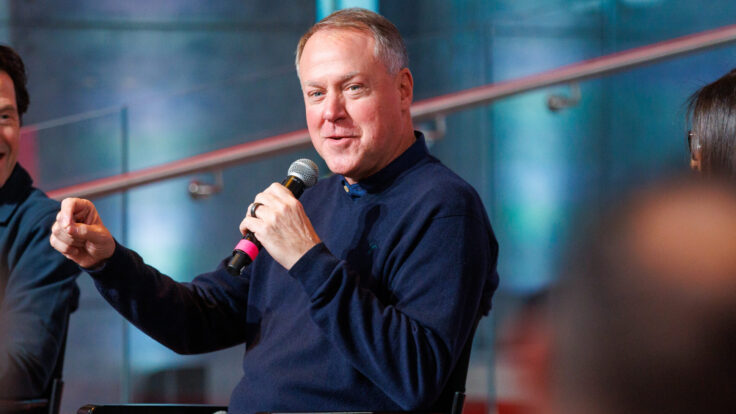
Plus, below the fold: Teddy Schleifer flags cloud-computing billionaire Jeff Lawson's first major steps into the political arena. And William D. Cohan joins Teddy on the latest episode of The Powers That Be to discuss how Wall Street is navigating the crippling sanctions on Putin’s regime, why some banks are still operating in Russia, and how hedge funds are playing both sides of the sell-off.
SPONSORED BY 

Fifteen years after it broke onto the scene in an unmistakably disruptive manner, re-defining the stodgy news business with its metabolic frisky style and scoop-bazooka, Politico seems intent on entering its own Washington sinecure of sorts—as the pendulum swings, in the words of one founder, towards institutionalism in D.C. Will its new newsroom leader facilitate the anti-disruption disruption? Earlier this year, on the occasion of Politico’s 15th anniversary, the famously thoughtful and far-sighted founding editor John Harris put forward a controversial thesis about the very industry he once participated in reshaping. A decade and a half earlier, he and his fellow co-founders, Jim Vandehei and Mike Allen, had disrupted the world of political journalism with a scrappy, high-metabolic inside-baseball approach that eschewed the musty conventions of legacy media institutions. Politico was an instant, groundbreaking hit. Mark Leibovich, Washington’s unofficial chronicler, even won the magazine industry’s top honor for his profile of Allen and the Politico phenomenon.
In those early days, Politico leveraged some brilliant observations about the white space in the market. Washington insiders, all too aware of the bullshit-laced pablum that saturated the professional political-media scene, instantly took to Politico as that rare media organization that cut through the noise and provided the truth beneath the talking points and K Street agendas. Back in those days, Politico (or The Politico, as it was originally titled) revealed subterranean Washington to be a far more complex and dynamic place than its Brooks Brothersy and Ann Tayloresque surface belied. Core to the thesis was the idea that journalists should break down the fourth wall with the reader and give them the unvarnished truth of what was going on behind the scenes in Washington.
Now, with Politico old enough to obtain a driver’s permit, Harris offered a countermanding idea for the next 15 years: “It is time for the pendulum to swing back...
ADVERTISEMENT 
FOUR STORIES WE'RE TALKING ABOUT 
Puck’s first annual, totally subjective and partially grievance-based salute to the interminable Oscar season. MATTHEW BELLONI 
Behind the scenes, Twilio C.E.O. Jeff Lawson has been making new strategic moves in the big-money world of Democratic politics... THEODORE SCHLEIFER 
The situation at MSNBC manifests just how bizarre things have gotten at the soon-to-be former House of Maddow. DYLAN BYERS 
With markets off their euphoric highs, the conventional wisdom appears to have changed overnight for Netflix... WILLIAM D. COHAN 
You received this message because you signed up to receive emails from Puck.
Was this email forwarded to you?
Sent to {{customer.email}}
Interested in exploring our newsletter offerings?
Puck is published by Heat Media LLC.
For support, just reply to this e-mail. For brand partnerships, email ads@puck.news |


SHARE