 |
 |
|
Howdy, welcome back to The Stratosphere.
|
|
A lot has changed in campaign finance since 2016, when I was a cub reporter at CNN covering money in politics and obsessing over which major donors were signing up to raise money for which candidates. Nowadays, I’m much less excitable. So too, it seems, are the megadonors themselves, who suddenly seem to have much humbler views of their own powers. Has the billionaire anti-Trump cavalry—seen as the last, best hope for beating him—at last given up?
My latest on all of that, plus a few scoops revealing which way the G.O.P.’s leading players are leaning, below the fold.
But first…
- Were you invited to Peter Thiel’s Christmas party? No? Well, it happened last Saturday at his Bel Air mansion, with a few hundred people slinking around. I say “slinking” because there were some cat-ear hats worn by staff. The party itself was “Japanese themed”—Thiel is big into Japan as an investor. There was a torch juggler, a Benihana station, and sushi on offer. Oh, also an escape room and a weed station, because why not.
- Meanwhile, Thiel’s political sparring partner at Stanford, Reid Hoffman, is weighing in on the Silicon Valley congressional race for Sam Liccardo, the former mayor of San Jose. Hoffman, one of the country’s biggest Democratic donors, is headlining a fundraiser on the 19th, per an invitation forwarded to me. Other sponsors of the lunch in Menlo Park include Eric Yuan, the founder of Zoom, former top Facebook exec Chris Kelly, and longtime Democratic insider Steve Westly.
|
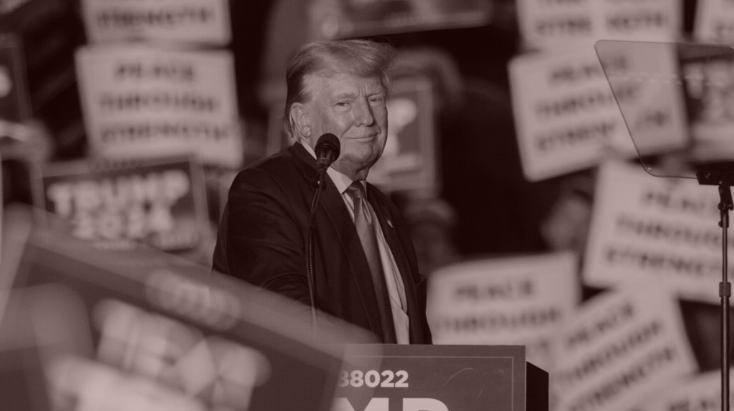 |
| The G.O.P. Donor Great Resignation |
| As the countdown to Iowa gets real, the Republican megadonor class is increasingly resistant to burn their cash and end up on Trump’s latest enemies list. Will the cavalry ever come? |
|
|
|
| Just over eight years ago, on the eve of the last open Republican primary, hedge fund founder Paul Singer hit send on an 1,100 word email that he hoped would be a clarion call to his fellow billionaires, declaring that he had “decided to support Senator Marco Rubio,” and urging them to open their checkbooks, too. It was October 2015, and donors were struggling to coalesce behind a challenger to Donald Trump. Singer whipped and whipped, and his first event for Rubio raised some $3 million—the Florida senator’s single biggest fundraiser—and for the next few months he seemed to levitate in the polls until he eventually suspended his campaign, after placing second to Trump in his home state.
Nearly a decade later, the rules of engagement have been rewritten for many Republican donors. Six weeks after the same point in the 2024 cycle, no Singer-like force is emerging. Instead, many are overcome by an incredible sense of pre-Iowa déjà vu, even as the G.O.P.’s leading financiers debate what they can learn from 2016 and what, if anything, they can possibly do differently this time around. Perhaps, some argue, it’s not even worth trying. |
|
A MESSAGE FROM INSTAGRAM
|
| |
 |
| New federal legislation will give parents a say in teen app downloads.
According to a new poll from Morning Consult, more than 75% of parents agree: Teens under 16 shouldn’t be able to download apps from app stores without parental permission.1
Instagram wants to work with Congress to pass federal legislation that gets it done.
Learn more. |
|
|
| Optimists counter that the Republican field is, in fact, consolidating far more decisively this campaign season, into what is essentially a three-way race between Trump, the obvious frontrunner, and Ron DeSantis and Nikki Haley, trailing some 30-40 points behind. At least there’s a clearer choice than in 2016, when at least six other candidates had enough money to remain in the race and divide the supposed anti-Trump majority. (Remember the Fiorina-for-V.P. gambit, the Kasich-Cruz “alliance,” or any of the other desperate, eleventh-hour attempts to force consolidation?) But the far more pervasive doomsday view at the top of the food chain is that it hardly matters whether Americans For Prosperity or Governor Chris Sununu think Nikki Haley is worthy of the presidency. The consolidation is cute, but it will almost certainly have the same impact as when Haley herself thought Rubio was worthy of the presidency in 2016: none at all.
Plus, there is even less appetite among Republican megadonors to take public stands against Trump this time around, for a few reasons. Top donors are questioning whether their public support is a net positive for candidates (for example, look how much incoming Haley has taken for a modest $250,000 check from Reid Hoffman). They certainly don’t think it’s worth sticking their necks out against a candidate like Trump with such a commanding lead. Major players remain on the sidelines, I’m told, and are now unlikely to encourage the party to consolidate around a Trump alternative like Singer did for Rubio. Sure, some people in Singer’s orbit might make a push—several of his confidants, including his longtime girlfriend, are raising for Haley—but few have the same resources or motor as Singer himself. People have sensed that Singer is not whipping his billionaire peers in the American Opportunity Alliance to lean in any particular direction, for instance.
The ambivalence extends to Wall Street, where two of the most closely watched Republican donors, Ken Griffin and Steve Schwarzman, seem to be in no rush to put their thumbs on the scale, beyond saying a few nice things in interviews—a tease which has caused palpitations inside Haley’s camp, which would love the cash. I’m told that Griffin likes Haley as a general-election candidate, but it’s been almost a month since he said he was at the “finish line” on a decision. Schwarzman, for his part, gave a statement to Axios more than a year ago saying “I intend” to support a new generation of G.O.P. leaders in the primary. And yet, despite meeting one-on-one with nearly every candidate in the field, he’s basically stayed on the sidelines ever since. Sometimes, polls get in the way of intentions.
It’s hard to blame anyone here, frankly. Donor consolidation is definitely happening, and mostly behind Haley, but the top-most donors need to see a path to victory before writing a disclosed $10 million check, and several insiders in this world say the billionaire club believes that more money would be a waste if it’s spent on fighting for second place. Why give seven figures to Haley’s super PAC, Stand for America, if the only outcome is to lower DeSantis’s favorables? To know if Trump is vulnerable, you have to spend money against Trump, argued one of the more optimistic people that I spoke with. A more pessimistic insider put it another way: “There’s no concerted effort to do anything. Because somebody had to show enough campaign capacity that they had a real shot at winning. And no one has.”
Then there’s the unspoken rationale: Many big donors, for all their bombast about the threats to capitalism and democracy and the future of the G.O.P., are concerned about retribution from Trump, personally. Why, I’m told, go public à la Singer and Rubio? Maybe the reputational hit is worth it if it will save the country, and maybe they’ll feel like they did the right thing. But it’s not worth it just to make Haley or DeSantis a stronger loser. “DeSantis could be done after Iowa,” said one fundraiser. “This could be done in February. So do people really want to take a huge L when they see the inevitable?” |
|
|
| All of that said, Haley is raising plenty of money. Last week she had a fundraising event near Naples, Florida, and has two more scheduled before Christmas in Boston and Atlanta, I’m told by a Haley bundler. She also has two more big fundraisers scheduled for New York City in January (when it obviously becomes harder to get off the hustings of the actual campaign trail) and a Bay Area swing in February. Spencer Zwick, the Romney fundraising eminence, has apparently been a huge help. On the soft-money side, I reported the other day that Jan Koum, the billionaire co-founder of WhatsApp, had quietly put $5 million more into her super PAC, for a total of $10 million, making the low-profile Israel hawk the presidential race’s second-largest donor, overall. Another person to watch closely is Ronnie Cameron, the Arkansas poultry magnate who gave millions to Rubio’s super PAC in 2016 and is one of the few members of the billionaire class to publicly say that they’ve flipped to Haley. Also in Arkansas, pay attention to billionaire investment banker Warren Stephens, another AOA leader and possible Haley backer. (A Stephens spokesperson declined to comment on his current thinking.) |
|
|
| Does any of that matter? “Forget about Trump—that’s not going to be a money thing as much. But versus Ron, that is a money thing,” said one top Haley source. The Haley forces expect to outspend the DeSantis forces from now through Election Day, which few people would’ve seen coming earlier this year. And while she has lagged in campaign organization to date, she also now has the Koch network behind her, and the Koch groups are convinced that Trump’s support is softer than the polling indicates.
But everyone around town knows it is crunch time for major donors. Obviously, there are tons of unknown unknowns—such as Trump’s legal jeopardy—that will become demystified over the next few months. The first of Trump’s four trials, for conspiring to overturn the 2020 election, is scheduled to begin on March 4, just before Super Tuesday. But megadonors are slowly inoculating themselves to the fact that their decision in the spring will crystallize to Trump or Biden… or maybe No Labels?
Indeed, the pessimism among major G.O.P. donors is great news for Nancy Jacobson, the leader of the putatively centrist, corporate-friendly third-party group. No Labels might emerge as the biggest beneficiary of the Republican Party’s donor woes, if only the organization can agree on a candidate. But there is a catch-22: It is obviously difficult to ask for $70 million for a ballot-access effort when the donors don’t know which names would actually appear on the ballot. If a moderate Republican agreed to run on a No Labels ticket, then perhaps that is the only release valve that someone like Paul Singer needs. |
|
|
|
| FOUR STORIES WE’RE TALKING ABOUT |
 |
|
 |
| Cher’s Royalty War |
| Inside a legal battle over how rights are valued in Hollywood. |
| ERIQ GARDNER |
|
 |
|
 |
|
|
|
|
|
 |
|
|
|
Need help? Review our FAQs
page or contact
us for assistance. For brand partnerships, email ads@puck.news.
|
|
You received this email because you signed up to receive emails from Puck, or as part of your Puck account associated with . To stop receiving this newsletter and/or manage all your email preferences, click here.
|
|
Puck is published by Heat Media LLC. 227 W 17th St New York, NY 10011.
|
|
|
|