 |
|
Welcome back to The Best & The Brightest, Real ‘Murica edition. This is Tina Nguyen, still recovering from a dangerous safari into the swamp, a.k.a. WHCD weekend. (My bones still hurt, though spotting a Property Brother in the wild made up for it. I’m pretty sure it was Drew Scott.)
This week: notes from the Tucker Bunker, a surprising new discipline in Mar-a-Lago, and Kevin McCarthy’s MAGA turnaround. Plus, my peerless colleague Teddy Schleifer on the latest Biden campaign and Peter Thiel fundraising gossip. (You can subscribe to his private email, The Stratosphere, here.)
But first…
- The Tucker Oppo Sitch: So far, Tucker Carlson has been relatively silent since Fox News forcibly removed him from his anchor chair, releasing just one video last week hinting at his censorship by the media elite and future revenge tour to come. Behind the scenes, his team told me last week, he was champing at the bit to rejoin the public discourse, just as soon as his exit was negotiated. Then, of course, the leaks started flying out of 1211 Avenue of the Americas: Several videos appeared on Media Matters showing Carlson making crude comments about sex technique with Piers Morgan, trashing Fox Nation, describing women as “yummy,” and offering sartorial advice for accused sex trafficker Andrew Tate. Shortly afterward, the Times ran a story alleging that a racist text from Carlson to a producer, about how “white men fight,” sparked an internal inquiry last year that precipitated his downfall.
Carlson’s allies and confidants have long prepared for leaks and embarrassing revelations, many of which were previewed during the discovery phase of the Dominion litigation. What most raised the Tuckerverse’s hackles, however, was not the content of the leaks themselves, but the fact that the videos—apparently recorded while studio cameras were rolling, but before the feed went live—were given to Media Matters, a decidedly liberal outlet that has published anti-Fox pieces for years. “Media Matters has tried to kill Fox for decades. Now someone is coordinating with them,” a person familiar with Carlson’s situation told me. “I can assure you every single high profile on-air person there is freaking out over this.”
- Meanwhile, at Mar-a-Lago: While most of the headlines about Ron DeSantis these days feature the governor’s laughably bobble-headed response in Japan to a question about his underwhelming polling (he’s anywhere between 24 and 45 points down against Trump), or his “low-wattage” hearts-and-minds trip to London, or his mismatched legal battle with Bob Iger over Disney World, the real story of the ’24 Republican primary so far may be his surprising lack of campaign organization. Sure, DeSantis isn’t technically running for president, yet, but any competent operation would have spent the past few months teeing up endorsements in Florida, which DeSantis wants to make the centerpiece of his campaign. Instead, Trump essentially swept the endorsement battle in the governor’s backyard, clinching 11 of the 12 members of the state’s congressional delegation who have picked a side.
For many RINOs hoping to keep Trump out of the White House, the headline here isn’t DeSantis’s flailing but Trump’s surprising discipline. “All the stories about the endorsements tell you a really important thing: They tell you that inside that world, Susie [Wiles] and Chris LaCivita, who have come from the world of real politics, [are] having him call people and achieve that objective, and staying on agenda,” said anti-Trump operative Rick Wilson. “That’s kind of remarkable. I mean, they didn’t have to trick him into doing it with some bullshit. They said, ‘Hey, you need to do this and this and this, and we need these endorsements.’ And he saw what was necessary, he went out and did it.”
So far, the charm offensive is working: Trump rolled into New Hampshire last Thursday with more than 50 local endorsements behind him, impressing G.O.P. power brokers, demoralizing critics, and contributing to the growing sense that his nomination is inevitable. DeSantis, who is expected to announce his candidacy in the coming weeks, has been trying to make the case that he can be a more competent, more disciplined alternative to Trump. His ongoing endorsement struggles signal the opposite.
|
| And now for some surprising news about Kevin McCarthy’s professional relations with the hostage-taking Taliban 20… |
 |
| Kevin & The 20: A Love-ish Story |
| As the debt ceiling looms, sources around the so-called Taliban 20 are expressing something unprecedented: admiration and trust that McCarthy, once considered the ultimate RINO, can deliver for them. |
|
|
|
| In less than a month, the federal government will approach and then smash through the debt limit, precipitating a crisis over a House G.O.P. debt ceiling bill that the White House has vowed to veto. Democrats are holding firm on the party line that they won’t negotiate on what they say should be a “clean” hike; Republicans, who hold the kill switch to the U.S. bond market, are under greater pressure to splinter as the final deadline nears. Nevertheless, Speaker Kevin McCarthy, who controls a tiny five-seat majority in the House, has somehow kept his conference together, advancing a draconian budget proposal with no public pushback from his frenemies in the Senate.
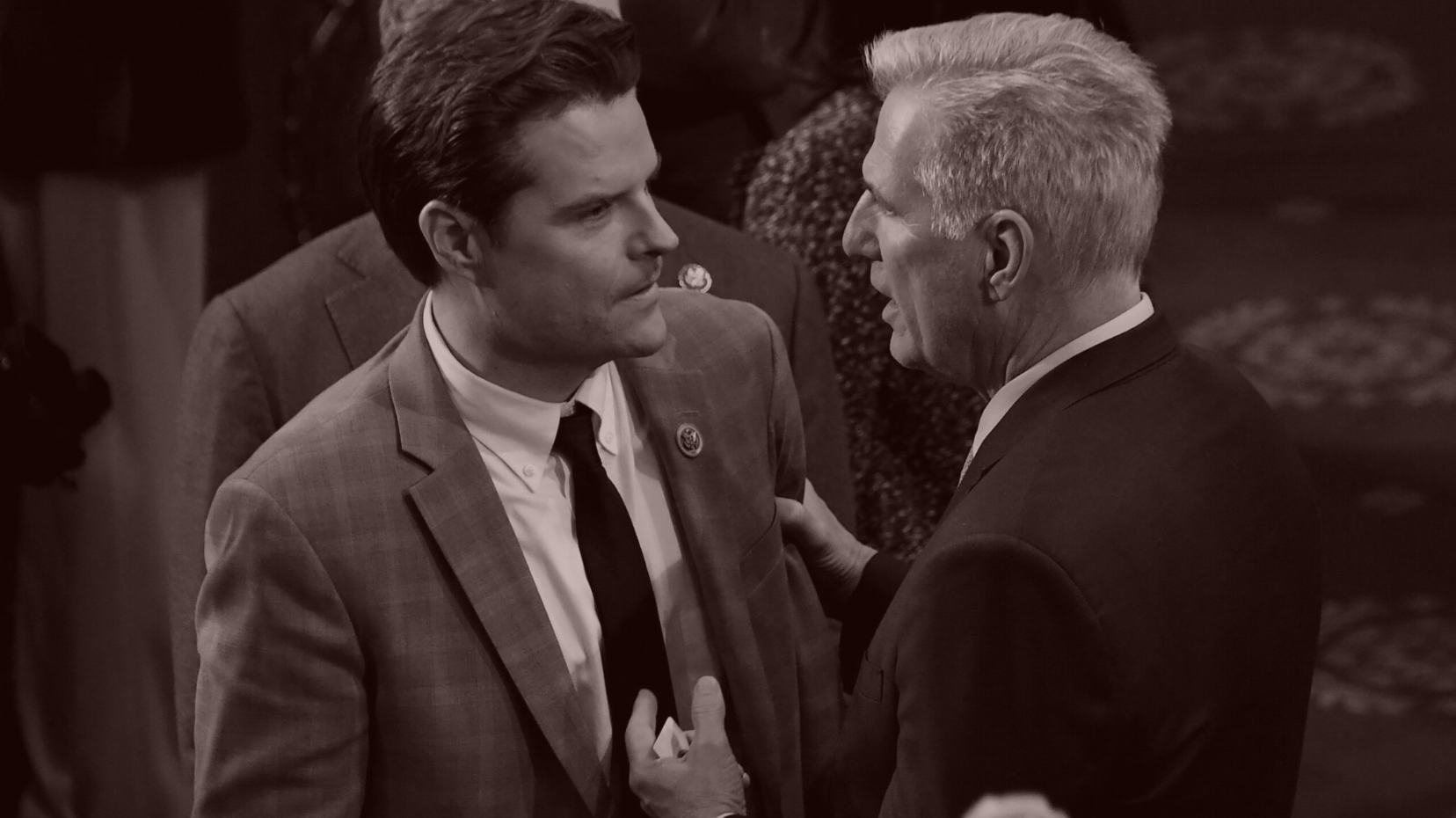
Perhaps most terrifying for Democrats, as Biden prepares to confront Republican leaders at the White House next week, is the prospect that the House G.O.P. comity holds. Indeed, when I recently spoke with sources connected to the so-called Taliban 20—the group of far-right representatives who took McCarthy’s speakership hostage in exchange for a power-sharing agreement earlier this year—they expressed something I have frankly never heard from any of them: admiration for McCarthy and trust that the man they once considered the ultimate RINO can deliver for them. “McCarthy’s coalition government is more stable than either the media or the Biden administration would like to believe,” a source close to The Twenty told me.
False solidarity, perhaps—and McCarthy did lose two members of his five-vote majority—but if there are hidden cracks in the alliance, nobody is speaking out of school. Even the Center for Renewing America, the far-right think tank that previously backed The Twenty in their efforts to extract concessions from McCarthy, offered up praise. “I do think that McCarthy has played things very well, up until this point, and I think he has a chance to be a historic speaker if he continues to do so,” a spokeswoman for the Center told me.
Members and allies of the original Taliban 20 group were particularly energized that McCarthy had adopted the anti-“woke and weaponized” budget cuts proposed by Renewing America director Russ Vought—which would slash funding for D.E.I. programs and initiatives, among others—as opposed to Social Security or Medicare, a red line for Donald Trump and the MAGA base. Other aggressive proposals, such as cuts to Biden’s student loan forgiveness programs and the full clawback of remaining Covid era funds, helped get the plan across the finish line. “The truth is, we’re simply returning spending to pre-Covid levels,” Rep. Chip Roy said in a video expressing the group’s culture-war-inflected thinking. “We don’t want to subsidize corporate cronyism and Chinese solar panels.”
The White House has said the proposal is a nonstarter, but the G.O.P.’s hardliners seem hellbent on making sure McCarthy can push his package—or something very much like it—through. Even Treasury Secretary Janet Yellen’s dire warning that the U.S. would breach the debt limit on June 1, months earlier than originally anticipated, has not shaken their resolve. “She’s a political appointee, she’s hawking the party line,” a source close to The Twenty shrugged. “I think [the Biden Administration] still thinks they can bully [McCarthy] into caving.”
It helps their cause that the relatively moderate Senate Republicans, held tightly by Mitch McConnell, have publicly vowed to let McCarthy handle negotiations. However, if McCarthy surrenders to Biden on any of the cultural issues that The Twenty care most about—or if McConnell expresses a desire for some changes to the McCarthy budget—then they are ready to take out their sword and go for his head again. After all, his current budget (the Limit, Save, Grow Act of 2023) passed by only one vote, with four Republicans defecting—including two members of The Twenty, Matt Gaetz and Andy Biggs. He would be plunged into public MAGA hell if the larger group decided it was in their interest. “[He’s] in huge trouble back home because he’s got a five seat margin,” said the Center for Renewing America spokesperson. “And they can take him out in a second if they wanted to.”
And now check out my Puck partner Teddy Schleifer’s excellent piece about the inner workings of Joe Biden’s effort to raise $2 billion for his re-election—and what various G.O.P. billionaires are feeling about DeSantis. Sign up for his private email, The Stratosphere, here… |
| Biden’s $2B Sausage Factory & Three Comma DeSantis Concerns |
|
| At around 9 a.m. on Saturday morning, Tom Steyer, the billionaire hedge fund manager, climate activist, and onetime presidential candidate, slipped into a room in the recently-rebranded five-star Salamander Hotel. Steyer was one of 120 or so Democratic bundlers and mega-donors who had come to Washington to meet Joe Biden’s re-election team and hear his most senior advisors—Jen O’Malley Dillon, Steve Ricchetti, Mike Donilon, Emmy Ruiz, Julie Chávez Rodriguez, and Ron Klain, among others—lay out their plan for victory. It was an amusingly understated atmosphere in a hotel basement ballroom, especially considering that the presentation was limited to people who raised or donated $1 million to support Biden’s campaign last time around. But attendees got a boxed Biden-Harris mug, some pasta, some KIND bars, and plenty of access.
The event was heavier on ego-stroking than insider details, based on conversations with a half-dozen attendees. While Biden worked the photo line just across from Jeffrey Katzenberg—who was busy with some gripping-and-grinning of his own—there was no announcement about whether Katzenberg, or anyone else, will serve as Biden’s national finance chair. Some attendees were similarly disappointed that the campaign didn’t reveal who will win the race for finance director, although D.N.C. fundraiser-in-chief Michael Pratt—the favorite for the latter role—earned rave reviews for the two-day confab, raising expectations that he’ll soon get the nod.
The weekend was a Politics 101 refresher for the Biden bundling network, which is hoping to raise north of $2 billion this cycle, in part by sweet talking their networks of lukewarm friends and business contacts into cutting checks for up to $900,000 for the 80-year-old president. (Biden’s age is a frequent source of groaning even among his bundlers, despite their own median age.) The prior evening, Biden and Kamala Harris hosted a cocktail reception and formal dinner, just in time for some bundlers to hit the White House Correspondents Dinner party circuit. Harris, another occasional source of donor groaning, received good reviews. But the real workday was Saturday, when Biden bundlers sat in on a half-dozen sessions over six hours on topics like digital fundraising and communications strategy, getting previews of ads and watching White House officials get awkward when they were posed campaign-related questions they weren’t legally allowed to answer.
Democratic officials were on surer footing when they were in control of the pitch. Sam Cornale, the executive director of the D.N.C., explained to donors just how much Trump would have to spend to raise $1—speaking in the familiar V.C. language of LTV and CAC—while reassuring them that his organization wouldn’t have to do the same. D.N.C. chair Jamie Harrison hyperbolically claimed that a $1 donation today has the same value as $100 four months before Election Day. Most importantly, the Biden people walked donors through math showing why this cycle would be the most expensive ever, greasing the wheels for the asks to come.
The real subtext of these briefings, after all, is to convince donors that their opinions and advice truly matters to campaign brass. Some cynics would argue this is essentially a con, wherein candidates buy off donors, and not the other way around, by creating the false impression that their thoughts on Ukraine or on climate change hold as much weight in Washington and Wilmington as they do when candidates drop into Holmby Hills or River Oaks. Regardless, the Biden mission was apparently successful. Biden’s team is preparing to press for a big round of early six-figure donations—an intimate 25-person, $1.5 million event in New York is in the works, I hear—and the Salamander Hotel lovefest was, by all accounts, a winner with the high-dollar crowd. “These things can be boring,” said one person who has been to many of these. “And it wasn’t.” |
|
|
| Meanwhile, the mega-donors on the Republican side have no such coordination. They face a more complicated year ahead as they weigh whether to gamble on a Trump challenger like Ron DeSantis or Nikki Haley, or to throw in early with the former president, still the dominant frontrunner for the G.O.P. nomination. Donors feel plenty of 2016 deja vu: Aides to Ted Cruz (now working for DeSantis) are pitching potential backers on the notion that their candidate is the one true conservative alternative to Trump; donors are fretting that too many non-Trump candidates will split the field; Chris Christie is contemplating a run, etcetera.
Over the last eight years, however, a few new donors have emerged who could shake up the G.O.P. fundraising universe and, potentially, the Republican primary field. One of the most chattered about in G.O.P. fundraising circles is Robert Bigelow, a 78-year-old Nevadan who initially made his money in commercial real estate, including the Budget Hotels chain, before investing his money into aerospace, including research into U.F.O.s and… life after death. Over the last two years, Bigelow has shot out from nowhere to become one of the country’s biggest donors—spending almost $50 million last cycle to elect Joe Lombardo as governor of Nevada. He is now preparing to do the same to elect DeSantis. Last year, Bigelow gave $10 million to the governor’s re-election campaign, an account with $86 million that will probably soon be transferred over to the DeSantis super PAC, Never Back Down. Bigelow then gave another $20 million to the super PAC last month, making him the largest known donor of the presidential campaign. “I will give him more money and go without food,” Bigelow told Time last month.
Then there is Peter Thiel, who Reuters reported last week “won’t fund candidates in 2024.” No disrespect, but the Reuters “exclusive” was massively oversold. As I’ve reported, Thiel’s interest in being a G.O.P. powerbroker was never really true. And he is just plain tired of Republican politics after spending $35 million, and a tremendous amount of his personal political capital and energy, on boosting Blake Masters and J.D. Vance during the 2022 midterms. He went 1-for-2, and associates told me after the midterms that he was feeling “blackpilled” about politics and what he could achieve with his money. Thiel has jettisoned his main political adviser and, as I reported a few months ago, has declined to get involved in the presidential race for now, even turning down a recent request from the Trump super PAC for money. Still, Thiel has not made any final decisions, I’m reliably told. (How could anyone at this point in the cycle, especially when Blake might run again?)
Perhaps the most closely-watched new mega-giver is Ken Griffin, the Chicago-to-Miami transplant who runs Citadel and has donated $10 million to back DeSantis in Florida. The Times reported last week that Griffin has soured a bit on DeSantis recently, which syncs with my own intel. Griffin, I’m told, has privately conveyed in recent months that he has been unhappy with how DeSantis has handled the Disney situation (which he’s also said publicly). “I think he doesn’t like the retaliatory aspect of how DeSantis handles things,” said my source, who has spoken with Griffin. Nevertheless, this person predicted that Griffin would ultimately back DeSantis: “I don’t see anyone else on the playing field that he would support.”
It is a familiar dilemma for major Republican donors who want to beat Trump: Who, exactly, can do it, and how do they get their other rich friends to agree with them? There don’t appear to be many viable non-DeSantis options for now. The 2016 G.O.P. primary taught major donors the perils of incoordination, after all. Democrats have the luxury of coordination by default; Republicans, this time around, might have to force it. |
|
|
|
| FOUR STORIES WE’RE TALKING ABOUT |
 |
|
 |
|
 |
|
 |
| Lazard Anxieties |
| Dissecting a trifecta of Wall Street plotlines. |
| WILLIAM D. COHAN |
|
|
|

|
 |
|
|
|
Need help? Review our FAQs
page or contact
us for assistance. For brand partnerships, email ads@puck.news.
|
|
|
|
Puck is published by Heat Media LLC. 227 W 17th St New York, NY 10011.
|
|
|
|