Welcome back to The Varsity. I’m John Ourand, holding down Puck’s
satellite office in the Hamptons for the next couple of days. Yes, I’m in town for Jessica Reif Ehrlich’s great annual Media in Montauk shindig. If you see Marchand, please remind him that the cabana wine cooler won’t restock itself!
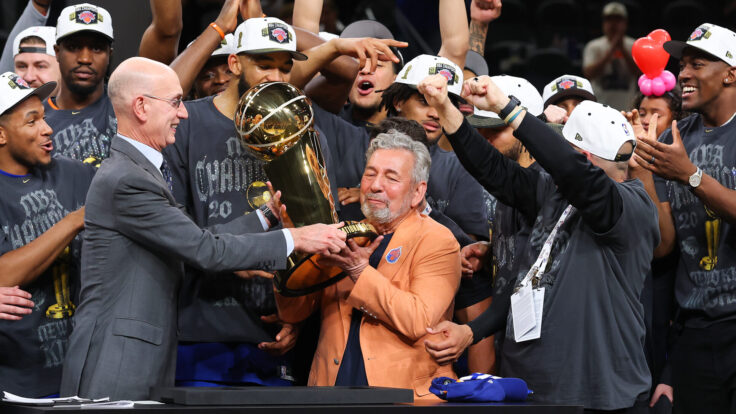
Monday night at MSG really was one for the books—big stars in a packed arena for a huge game. I spent the pregame hanging out courtside with giddy ESPN and NBA executives. With a historic franchise, massive star
power, and the country’s biggest TV market in play, not even an errant Wemby elbow could knock the smiles off their faces.
In tonight’s issue, we continue our commitment to bringing you tomorrow’s podcast today, with a preview of my scintillating conversation with LightShed partner Rich Greenfield about the latest NFL kremlinology: Netflix outbidding YouTube for games, what it all means for current rights-holders, and the mounting fears in the
industry that Roger Goodell is already turning the screws on the league’s partners.
Also mentioned in this issue: Tom Brady, Troy Aikman, Stephen A., Scott O’Neill, Joe Buck, Jimmy Pitaro, Pat McAfee, Ari Emanuel, Mark Shapiro, and more… |
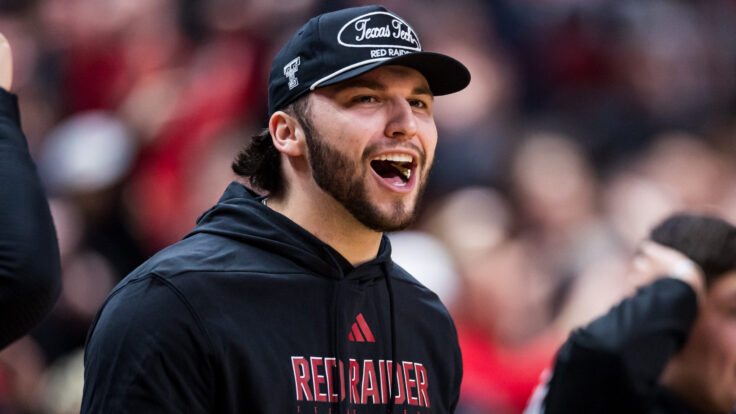
- The $60 million man: Pat McAfee recently hired Ari Emanuel and Mark Shapiro to represent him, and the ESPN star is now staring at a potential $60 million annual deal, per a good Marchand scoop today. While that figure may take your breath away, ESPN is
essentially paying a licensing fee for McAfee’s show, which his company produces every weekday afternoon. (The first two hours appear on ESPN and YouTube, and a third hour airs exclusively on YouTube.) ESPN is also paying for his celebrity; McAfee has become the biggest star of one of Bristol’s most profitable programs, College GameDay. And, per Marchand, he will do more NFL programming should this deal go through.
Under chairman Jimmy Pitaro, ESPN has shown that
it is willing to cough up big money for stars—and to pay a premium for everyday talent whose content performs across platforms. When he needed to upgrade ESPN’s NFL booth, Pitaro committed to pay more than $30 million combined for Joe Buck and Troy Aikman. They’ve gone on to sign walking Instagram Reel Stephen A. Smith (also repped by Shapiro) for close to $30 million per year, and are about to re-up McAfee for much more. Turns out there’s a lot
of value in those viral field goal attempts. - Have I got a deal for you!: I really don’t want to spill much more ink on LIV Golf, which has taken on a kind of dead-man-walking vibe since the Saudis said they were getting out of the business back in April. At the time, the country’s sovereign investment fund said that it would underwrite the tour through the end of the year, but even that commitment seems to now be in doubt. When asked during a CNBC
appearance today if the tour had enough money to put on its final four tournaments this year, C.E.O. Scott O’Neill said, “What I can guarantee is a heck of a return if you come invest in this business.”
O’Neill did go on to say that he took the Saudis at their word when they said funding will last through the year. (“They have been very public about funding us through the season,” he said.) Of course, the sports business is filled with monied executives who base decisions
on their passion as much as they do on Excel spreadsheets. O’Neill is in the market looking for around $350 million to keep the lights on. Can’t knock a guy for trying. - Big Ten malaise: A few industry folks took umbrage at my contention that Michigan’s deal to play Duke in Miami—thereby circumventing the Big Ten’s Fox deal—offered a good illustration of the raw feelings that remain between the school and the conference. Several media executives said
the move was more about capital optimization in the N.I.L. era than a blatant middle finger to the conference. “The people that set up these types of games are getting more creative, and we’re going to see this happening a lot more frequently until the conferences get better at nailing this down,” one said. In this case, Amazon will carry Michigan and Duke from Miami because the state of Florida falls outside the Big Ten’s territory.
These loopholes have existed forever, and the
TV networks essentially played a “gentleman’s game” where a given conference’s home network would get the game one year and the other’s home network would get it the following year. “Fox and ESPN essentially worked out a détente on this,” one executive said. But now a streamer is in the mix. And not just any streamer: Amazon swung and missed on Big Ten rights a couple of years ago. So not only is this a story about the tension between a conference and one of its most powerful schools, it is
also about the tension between traditional linear TV and deep-pocketed streamers. Everybody happy now?
|
|
|
|
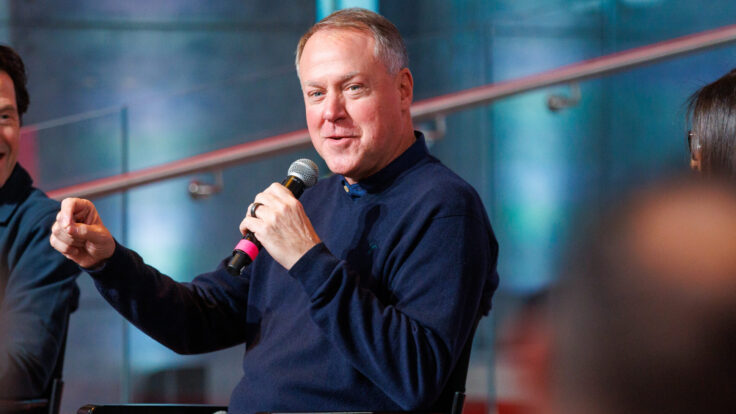
Rich Greenfield, the LightShed partner and sports guru, weighs in on the looming
NFL rights renegotiation bonanza: who wins, who blinks first, and why the league still has all the leverage in the post-cord-cutting era. |
|
|
|

| John Ourand
|
|
|
|
Just four months ago, following the Super Bowl in February, YouTube seemed like the frontrunner to
land a coveted five-game package of regular-season NFL contests. YouTube executives were happy with their results from the season, including their exclusive São Paulo game. And, of course, YouTube can afford to pay whatever it costs to land any package, let alone a five-pack. But about a month ago, Netflix suddenly picked up those games, leaving YouTube empty handed.
Immediately, some rights-holders worried that the powerful streamer would prove to be more bark than bite when it
comes to investing in sports rights. But LightShed Partners’ Rich Greenfield doesn’t believe that the sports business should read too much into the NFL deal misfire. I spoke to Rich for tomorrow’s episode of the Varsity podcast—a conversation we’re giving you a lightly edited preview of tonight. |
John Ourand: What’s your perspective on what’s going on right now
with the NFL and the broadcasters?
Rich Greenfield: The most interesting development over the past month or so was YouTube not getting games after what appeared to be an incredibly successful game down in Brazil last year. It was surprising to see YouTube—and yes, they still have Sunday Ticket—out of broadcasting linear live games on their own. It was certainly not something we expected. Netflix came in and appears to have outbid YouTube, which is hard to imagine given
the scale of Google today. But financial discipline is real. YouTube doesn’t have a dual revenue stream model the way Netflix does.
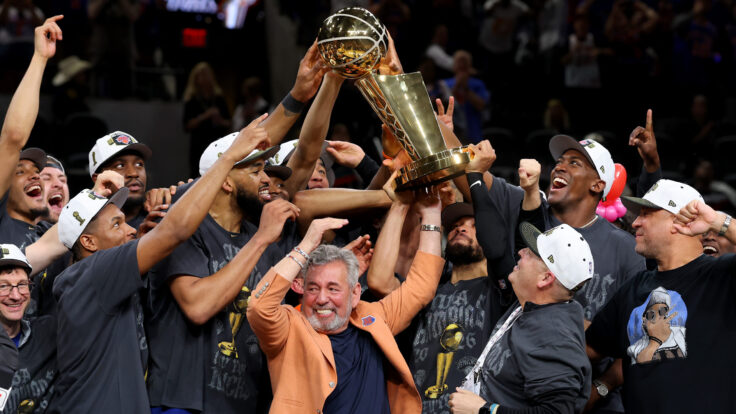
What’s interesting now is that the Netflix deal goes through 2029, which coincides with the date when the NFL can opt out of its broadcast TV deals. It feels like the NFL is saying: if you don’t renew by fall or winter of 2026, who knows what happens in 2030? My guess is, seeing the excitement around sports right now—you think about what’s happening in New
York right now with the NBA championship—it’s hard to imagine the current partners not trying to lock the NFL in for as long as humanly possible.
What does YouTube’s lack of a deal mean for YouTube and sports? What should other leagues like MLB or the NHL take away from this?
YouTube is still spending a heck of a lot of money on Sunday Ticket, so it’s hard to say they’re out just because it didn’t win a five-game package. The NFL clearly has a strong interest in
developing multiple partners; the way sports rights work, you need more bidders than packages. Just like they built up Amazon for a number of years before they got Thursday Night Football, I believe the NFL is very interested in building their relationship with both Google/YouTube and Netflix. The NFL sold a huge package to YouTube in Sunday Ticket; it had not sold a huge package to Netflix—it went from two games to five.
The NFL needs the tension. The NFL wants
to have more bidders because it wants to really rethink what happens in 2030. The risk for linear TV is, what if the packages look different? Could the NFL create more of an event package? Netflix is clearly telling the NFL that they like events. It doesn’t want a traditional linear package. Could you have two opening day games? Could you have two Thanksgiving, two Christmas, maybe two wild cards? How could you recompose packages?
Just because the packages look the way they do now does
not mean that’s what they’ll look like in 2030 and beyond. And I think that’s the ultimate leverage that the NFL has, is fear of change. If I’m a broadcast partner, I probably really like what I have now, and the last thing I want is anything to change. |
“The
One Thing That Truly Matters”
|
What’s the likelihood that the NFL will move away from broadcast?
The
reality is, there is no league that has put as many games on broadcast TV, and is [more of] a believer in broadcast TV, than the NFL. I don’t think that’s going to change anytime soon. The entire broadcast model relies on the NFL. I can’t imagine CBS, NBC, ABC… these businesses don’t exist the way they do if they don’t have NFL rights. They’re going to want to recut these deals sooner than later. And my guess is before the end of 2026, these deals get recut in some form.
There’s a
risk for broadcasters if they wait until 2029, but there’s also a risk if they come to the table now and the NFL wants a billion dollars more a year.
The NFL is only going to do something that’s a win-win for their partners; destroying your partners doesn’t create a great long-term business. But when you hear that MLB is renewing in 2028, the NHL is talking about an early renewal—if the NFL doesn’t buy out those options, maybe it’s a 2027 event. I’d be very surprised if by 2027
this didn’t happen. The way this historically works is you recut the deals, the costs go up, and then if you’re a broadcaster or a cable provider, you have to work with all of your partners, whether that’s Charter, whether that’s YouTube TV, and you need to basically alter those deals to afford the step up in cost. And my guess is that it will continue to drive the pricing of all of these bundles higher and higher. Sure, it leads to more cord-cutting, but ultimately it gets passed on to
consumers in that the bundle keeps getting more expensive.
Who is best situated right now among the TV companies and streamers?
Amazon is in an interesting position. They were the incremental bidder that probably helped drive costs up last time. But here’s the thing: If Amazon didn’t have the NFL, they’d be fine. The story doesn’t get worse without the NFL. Yes, it hurts their advertising business, but there’s no investor buying or selling Amazon because of the
NFL. That puts Amazon in a very different place than everybody else.
I’ve been struck by the fiscal discipline the streamers have shown.
Look at NBC and the NBA. You can’t actually make the math work. ESPN did not need the NBA. ESPN gets its affiliate fees because of the NFL, not the NBA. There is a really important differential here: Streaming is interesting and helps these companies build an ad business. There’s no way Amazon or Netflix is building advertising
without the NFL, but it is not existential to either of them. They will both survive and flourish with or without the NFL. That’s very different from the others. |
The
Cord-Shavers Are Coming
|
I’ve been interested in Charter’s approach to the business—creating a big bundle with all
the broadcast and cable channels and a lot of the streamers. Has Charter figured something out? Has cord-cutting bottomed out?
Pay TV is in sub-70 million multichannel homes, but cord-shaving is a bigger and bigger deal. Charter is zagging where everyone else is zigging. While DirecTV and YouTube are doing skinnier bundles, Charter is doing the super-deluxe bundle: all the channels plus all the streaming. The jury is still out.
If it was working so well, you’d think Comcast would copy it. They haven’t. And if you wanted to watch every NFL game, buying all the streaming services for six months would be far cheaper than Charter, unless you want all those other channels. For the first time, consumers have real choice.
It sounds like a tough road for linear TV executives.
On the flip side, the bundled experience is still a better viewing experience. Most people I know have dropped cable for
YouTube TV because it’s just better. My biggest struggle with ESPN Unlimited since launch: How do you build a single-party streaming service? You only get so many games, and people still want to flip between games, watch a different college football game. Having multiple channels aggregated together is still really powerful.
I think if those NFL deals don’t get recut, and somebody loses the NFL in 2030, that’s when you’d actually worry about the future of linear TV. But that’s exactly why
they renew: to perpetuate the health and longevity of linear. |
No Cheap Seats today since we ran long. See you all on Thursday,
John |
|
|
|
Join Puck’s chief political columnist, John Heilemann, as he roams the corridors of power and influence in America on
this twice-weekly interview show, taking you beyond the headlines with the people who shape our culture: icons and up-and-comers, incumbents and insurgents, moguls and machers in the overlapping worlds of politics, entertainment, tech, business, sports, media, and beyond. The conversations are rich and revealing, unrehearsed and unexpected… and reliably impolitic. A Puck-Audacy joint, new episodes drop every Wednesday and Friday. |
|
|
|
An essential, insider-friendly Hollywood tip sheet from Matthew Belloni, who spent 14 years in the trenches at
The Hollywood Reporter and five before that practicing entertainment law. What I’m Hearing also features veteran Hollywood journalist Kim Masters, as well as a special companion email from Eriq Gardner, focused on entertainment law, and weekly box office analysis from Scott Mendelson. |
|
|
|
Need help? Review our FAQ page or contact us for assistance. For brand partnerships, email ads@puck.news. You received this email because you
signed up to receive emails from Puck, or as part of your Puck account associated with {{customer.email}}. To stop receiving this newsletter and/or manage all your email preferences, click here. |
Puck is published by Heat Media LLC. 107 Greenwich St., New York, NY 10006 |
|
|
|
|