 |
 |
| Ding dong, it’s The Best & The Brightest, coming in hot with a dispatch from the trenches of the culture wars. It’s been a while since I (Tina) have reported on the halls of Congress and, specifically, the 20 Republicans who held Kevin McCarthy’s speakership hostage. While they haven’t made much noise in the months since the speakers’ election, the newest iteration of the Taliban 20 are gearing up for the debt ceiling fight—and have no qualms about blowing up the economy in order to destroy woke libs.
P.S. In other D.C. news, my colleague Teddy Schleifer, who has been dominating coverage of Jeff Bezos’s quest to buy the Washington Commanders, broke some news this morning about his bid. (And sign up for his stellar newsletter, The Stratosphere, if you haven’t already.) |
 |
| The Taliban 20’s McCarthy To-Do List |
| “There’s no reason for the 20 to negotiate against what was already agreed to,” Gaetz told me, regarding the grab bag of promises they extracted in exchange for supporting Kevin McCarthy’s speakership in January. “We shouldn't have to pay twice for the same hostage.” |
|
|
|
| Congress hadn’t been back more than a few days from its March recess when The New York Times kicked a Capitol Hill hornet’s nest with a story insinuating that Kevin McCarthy, the Speaker of the House, had lost his faith in Jodey Arrington, the Budget Committee chair, to actually deliver the party’s budget. “More than half a dozen people familiar with his thinking” told the Times that McCarthy regards Arrington as incompetent; others said he had called Steve Scalise, his No. 2, “ineffective,” and so on. So much for party unity.
The House G.O.P. proposal, of course, will be a mostly symbolic document—a framework for the spending cuts that Republicans will demand in exchange for increasing the debt limit before the U.S. government runs out of money this summer. But it’s also the critical test for McCarthy’s tenuous leadership, which he secured in January by the skin of his teeth after a grueling 15 rounds of voting. If McCarthy can’t unite his conference around a set of principles, and then navigate budget negotiations with Biden, he risks blowing up his speakership.
Matt Gaetz, the unofficial spokesperson of the so-called Taliban 20, the loose confederation of MAGA-inflected politicians who stalled McCarthy’s leadership bid, waved away the Times mudslinging as fake news. “I’m not entirely sure it’s true, to be honest,” Gaetz told me. “I don’t see anyone putting their names to those reports and it is not like McCarthy to dog his colleagues.” But when I asked about the party’s struggles to coalesce around a strategy that would appease his conference’s right wing—including members, like himself, who support McCarthy on an openly quid pro quo basis—Gaetz conceded that there is, indeed, a long way to go. “The framework that I’ve heard to date isn’t enough,” said Gaetz, referring to the laundry list of demands the Twenty had put to McCarthy: stripping the federal government of diversity initiatives, defunding or defanging the F.B.I., curbing the D.O.J.’s ability to investigate civil rights issues, etc. “And I think many of the people who saw it as part of the speaker contest are likely to feel the same way.”
It’s a concern that was echoed by other sources familiar with the thinking of McCarthy’s antagonists, as well as their populist, anti-woke allies outside of Congress, who say that most of the current budget proposals that are being circulated within the House G.O.P. conference don’t go far enough. “It’s not going to be the ‘conservatives’ who have to come to the table,” an official at the Center for Renewing America, a think tank affiliated with the Twenty, told me. “It’s going to be McCarthy, because conservatives own the table.”
Members are playing their cards close to the vest, for now, and even Gaetz—once McCarthy’s prime antagonist—is being sorta polite. But the Gaetz-adjacent bloc knows they have the leverage over McCarthy to make his life hell. “There’s no reason for the 20 to negotiate against what was already agreed to,” Gaetz told me. “We shouldn’t have to pay twice for the same hostage.” |
| A MESSAGE FROM INSTAGRAM |
|
 |
| How can families create positive Instagram experiences together?
Family Center supervision tools allow parents to view who their teen follows and who follows them, manage daily time limits and be notified when their teen shares reported accounts, once Supervision is set up.
Explore 30+ tools. |
|
|
|
|
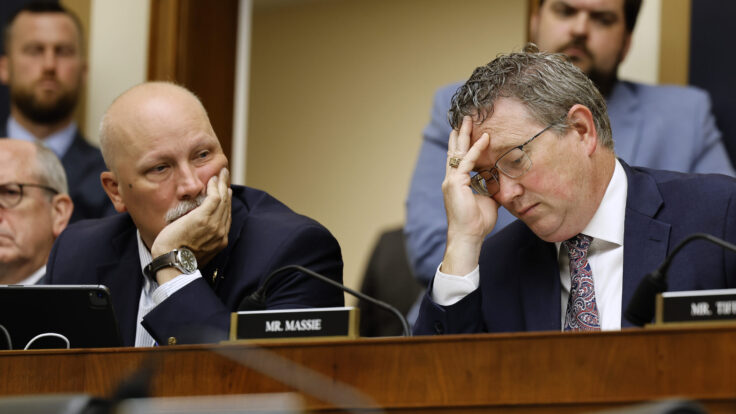
| We still don’t know the full extent of what McCarthy promised, or to whom, in the course of those final rounds of voting. It is, in fact, an ongoing source of contention that McCarthy didn’t put anything down on paper. But McCarthy knows, as do the Twenty. And while this group doesn’t perfectly overlap with the budget hardliners—Thomas Massie, a staunch McCarthy supporter, is also strapping on his tricorne hat—they do share a key outside ally: Russ Vought.
Vought, the former director of the Office of Management and Budget under Donald Trump, is the founder and president of the aforementioned Center for Renewing America, which has become a major intellectual hub for the growing nationalist-populist phenomenon in Washington. “Honestly, more than any particular member, I would pay very, very close attention to what Russ Vought is signaling because that will inform the approach of probably a dozen members on the inside, ranging from people like Chip Roy to Dan Bishop to Anna Paulina Luna,” said a G.O.P. strategist close to the original Twenty and their allies. “Russ has functionally become the think tank of the Freedom Caucus, or at least the part of the Freedom Caucus that wants to fight” the establishment, this person continued. “[He’s] establishing an appropriate winning condition, which is the way that he’s chosen to frame it: defunding woke, weaponized government.”
And Vought, unlike Arrington or McCarthy, has put forward a fully realized FY 2023 budget proposal, which details exactly where and how the Center for Renewing America and its allies in Congress would nip and tuck the federal government. Among the targets for significant cuts are the F.B.I. and D.O.J. (specifically the “highly politicized” Civil Rights Division and the Environment and Natural Resources Division, as well as the “woke and weaponized Community Relations Service [Office]”); the “radical” Office of Environmental Justice; and community grant programs with any “focus or emphasis on equity, race essentialism, or radical gender theory.”
And there’s more: The Center for Renewing America also proposes that the National Science Foundation’s budget be cut by 54.4 percent, eliminating grants to research universities who have adopted “radical gender and race ideology and infusing it in every aspect of their activities.” Their proposed budget for Veterans Affairs would cut all government-sponsored abortions and gender-affirming care. The U.S. Army Corps of Engineers budget would be preserved only if they end “meritless D.E.I.-based hiring practices.” There are even proposed cuts to NASA, the most popular government agency, specifically to “wasteful Science programs (climate, carbon tracking, etc.) that are unrelated to deep space exploration.”
Notably, the CRA’s budget framework is more populist than fiscally conservative. They explicitly, and repeatedly, state that they will not slash the budgets of Medicare and Social Security, two behemoth entitlement programs extremely popular among MAGA voters. In fact, the CRA proposes a 6 percent increase to the budget for the Department of Homeland Security, to help lock down the border and complete Trump’s wall. (With the caveat that the D.H.S. budget eliminate “woke” departments like the Office of Intelligence and Analysis, which has studied the rise of rightwing extremism.) “Is that going to completely rectify our entire budget problem? No,” said the G.O.P. strategist aligned with the Twenty. “Is it a good framework for low hanging fruit, to decrease government spending and go after some of the enemies of the right? 100 percent.”
For House Republicans dead set on placing culture war issues at the center of the looming debt ceiling fight, the CRA budget blueprint is a foundational document. And, for the first time in a long time, they control the relevant legislative chokepoints to place their demands on the agenda. As a spokesperson for the CRA pointed out to me, both Chip Roy and Ralph Norman—members of the original Twenty—as well as Massie, sit on the House Rules Committee, which decides which legislation gets put on the floor to a vote, and which bills do not. “This is a very new world,” said the spokesperson, “and I don’t think reporters on Capitol Hill fully understand the power that the 20 actually have.” |
|
|
| “There Is No Such Thing as ‘Default’” |
|
| The fluid membership and rapidly-evolving nature of the Twenty is, no doubt, a headache for McCarthy, a characteristically temperate institutionalist whose speakership can be put to a vote of no confidence at just about any time—one of untold Faustian bargains McCarthy made to secure his job. Unfortunately, it’s hard to keep the government funded and functional with a dagger always at your throat. Wall Street is mostly downplaying the risk of a debt ceiling blowup, but the reality is that it only takes five members of Congress—the margin of McCarthy’s majority—to set fire to the bond market because they decide the budget is just a hair too woke for their liking.
Even sources who are deeply enmeshed in these closed-door discussions aren’t sure how the debate will play out, or which members of the original 20 anti-Kevins might decide to gamble on playing debt-ceiling chicken. “The way to think about the [original] 20 is as the set of people who are willing to contradict the mainstream on the discrete issue of the McCarthy [speakership] fight, but the people who are going to be a thorn in the debt ceiling are going to be utterly unique to that fight,” the strategist close to the Twenty told me. Some of the group’s original members are not as invested in the intricacies of the budget fight, while non-members, like Massie, will be crucial to the negotiations.
Regardless, the real danger for McCarthy remains that the House contains more than a dozen members who aren’t responsive to leadership at all—far outside the margin of safety for a Republican party that would like to avoid blame for the U.S. defaulting on its debt in a pre-election year. Even “[Jim] Jordan doesn’t have the kind of pull, nor do I think he would exercise the kind of pull needed, to actually keep a lot of those Freedom Caucus members quiet on some massive debt ceiling increase fight, or whatever,” noted the strategist. “That goes to the core of how a lot of these members define themselves and their personal sociology.”
And anyway, it’s easier to buck leadership when you’ve got other, outside sources of funding and support in your corner. “There is no such thing as a ‘default,’” the CRA spokesperson told me, previewing the sort of argument that may become commonplace on the right as the debt ceiling looms. “That’s a weaponized term that the establishment uses.” |
|
|
|
| FOUR STORIES WE’RE TALKING ABOUT |
 |
|
 |
| Elon Debt Roulette |
| Notes on Twitter’s looming debt fiasco, Apple’s M&A “wallet,” and more. |
| WILLIAM D. COHAN |
|
 |
| Salame’s Zipped Lips |
| Notes on an S.B.F. mystery, tech G.O.P. bundling wars, and Bezos’s Commanders interest. |
| TEDDY SCHLEIFER |
|
 |
|
|
|
 |
 |
|
|
| Need help? Review our FAQs
page or contact
us for assistance. For brand partnerships, email ads@puck.news. |
|
| Puck is published by Heat Media LLC. 227 W 17th St New York, NY 10011. |
|
|
|