{{ 'now' | timezone: 'America/New_York' | date: '%b %d, %Y' }}
|
|
|
|
Welcome back to The Best & The Brightest. I’m Leigh Ann
Caldwell.
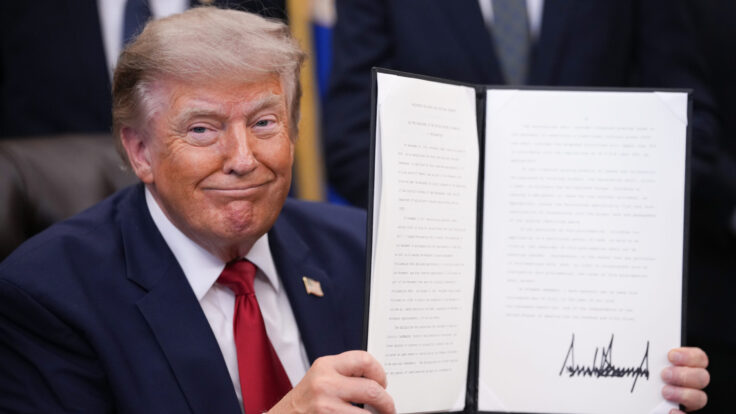
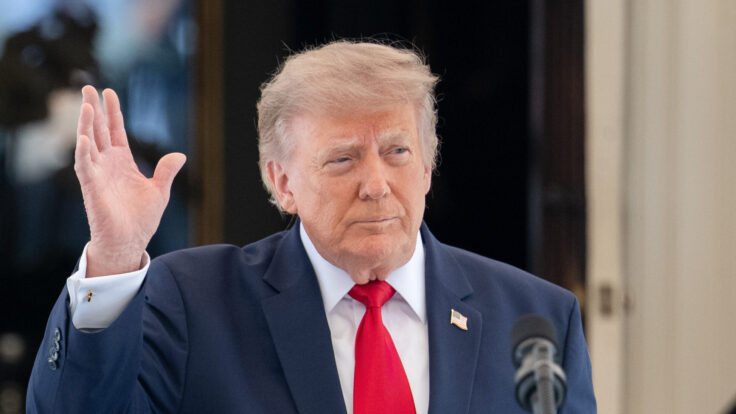
President Donald Trump made a lot of news today, telling reporters in the Oval Office that the bipartisan housing bill was “a yawn” and “so unimportant compared to the SAVE America Act.” As I reported yesterday, Trump delivered essentially the same message to Senate Republicans during their
closed-door screamfest last week. (Subscribe here if you don’t already have full access to this scoopy, way-ahead-of-the-news-cycle email. As always, if you have tips or feedback, you can reach me on Signal at LAC.89.)
Meanwhile, as the white smoke rose from the Supreme Court, Trump declared that the justices had delivered “the Greatest Increase in Presidential Power in the last 100
years.” (They did decline to expand executive authority over independent regulators to include the Fed, though.) The court also broke with the president on mail-in ballots. Buckle up. It’s shaping up to be a very long summer.
In today’s issue, my pal John Heilemann shares his characteristically candid conversation with Sen. Chris Van Hollen about the Iran war, his 2028 litmus test, and more. Plus, up top, Marianna Sotomayor and I have the
latest on the House Democratic establishment’s emerging civil war with the left.
Also mentioned in this issue: Hakeem Jeffries, Darializa Avila Chevalier, Bill Cassidy, Claire Valdez, Melat Kiros, Joe Biden, Diana DeGette, Adrian Espaillat, Benjamin Netanyahu, Michael Bennet, Dan Goldman, Alexandria
Ocasio-Cortez, Phil Weiser, and more.
|
- Hakeem
Jeffries’s red scare: Tomorrow, a D.S.A.-weary Democratic establishment will be closely watching the results in Colorado, where the 30-year congressional veteran Rep. Diana DeGette is facing a serious primary threat from 29-year-old democratic socialist Melat Kiros in her solidly blue Denver district. Meanwhile, Sen. Michael Bennet, who is running for governor, has encountered a harder-than-expected challenge from Attorney General
Phil Weiser in a race where the litmus test has become which candidate can advance the case against Trump most aggressively.The anti-establishment message has become difficult to ignore, particularly in deep blue districts where Democratic voters have turned on incumbents they feel aren’t fighting hard enough. Last week, of course, five-term Rep. Adrian Espaillat was unexpectedly toppled by democratic socialist Darializa Avila
Chevalier in Upper Manhattan; Rep. Dan Goldman was trounced by D.S.A.-backed challenger Brad Lander; and retiring Rep. Nydia Velázquez’s handpicked successor lost to D.S.A. member Claire Valdez. D.C.C.C.-backed candidates also fell in central California and Maine’s 2nd congressional district. “The core of this electorate isn’t ideologically driven—even within the Democratic primaries,” Democratic strategist
Jesse Ferguson told me. “It’s opposition to the status quo and nominating candidates who know the old way of doing this isn’t working.” Even House Democratic leader Hakeem Jeffries acknowledged today that Democrats face an “unsettled electoral environment.”
Of course, Jeffries is somewhat downplaying the internal divisions facing his caucus and state delegation when New York’s socialism-curious trio arrive in Washington next year. “At the end of the day,
our ability to actually enact positive change for the people that we represent in New York City and in New York State is directly tied to our ability to take back control of the House,” he told Marianna when she caught up with him on the Hill today. Yet in a particularly telling comment, Jeffries added that he will strive to ensure that the historically “close-knit” New York delegation maintains its “cohesiveness.”
Notably, Jeffries told Marianna that he has yet to talk
with Avila Chevalier since she won her primary last week, but he has connected with Valdez and Lander. While we don’t yet know the specifics of how Jeffries will approach integrating these new members into the delegation, one thing is for sure: He’ll need confidantes and peacemakers to make sure the new members understand the rules of the road. Many are pointing to Rep. Alexandria Ocasio-Cortez as a potential asset—the sort of peacemaker relationship that Nancy
Pelosi didn’t have when the original “Squad” barreled into Congress during the last blue wave.
|
|
|
|
Maryland’s senior senator unloads on Trump’s Iran war, predicts an ugly fight over the
midterms, and explains why Gaza will be a defining debate of the 2028 Democratic presidential primary.
|
|
|
|
About a month ago, something unusual happened. A federal elected official published an op-ed in The
New York Times that didn’t induce immediate narcolepsy. Instead, it stuck with me for weeks. Titled The Hard Truth My Party Needs to Face, the piece argued that Donald Trump’s approach to the Israeli-Palestinian conflict had plainly failed, but it also conceded that the Democrats’ strategy had been equally
ineffective—and possibly more insidious. For years, the author wrote, Democrats had “provided reflexive and unconditional support to Israeli governments, even as their actions have increasingly undermined American interests and values.”
Then he turned his attention to 2028 and fired a shot across the bow of his party’s presidential field. Democratic primary voters, he warned, won’t trust any candidate who lacks “moral and strategic clarity”—especially one who voted to send
Benjamin Netanyahu bombs during his assault on Gaza, or plans to bring back Biden-era advisors “who whitewashed the truth” and “refuse to acknowledge their complicity” in what the author described as “ethnic cleansing” and “genocide.”
The author was Chris Van Hollen, Maryland’s senior
senator, who serves on the Appropriations, Budget, and Banking committees. But it’s his seat on Foreign Relations that Van Hollen seems to hold most dear. Unlike many (most?) of the senators who delight in bloviating endlessly about world affairs on cable news, Van Hollen actually knows more than a thing or two about foreign policy—an inheritance he took from his father, a career foreign service officer who rose to become an assistant secretary of state and U.S. ambassador to Sri Lanka; his
mother, who worked at both the C.I.A. and the State Department; and an upbringing in far-flung global locales from India and Pakistan to Turkey.
On the latest episode of Impolitic, Van Hollen joined me for a wide-ranging conversation about the arguments in his op-ed, as well as the thorny branches stemming from it—Trump’s apparently inevitable bid to steal the midterms, the Democratic Party’s shifting center of gravity, and much more. (For those of you keeping score at home, Van
Hollen recently said that he is “kind of kicking the tires a little bit” on a 2028 presidential bid himself.) As always, this conversation was condensed for length and edited for clarity. You can find the whole megillah here.
|
“No End to
Their Groveling”
|
John Heilemann: Last week, Trump claimed the U.S. has “total control” of
the Strait of Hormuz—only to see Iran strike a container ship soon thereafter, setting off a four-day stint of further attacks and counterattacks by the U.S. Doesn’t seem like total control to me. How about you?
Sen. Chris Van Hollen: Absolutely not. There’s not even a factual dispute here. But again, the president likes to imagine things and lie to the country. For him to suggest our blockade was somehow a great thing for the country obviously
makes no sense, since it drove up prices here at home. This war has been a disaster from the start for many reasons. It’s an illegal war, and it showed exactly what many of us predicted—Iran would use its geographic and strategic position to shut off the Strait of Hormuz, which is precisely what they did. And then Trump’s supposedly brilliant idea was that we’d shut it off, too. That didn’t help anybody.
As we hit the four-month mark with the war, we have a vaguely worded
memorandum of understanding and a 60-day ceasefire that’s barely holding. What scenarios do you see unfolding in the coming months?
I can only tell you what I hope they’re pushing for: that the ceasefire holds and we get some kind of agreement. But I’m very much of the belief that there’s no good way to end a bad war. When you’re in a hole, the best thing to do is stop digging yourself deeper. The M.O.U., of course, isn’t perfect, and the
original sin was Trump tearing up the JCPOA— which, by the way, his first administration had certified Iran was complying with. But they tore it up and here we are. I want to see this war end. I could quibble with an imperfect M.O.U., but I do hope it goes through and we end this war.
From the jump, this war struck me as a lot of things, but first and foremost just completely nonsensical. And it’s unfolded accordingly, and with predictably bad results, ever since. In your
study of history and experience in the Senate, have you ever seen a stupider war than this?
I’ve used that exact word—“stupid”—from the get-go, and every day proves us right. It allowed Iran to use its geographic leverage exactly as we predicted. We now have a more militant version of the Iranian regime in place. Prices have gone up, American soldiers have died, thousands of civilians are dead. Prime Minister Netanyahu said a few weeks into the
war that he’d been wanting to do this for 40 years—and he finally found a president who was stupid enough and reckless enough to do it with him.
Last week, four of your Republican colleagues voted with Democrats for the second time recently to put a war powers resolution on the Senate floor, directing Trump to stop hostilities with Iran without congressional authorization. Trump lost his shit, went up to the Hill, got into a shouting match with outgoing Louisiana Senator Bill
Cassidy, who seemed at first to stand his ground—then changed his vote a few hours later. WTF?
The bottom line is that at the end of the day, these guys still bow down to Donald Trump. There’s no end to their groveling. What’s really scary is that this is the Article One branch of government, and the Republican caucus essentially let the president come in and scream at them. It shouldn’t be news that a member of the caucus actually stood up for
himself, which Cassidy momentarily did, before completely caving and reversing himself on the single most important power Congress has—the power regarding war and peace. That’s the story of the Republican Party today.
Do your Republican Senate colleagues think Trump is actively trying to undermine their prospects in the midterms? Because he sure seems to be.
If you look at everything Trump’s doing, you’d think he was trying to
sabotage them. But here’s the thing: They may well be thinking that Trump’s trying to sabotage them, and yet they still sit in a caucus meeting and let themselves be berated by the guy undermining their chances in November, and nobody says a peep except Bill Cassidy—who then caves. This is why our country is in such danger. You can see how a democracy can crumple and fold when one party turns into a personality cult. That makes the rest of our jobs all the more important to push
back.
Trump invoked the phrase “national emergency” the other day on Truth Social, in a post about vote-rigging and the SAVE Act, which struck me as another case of him telegraphing his punches. Are we headed toward a world where Trump declares some kind of national emergency as a pretext for messing with the midterms to keep control of Congress?
I think there’s no doubt Trump is trying to rig the midterms, and the SAVE Act was
part of that strategy. It would make it extremely difficult for millions of American citizens to vote. I’m quoting him, he said, “It would guarantee Republicans the midterms.” It signals he’s prepared to do anything to steal the elections. That’s why the battle over the post office and absentee ballots matters so much. Everything he’s telling us is that he’ll do whatever he can. So we need to be prepared. Most of all, we need to keep warning the American people. They can try to rig elections,
but if we have a huge turnout, we can overwhelm those efforts. And telling people you’re going to take away their right to vote is often a powerful motivator to get them out to vote.
|
Israel has moved to the center of Democratic politics, as we saw last week in the New York primaries,
and as we’re seeing in the Michigan Senate primary and elsewhere. Your op-ed opens by saying Democrats need to face a hard truth: that while Republicans have failed on the issue of Israel and Palestine, so has your party—by providing unconditional support to Israel even when its government’s actions have undermined American interests and values. What spurred you to weigh in now?
This piece was way overdue, but the circumstances on the ground have
become so terrible that there’s urgency to do it now. I was among the first to say, after the heinous October 7 attacks, that Israel had every right and duty to defend itself against Hamas. But what we witnessed in Gaza went far beyond targeting Hamas—it was collective punishment of the people of Gaza. We also see the deepening occupation in the West Bank, violent settlers killing Palestinians and driving them off their land with the complicity of Israeli security forces—and all of it with the
complicity of the United States.
For those of us who truly believe human rights, self-determination, and the rule of law are central to our foreign policy, the unconditional support to the Israeli government is unsustainable, and the American people are sick of it. It’s also a matter of whether people are willing to tell the truth and take the political hits. At some point, you have to say the truth matters. I have to look myself in the mirror every day, and I’m not going to keep
pretending it’s okay for the U.S. to provide an open checkbook to Netanyahu and that crowd.
Your message is mostly aimed at your own party—which faces both the opportunity and the necessity of reimagining its foreign policy into 2028 and beyond. Against that backdrop, do you agree with the many Democrats who believe the Biden administration’s handling of Israel and Gaza after October 7 was the single greatest failure of Biden’s foreign
policy?
I do. And to be clear, Biden got a lot right on foreign policy, with respect to Ukraine and a host of other issues. But this was a great stain. They completely failed to exercise American leadership and leverage to prevent the genocide in Gaza. Beyond the damage to human beings in that moment, it undermined our credibility around the world. The Biden administration claimed human rights were central to our foreign policy. So when they
refused to use leverage to protect human rights in Gaza, it told the world we didn’t mean it. It exposed a double standard. It’s easy to call out human rights abuses in China; it’s much harder with a partner and historic friend.
You write that “primary voters won’t trust any Democratic presidential candidate who does not have a record of moral and strategic clarity on these issues, especially if … he or she voted to send Netanyahu bombs while his government imposed a total
blockade on Gaza. Nor will they support a candidate who plans to re-enlist senior Democratic decision makers who whitewashed the truth during the Biden administration and refuse to acknowledge their complicity.” Say more about all this, please.
I remember vividly we had a vote on a joint resolution of disapproval saying we wouldn’t send more bombs to Netanyahu while he was starving people and cutting off
humanitarian aid. It was the clearest possible example of where we should make a statement—and we got just 15 Democratic senators. If you can’t say no to sending bombs during a complete cutoff of humanitarian aid, that’s a bad sign for someone who wants to be a leader, including exercising moral leadership.
There’s a place for people to recognize the huge mistakes they made and to acknowledge them honestly. I believe in redemption. But people shouldn’t just skate by this, and the
congressional races in New York prove that voters won’t let them.
|
|
|
|
Join Emmy Award-winning journalist Peter Hamby, along with the team of expert journalists at Puck, as they let you in on the
conversations insiders are having across the four corners of power in America: Wall Street, Washington, Silicon Valley, and Hollywood. Presented in partnership with Audacy, new episodes publish daily, Monday through Friday.
|
|
|
|
The industry’s go-to source for unflinching reporting on the trillion-dollar business of artificial intelligence—perhaps the
single most important new technology of our time. Ian Krietzberg, the powerhouse journalist behind The Deep View, delivers twice-weekly insights into the latest dealmaking and breakthroughs in A.I., and how the intersecting worlds of finance, entertainment, media, and politics are being transformed in its wake.
|
|
|
|
Need help? Review our
FAQ page or contact us for assistance. For brand partnerships, email ads@puck.news.
You received this email because you signed up to receive emails from Puck, or as part of your Puck account associated with {{customer.email}}. To stop receiving this newsletter and/or manage all your email preferences, click here.
|
Puck is published by Heat Media LLC. 107 Greenwich St., New York, NY 10006
|
|
|
|
|