Welcome back to What I’m Hearing, and a big welcome to those who have joined the WIH community
lately for our new music coverage. Tell a friend, or go ahead and subscribe them here as a treat.
First, a correction from Thursday: Former Universal exec Ron Meyer was discussed in an Epstein files email as planning to fly to New Orleans with Ghislaine Maxwell, not Jeffrey Epstein. Meyer never flew with Epstein. Apologies to him for the
error.
Tonight, let’s decode today’s wild development in the Warner Bros. sale. Plus: why bidders for the Casey Wasserman agency may not get what they’re craving, and some stark lessons for Hollywood about monetizing fandom.
Programming note: This week on The Town, Lucas Shaw and I previewed who might buy
Wasserman, DramaBox exec Shicong Zhu explained the microdrama boom, and Survivor boss Jeff Probst offered advice to his Season 1 self.
Subscribe here and here.
Not a Puck member yet? Just click here. Got a news tip or an idea for me?
Just reply to this email, text me, or message me on Signal at 310-804-3198.
Discussed in this issue: Casey Wasserman, Stephen Colbert, Simon Halls, Kendrick Lamar, Bob Iger, Pat McAfee, Bryan Lourd, Tyree Dillihay, Anjali Sud, Suzanne Scott, Mike De Luca, Kelly Bush Novak, Brendan
Carr, Ed Sheeran, Eddy Cue, François-Henri Pinault, Ryan Gosling, James Talarico, Ari Emanuel, SZA, Adam Mosseri, Josh D’Amaro, Joe Rogan, Michael Eisner, David Remnick, Pam Abdy, Lenzo Yoon, Mike Bidgoli, Joon Choi,
Hasan Piker, Wooseok Seo, Clavicular, and… the Jeremy Piven Experience.
But first…
|
Who Won the Week: Paul Feig
|
The veteran director’s The Housemaid, with $374.1 million worldwide, just passed Sinners to
become the highest-grossing original movie of 2025. (Well, it was a popular book, but still a crazy number.) And it cost just $35 million.
Runner-up: Director Tyree Dillihay and Sony Animation, whose Goat broke the originals curse with a $35 million domestic four-day opening, trouncing last year’s Pixar debut of Elio at half the cost.
Second runner-up (sigh): Suzanne Scott, the Fox News C.E.O., whose network
generated 2.2 percent of all TV usage in January, per Nielsen—the same share as ESPN, which spends billions of dollars on sports rights.
Honorable mention: Mike De Luca and Pam Abdy at Warner Bros. Wuthering Heights underperformed a bit in the U.S., but the $37.5 million four-day weekend (and big $88.5 million worldwide) represents their ninth No. 1 opening in a row, going back to A Minecraft Movie last
spring.
Speaking of Warners and today’s news…
|
The Very Unofficial Warner Bros. Spin Translator
|
Thanks to the latest (what is it… tenth?… eleventh?) sweetened offer from Paramount, the Warner Discovery
board has reopened its closed Netflix deal. But only for seven days, presumably so Paramount can make its “best and final” pitch to shareholders. Here’s what the three companies said via their publicists, and what they really meant…
Warners: “During this period, WBD will engage with PSKY to discuss the deficiencies that remain unresolved and clarify certain terms of PSKY’s proposed merger agreement.”
Translation: “Pay us
more.”
Netflix: “While we are confident that our transaction provides superior value and certainty, we recognize the ongoing distraction for WBD stockholders and the broader entertainment industry caused by PSKY’s antics.”
Translation: “Seriously, people, how many times do these spoiled brats need to be told they’re not good enough?”
Paramount: “Paramount already offers a higher value of $30 per share, all-cash and a more
expeditious and certain path to closing a transaction.”
Translation: “Trump picked us months ago.”
Netflix: “WBD stockholders should not be misled into thinking that PSKY has an easier or faster path to regulatory approval—it does not.”
Translation: “You think Larry and David are the only ones who can rub cocoa butter on the president’s belly?”
Paramount: “The WBD
Board has chosen to avoid making the customary determination … that Paramount’s superior $30 per share all-cash offer ‘could reasonably be expected to result in’ a superior proposal.”
Translation: “Seven days? Really? We were hoping to drag this out long enough to get a regulatory approval to wave in everyone’s face.”
Netflix: “Separately, the foreign funding behind PSKY’s bid is already raising serious national security
concerns.”
Translation: “Surely you remember the Saudis, right? The bonesaw guys? That’s them. Co-owning CNN.”
Paramount: “Although the board’s actions are unusual, Paramount is nonetheless prepared to engage in good faith.”
Translation: “We’re still suing if we don’t get this deal. But, yeah, we’ll pony up by this time next week.”
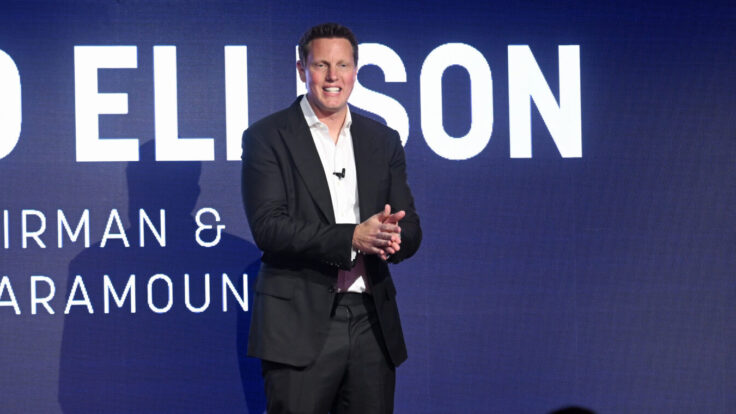
More: David Ellison now has a week to answer one question: If the
Netflix deal is sure to be blocked, why not just wait for that to happen and buy Warners for a lot less?
|
“But what I can show you is what we always show when we have to pull material at the last
minute—this tasteful nude of Brendan Carr.”
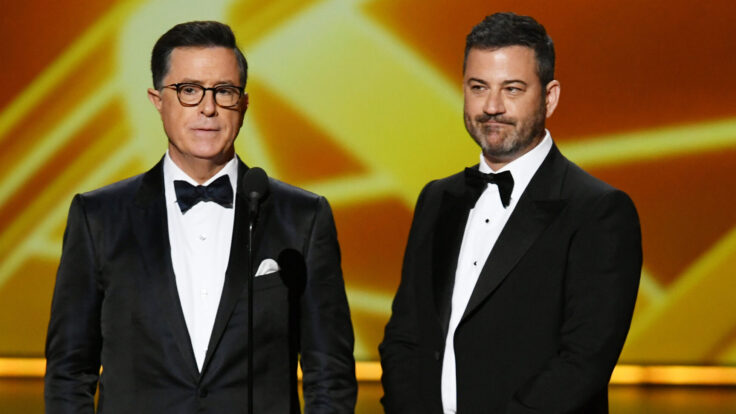
—Stephen Colbert, revealing in his Monday monologue that CBS lawyers barred Texas State Representative James Talarico from appearing as a guest out of fear of Carr’s F.C.C. “equal time” threats. (CBS claims Colbert could have also hosted Talarico’s rivals; instead, the interview was posted here…
and will now be watched by waaay more people than if it had aired normally. Nice work, everyone.)
Now for a Casey Wasserman update…
|
Let the Wasserman Bidding Begin
|
Casey Wasserman and his backers at Providence were interviewing prospective
bankers this weekend as more than a dozen potential bidders began reaching out about the suddenly available agency. Wasserman is insisting to colleagues that the 4,000-employee sports and talent firm is worth more if sold whole, rather than carved up into pieces, but that’s debatable, and the ultimate disposition will depend on who bids what for the assets. The valuation spin game around town is already out of control, so I asked Puck’s new music contributor, Dave Brooks, for an
assessment…
Dave Brooks: Multiple industry sources I spoke to pegged the value of Wasserman at more than $1 billion, though that number could change dramatically based on how the parts are divided. Excel, a smaller sports agency, sold a majority stake to Goldman Sachs in November at a reported valuation of nearly $1 billion. I’m told Wasserman generates more than $1 billion annually in revenue and more than $100 million in EBITDA. (Its debt load is unclear.)
A
prospective buyer of all of Wasserman would get the sports and music agencies, plus the various marketing and branding firms that represent about half of its business, plus the Brillstein talent management firm. A strategic talent agency buyer, such as CAA, run by Wasserman’s longtime pal Bryan Lourd, or WME, co-founded by his arch nemesis Ari Emanuel, would need to divest Brillstein to comply with California law. CAA, which was valued at $7 billion in the 2023
sale of its majority stake to François-Henri Pinault, is likely too big to acquire all of Wasserman without incurring regulatory scrutiny. WME backer Silver Lake is an NFL owner, so it could not take on Wasserman’s football business. Both Casey and Providence, which owns 60 percent of the company, have blocking rights and are expected to hold out to get the big price tag they’re looking for.
Those signing the N.D.A. to view the books might be surprised to find out
Wasserman Music isn’t as lucrative as they thought. Yes, touring is generating eye-popping grosses. Four of the top 10 acts for 2025, according to Billboard Boxscore, are Wasserman clients: Coldplay ($464.9 million), Kendrick Lamar and SZA ($358 million), Imagine Dragons ($241.6 million), and Ed Sheeran ($214.5 million). But artists in the nine-figure stratosphere don’t pay close to the typical 10 percent booking fee. Acts in the Coldplay strata
usually have global touring deals in place with promoters like Live Nation and AEG’s Messina Touring Group that effectively hand most decisions to the concert promoter in exchange for a big guaranteed paycheck. That leaves very little actual booking work for the agents to do.
It’s not uncommon for a major marquee client generating $2 million a night to pay just $10,000 per show to the agency, or even less. In fact, many agents sign these big clients not because they expect to bring home
giant commissions, but because they help attract developing clients fielding multiple offers. (A Wasserman rep declined to comment.)
|
$271.6 million
Net production budget of Disney’s 2025 flop Snow White, per new
filings in the U.K. It grossed just $205 million worldwide. [Forbes]
26.5 million
Average daily viewers of NBC’s coverage of the 2026 Olympics across TV and streaming through the first five nights, making it the most-watched Winter Games in 12 years.
[NBC/Nielsen/ MPN]
$10.3 billion
Ad-supported streaming revenue in 2025, up 60.9 percent from 2024, a higher jump than any other home entertainment segment.
[DEG/ MPN]
30 percent
Share of U.S. consumers who cite cutting household expenses as the top reason for canceling a streaming service, up from 26 percent in 2020.
[ Parks Associates]
Now Julia Alexander is here with a great test case for cultivating superfandom…
|
|
|
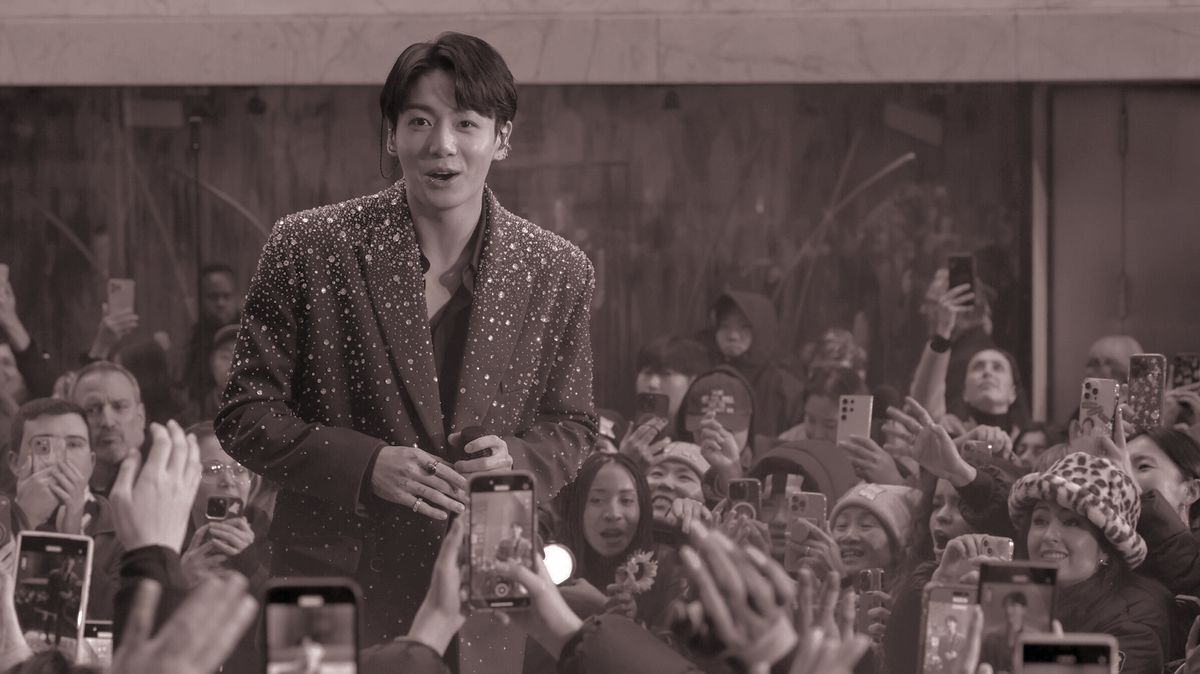
Weverse, a social/streaming hybrid from South Korea that provides exclusive content to BTS
superfans, could offer a roadmap for Hollywood to succeed in a future dominated by YouTube and infinite slop.
|
|
|
Hybe, the South Korean entertainment conglomerate, is best known for its roster of K-pop super-acts: BTS,
Seventeen, Katseye, etcetera. But it’s equally notable for innovations. In 2019, Hybe’s then co-C.E.O., Lenzo Yoon, and Wooseok Seo launched Weverse, a novel social/streaming hybrid platform designed to leverage the parasocial obsessions of their audiences. Today, the bet is simple: Customers pay $24 to $48 a year for access to exclusive live events, merch, and album release parties. For Weverse’s most engaged users, however, the main draw has become the
community itself.
Weverse is still a relatively minor player in a crowded direct-to-consumer space. With just over 12 million monthly active users, the service more closely resembles anime streamer Crunchyroll (17 million paid subs) than Netflix (325 million). But the platform is growing and profitable, powered by a tiered model whereby higher-paying users enjoy community features, including the equivalent of digital clubhouses—sort of like a subreddit dedicated to an artist. At a time
when the media has splintered across a thousand platforms and genres, Weverse is going ultra-niche.
On one level, it’s hard to compare Hybe’s overall business with the likes of Disney or Netflix—large media companies with ultra-diversified content portfolios. But Weverse’s approach could offer critical lessons for a streaming industry struggling with high churn. As Hollywood faces increasing pressure from YouTube and the looming tide of A.I. slop, media executives may want to reevaluate
their superfan playbooks.
|
Joon Choi, the C.E.O. of Weverse, spends a lot of time thinking about attention—the benefits
for companies that can command it at scale, and the risks for those who can’t. Most streamers “put all their own effort [toward making] their businesses work through pure viewership,” Choi told me this month from his office in Seoul. But an engaged audience, he argued, correlates with both higher spending and “a better conversion rate into our more exclusive membership tiers.” While exclusive content may attract casual customers, Choi continued, it’s the sense of community, and the opportunities
for contributing, that keep those users around and encourage them to spend.
“Understanding both sides, attention and connection, is why we’re so focused on understanding the underlying nudging mechanisms for moving those light fans into superfans,” Choi said. “What would be the factor, or the key service element, which can encourage the stronger connection between the fandoms, rather than just scaling content?” In many ways, that’s the billion-dollar question.
|
Hollywood is hardly unaware of these dynamics. Paramount, Netflix, and Disney have all introduced shortform
and user-generated content to make their services feel less like a TV channel. Podcasters and influencers are striking deals with Netflix and Hulu. At Tubi, C.E.O. and former Vimeo executive Anjali Sud and her chief product officer, Mike Bidgoli—who came up through Instagram, Facebook, and Pinterest—have launched initiatives such as “Stubios,” allowing Gen Z audiences to have input during the development of creator-led series and
films.
But in other ways, it can seem like legacy media is taking its fandoms for granted—and is woefully unprepared to defend its slice of the attention economy. Peacock, for example, has barely made any attempt to cater to the devout audience in its Bravo hub. Disney+ offers some perks for members, but it’s mostly things like discounts and sweepstakes. They’re almost certainly leaving money on the table. According to an internal Patreon study, the direct-to-fan segment of the creator
economy is expected to grow from $194 billion in 2025 to $231 billion in 2027—and more than 80 percent of fans were likely to spend additional money each month for access to a community built around a favorite creator, show, or artist.
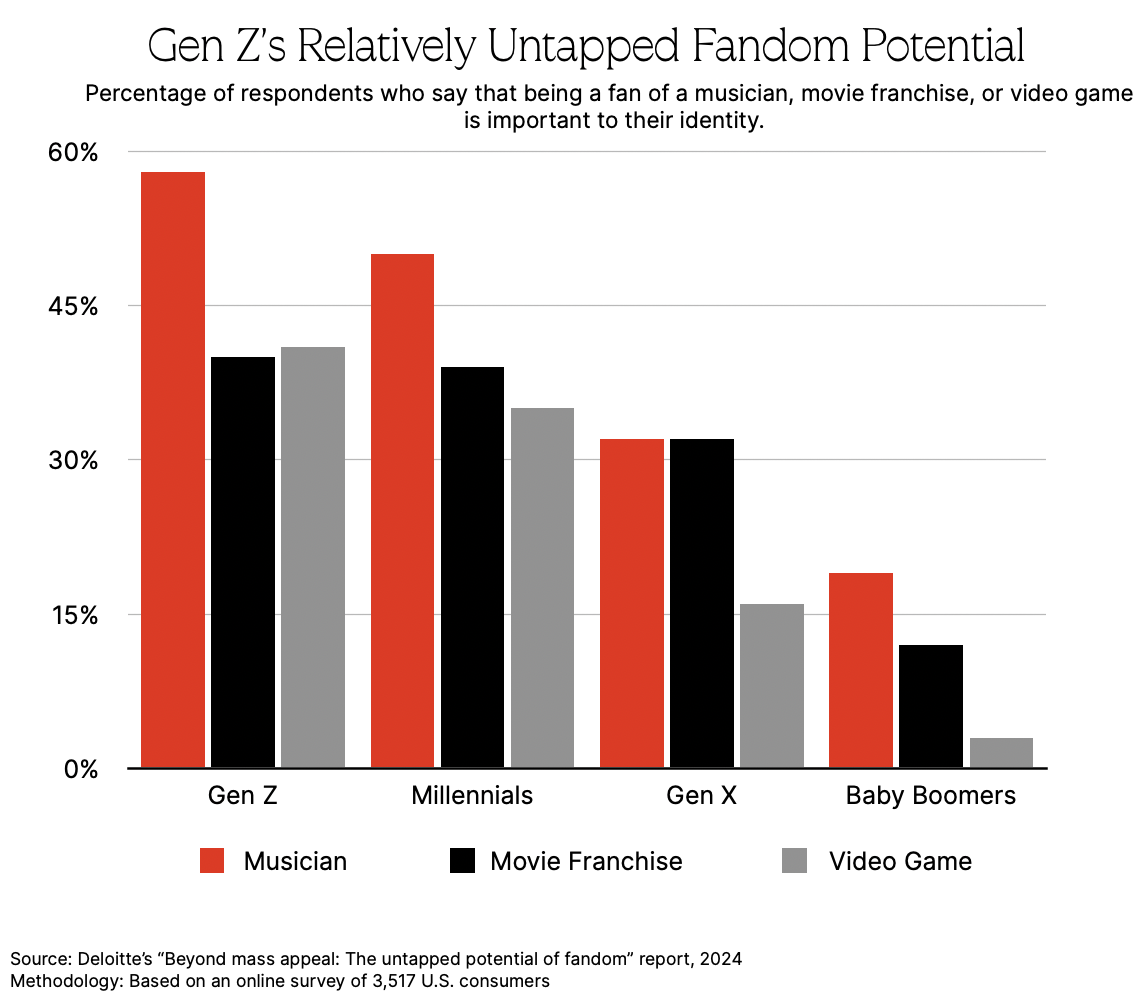
Those numbers align with recent research by Deloitte, which found that more than 40 percent of consumers express fandom through purchases, leading it to recommend companies “consider the intensity of their fan bases (not just the number of viewers) when
considering new investment and monetization strategies.” Indeed, some of the most prolific I.P. to emerge from YouTube over the past few years—such as Skibiddi Toilet, now being turned into a movie by Michael Bay—owes its longevity to active fan creation. More than 35 percent of YouTube viewers aged 14-24 contributed to the creation of an online series or creator project in the past year, according to an internal YouTube study. “A passionate fan base (regardless of size) might
be worth more than an audience of average, casual fans,” Deloitte concluded.
|
Legacy players have an advantage, of course—and YouTube, for all its incredible success, has yet to birth
I.P. on the order of Marvel or Harry Potter or Stranger Things. Needless to say, there are no Joe Rogan or BTS theme parks (although MrBeast experimented with a temporary park in Saudi Arabia last year). But there’s no question that Hollywood could stand some innovation, especially as the industry braces for a wave of infinite A.I. content. “Even though you are successful in acquiring the attention, sustaining the business is another story,”
Choi told me. At Weverse, he’s focused on building both “experience and lifestyle, learning how to weave them cohesively, connecting offline experiences with online content and community.” Weverse’s fan festivals, where digital communities can interact in person, often sell out in Korea, and the company is planning to bring them to the U.S.
Live events are hardly a new strategy, but consumers are prioritizing them more. Concerts are now the music industry’s primary revenue
driver: In 2024, the top 100 tours brought in a record $9.5 billion, and the global live music industry is expected to grow 7.2 percent annually over the next several years, according to Goldman Sachs. Consumer spend on sporting events is up 25 percent compared to pre-pandemic levels, with digital-to-physical crossovers accelerating. More than 60 percent of Gen Z audiences would pay to watch a V.R. game if shown from the player’s point of view, according to a report from sports research firm
WSC, something Apple’s Eddy Cue is surely thinking about with its $750 million F1 deal.
Choi, for his part, doesn’t believe the Weverse approach can work for individual TV or film franchises. “ Friends superfans?” he scoffed. “There are some but not significant enough to build it as a business.” And while there are clearly Friends pop-ups and Sex and the City bus tours that fans do show up for, Choi’s point was more about finding the balance
between investing in the right hybrid communities where digital growth can be achieved (through fostering community and digital goods) alongside real-world activities that build stronger memories and fandom. Finding ways to connect fans around content, rather than simply creating more content, seems like one pathway to success. The Disney board may have had similar notions in mind when they selected parks veteran Josh D’Amaro, who oversees games and is thinking about
movie premieres in Fortnite, to succeed Bob Iger as C.E.O. Meanwhile, Netflix is hosting Bridgerton ball events, while YouTube and Twitch are pushing membership offerings with livestreams by podcasters like Pat McAfee and creators such as Hasan Piker. As Sud said earlier today, fan passion—not just time spent—is the new entertainment metric.
As we were ending our conversation, Choi reflected on the seeming inevitability
of dominant tech platforms—YouTube, Instagram, ByteDance, etcetera—and the rapid advance of generative A.I., including ByteDance’s new Seedance 2.0 tool, which is so powerful and so copyright-infringing that Hollywood studios instantly fired off cease-and-desist letters. “We know we cannot stop it. But on the other side, what we’re focusing on is more about the tangible memory,” he said. “Being a superfan of something or someone is a really rewarding experience. Those needs, and the value
around serving those needs, will only get more important with the A.I. algorithm dominating our world.”
|
Much like OpenAI with Sora 2 last summer, China’s ByteDance is pledging to curb the rampant I.P. infringement
(see: the Cruise vs. Pitt fight) on Seedance 2.0. So I guess this means Disney will be announcing a big deal with Seedance soon? [CNBC]
Looking forward to someday replaying Instagram C.E.O. Adam Mosseri’s testimony this week that social media is not addictive, just
like we do those 1950s videos of Philip Morris executives. [ CNN]
With TV deals in flux and the NFL coming for everyone’s money, it’s not a great time for an MLB lockout. [ ESPN]
Heated
Rivalry got 30 percent of its budget from Canadian tax credits and a $2.3 million grant from the Canada Media Fund. [ Bloomberg]
Disney’s Josh D’Amaro has succeeded with something called “experience intelligence.” Okay…
[ HBR]
Clavicular got brutally profile-mogged by a baldmaxxing jester-writer at The New York Times. [ N.Y. Times]
As Bob Iger exits Disney, Michael Eisner sat for a long profile with Graham Bensinger that reminds us all he revived animation… and took the parks international… and bought ESPN… [ In Depth]
David Remnick succinctly explains how publicists and social media killed entertainment journalism.
[ Pablo Torre]
Speaking of said death, this is funny: I did a Q&A with Interview a couple weeks ago where I mentioned Simon Halls and Kelly Bush Novak as publicists who have lied to me. A reader just tipped me that Simon and Kelly got themselves removed from the article, thus proving Remnick’s point nicely.
[ Interview]
Hurry, tickets for Jeremy Piven’s “Piven Experience” at a New Jersey Italian restaurant (including a free ARISFRRI license plate!) are going fast. [ Instagram]
|
Lots of strong feelings about
my Thursday analysis of the Casey Wasserman scandal. Some examples…
“You would have been wise to start this whole Wasserman story with this paragraph: ‘And it didn’t help that this is the second recent bad-behavior scandal for Wasserman, coming nearly two years after a Daily Mail exposé of the ‘serial cheater,’
including details about consensual relationships with subordinates at his company. Not a bastion of good judgment.’ When men like this get a pass, the behavior continues, and more lives of women are ruined personally and professionally. I guess it is an ‘If you know, you know’ situation with Casey, and unfortunately too many who know let it slide because, well, this is America. He has a daughter, are we not thinking how she feels? What an honorable father she has stomping all over women, in all
ways big and small. Men need not be pigs to be successful, and he deserves no award or to represent America in the Games, unless asking women to wear tight leather outfits is the type of man we want to champion. For that he gets the gold.” — A stylist/brand consultant
“Agree, Ghislaine exchanges are ancient history, but the Daily Mail exposé is not. Optics, as you say, are everything, and the optics say he’s a serial shagger—and with subordinates. He’s a poster boy for
the kind of male Hollywood power dynamic and entitlement a post-#MeToo world was meant to at least push back on. I’m guessing the Olympic committee would rather keep him on board with a padlock on his zipper than open the door for the MAGA morons. What a world!” — Occupation withheld
“Did Wasserman deny those reports or file a [libel] lawsuit? These are relevant questions to the discourse of someone leading a company that has his name on it and the L.A. Olympics.” — A
producer
“For the artists and athletes who left Wasserman because of Casey’s emails from the early 2000s, make sure you stay consistent during your signing meetings at WME/CAA/UTA/IAG and ask to see the emails of leadership during that era too.” — A manager
“Showbidness.” — Another manager
|
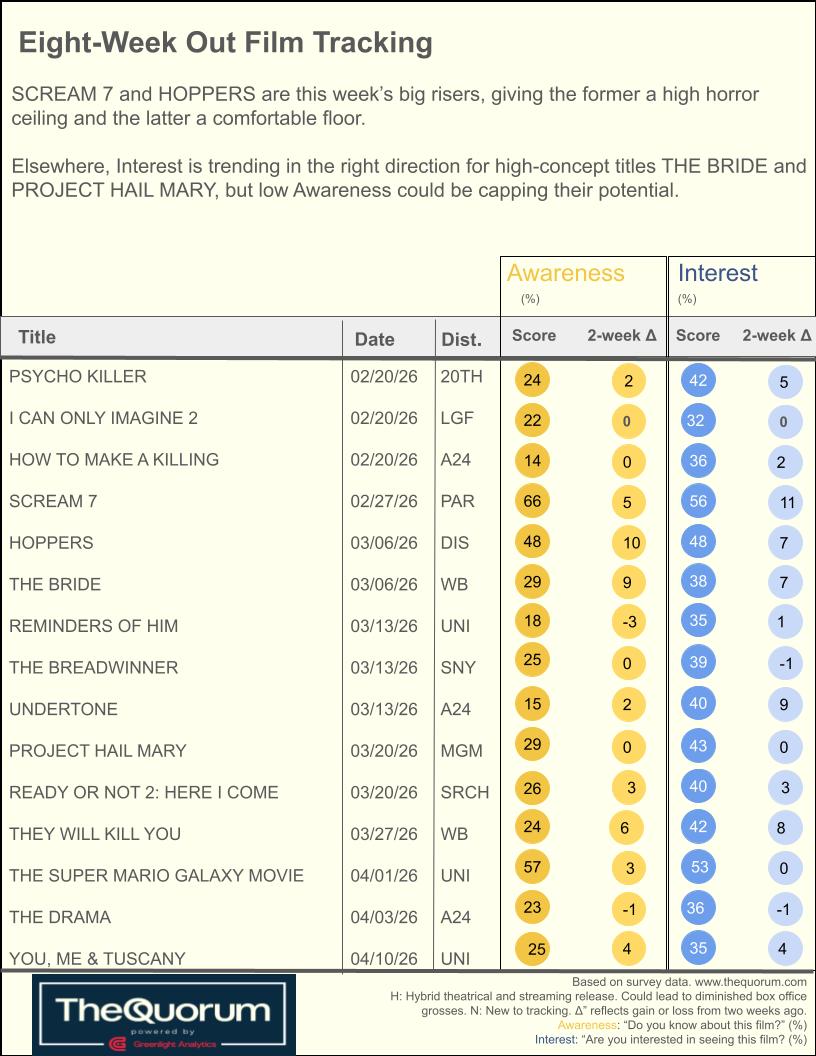
Given the Super Bowl spot and viral Ryan Gosling videos, I’d have thought awareness for
Amazon’s Project Hail Mary would be higher than in the latest early tracking chart from The Quorum…
|
Have a great (short) week,
Matt
Correction: Doug Emhoff’s title was
second gentleman, not first gentleman, as I mentioned Thursday.
Maya Tribbitt contributed research for this issue.
Got a question, comment, complaint, or guesses on how long Anderson Cooper “spends more time with his family” before taking a post–‘60 Minutes’ gig? Email me at Matt@puck.news or call/text me at 310-804-3198.
|
|
|
Join Emmy Award-winning journalist Peter Hamby, along with the team of expert journalists at Puck, as they let you in on the
conversations insiders are having across the four corners of power in America: Wall Street, Washington, Silicon Valley, and Hollywood. Presented in partnership with Audacy, new episodes publish daily, Monday through Friday.
|
|
|
The ultimate fashion industry bible, offering incisive reportage on all aspects of the business and its biggest players.
Anchored by preeminent fashion journalist Lauren Sherman, Line Sheet also features veteran reporter Rachel Strugatz, who delivers unparalleled intel on what’s happening in the beauty industry, and Sarah Shapiro, a longtime retail strategist who writes about e-commerce, brick-and-mortar, D.T.C., and more.
|
|
|
Need help? Review our
FAQ page or contact us for assistance. For brand partnerships, email ads@puck.news.
You received this email because you signed up to receive emails from Puck, or as part of your Puck account associated with {{customer.email}}. To stop receiving this newsletter and/or manage all your email preferences, click here.
|
Puck is published by Heat Media LLC. 107 Greenwich St., New York, NY 10006
|
|
|
|