Welcome back to What I’m Hearing, coming to you from the designated old people area of Spotify’s
Best New Artist party in West Hollywood.
It’s Grammy week, which always arrives in L.A. just as Oscar season is starting to get a bit boring, so tonight is a great time to introduce a music contributor to WIH. Dave Brooks, the veteran music journalist and touring business expert, will deliver occasional news and analysis for us. (Send him tips or complain about Ticketmaster fees at RealDaveBrooks@gmail.com.)
Tonight
he and I have an interesting crosstalk, and he breaks some news about the future of the Grammys show. Plus: I got some demographic data on Melania pre-sales, and one of the more amusing movie producer reunions in town.
Discussed in this issue: Brett Ratner, Mark Canton, Melania Trump, Simon Halls, Victoria Palmer-Moore, Steve Ballmer, Harvey Mason
Jr., Ben Winston, Sabrina Carpenter, Peter Guber, Justin Bieber, Lady Gaga, Pharrell, Pusha T, Michael Rapino, Malice, Post Malone, Lauryn Hill, Kendrick, Bruno Mars, Bad Bunny, Scooter Braun, Hailey, Ariana
Grande, Elton John, Madonna, Beyonce, Harry Styles, Jim Dolan, Danielle Pelland, and… pissed-off Park City people.
Not a Puck member yet? Just click here. Got a news tip or an idea for me? Just reply to this email, text me, or message me on Signal at
310-804-3198.
Let’s begin…
|
- How red is Melania’s audience?: Generally, about 64 percent of domestic box office comes from areas designated “blue” (majority Democrats), and 36 percent from red areas (Republicans). Blame the fact that more theaters are located in and around big cities, which lean blue. But Melania, the first lady’s documentary directed by the noted feminist artist and thinker Brett Ratner, has generated 53.4 percent of its ticket presales from red counties, and 46.6 percent
from blue counties, per data shared with me by tracking firm Entertainment Intelligence. That’s about an 18-point swing from the usual split, so it’s definitely a more rural, older, and whiter audience than a typical film. (Fun fact: The two top-performing counties are Palm Beach, Florida, and Maricopa, Arizona, and the film is overperforming in Houston, Miami, and Orlando/Daytona.) But Melania’s audience is not overwhelmingly from red zones. By contrast, last fall’s
Donald Trump movie The Apprentice broke 81 percent blue to 19 percent red. Apprentice excelled in New York, L.A., and D.C., per that same firm’s data.
- Ratner’s low-key media strategy: Having dealt with Brett Ratner over the years—right up until the MeToo cancellation, his publicist was Simon Halls—I’m a little surprised his ego could resist doing some big comeback interview with a friendly venue, like
Fox News or Joe Rogan. But so far, no on-the-record participation in the various write-around profiles, or any stand-alone press interviews, except walking the red carpet and doing Tom Cruise–style stop-n-chats at tonight’s D.C. premiere. Ratner has a new publicist, London-based Victoria Palmer-Moore of Sodali & Co., so let’s see
whether his willpower holds if Melania is a hit. (When I asked for an interview for The Town, Palmer-Moore responded only, “I’ll discuss with Brett.” Not holding my breath.)
- Guber, Canton, and a Sony 30th anniversary reunion!: The early ’90s at Sony Pictures remains one of the more amusing eras of Hollywood history, when the Japanese took over the old Columbia Pictures and paid enormous sums to Batman producer Peter
Guber and his hairdresser-turned-partner Jon Peters to run the studio. (Spoiler: It ended very badly; if you haven’t read Hit & Run, Kim Masters’ book with Nancy Griffin on the Guber/Peters debacle, do so immediately.) Now two key players of that era are getting back together. For real. Mark Canton, who ran Columbia TriStar under Guber at Sony, tells me he’s joining Guber’s Mandalay Pictures as co-managing
director, running the film side of the business.Yes, it’s been more than 30 years since Canton and Guber last worked together. Guber left Sony in 1994 amid a $3.2 billion loss at the studio (back when $3.2 billion was a lot of money), and Canton was ousted in 1996 after flops like The Cable Guy and Last Action Hero. Guber started Mandalay Pictures and eventually became a powerful sports mogul with the MLB’s Dodgers and the NBA’s Warriors, and Canton has
produced tons of big projects, including 300 and the Power TV franchise at Starz. But now, with Guber about to turn 84 (Canton is 76), the duo wants one more shot at making movies together, though Canton is keeping his Canton Entertainment and his TV business separate. Why this late-career professional reunion for the longtime friends? “We know what we’re doing,” Canton told me this afternoon. “We are gonna be very competitive.”
- Box office
over/under: Turns out 20th Century’s Send Help isn’t really a horror movie as advertised. But critics like it, and pushing the horror elements is smart, so I’ll take the over on the $15 million tracking. I also think Melania lookie-loos will push it over $5 million. Sorry.
|
Now on to my Grammy week chat with Dave…
|
|
|
Music’s biggest night arrives as its contract with
Crypto.com Arena expires, Recording Academy production costs are skyrocketing, and sources say Steve Ballmer wants to lure the show to the crosstown Intuit Dome. Plus: why Harry Styles could be the biggest tour of 2026, the high price of Bieber’s facial paralysis, and whether the Trump guys will kill Live Nation.
|
|
|
Unlike Hollywood with the Oscars, the entire music business convenes around various events tied to Grammy
Week each winter. No better time to debut a new Puck contributor Dave Brooks, a veteran music journalist and touring business expert who will contribute occasional news and analysis from the music world. Tonight, Dave and I go back and forth on several hot topics, including the current hierarchy of streaming platforms, the viability of the Sphere, the financial health of the Recording Academy, and the Grammys’ possible move to a new home—Steve Ballmer’s Intuit
Dome?—after Sunday’s show.
|
Matt: Happy Grammy week, Dave, and welcome to the Puck extended family. I
want to start with the Grammys themselves. This is the last year of CBS’s 50-plus-year relationship with the show, which is bolting to Disney/ABC in 2027 as part of a 10-year, $500 million-plus deal. You were telling me that the Grammys venue could change next year too, is that right?
Dave: Yes. I’m told AEG’s contract to host the Grammys at downtown’s Crypto.com Arena is up after this year’s show. And here’s some news: L.A. Clippers owner
Steve Ballmer is putting together a bid to lure music’s biggest night across town to his $2 billion Intuit Dome. Part of Ballmer’s sales pitch to Recording Academy C.E.O. Harvey Mason Jr. will be Intuit’s fan-first design, with its steep vertical seating and loud acoustics.
|
|
|
A MESSAGE FROM OUR SPONSOR
|
|
|
But Intuit only has about 100 luxury suites, which could be a problem because roughly half
of the $12 million the Grammys generate each year from the current AEG deal comes from leasing Crypto.com’s 172 suites for the night and splitting the proceeds with AEG. The other $6 million comes from tickets—the Grammys manage the sale of roughly 16,000 seats for the event and keep 100 percent of the revenue.
Matt: Not a bad deal. You think the Grammys would leave their home for 23 of the past 26 shows? Downtown L.A. has the Peacock Theater for the
preshow awards and the convention center for the afterparty and MusiCares event. I remember when Grammy Week moved to New York in 2018, it was kind of a disaster, with a much smaller venue for the MusiCares ceremony, bad weather, and the city reneged on some promised incentives.
Dave: I’m told Mason is supportive of an Intuit bid, which would likely apply competitive pressure on AEG at a time when the cost of producing the Grammys has shot up. The Recording Academy’s tax
returns are public, and its most recent filings reveal the 2024 event costs ballooned to $46 million, up 22 percent from 2023 and a staggering 76 percent increase from 2020. Overall, the organization posted record revenue of $107.1 million in 2024, but a $14.7 million loss due to those production costs. Since 2020, the Recording Academy has operated at a deficit in four of the past five years (Covid certainly didn’t help), and sources tell me the board is concerned.
Matt:
Yikes. Why is the show so much more expensive now?
Dave: The Academy’s tax returns do not include a line-by-line breakdown of Grammy-related expenses. They do, however, list the five largest contractors, all production companies, which billed a combined $33 million in 2024, along with $12 million in unspecified “event expenses.” Producer Ben Winston’s company, Fulwell 73, billed the Recording Academy $20.1 million as the lead producer of the CBS
telecast—more than double what Fulwell charged in 2023.
|
Matt: Sabrina Carpenter, Justin Bieber, and Lady
Gaga have been announced as performers, but am I wrong that the Grammys lineup feels a bit less starry this year?
Dave: I don’t think all the performers have been announced yet, but yes, this year feels a little lighter. There’s a lot of buzz for Pharrell Williams and a reunited Clipse, which is Pusha T and Malice, who dropped a record last year—after a 16-year lull—that’s landed them five nominations, including
album of the year. Post Malone, Ms. Lauryn Hill, and Reba McEntire were added for the memorial section of the show. I expect one or two big names will be announced on Friday, maybe Kendrick Lamar or a return by Bruno Mars, both of whom are up for record of the year. Part of the issue is that nearly all the record of the year artists played the Grammys last year. Bad Bunny is up for both record
and album of the year, but he’s playing the Super Bowl in a week.
Matt: Bieber at the Grammys is a big deal, considering he hasn’t performed publicly in two years and not regularly since he canceled his tour in 2022. Does he still owe money to AEG from that cancellation? The speculation is that he’s gonna tour either later this year or in 2027, and that his Coachella headlining performance will kick that off. Is that what you’re hearing?
Dave:
Technically, Bieber owed the money to his former manager, Scooter Braun. Back in 2022, Bieber had to cancel the Justice tour because he was suffering from facial paralysis caused by some serious health issues. AEG had fronted him $40 million and wanted a lot of the money back when he canceled—I heard the figure was $26 million. Braun stepped in and paid AEG the full sum. So Bieber likely owed Braun $26 million, as well as $4 million in unpaid commissions, and last year they
reached a settlement, in part with money Bieber made from selling his music catalog in 2023. (Yes, he’s only 31.)
His Coachella set marks a major return to live for him, as well as a return to relevance for Coachella, which has struggled with ticket sales the previous two years but sold out in a couple days after announcing Bieber. He’s making $10 million off his two Coachella sets and negotiated the gig without an agent, I was told, which saves him a pricey commission. After Coachella,
he is expected to announce a North American stadium tour, although the big question right now is how long the tour will run. There’s huge demand, but he and wife Hailey are being very conservative, and as of now, sources say he only wants to play 10 to 12 shows. A lot of people hope he’ll do more.
|
Matt: Speaking of tours, what acts are industry players most excited about
this year? Bruno and Ariana Grande seem like they’re gonna be standouts. I was just looking at the numbers from last year, and the big acts seem to be getting younger. Only one of the top 10 artists (Post Malone) is under 35, but only one (Oasis) is over 50. I know the older fans have driven the touring business for years because they can afford the top ticket prices, but do you see a real shift in the market here, or will we end 2026 with the Rush 50th
anniversary tour up there with AC/DC?
Dave: This is the youngest top 10 we’ve seen in years! There’s no Elton John, or Rolling Stones, or Bruce Springsteen, or Madonna. Beyoncé, the top draw, is 44, and four acts in the top 10— Kendrick Lamar, the Weeknd, Lady Gaga, and Post Malone—are under 40 and had songs on the Hot 100 in the past 12 months. More
people are spending more money to see contemporary artists with current hits than they have in the past. Second, some acts—like Imagine Dragons and Coldplay—are tapping into underserved markets like East Asia, India, and the Middle East, and they’re being rewarded, in part, by being first. Lastly, fewer big legacy acts are on the road right now. The oldest bands playing stadiums in ’26 are Journey, Mötley Crüe, and Guns N’ Roses.
Matt: Great point. So who are you excited
about?
Dave: Harry Styles is shaping up to be the biggest tour of 2026—he’s basically performing residency shows in major cities on three continents. So far, it’s 10 shows in Amsterdam and London, and 30 shows at Madison Square Garden in New York. More cities are almost certainly coming. BTS, coming off a four-year hiatus, is another huge tour that sold out in seconds.
One thing to watch this summer: Michael Rapino
at Live Nation has warned that the FIFA World Cup, which is scheduled to take place in North America in June and July, will materially impact the number of stadium shows this summer. That’s a one-time blip.
|
|
|
A MESSAGE FROM OUR SPONSOR
|
|
|
Matt: Speaking of Live Nation, its stock is down about 15 percent from its high in
September. Why?
Dave: Despite how Live Nation spins the data, the main two companies that track concert ticket sales—Pollstar and Billboard—have both reported that sales for the year are essentially flat or down slightly. The top 100 tours for 2025 grossed about $9.5 billion, flat year over year. The other major metric, average ticket price, is down a few cents over 2024. That’s after four years of consistent growth coming out of the pandemic. So the message to Wall
Street is that growth is more difficult to find, especially in North America, which is a very mature market.
Also keep in mind that Live Nation and Ticketmaster are still fighting the D.O.J. effort to break them up. The stock would probably be down even further if not for the weakness of the government’s case. Last week, Live Nation filed a lengthy motion to dismiss calling into question the government’s own math about whether Ticketmaster is a monopoly. I think the case is seen more as a
tossup now than a few months ago, when many thought it heavily favored the state attorneys general and the D.O.J.
|
Matt: How bullish are you on the Sphere? Wizard of Oz is pretty clearly a hit, with
more than 2 million tickets sold, but Jim Dolan hasn’t announced any follow-up, and the live acts are still sporadic (though I’m definitely seeing No Doubt this spring). The Sphere share price has more than doubled in a year.
Dave: I’m more bullish on Sphere now that a second, smaller venue is planned for outside D.C. Scalability has long been the missing piece of the Sphere model. The venue’s video capabilities are extraordinary, but each production
costs between $10 million and $20 million to stage. A friend who represents an act that has played Sphere told me the cloud-hosting bill alone to store a show’s video components was roughly $900,000. Those costs are extremely difficult to amortize across a limited run at a single venue. A second Sphere spreads those expenses across more performances and expands the pool of acts that can make the economics work. Wizard of Oz is performing well for Dolan, and I think a slate of 10 to 14
acts per year is the right content mix. I’m especially bullish on pricing: Fans are clearly willing to pay $200 to $300 per ticket.
Matt: Finally, let’s do a ranking of how the labels feel about the distribution platforms. I feel like YouTube has been the villain for years now, paying the lowest royalty rates. But then someone who would know told me last week that the hierarchy has changed. Where are artists and labels with YouTube, Spotify, Apple, Amazon, and the
rest?
Dave: I hear the most complaints about Spotify—not over royalty rates but over its discovery platform algorithm, and its increased use of A.I. music, and its bundling of audiobooks with the premium subscription tier, which some critics rightly argue pulls from the same revenue pool previously accessible only to artists. The Spotify algorithm tends to prioritize music that has a lower royalty rate in exchange for that song’s
promotion by Spotify. So say I ask Spotify to play “Dire Wolf” by the Grateful Dead. After that song is over, Spotify will play a song being promoted by one of Spotify’s label partners, as opposed to another Dead track. Big rights holders think this is unfair and that the next few streams should be music by the same artist.
YouTube comes in second, mainly because its royalty rates and payouts per stream are among the lowest of the big services. Most people I talk to say Apple pays out the
most per stream, followed by Amazon, then Spotify, then YouTube. Some labels are annoyed that YouTube stopped reporting its streaming data to Billboard, especially hip-hop and major pop acts who more heavily rely on YouTube.
Matt: Where are you sitting on Grammy night? CBS invites me but I’m in a media block one level up.
Dave: This year a friend who bought one of the suites invited me there, though I’ve been told that everything that happens is
strictly off the record. Any dispatches you get from me will pertain to what’s happening onstage only.
|
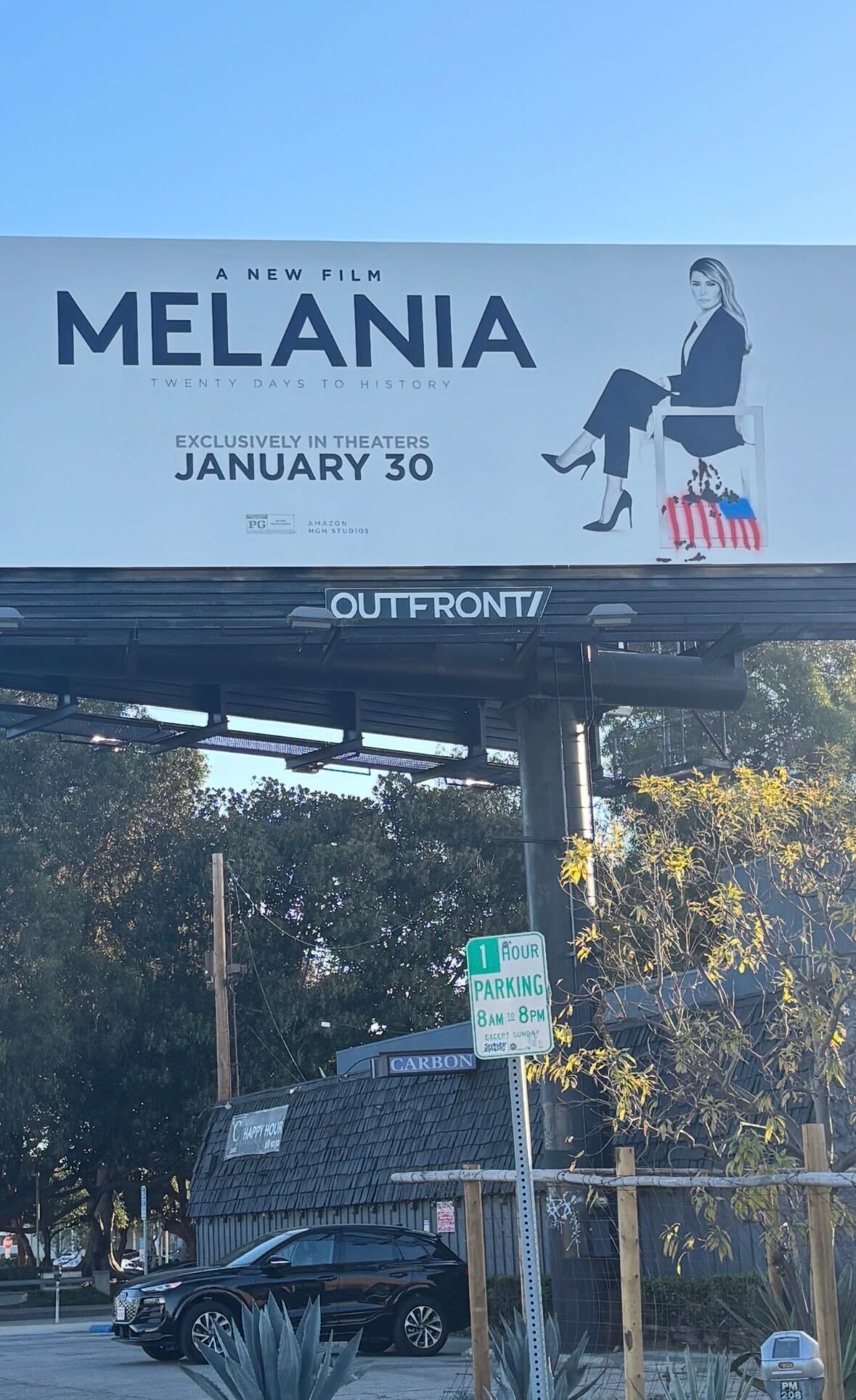
Sadly, the Melania billboard directly outside Amazon’s HQ in Culver City has been desecrated.
(Thanks to former TV Line editor Michael Ausiello for posting…)
|
|
|
See you Monday,
Matt
Sundance follow-up: CAA and events producer Danielle
Pelland want everyone to know there’s no beef between them after the security breach and alleged assault on Maxwell Frost at last week’s party. Noted! In addition, a few Park City folks objected to me pointing a finger at locals for the festival’s move to Boulder. It’s true that Utah legislators refused to match Colorado’s financial incentives, but I’d argue the increasingly frosty relations between Sundance and a vocal segment of the local community played a key
role.
Got a question, comment, complaint, or some tasteful earplugs? Email me at Matt@puck.news or call/text me at 310-804-3198.
|
|
|
Puck founding partner Matt Belloni takes you inside the business of Hollywood, using exclusive reporting and insight to explain
the backstories on everything from Marvel movies to the streaming wars.
|
|
|
Ace media reporter Dylan Byers brings readers into the C-suite as he chronicles the biggest stories in the industry: the future
of cable news in the streaming era, the transformation of legacy publishers, the tech giants remaking the market, and all the egos involved.
|
|
|
Need help? Review our
FAQ page or contact us for assistance. For brand partnerships, email ads@puck.news.
You received this email because you signed up to receive emails from Puck, or as part of your Puck account associated with {{customer.email}}. To stop receiving this newsletter and/or manage all your email preferences, click here.
|
Puck is published by Heat Media LLC. 107 Greenwich St., New York, NY 10006
|
|
|
|