Welcome back to What I’m Hearing, where I’m still waiting for my invite to Pope
Leo’s big Jubilee celebration this weekend, alongside Dave Franco and Chris Pine. Apparently, His Holiness has never seen the racier parts of Neighbors.
It’s also a big weekend for Hollywood’s version of religion: the awards race. I’ll see everyone at our Stories of the Season event tomorrow night, then I’ll squeeze into my tux for the Governors Awards on Sunday. Bummer that Hersholt honoree Dolly Parton is too sick to
attend, but hopefully Tom Cruise will collect his honorary Oscar after hanggliding into the Ray Dolby Ballroom and landing on a screeching motorcycle.
Tonight, strategies emerge in the war for Warner Bros., Scooter Braun gets hot and heavy with OnlyFans, the Academy takes on A.I., and the new Amazon TV boss takes an axe to the old boss. Plus, a skeptical look at the whole microdrama trend: What’s real and what’s… Quibi?
Discussed in this
issue: David Zaslav, Bob Iger, Jen Salke, Scooter Braun, John Malone, Brian Roberts, Keily Blair, Gunnar Wiedenfels, Anjali Sud, Mike Cavanagh, Lisa Kudrow, Jamie Sharp, Matthew Ball, Peter Friedlander,
Bill Block, Ted Sarandos, JB Perrette, Lloyd Braun, Sydney Sweeney, Jeffrey Katzenberg, Daniel Kwan, and… The Double Life of My Billionaire Husband.
Not a Puck member yet? Just click here. Got a news tip or an idea for me? Just reply to this
email, text me, or message me on Signal at 310-804-3198.
Let’s begin…
|
- The
Warner Bros. tap dance begins…: A big day for David Zaslav! On Thursday, the Warner Bros. Discovery C.E.O. and deputies Gunnar Wiedenfels and JB Perrette were among those showing the company’s shiny wares to David Ellison and the Paramount suitors. Per a source familiar, it wasn’t the first management presentation of the WBD financials to help potential bidders better understand the company and—Zaz hopes—entice them to
offer more money. But the tap dance for Ellison & Co. came as Zaslav is trying to fend off a table-clearing bid from the deep-pocketed family and generate the promised bidding war for the Streaming & Studios unit—a process that Zaz insists will ultimately benefit shareholders… while also prolonging his reign as a Hollywood mogul.To that end, former WBD board member John Malone went on CNBC today to cheerlead. “We have three or four aggressive bidders,” Malone
declared. The Journal then reported that Comcast and Netflix are indeed “preparing bids” for at least part of the company.Never mind the regulatory issues surrounding Netflix, the market-leading streamer, potentially gobbling up HBO Max, the fourth-ranked
subscription platform. Or the fact that Trump hates Comcast, whose C.E.O., Brian Roberts, is said to increasingly believe that Warners is a must-have asset, and that his company can structure a deal that would not transfer the NBC station licenses and thus not require F.C.C. approval. A D.O.J. lawsuit could delay any transaction by a year or two—a hurdle that the Warner Discovery shareholders might consider when weighing Comcast vs. Netflix vs. the Ellisons,
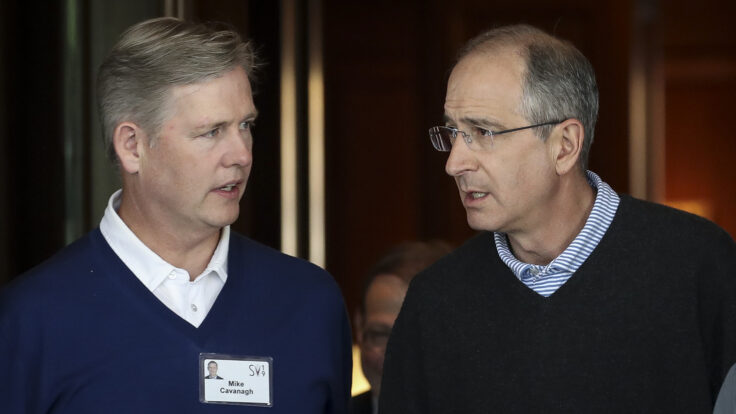
whose butt-kissing of Trump would likely smooth that path, at least in this country. But maybe if Comcast positions recently promoted co-C.E.O. Mike Cavanagh as the face of the bid, the Trump people will forget all about “Concast” and MSNBC. (To that end, Cavanagh was front and center at a holiday get-together with the media last night on the Universal lot.) And if they promise Zaz a role at the combined company, maybe he can return the favor by whispering in those boardmembers’
ears.With bids due in a week, and a decision to be allegedly rendered before Christmas, it’s looking like the board will have to decide between a big check now from the Ellisons or Zaslav’s pitch to hold out for the promised riches of either a split or a pre-split carve-up to either Netflix or Comcast and a partner… with the shareholders getting stuck with the TV networks and all that debt. Meanwhile, people love to point out that the Oracle share price has dropped 27 percent in
a month, as if Larry Ellison will soon be applying for SNAP benefits. But that may inject a bit of uncertainty re: whether he’ll agree to cut a $60 billion check on his own. (Disclosure: Through our recent acquisition of Air Mail, Zaslav is a de minimis investor in Puck.)
- Scooter and OnlyFans: The striptease: Until a couple weeks ago, Scooter Braun was quietly negotiating to buy OnlyFans. Yes, per two
sources familiar, the former music manager turned wannabe K-pop mogul turned Sydney Sweeney P.D.A. partner had lined up financial backers, was deep into talks with C.E.O. Keily Blair and deals guru Jamie Sharp, and had sketched out the contours of a role as the face and brains of the porn-friendly video platform. But alas, those talks have broken down, I’m told, and Braun has walked away from what could have been an extremely lucrative
opportunity. OnlyFans, currently owned by Ukranian American businessman Leonid Radvinsky and his Fenix International, generated $6.6 billion in revenue in 2023, according to a filing obtained by Reuters, which reported in May that L.A.-based investment firm Forest Road Co. was among the suitors
for the company. It would have been valued at around $8 billion, per press reports.Why Scooter? His music and entertainment industry connections were of interest to execs at OnlyFans, whose top creators have included Cardi B., Iggy Azalea, and Bella Thorne. The platform generally keeps 20 percent of revenue generated by creators, so bringing in high-profile stars (preferably those willing to strip on camera) is a priority. It’s unclear
why the Scooter talks ended, though he likely realized that every controversy about abuse on the platform would forever generate his name in the headline. Braun, a onetime Success magazine cover star, loves press about himself, but maybe not that much. (Scooter declined to comment, and OnlyFans did not respond.)
|
|
|
A MESSAGE FROM OUR SPONSOR
|
“An adrenaline-filled psychological thriller full of jaw-dropping twists and
turns.”
-TheWrap
“Starring a murderer’s row of gifted actors including Snook, Dakota Fanning, Jake Lacy, Abby Elliott, Jay Ellis, Sophia Lillis and Michael Peña, the series is an engaging thriller with an improbably high rate of satisfying twists.”
-The Washington Post
“All Her Fault is compulsively watchable”
-Vulture
“Snook and Fanning deliver memorable and strong performances…”
-Collider
_____
[READ] In ‘All Her Fault,’ Sarah Snook and Dakota Fanning take on mom guilt and the mental load
[WATCH] Sarah Snook Talks ‘All Her Fault,’ Becoming a Mom, ‘Succession’
[READ] Jake Lacy Won’t Flip A Table — But He’d Like You To Think He Could
_____
All episodes of ALL HER FAULT are streaming now,
only on Peacock.
|
|
|
- Amazon’s
new boss dings the old boss: Time was, a fired studio head could reliably expect to be kissed into several projects as a producer, and his or her replacement would dutifully greenlight those projects, regardless of quality. Now that Big Tech owns Hollywood? Not so much. Jen Salke, ousted as Amazon MGM Studios head in March, was set to produce Jealous, a Y.A. series starring the Spanish actress Nicole Wallace. But Peter Friedlander,
the Netflix exec who recently took over TV for Amazon, just killed the show, Kim Masters tells me.No animosity, I don’t think; Friedlander just didn’t believe the project was very good. A bummer for Salke and her fledgling Sullivan Street label, though the veteran TV exec is still attached to produce two Amazon movies, the sequel to the 2023 rom-com Red, White & Royal Blue, and a Kevin Costner–Jake Gyllenhaal dramedy called
Honeymoon With Harry. And she can still take Jealous to other buyers. Maybe Netflix would enjoy turning a Friedlander castoff into a hit. (Amazon declined to comment.)
- A.I. comes to the Academy: I guess it’s not surprising that the Film Academy–hosted symposium on A.I. last weekend was much more about the threat to Hollywood, rather than the opportunity presented by a new creative medium. According to members who
attended, the event featured guests like neurologist David Eagleman, who spoke about humans’ biological need for story, and a screenwriter who built his own chatbot to brainstorm ideas.Filmmaker Daniel Kwan, an Oscar winner for Everything Everywhere All at Once, sparked some activity in my inbox with his pretaped talk on “how paralyzed everyone is here” in Hollywood, and a thoughtful call to action: “We are going to have to do something kind of
unprecedented to match the scale of this problem,” he said. “We’re going to have to unite everyone in this industry, Hollywood, unions, agencies, the Academy. Everyone together as one unified front to push back against the tech industry.” Seems like a high hurdle, considering the studios increasingly are the tech industry. Hopefully, Kwan said, “this doesn’t have to become a massive fight. But if it does, we have to remember that we still have power, and that power comes from working
together.”
- Box office over/under: Paramount’s Glen Powell-is-a-star bet The Running Man is tracking for about $24 million, which seems high given the weak I.P. and strong hold for Predator: Badlands. Ditto Lionsgate’s Now You See Me: Now You Don’t, which is tracking for about $19 million. I’ll take the under on both.
|
Now Julia is here to throw a little cold water on the hot microdrama trend…
|
|
|
They’re the new street drug of the content economy—telenovela-level action parceled out in
90-second clips designed to make viewers fork over in-app dollars for the next hit. Can anyone make them work in the American market?
|
|
|
The only force in Hollywood more powerful than ego may be FOMO. Netflix’s Ted Sarandos is
experimenting with video podcasts after watching how they took over YouTube. Disney’s Bob Iger wants to build digital theme parks in Fortnite so he doesn’t miss out on another time sink. Tubi’s Anjali Sud is building a shortform vertical app to stave off TikTok. And then there’s microdramas…
American entertainment executives have been caught somewhat off guard by the exploding popularity of the mini-soap-opera format. This year, apps like
DramaBox, ReelShort, and FlickReels will surpass $3 billion in revenue outside of China, according to Owl & Co.’s Hernan Lopez—a nearly threefold increase since 2024. Together, the top 20 microdrama apps reportedly have 250 million monthly active users, which includes 10 percent of smartphone owners in the U.S., now the largest market for these videos outside the Asia Pacific region. Sure, that’s a far cry from Instagram (3 billion monthly active users) or YouTube (2
billion daily active users), but the audience is sizable and growing.
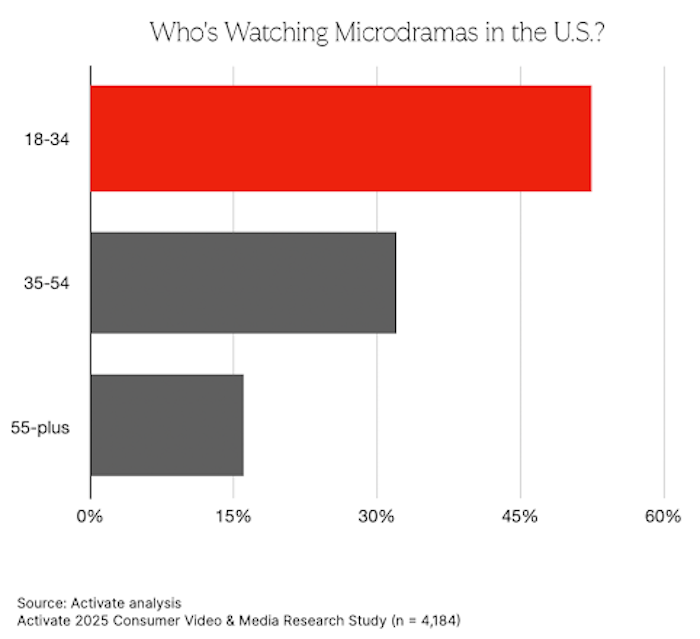
Not surprisingly, the average viewer is Millennial or younger—the growth demo everyone is courting. According to Activate Research’s 2026 trends report, 28 million Americans (more than half between 18 and 24) watched microdramas in the past year, and that number is expected to rise by 10 percent next year. With average budgets around $150,000 per series, the number of dedicated microdrama studios in the U.S.
will likely multiply in the months ahead. (Time spent solely watching videos on social media, as opposed to messaging, has increased by 22 percentage points over the past four years in the U.S., per Activate.)
|
Obviously, it’s hard to talk about microdramas without invoking the specter of Quibi—the much-hyped and
quickly failing shortform streaming app co-founded by Jeffrey Katzenberg and Meg Whitman. But the digital media landscape, and audience behavior, has evolved massively since the platform shut down in December 2020, and several companies are betting that Quibi—far from being a business school case study in face-planting—was simply ahead of its time. This summer, former ABC Entertainment head Lloyd Braun launched MicroCo, a new microdrama company;
GammaTime, led by former Miramax chief Bill Block, launched in October. And TelevisaUnivision is building microdrama stories directly into its popular Vix streamer.
Of all the entry points into microdramas, Vix’s feels the most replicable. Executives at rival streamers could certainly set aside a portion of their programming budget to experiment with these types of vertical-first, mobile-only formats without doing much harm to the bottom line. Also, shortform is a massive
business. Instagram Reels has a $50 billion annual run rate, YouTube Shorts drives more revenue per hour watched than longform video, and the time U.S. adults spend on TikTok each day has grown eightfold since 2021, per eMarketer.
|
|
|
A MESSAGE FROM OUR SPONSOR
|
“An adrenaline-filled psychological thriller full of jaw-dropping twists and
turns.”
-TheWrap
“Starring a murderer’s row of gifted actors including Snook, Dakota Fanning, Jake Lacy, Abby Elliott, Jay Ellis, Sophia Lillis and Michael Peña, the series is an engaging thriller with an improbably high rate of satisfying twists.”
-The Washington Post
“All Her Fault is compulsively watchable”
-Vulture
“Snook and Fanning deliver memorable and strong performances…”
-Collider
_____
[READ] In ‘All Her Fault,’ Sarah Snook and Dakota Fanning take on mom guilt and the mental load
[WATCH] Sarah Snook Talks ‘All Her Fault,’ Becoming a Mom, ‘Succession’
[READ] Jake Lacy Won’t Flip A Table — But He’d Like You To Think He Could
_____
All episodes of ALL HER FAULT are streaming now,
only on Peacock.
|
|
|
So why aren’t the larger legacy players jumping in? Are they just going to cede the field to the tech giants?
Why wouldn’t Disney or Netflix want to build the next TikTok? Behind all the positive data, there are a few red flags—and lessons from at least one comparable industry that’s enough to give Hollywood pause.
|
This Is Terrible, But I Can’t Stop
|
What exactly is a microdrama—and how is it different from a TikTok video or a Bluey short?
Technically speaking, microdramas are 60-to-90-minute feature films told in a series of 30-to-90-second (on average) installments. They’re usually romance or fantasy in genre, and often end with the kind of tantalizing cliffhangers usually reserved for telenovelas.
The most watched show on ReelShort, the second-most-popular microdrama app, is called The Double Life of My Billionaire Husband, which has amassed close to 500 million views, according to Lopez. You can watch the first
30 minutes of the film on ReelShort’s YouTube account, where it has racked up 23 million views. The first few “chapters” focus on a young woman who marries a troubled man with a hidden past and secret wealth. Another popular microdrama series, The Lost Heir: Dawn of Reckoning, is a Chinese series on DramaBox that follows a wealthy C.E.O. who finds her long-lost son trying to find success after making a new discovery while working under miserable conditions. Not exactly catnip for
Academy voters, is what I’m saying.
But as should be abundantly clear by now, quality doesn’t particularly matter in the fight for attention, and microdramas don’t have a history of delivering it. Some, though, are betting that it can be a differentiator. Erick Opeka, President and Chief Strategy Officer of Cineverse, which has a 50 percent stake in MicroCo, recently argued that his team can build a better microdrama—“one that is more consistent with the entertainment experiences Americans are accustomed to.” But they’re not trying to take on premium TV, either. Even with a more U.S.-centric focus, microdramas will likely be heavy on the cringe, since that’s what audiences want. To paraphrase the vast majority of comments on these videos: The acting is terrible, but I can’t stop watching.
Naturally, the addictive
quality of microdramas informs the business model, too. Most apps feature a barrage of low-grade advertising, in addition to opportunities for in-app purchases, driven by a small core of highly engaged “superusers” who are willing to pay for access to a story’s next chapter. It’s a very specific part of the market that microdrama companies are focusing on, and for good reason. According to Activate, superusers of video apps in general make up 28 percent of the audience but account for 52 percent
of total spending in the U.S. Which is why the most useful comparison to the microdrama business isn’t scripted entertainment and streaming but rather mobile gaming.
|
Many of the most successful mobile games, of course, are driven by a “freemium” model, where users sit
through a torrent of bad ads to play a game for free, paying for upgrades along the way when the game gets too tough. Microdramas are guided by similar soul-crushing freemium designs: Content is often free, but extracting any real enjoyment requires regular micropayments—often to unlock the next chapter. Like Candy Crush, these microdamas are designed to be heavily addictive and pull dollars from their most invested audiences. It’s hardly a coincidence that Crazy Maple Studio, the
company behind ReelShort, is also a narrative story game studio that has mastered this exact strategy.
While advertising is a growing part of the microdrama business, issues persist. Even the most bullish analysts have acknowledged how crucial in-app purchases are to the microdrama industry’s bottom line. Those payments also come with hefty vigs to their respective app stores. In 2024, the vast majority of all microdramas revenue came from in-app payments, according to Lopez, which means
that 30 percent of those revenues flowed to companies like Apple and Google. ( Roblox, the most popular mobile game ever published, pays $22 to Apple and Google for every $100 in player spend, according to research published by Matthew Ball earlier this year.) Advertising will play a bigger role this year, but it still won’t come close to the revenue
derived from in-app purchases. Sensor Tower, the mobile research firm, estimates that microdramas brought in $700 million in revenue in the first quarter of this year through in-app payments alone.
|
Putting the Drama in Microdrama
|
The format also comes with a high cost of customer acquisition. ByteDance was spending $3 million a day in
advertising in the U.S. alone in 2018, according to analyst Eric Seufert. But at least ByteDance didn’t have to pay for scripted content. It relied on user-generated content to create a cascading engagement effect: more people uploading, more content to watch, more time spent. Monopoly Go!, one of the most successful mobile games of the past five years, recorded $5 billion in bookings, but spent 36 percent of its net revenue (or $1.25 billion) on player
acquisition, per Ball. As a natural consequence of market saturation, companies are spending more money each year for tinier slivers of people’s time. Royal Kingdom, the tile-matching mobile game, even paid Friends stars Lisa Kudrow and Courteney Cox to appear in its ads.
It’s likely that a few microdrama apps, and studios dedicated to this audience, will find success, but power laws will eventually come into play. There’s a
good chance that some of the most successful microdrama apps will be those where audiences are already bought into the mechanics of scrolling through shortform video and paying for in-app purchases: In other words, YouTube, Instagram, and TikTok.
Part of Quibi’s failure came from not leaning into mobile-first culture enough, which presents another dilemma. If part of the appeal behind microdramas is their poor quality and video-game-like addictiveness, are these businesses that Sarandos
and Iger even want to be in? (Sarandos would rather try out video podcasts, which Frankenstein viewers may be slightly more interested in.) For all the data that suggests this is the next obvious win, there’s as much data from related industries that warns of some big potential losses, too.
|
See you Monday,
Matt
Got a question, comment, complaint, or Scooter Braun OnlyFans fantasy
videos? Email me at Matt@puck.news or call/text me at 310-804-3198.
|
|
|
Need help? Review our FAQ page or contact us for assistance. For brand partnerships, email ads@puck.news.
You received this email because you signed up to receive emails from Puck, or as part of your Puck account associated with {{customer.email}}. To stop receiving this newsletter and/or manage all your email preferences, click here.
|
Puck is published by Heat Media LLC. 107 Greenwich St, New York, NY 10006
|
|
|
|